When ripples become tidal waves: Can we predict when the next global crisis will hit?

 Getty Images
Spotting the events that might lead to a major period of upheaval is notoriously difficult. Could artificial intelligence be the crystal ball we need?
Four hundred years ago in what is now the Czech Republic, tossing your enemy out of a window was a dramatic way to make a political statement. On 23 May 1618, in the chancellery of Prague castle, a group of Protestant nobles accused two Catholic royal governors of ignoring their rights. The heated confrontation culminated in the ejection of the Catholic governors and their secretary from a third storey window.
Remarkably, the three men survived the defenestration – thanks to the outstretched arms of angels who swooped in to catch them, if the Catholics were to be believed. According to a Protestant version of events, it was a rather less glamorous pile of manure that broke their fall.
The tussle should have been little more than a footnote in the centuries of simmering, bloody hostility between these two Christian factions in medieval Europe. But it would prove to be far more consequential.
The incident triggered the Protestant-led Bohemian revolt against the Catholic Habsburg emperor, which mutated into one of the most destructive wars in European history – the Thirty Years' War. The gruelling three decades of conflict would drag in more than a dozen nations and claim millions of lives in the widespread devastation, famine and disease that followed.
It's one of many examples throughout history of an event having unexpectedly far-reaching consequences.
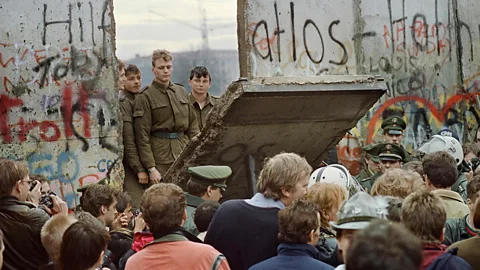
History is replete with examples: the East German official who misspoke during a press conference and sent thousands rushing to the Berlin Wall, hastening the end of the Cold War; Archduke Franz Ferdinand's driver taking a wrong turn in Sarajevo, placing him in the path of an assassin and igniting the powder keg that sparked the First World War. The Tunisian fruit seller who set himself on fire after his scales were confiscated by police, triggering the Arab Spring uprisings that engulfed six countries and deposed four state leaders.
Looking back, the warning signs were there to see. A range of factors can provide the tinder for a cataclysmic event. The challenge is knowing, in advance, which spark will catch.
But predicting how and when major world events might unfold is something researchers hope sophisticated artificial intelligence models will one day be able to achieve. They believe that with enough data, it should be possible to map how the ripples caused by seemingly minor incidents build into the tidal waves that can shift financial markets, spark revolutions or lead to war. Already, AI technology is providing hints of what might be possible.
Using the past to predict future crises
The idea of predicting the future based on patterns extracted from the past is far from new. In the first half of the 20th Century, Russian American sociologist Pitirim Sorokin pioneered a data-led approach to explain why past empires imploded. To do so, he attempted to quantify societal instability across the ages, gathering data on "micro-events", such as political assassinations or riots, and "macro-events", such as civil wars and revolutions.
In the case of Ancient Rome, he used his data to make the case for what he believed caused the empire's downfall: excessive materialism and hedonism leading to decadence and "over-ripeness".
Today, complexity scientist Peter Turchin is upholding the spirit of Sorokin's work at Oxford University's World History Lab in the UK. For more than a decade, Turchin and his team of researchers have amassed 80,000 pieces of qualitative and quantitative data from societies stretching back to Palaeolithic times in an effort to explain the past and predict the future.
"We're looking for moments of crisis," says researcher Samantha Holder, who works on the project. From the late bronze age collapse to the dissolution of the Habsburg Spanish Empire, crises are given a score to reflect their geographical reach and intensity. This data is analysed for patterns with the help of predictive computational models – a process which doesn't currently use AI but soon could do.
Turchin’s team has used their database to propose hypotheses about why moments of crisis arise. Revolutions, they have found, tend to stem from a confluence of factors including parts of the population becoming poorer and a growing number of elites vying for a limited number of ruling positions. "If these things happen at the same time and the state has a financial crisis, revolution and civil wars become more likely," says Holder. She cites the French Revolution as an illustrative example.
Turchin used these methods back in 2010 to predict that 2020 would be particularly chaotic. A period of intense political instability would be brought on by a "dark triad" of social maladies: too many elites jostling for power, falling living standards and a weak fiscal state, he warned. After a global pandemic that sent shockwaves through the world economy and an intense period of political turmoil, Turchin appeared prescient.
At present, the team uses AI to assist in the collection and classification of vast historical data sets. But they hope to use AI on the prediction side in future. "Machine learning algorithms… could enhance the mathematical modelling we are doing," says Jakob Zsambok, a research assistant who also works with Turchin. "We are looking in this direction."
 Getty Images
Critics including the late anthropologist David Graeber have cast doubt on the notion that we might be able to use history to predict the future. And random, one-off "Black Swan" events that can trigger periods of upheaval are, by their very nature, impossible to predict. But in many cases, there are warning signs that precede these triggers.
Modelling chaos
Unsurprisingly, governments and the military are two of the players that have paid most attention to this field so far.
In 2020, a secretive US intelligence project used an AI called Raven Sentry to predict attacks from the Taliban in Afghanistan. The AI tool was fed data on historical violence in the region combined with real-time intelligence including weather data, social-media posts, news reports and commercial satellite images, according to a paper published by a journal of the US Army War College. The model reportedly achieved 70% accuracy, roughly comparable to human analysts, "just at a much higher rate of speed".
One of the defence contractors involved in the effort, Rhombus Power, claims to have used generative AI to predict Russia's invasion of Ukraine by analysing open-source data including satellite imagery, movements at missile sites, and local business transactions. Those predictions, however, were not made public beforehand, so it has not been possible to verify the companies claims.
Other researchers are also developing neural networks aimed at predicting food crises, in some cases using climate data alone. But some researchers remain sceptical about the reliability of AI to make such predictions.
The UK's Alan Turing Institute for AI, for example, assessed the level of maturity for AI-driven prediction technology. Their conclusion? On the whole, it’s probably not quite there yet.
"One of the challenges in building something like this is that it's not easy to get the right AI training data to predict future conflicts," says Anna Knack, a senior research associate at the Turing Institute, who specialises in national security and conducted the analysis. "The problem is, when we think about things like the Arab Spring or 9/11 or Iran or Kashmir, all that information sits in fragmented places all around the intelligence community."
"It's really hard to predict even the current thinking of some of our state leaders," continues Knack. Her report concluded that, right now, the two most promising ways AI could help are in tracking conflict risk indicators more accurately and identifying possible outcomes immediately after a shock takes place.
Almost as useful as knowing when a disaster will strike, is understanding the potential ripple effects, says Eugene Chausovsky, senior director at The New Lines Institute in the US, a research and policy think tank that conducts forecasting. "Where could this crisis impact, not only geopolitically, but economically?"
Over the past year, Chausovsky and his team have been simulating versions of the Strait of Hormuz crisis we're currently living through. In partnership with AI startup, Mantis Analytics, they have used AI to augment their analyses – assessing downstream impacts on energy markets, semiconductors and agriculture.
AI tools have "enabled us to massively expand the data streams that we work with," says Chausovsky – from open-source monitoring to global news to "statistical databases on everything from trade to energy to critical minerals". This helps to improve the accuracy of the simulations they run.
They have also experimented with having AI take part in simulations of conflicts alongside human experts, with bots taking turns to play state leaders. Right now, "You lose some of the nuance and the complexity that you may have at the human level," says Chausovsky. Interestingly, the AI also tends to be more conservative than human players – refraining from taking escalatory action, for example.
The United Nations Development Programme is already deploying AI to help it assess the impact of major disasters and events. After the 2023 Herat earthquake in Afghanistan, it used its AI-powered Rapid Digital Assessment tool to estimate how much damage and debris might be at any given location, enabling it to deploy rescue efforts more precisely.
The UN has also been investing in AI early warning as part of what it calls "proactive crisis management". It combines historical and near real-time data on a Crisis Risk Dashboard to identify potential violent hotspots before things escalate. In Sri Lanka, for example, it monitors hate speech and macroeconomic data, while elsewhere it might look at displacement of populations or migration.
The next financial crash
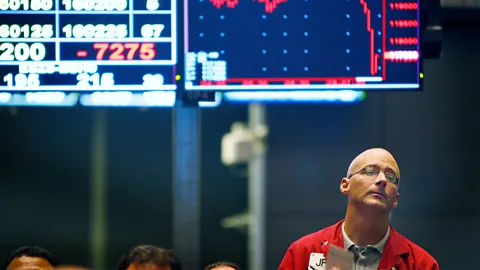
Financial regulators are also hoping AI can give them a headstart on potential problems. They have access to "incredibly granular, essentially real time data on who owns what throughout the financial system", says Antonio Coppola, assistant professor of finance at Stanford University. This, combined with AI techniques like deep learning, could be used to better inform how financial markets can be regulated.
Part of a financial regulator’s role is considering policy interventions to prevent or mitigate financial crises. Rather than predicting crises, Coppola's current work is focused on "if this big wave of stress comes along, where are the problems going to be? Who exactly is going to get in trouble?"
In a recent proof of concept paper, Coppola built a model trained on a large-scale data set made up of financial portfolios covering about $40tn (£30tn) of wealth in the shadow banking system. Shadow banks provide services similar to commercial banks but exist outside of normal financial regulations and harbour a significant amount of financial risk. The shadow banking system contributed to the liquidity crisis during the Covid-19 pandemic, for example.
Coppola found that by training the AI model on 20 years of data up to 2019, it was able to accurately forecast which markets experienced the largest selling of financial assets in 2020, and which investors contributed the most to the market downturn.
The results proved to be 10 times better than traditional methods informed by economic theory, according to Coppola. But he hastens to add that AI should not replace traditional economic modelling. Rather, it could supplement it.
Next, Coppola is looking at how these AI models could incorporate unstructured data like news headlines to improve their accuracy.
Other researchers are already examining how AI could be used to predict the financial crises themselves, but the area is still in its infancy.
 Getty Images
While it may take some iterations before AI is accurately predicting crises, it is already racking up successes in the lower stakes arena of forecasting tournaments, where participants stake bets on the likelihood of different world events taking place – from sporting to political. AI startups are creeping up the league tables, although humans are, for now, still ranking top.
More like this:
But there is also the possibility that AI itself could precipitate the next global crisis. Many economists are already predicting an AI bubble that if it bursts could be ruinous for financial markets, while tech bosses have warned of the wider societal disruption the technology might cause.
With that in mind, I asked the AI chatbots ChatGPT, Gemini and Claude about the probability that AI itself could cause a future global crisis. (A 2024 study found that, despite their tendency for hallucinating false information, combining predictions from multiple AI chatbots can achieve accuracy on par with human forecasters.)
In response to my queries, Claude declined to give a specific number while Gemini gave it "a 50/50 toss-up".
ChatGPT, however, put the probability that AI "contributes to a serious global crisis at some point this century" at "roughly 20-40%". It put the likelihood of an existential crisis at less than 5%.
For now, it seems, we'll have to wait and see.
--
For timely, trusted tech news from global correspondents to your inbox, sign up to the Tech Decoded newsletter, while The Essential List delivers a handpicked selection of features and insights twice a week.
