Magritte and the subversive power of his pipe

 Succession Magritte c/o SABAM
Some think that this mysterious Magritte painting is the beginning of modern art. It inspires a lot more questions than you might think, writes Cath Pound.
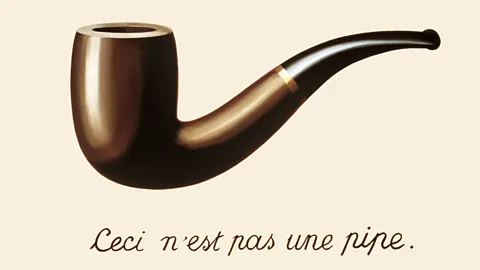
René Magritte’s The Treachery of Images (This is Not a Pipe) is one of the most famous yet persistently enigmatic works in the history of art. One of the word-image series of paintings in which the Belgian artist sought to challenge linguistic and visual conventions, it was also part of his life-long quest to show that images could be equal to words in the expression of consciousness.
The iconic painting is returning to its country of origin for the first time in 45 years as part of a major exhibition at the Royal Museums of Fine Arts of Belgium examining Magritte’s influence on contemporary artists from Jasper Johns to Gavin Turk, giving us a fresh opportunity to attempt to define the indefinable.
“This word that we pronounce ‘pipe’ is this object in reality, not on the paper, and the idea of Magritte is to show that it is nothing to do with reality, it is just a convention,” says Michel Draguet, curator of the exhibition. While it is easy enough to understand an image of a pipe is not an actual pipe, Draguet explains that “the real problem with the work is that you have to give a new definition to the pipe, your own definition”.
 Getty Images
Asking philosophical questions, rather than giving art historical answers, had long been Magritte’s aim. Although he had begun painting at the age of 12 and experimented with Cubism and Futurism, Magritte soon tired of painting as an end in itself and disliked being called an artist, considering himself a thinker who communicated through paint. Well versed in the history of philosophy, he was aware that from Plato to Hegel, figurative representation had been dismissed as a confusion of the senses and poetry considered the highest form of human expression.
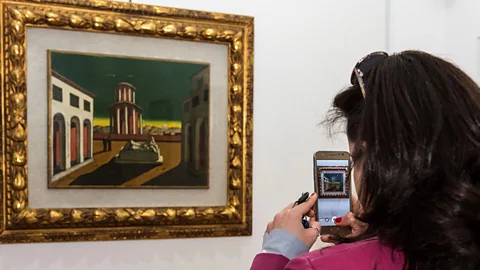
Surrealism, the movement to which Magritte would become aligned, had begun life as a largely literary movement, and its founders were equally sceptical about the value of painting. It was only with the discovery of the metaphysical works of Giorgio De Chirico, through whom Magritte claimed to have discovered “the ascendancy of poetry over painting”, that they – and he – changed their minds.
 Succession Magritte c/o SABAM
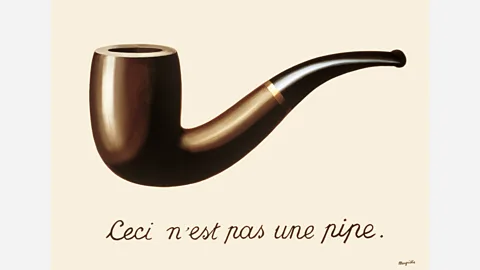
In his famous essay on The Treachery of Images, the philosopher Michel Foucault refers to the artwork as an “unravelled calligram”, a calligram being an image formed of the words which describe it, which Magritte had “unravelled” by separating the image from the text.
Although Magritte disagreed with this definition, he certainly believed that an image was as capable of expressing thought as poetry. As Draguet says, for Magritte poetry was “beyond the word; something deeper than the word”.
Real or not real?
His decision to paint a pipe to emphasise this point may well have been down to the fact that shortly before Magritte began work on The Treachery of Images, André Breton and Paul Éluard, two of Surrealism’s leading figures, published Notes on Poetry in La Révolution Surréaliste, in which they declared “poetry is a pipe”.
 Charly Herscovici c/o SABAM
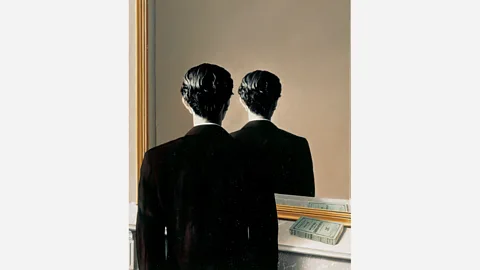
Magritte’s declaration that “this is not a pipe” could then be seen as a claim that it is something different, but equally valid. Although we should also bear in mind that the original title of the painting was L’usage de la parole I (The Use of Speech I), which implies that we should question the veracity of the words, not the image.
Magritte’s apparent ambivalence to such a dramatic switch of emphasis may seem odd but, as his colleague Paul Nougé appreciated, Magritte’s titles were always a “commodity for discussion”, and “not explanations”. He understood that an individual’s response to an image would always be dependent on their personal experiences and understanding of the object.
 Getty Images
The indefinable nature of Magritte’s paintings meant that they would become a particularly provocative and fertile source of inspiration for younger artists. “If you have answers, you are obliged to go in the same direction,” says Draguet. “If you ask questions you can take the question and start again.”
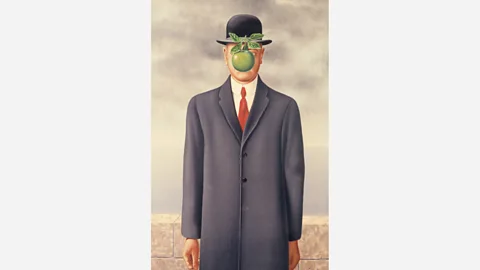
However, although Magritte had painted The Treachery of Images for a show in Paris in 1929, the stock market crash that year meant that many galleries closed, and it wasn’t until a 1954 exhibition at the Sidney Janis Gallery in New York that his work began to attract attention among a new generation of artists including Andy Warhol, Paul Rauschenberg and Jasper Johns.
 Alamy
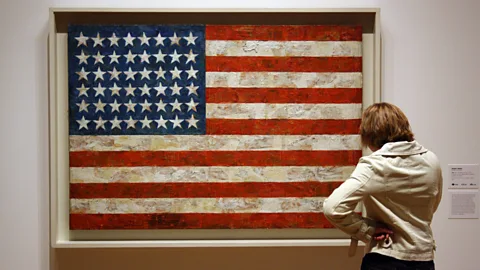
AlamyFor Johns, known for depicting everyday objects such as numbers, targets and flags in unexpected ways, the exhibition “really made an impression”, according to art historian Roberta Bernstein, author of the Catalogue Raisonné of his work. “I think it was one of the things that was brewing in his mind before he painted his first flag,” she says.
“Conceptually the idea of Magritte saying ‘this is not a pipe, it’s an image’ is central to understanding Johns’ flag,” she adds, although Johns twists the question so that it becomes, “is this a flag or is it an image?”
 Alamy
AlamyShe believes he also had an impact on Rauschenberg and “the fact that both of them started collecting his work when they could afford it is a reinforcement of that”.
Rauschenberg always denied the link, but seeing his Bellini Series, a collection of Pop Art collages of Renaissance figures, next to Magritte’s The Ready-Made Bouquet, in which Boticelli’s Primavera is arbitrarily placed on the rear of a man in a bowler hat, it is hard to believe that there wasn’t some influence.
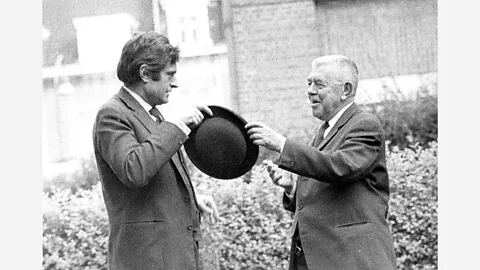
Claes Oldenburg would also draw inspiration from Magritte’s work. The origins of his abnormally enlarged objects can be traced back to Magritte’s Personal Values, in which Magritte places outsized objects in a bedroom whose wall is a painted sky. However, Magritte was reportedly unwilling to see himself as a precursor of Pop Art, a movement which he felt sacrificed too much to the vagaries of fashion. According to Draguet, Magritte was generally ambivalent to contemporary developments in art. The notable exception was his fellow Belgian Marcel Broodthaers: his “spiritual son”, as Draguet puts it, with whom he shared a close affinity.
 The Estate of Marcel Broodthaers/RMFAB Brussels/J Geleyns/Ro Scan
The two met after World War Two and bonded over a mutual appreciation of the poet Mallarmé, whose theories about representation were close to their own. Although Broodthaers had begun life as a poet, he turned to the visual arts in 1964, creating his first work by embedding unsold copies of his poetry collection, Pense-Bête, in plaster. He took Magritte’s play on words to a different level by encrusting his Music Lectern with mussel shells, exploiting the difference in meaning of the French word moule depending on the gender, to question the definition of art and the art market.
Broodthaers found a particular source of inspiration in The Treachery of Images, which he considered the starting point for modern art, and pipes feature frequently in his work. Possibly it was Broodthaers’ interest that caused Magritte to re-imagine the painting on several occasions, creating pipes wafting smoke and even one defiantly declaring “this continues to not be a pipe”. But if we hope to find clarification from these later versions, it soon becomes clear that we may as well attempt to take the pipe from the canvas and smoke it. It continues to be an enigma.
And if you liked this story, sign up for the weekly bbc.com features newsletter, called “If You Only Read 6 Things This Week”. A handpicked selection of stories from BBC Future, Culture, Capital and Travel, delivered to your inbox every Friday.
