'The cult of Saint Sebastian': How a brutally tortured 3rd-Century saint became a gay icon

 Getty Images
A Roman soldier who was killed for his Christian beliefs, Sebastian has been a hero for gay men over the centuries – from Oscar Wilde to Keith Haring. Here's why.
Loaded and emotive, the term "gay icon" is often applied to resilient female celebrities like Judy Garland (embattled), Cher (high camp) and Madonna (tireless). When Dusty Springfield died in 1999, Pet Shop Boys singer Neil Tennant was asked why his friend and collaborator had become "such a gay icon". Tennant's response, as he recalled in a 2024 interview with Mojo, was pretty dismissive: "To call her a gay icon is simply to marginalise her. It's to say, 'She's only of interest to gay people.'"
Tennant made a good point regarding Springfield, but attaining "gay icon" status can also be celebratory and subversive. This is certainly the case with Saint Sebastian, a Roman soldier who was killed for his religious beliefs in AD288, during a sustained persecution of Christians by the emperor Diocletian.
 Getty Images
Sebastian is venerated as a saint in both the Catholic and Eastern Orthodox churches, which have long disseminated the legend that he was clubbed to death after berating Diocletian for his "sinful" pagan views.
However, it is an earlier attack on Sebastian by the emperor's henchmen, in which he was tied to a tree and pelted with arrows, that has made this unknowable martyr an enduring muse to artists of repute – there are no fewer than 14 depictions of Sebastian in the National Gallery, London's collection – and a perennial conduit for gay desire.
How the cult of Saint Sebastian grew
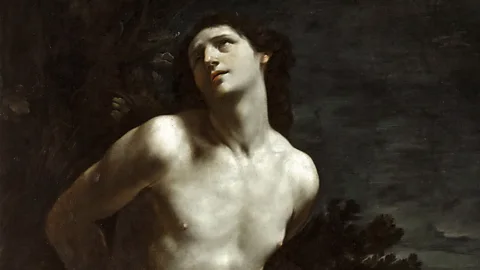
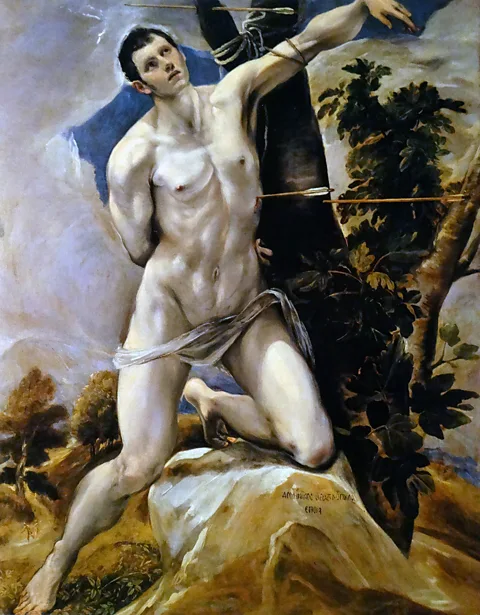
Sebastian's emergence as a gay icon can be traced back to the culturally transformative Renaissance period of the 14th to 17th Centuries, when prominent artists including Guido Reni, El Greco and Sandro Botticelli depicted his arrow-pierced body with a smouldering homoerotic subtext.
Daniel Fountain, a senior lecturer in art history and visual culture at University of Exeter in the UK, tells the BBC that these arrows are generally perceived by art historians as a phallic "symbol of penetrative sex and queerness". People's History Museum director Clare Barlow, who curated Tate Britain's 2017 exhibition Queer British Art 1861–1967, believes the arrows "take on a huge psychosexual significance" in a lot of these paintings whether this was the artist's intention or not. "And the fact that Sebastian is often painted as a very beautiful youth only makes him more entrancing," she adds.
During the Renaissance period, when attitudes towards homosexuality were much less tolerant, artistic depictions of Sebastian's lithe, desirable body became fashionable and fascinatingly ambiguous. Much like Michelangelo's 16th-Century masterpiece David, which crystallised an ideal of male beauty in marble form, paintings of this beautiful, persecuted saint served as an acceptable conduit for gay male desire.
Still, Barlow points out that it is "often very hard to track whether this was a particular artist's overt intention, or whether it was simply read into their work by a community of viewers who were hungry for representation". In some cases, it may well be a little of both.
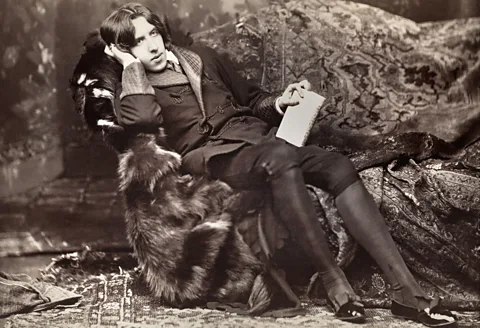
Over time, though, it's fair to say that Sebastian blossomed into what we might now describe as a highbrow queer reference. According to writer performer and educator Holly James Johnston, who paid tribute to Sebastian in 2025 with a living sculpture performance at The Wallace Collection in London, the "cult of Saint Sebastian reached its peak" during the late-19th Century, when eminent intellectuals such as Oscar Wilde, English essayist Walter Pater and French writer Marc-André Raffalovich claimed an affinity with him that telegraphed their sexuality.
 Alamy
AlamyRaffalovich wrote extensively about homosexuality in decades when it was taboo, but ultimately struggled to reconcile his own gay desires with his religious beliefs. When he joined a Catholic order in 1896, he chose the name Brother Sebastian in tribute to his favourite saint. "Sebastian became part of a sort of queer-coded language at that time," Johnston says. "For well-educated men, it was a way of sharing and expressing your queer desires through an icon who was immediately recognisable to other queer individuals."
What Sebastian has been seen to represent
At the same time, Sebastian's queer appeal runs more than skin deep. In her 1962 essay The Artist as Exemplary Sufferer, the cultural critic Susan Sontag cites Sebastian as an archetypal example of the "exemplary sufferer", partly because his brutalised body has been glamorised by artists. "He is almost always depicted in the same way, which is in contrapposto, so his leg gives slightly and the body slumps beautifully. And then he looks up to the heavens, in this pleading or even desiring way," says art historian Professor Dominic Johnson of Queen Mary University.
The penetrative symbolism of the attacking arrows in paintings becomes even more suggestive when it is combined with an apparent expression of sexual ecstasy etched on Sebastian's face. "In one painting by El Greco, The Martyrdom of Saint Sebastian, it almost looks as though his loincloth is falling off," says Johnston. For this reason, Daniel Fountain suggests that Sebastian can be viewed as an historic embodiment of "contemporary BDSM (bondage, discipline, dominance and submission) practices". Though these aren't exclusive to the LGBTQ+ community, they enjoy greater prominence in certain queer subcultures.
The nature of Sebastian's emotional pain is also ripe for projection. Johnson suggests that Sebastian's story may particularly appeal to anyone with a "nihilistic" or bleakly "romantic vision of homosexuality", especially in less welcoming times. "He was someone who tried to hide who he was – a Christian – before being shunned by society and persecuted for his beliefs," Fountain says. "A lot of queer artists have found a resonance with this narrative of exclusion."
 Getty Images
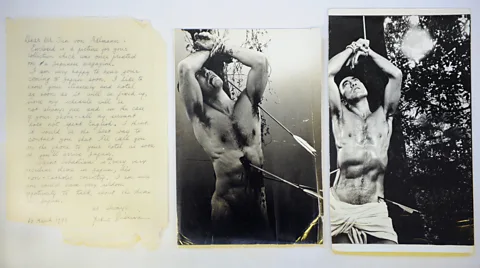
These include Oscar Wilde, who adopted the pseudonym Sebastian Melmoth in tribute to him during his final, exiled years in Paris, following his imprisonment for gross indecency for relationships with men in 1895. Late in post-war Japan, provocative author Yukio Mishima revealed that a famous painting of Sebastian prompted his sexual awakening and recreated the saint's arrow-stricken martyr pose in a series of celebrated photographs.
His impact in the 20th and 21st Centuries
Sebastian's gay icon status has burned just as brightly since the 1969 Stonewall uprising ignited the modern LGBTQ+ rights movement.
In 1976, the influential artist, film-maker and gay rights activist Derek Jarman celebrated him in Sebastiane, a film deemed groundbreaking for its unselfconscious male nudity and positive depictions of gay sexuality. While Sebastian (Leonardo Treviglio) is lusted over by his commanding officer (Barney James), who eventually kills him, two fellow soldiers are shown enjoying a loving gay relationship.
"It's an important film partly because it was so controversial, especially when it was shown on British public television in 1985," says Dominic Johnson. "But it’s also significant because it’s such a beautiful, thoughtful and provocative film about gay men and desire."
More like this:
Johnston believes Jarman's tender and erotic film "helped to blow the lid off" his status as a semi-veiled gay icon. Barlow agrees with this interpretation of Sebastiane, arguing that Jarman embraced the "homoerotic subtext" in numerous Renaissance paintings of the seductive saint, then "dialled it up to 11".
Because Sebastian's gay icon status is so layered and deep-rooted, it has also proved malleable. At the height of the HIV/Aids epidemic in the 1980s and early '90s, his image was referenced in works by contemporary artists including Keith Haring and David Wojnarowicz, both of whom would die of the disease. In medieval times, Sebastian was perceived as a saint who could protect people from the plague, perhaps because of the way Irene was able to heal his arrow wounds. "There are clear parallels with the way he is embraced in the 1980s, during a very different plague, when depictions of Sebastian herald him as a kind of patron saint of queerness, sickness and perseverance," Fountain says.
 Alamy
AlamyAnd Sebastian is still inspiring LGBTQ+ artists and performers and artists today.
In 2022, when London's Residence Gallery put on a group show inspired by Britney Spears, multi-disciplinary artist Gray Wielebinski created a starkly evocative installation that referenced the whip she brandished on her 2009 world tour, the live python she performed with at the 2001 MTV Video Music Awards, and Sebastian's signature attacking arrows.
The Dallas-born artist was making a connection between Sebastian’s persecution and the way Spears, a modern-day gay icon, has arguably been targeted for her intense fame. "There's a sort of knowingness to Sebastian's gaze [in many artworks] as well as a grace and gravitas in his posture," Wielebinski tells the BBC. "I wanted to give Britney that same grace and a bit more agency in terms of knowing her fate."
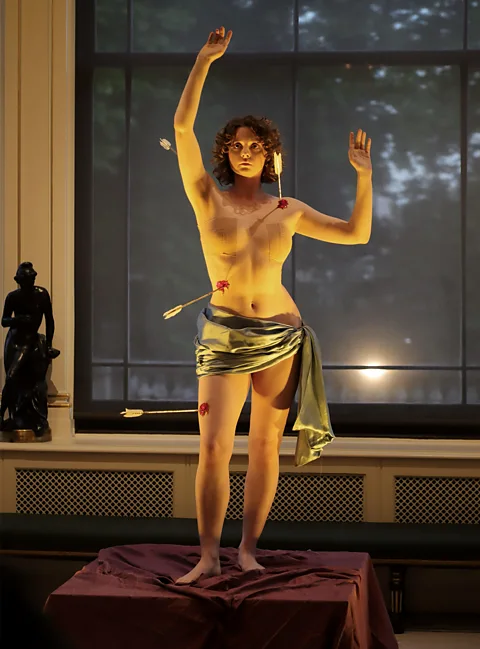 Holly James Johnston/ J Chichester
Having been painted by artists and embraced by queer thinkers for centuries, Sebastian's gay icon status is now as complex as it is unequivocal. But at this point, there is nothing marginalising about the way he is perceived. On the contrary, this historical figure, whom we know very little about, has become a bottomless wellspring of strength and creative inspiration.
For as long as queer people can see aspects of themselves in his image, his legacy will continue to flourish and evolve in fascinating ways.
--
If you liked this story, sign up for The Essential List newsletter – a handpicked selection of features, videos and can't-miss news, delivered to your inbox twice a week.
