'The vibrant proof of a presence slipped away': Why David Hockney's 1967 masterpiece is newly poignant after his death

 Tate
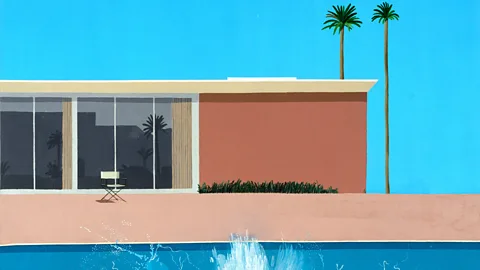
TateIn the wake of legendary British artist David Hockney's death, aged 88, his famous meditation on presence and absence, A Bigger Splash, takes on a new meaning.
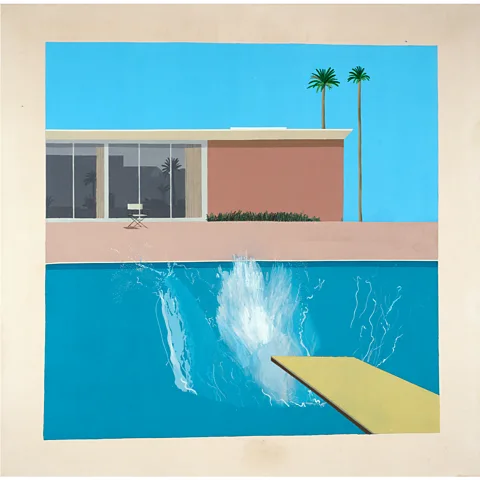
Created three years after moving to Los Angeles from London, David Hockney's iconic acrylic painting A Bigger Splash is a study in perception and the fleetingness of being. Since its emergence in 1967, the work has been cherished as a powerful metaphor for liberation and the freedom of personal expression.
At first glance, the painting's abrupt, split-second syncing of exploding pool water and clean summer light may seem a conspicuous heir of the impromptu plein air snapshots of sun and stream that characterised the vision of the Impressionists.
But to understand the carefully calibrated contours of Hockney's canvas, one needs to look further back. Much further. Though the work may chronicle a flashing instant in time, his masterpiece – a fusion of photography and drawing, ancient frescoes and cutting-edge aesthetics – was in fact millennia in the making.
The year before Hockney moved to California, he visited Egypt. There, he was able to study and draw, first hand, tomb art he had first encountered in the British Museum and had been obsessed with as a student. Leaving behind his camera, the young artist focused on translating the flatness of ancient frescoes and the stylised, statuesque figures to his drawing pad.
The crispness and intense immediacy of these Egyptian reliefs seem to have rhymed in his mind with the calm cool colours that he had always admired in the early Renaissance frescoes and tempera panels of artists such as Masaccio, Fra Angelico and Piero della Francesca. Suddenly, the chaotic and cluttered compositions he had been pursuing previously no longer made sense.
 Tate
TateAfter moving to the US, the burgeoning influence of those masters would merge in Hockney's imagination with the bold language of the prevailing contemporary art movement of the time, American Pop Art. What might it mean to combine the commercial punch of Andy Warhol's soup cans or Roy Lichtenstein's comic book "pows!" with the crisp music of Egyptian reliefs and tranquillity of 15th-Century frescoes? The ingenious, if seemingly implausible, blend of ancient and modern inspirations was expedited by a similarly invigorating collision of media.
Capturing a moment in time
Though A Bigger Splash appears, on its surface, to be a meticulously observed moment in time, it was, in fact, a fusion of personal and borrowed experience. The painting owes its most immediate origin to the artist's chance discovery of a technical manual about swimming pool construction. A photograph of a splash made by an unseen diver and diving board in Swimming Pools, published by Sunset Books in 1959, stripped of a pair of poolside onlookers, was soon fused on Hockney's canvas with a stylised version of the building behind them, similar to ones he had recently been committing to his drawing pad.
More like this:
Against a jigsaw of flat and abstracted shapes that echo the palette and contours of contemporary abstract artists, such as Richard Diebenkorn, Hockney attempted to suspend convincingly a burst of pool water, propelled into the air by a vanished swimmer. It took weeks.
The result would be one of the most instantly recognisable images in art history. Though the work makes significant use of photography as an invisible scaffold for constructing an image, the canvas is a bold affirmation of the primacy of paint and the imagination of the painter in orchestrating a powerful composition.
In the years and decades that followed, Hockney would continue to experiment with the relationship between technology and painting, particularly in his innovative photocollages, iPad drawings, and ceaseless experiments with perspective that defined his indefatigable later years.
Looking back on the artist's astonishing career and contribution to the history of image-making through the lens of this, perhaps his best known work, it is clear that Hockney understood that while art cannot stop the elapse of time, it can suspend in luminous traces the vibrant proof of a presence that has slipped away.
--
If you liked this story, sign up for The Essential List newsletter – a handpicked selection of features, videos and can't-miss news, delivered to your inbox twice a week.
