How the humble garden shed inspires genius

 Alamy
Why waste time chasing inspiration at the office, when a better good alternative can be found closer to home?
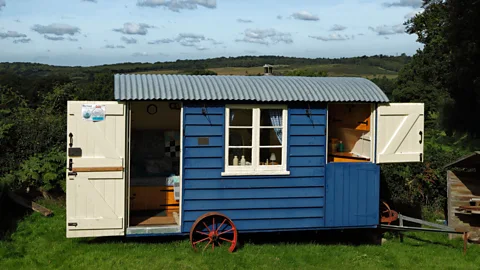
In Britain, the shed at the bottom of the garden is far more than just a place to store tools. It is an institution – a domestic oasis where owners seek refuge, an outlet for individual style, and, increasingly, an office space.
Britain is often quoted as having more sheds per capita than any other country. Around two thirds of Brits own a shed; of those who don’t, 44% would like to. The annual ‘Shedonomics’ survey by Cuprinol also found that 62% of Brits would be deterred from buying a home if it didn’t have a shed or a garden big enough for one, while UK shed listings on Airbnb are in high demand. Even former Prime Minister David Cameron has splashed out £25,000 on one: he plans to use it to write his memoirs.
So what is it about the British and their garden sheds? And can time spent in a shed really be a boon to your creativity and productivity?
It may be no surprise that, with both flexible working and open offices on the rise, workers seem more interested in private, quiet spaces. The 2016 What Workers Want survey found that more than half of employees were dissatisfied with the noise levels in their offices and with hot-desking, and that more than a quarter thought their workplace’s design made them less productive. Meanwhile, nearly a quarter of a million more people work from home in the UK today than a decade ago. As humble as it seems, a private shed is the antithesis to the open-office plans disliked by many workers – and one that a growing cadre of freelancers, entrepreneurs and flex workers are able to use.
 Alamy
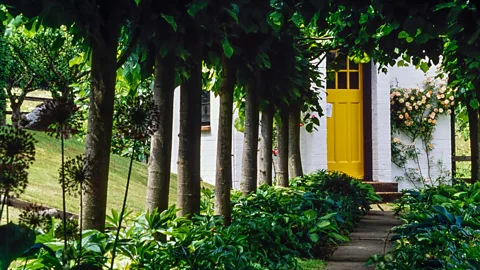
But the garden shed has long pre-dated the concept of flexible working. Children’s author Roald Dahl used to write in a 6ft x 7ft (1.8m x 2.1m) shed he described as his “little nest”, where he would go to work at 10am every day with a woollen blanket over his lap to keep him warm. Dahl’s shed was inspired by – and built to the same dimensions as – the shed which poet Dylan Thomas used for writing.
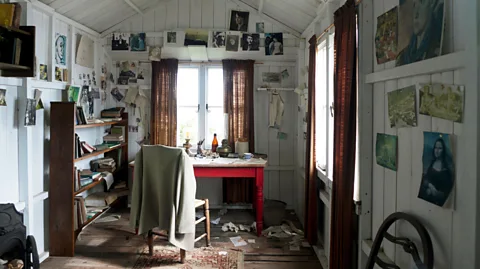
Ted Dewan, the writer and illustrator of the Bing children’s cartoons, has a shed in his garden in Oxford. It was inherited from author Philip Pullman, who penned the fantasy trilogy His Dark Materials within its wooden walls before passing it on – along with a ‘covenant’ that it be used only for creative purposes.
 Alamy
“I think the informality of the shed is part of what makes it exciting and creative,” says Dewan. Having occupied the ‘Pullman Shed’ since 2003, he has made many additions and alterations. Light comes through a metal window salvaged from a nearby factory; he also has added shelves from an optician's office and an antique dentist’s chair. “It represents the ultimate improvised dwelling – and that’s a guarantee to be a more creative space,” Dewan says. “There’s also something about the slight hardship of sheds. Bracing up and waiting for the heater to kick in appeals to something in me that is not getting beaten up enough because my job is not physically demanding!”
Dewan himself is an expat from the US. It’s “not a land of sheds,” he says. “I love the fact that the humility of sheds is celebrated here. It feels essentially British… it’s a country that appreciates the humble magic of an improvised dwelling.” In a nation where the headquarters of its highest office are in a nondescript terraced house called Number 10, it seems Brits may work best in an approachable, non-intimidating environment.
Another shed lover, Andrew Wilcox, inspired by childhood memories of his grandfather’s dark and musty allotment hut, started a shed blog in 2001 in which people shared photos of their trusty sheds. By 2007, this had turned into an annual Shed of the Year competition.
For the last four years, that competition has been a national televised event on the UK’s Channel Four. Finalists have included hobbit houses, sheds built as train stations for giant toy train sets, pub sheds, Doctor Who sheds, even giant teapot sheds. And while most could be described as ‘man caves’, there are plenty of ‘she sheds’ too.
 Alamy
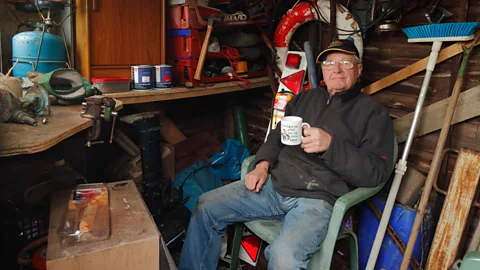
Despite this modern ‘shed bling’, Wilcox says there is a direct lineage to his grandfather’s humble tool shed. “It’s about escaping and doing whatever it is you do in your shed,” he says. “Some people have multiple sheds, his and hers sheds, sheds for the kids… But even if they have a small off-the-shelf shed they can still create this magical escape… You can open the door and just disappear.”
The British artist Chris Cyprus, whose exhibition is on show at Manchester’s Saddleworth Museum & Gallery, features sheds and allotments in his paintings. He describes sheds as “dens” for grown-ups. “We’re building a shed out of nothing and painting it the kinds of colour we’d never dare to use in our houses,” he says. “To me, they represent freedom, creativity and a return to simpler things.”
Chris Law and his fiancée Julie Ann Marchant have taken this ethos to the extreme. They now live in their shed. Built by the couple, largely out of salvaged wood and with wheels to make it transportable, it is just 7ft x 11ft (2.1m x 3.4m). Currently parked in Cambridgeshire, its upstairs bedroom – all 3ft 2in (97cm) high of it – is accessible via a porthole. The bathroom, with shower and toilet, measures just 2ft x 4ft (60cm x 121cm).
Law used to live in a five bedroom house. “I’ve gone from a 2,000 sq ft (609 sq m) house to an 84 sq ft (25.6 sq m) house – that really is downsizing, isn’t it? But I look forward to coming home,” he says. “I actually wouldn’t want to live in a very big house again.” It’s cosy and intimate – plus it only cost £1,000 ($1,300) to build.
More commonly, though, Brits are moving into their sheds to work, not live. The Shedonomics survey in 2015 found that 5% of shed owners worked from their sheds; by 2017, 13.8% of them did. And according to AMA Research, money spent on garden buildings for ‘year-round use’ has increased every year since 2012.
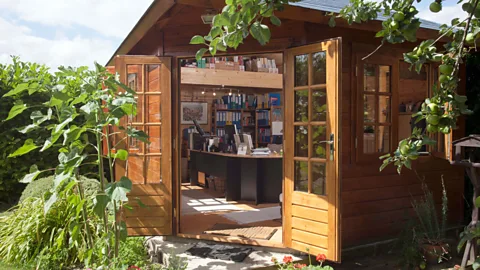
Neil Wallis, an environment and transport consultant based in Banbury, Oxfordshire, works out of a wooden cabin at the bottom of his garden. “It’s a lovely place to work,” he says. “It’s about a 30 yard (27m) walk from my house, so it’s got to be one of the shortest commutes ever – in the summer I can pick some berries from the fruit patch on the way.”
The key to understanding the British shed, he suggests, is the garden. “The British have always had a tradition of gardening, of tending our small plot. The garden shed was traditionally a place to store tools, and this is simply an extension of that.” The tools, however, now are laptops and monitors.
 Alamy
One thing all these sheds have in common is that they give the owner a sense of escape – without having to go too far. My father’s woodworking shed, extant since the 1980s, is similar to the Pullman shed with its own ecosystem of reclaimed items, including a Victorian linen press, bedsit cooking hob and apothecary cabinet. I ask him if he sees it as his refuge.
“My shed isn’t my castle,” he says with a laugh. “It’s just a place where you can do things, leave them overnight and you don’t have to clear it away.” But, he adds, “when you are doing work in it, you are totally involved in your work… totally absorbed in that environment. There is a sense of apartness.”
A private place for reflection, for work, for creativity, a shed may not be exclusively British – the Shed of the Year now has an international category. But it remains an integral part of British life.
This story is a part of BBC Britain – a series focused on exploring this extraordinary island, one story at a time. See every BBC Britain story by heading to the Britain homepage; you can also follow us onFacebookandTwitter.
