Example questions
Use these questions to hone your knowledge of To Kill a Mockingbird, and to practise using your notes and analysis in organised paragraphs that focus on how particular characters, themes or ideas are shown in the novel. There is an example answer in the following section to demonstrate how you can do this.
- How does Lee explore the theme of courage in To Kill a Mockingbird?
- To what extent is Atticus presented as a positive role model in To Kill a Mockingbird?
- In what ways do community and family matter in To Kill a Mockingbird?
- In what ways is prejudice a part of everyday life for the characters in To Kill a Mockingbird?
- Examine how far Boo Radley is presented as an important character in To Kill a Mockingbird.
- How does Lee present childhood in To Kill a Mockingbird?
- To what extent do the children show understanding towards others in To Kill a Mockingbird?
Example answer
Below is a demonstration of how to use your revision material to answer an example essay question. The answer below is not a full essay, but only an extract of a longer answer showing some of the points that could be made.
Q: How does Lee explore the theme of courage in To Kill a Mockingbird?
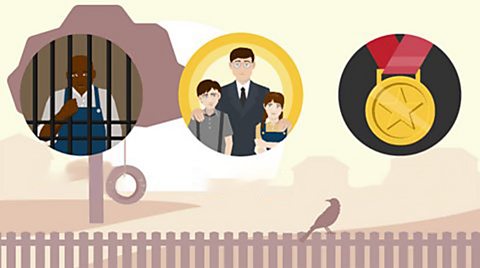
A: Harper Lee’s Pulitzer-winning novel To Kill a Mockingbird is regularly considered among the greatest novels of all time, and part of the reason it means so much to people is the admirable strength and courage of Atticus Finch, one of the protagonists and the father of the narrator, Scout Finch. Atticus takes on a trial he knows he cannot win, defending a black man falsely accused of rape in the 1930s racist south, and does his best to argue the case regardless. He notes that he has to do it for his own peace of mind, and tells Scout that if he didn’t, “I couldn’t hold up my head in town, I couldn’t represent this county in the legislature, I couldn’t even tell you or Jem not to do something again”. This admirable stance lies at the heart of the novel, but is not the only example of courage in the story. Courage is not only displayed by Atticus but by characters like Miss Maudie, who loses her house to a fire, Boo Radley who leaves the safety of his home to save the Finch children, and even Mrs Dubose, who battles a morphine addiction so she can be free before she dies. All of these examples serve to show different types of courage, and as Scout recounts them, we see how she and her brother begin to get a deeper understanding of what courage really is as they mature.
The tomboy character of Scout starts out believing that courage lies in physically fighting for what she thinks is right. She has no problem jumping into fights with other children, particularly those who badmouth her father for taking on the trial. When Atticus asks her to stop answering verbal insults with physical violence, she is upset as she believes refusing to fight is a sign of weakness and cowardice – the opposite of courage. However, as the novel progresses, she sees the merit in other types of strength. One example of this is when she is forced to attend Aunt Alexandra’s missionary tea party. She has resisted attempts to force ‘ladylike’ behaviour on her before, finding dresses and gossip to be boring and oppressive. However, she sees the emotional maturity and inner strength it takes for Miss Maudie and her aunt to politely host the ladies of Maycomb with their ignorant and racist attitudes, especially since both women are shaken by the sudden news of Tom Robinson’s death. Scout then understands there is a kind of courage in these women that is very different from the courage in a fist-fight. Scout is determined to act like them as they keep their chins up and carry on: “If Aunty could be a lady at a time like this, so could I”. Scout previously thought of the women as weak and boring, and even says Jem was “more like a girl” than her for stopping her from needlessly killing a bug; she starts to see courage in Miss Maudie and even Aunt Alexandra, showing her that keeping going in unpleasant circumstances can be as great a form of courage sometimes as beating up an opponent.
This essay could go on to make the following points, backed up by evidence from the novel and analysis/interpretation of that evidence:
- Explaining events surrounding Mrs Dubose and why Atticus refers to her as the most courageous person he ever met, as well as how he defines ‘courage’ for Scout at this point in the novel.
- Examining the courage shown by Boo Radley in saving the children from Bob Ewell’s attack – he not only stands up to an armed opponent, but he has to find the emotional strength to leave his home in the first place and deal with the interactions that come from bringing the injured Jem home.
- Analysing the character of Atticus and his speech and actions regarding the trial, from what he tells the children about it to how he keeps watch over Tom to prevent a lynching. The shooting of the rabid dog demonstrates Atticus can show physical strength and mastery, but as he notes with Mrs Dubose, he doesn’t want his children to think courage is about force, guns or even winning. Rather, he helps them gain the understanding that courage is standing up for what is right even when one cannot and will not win.
- Lee demonstrates the opposite of courage in the form of Bob Ewell, who not only abuses his family and lies in court, but launches a cowardly attack on two defenceless children alone in the dark as a terrible attempt at revenge. Likewise, the newspaper editor Mr Underwood, who is known to be racist against black people, publishes an editorial which condemns the cowardice of the guards who shot a “cripple” in the back when Tom Robinson tried to escape.
Further study
To Kill a Mockingbird at 50. video
Marking the 50th anniversary of To Kill a Mockingbird, writer Andrew Smith visits Monroeville in Alabama, the setting of the book, to see how life there has changed in half a century.
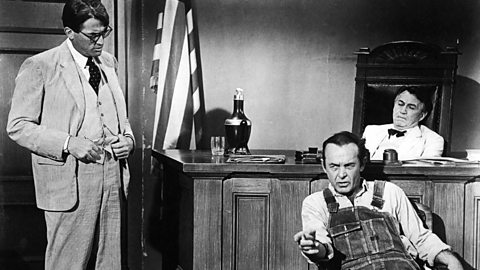
To Kill a Mockingbird play: A tale for these times. audio
Andrea Davy stars as Calpurnia in Aaron Sorkin's first version of the play. The Midlands-based actor speaks to Karen Gabay about its relevance in 2026.

Witness History: To Kill a Mockingbird. audio
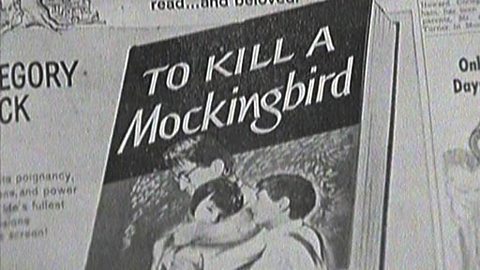
Louise Hidalgo speaks to Gregory Peck's son Carey about the film of Harper Lee's novel, To Kill a Mockingbird.
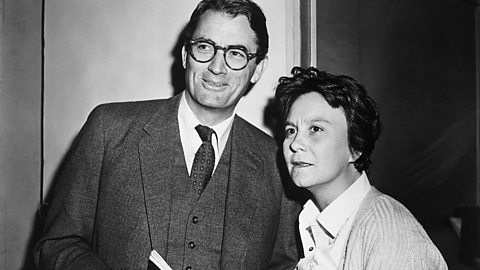
In Context: To Kill a Mockingbird (pt 1/3) video
Andy Kershaw examines the historical context of Harper Lee’s novel To Kill a Mockingbird, explaining that the author drew on the only perspective she had experienced – that of a southern white woman.

In Context: To Kill a Mockingbird (pt 2/3) video
Andy Kershaw paints a picture of the society inhabited by Harper Lee when she was writing her novel, To Kill a Mockingbird.
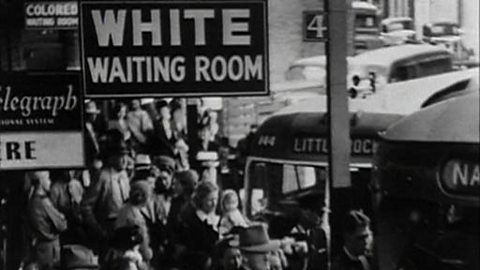
In Context: To Kill a Mockingbird (pt 3/3) video
Andy Kershaw looks at how Martin Luther King's mobilisation of the black population of America affected the nation's response to Harper Lee's novel, To Kill a Mockingbird.
More on To Kill a Mockingbird
Find out more by working through a topic
- count1 of 5
- count2 of 5

- count3 of 5