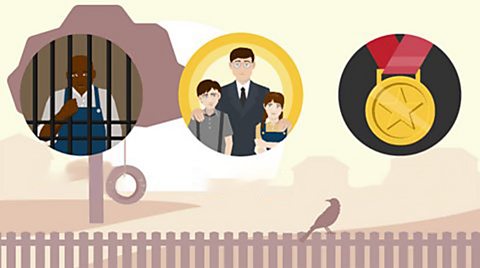
Form
Harper Lee wrote To Kill a Mockingbird in the form of a novel, which is a fictional Ordinary language both spoken or written; different from poetry (which does not reflect everyday speech patterns).Narrative is another word for story.:
- fictional – something imagined or untrue
- prose – writing that is not in verse
- narrative – a written account of something
Generally, a novel will be built around characters and action, and will be recognisable in its A literary movement and style that aims to present life as it really is, focusing on ordinary people, everyday settings and plausible events. – that is, showing things as they really are.
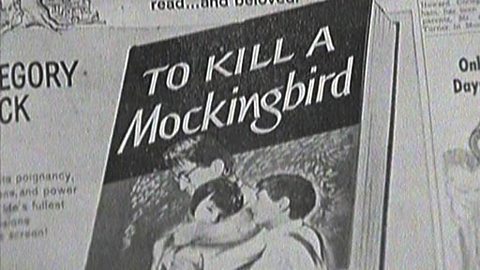
Lee began writing To Kill A Mockingbird in the 1950s and submitted it for publication in 1957 but she was told to rewrite it as the publishers felt that her original work appeared to read more like a series of short stories. After working on her manuscript, Harper Lee resubmitted it for publication and it was finally published as one long novel in 1960. It was immediately successful and won many literary awards. Among these was the prestigious Pulitzer Prize, an award usually awarded to a novel which portrays American life – this is certainly something Harper Lee’s novel does. Since its publication it has sold over 30 million copies and in 2008 it was voted the greatest novel of all time.
When analysing form in To Kill a Mockingbird you can refer to:
- the type of text
- the style of writing
Evidence and explanation of the form used
- Writing To Kill a Mockingbird as a long novel gave Harper Lee more opportunity to develop her investigation into the important themes that she wished to discuss, such as courage and prejudice.
- Novels also give wider scope for character development. This meant that throughout To Kill a Mockingbird, Harper Lee could show the way in which Scout and Jem mature as the novel progresses.
- It also meant that she could take her time presenting the reader with quite complex characters like Atticus, about whom there is much to write.
Structure
The novel is centred on the lives of members of the Finch family between 1933 and 1935. It is The teller of a story; the voice in a text that describes or narrates the events of the plot. The narrator is often either a character in the story, or an authorial voice who gives a commentary on events but doesn't take part. by Scout Finch who is looking back on events which began when she was almost six years old. She narrates the events in Chronological means following the time order in which events happened. Stories told chronologically start with the earliest event and end with the last. order – in the same order that they took place at the time – so that by the end of the novel, two years later, events have come full circle and the characters must come to terms with all that has happened to them during this period.
The novel is split into two parts:
- Part one covers chapters one to eleven
- Part two covers chapters twelve to thirty one
When writing about structure, think about:
- How is the text put together?
- What is the significance of this?
- How does the structure reflect the themes of the text?
- What is the overall effect of the structure?
Evidence and explanation of the structure used
Part one
Part one of the novel is important because it provides the reader with the background information they need to appreciate the full impact of Tom Robinson’s trial on the people of Maycomb. For example, the reader learns that many residents of Maycomb are racists who are willing to assume Tom Robinson is a guilty man without waiting to consider the evidence of the trial. Atticus himself points this out when he comments to his brother, Jack Finch: “Why reasonable people go stark raving mad when anything involving a Negro comes up, is something I don’t pretend to understand…”
Atticus Finch is presented as a lawyer who can be trusted to believe in Tom’s innocence and do all he can to prove this, even though it will make life difficult for him. In part one, Scout and Jem are shown as young children who are less mature than they are in part two. In part one they are determined to coax Boo Radley out of his house so they can catch a glimpse of him. By part two, Jem in particular has matured enough to realise that there may be reasons why Boo Radley does not wish to leave his house and that ultimately he should be left in peace. Jem tells Scout: “I think I’m beginning to understand something. I think I’m beginning to understand why Boo Radley’s stayed shut up in the house all this time… it’s because he wants to stay inside.”
Tom Robinson’s trial is central to the novel and this is why structurally the build-up to it takes place at almost the halfway point of the novel itself. This helps underline how important the trial is.
Part two
Part two shows how the characters cope with the result of the trial. The reader discovers that when Bob Ewell threatens Atticus at the end of the trial he fully intends to carry out his threats. This can be seen throughout the final chapters of the novel, particularly in chapter 22 when Bob Ewell spits at Atticus before attacking Jem and Scout in chapter 28. Harper Lee also reveals that Tom Robinson despairs of ever being found innocent. Even with Atticus on his side he does not believe a justice system, which so favours white people, will help his cause and so he tries to escape, a move which ultimately costs him his life.
Harper Lee is also very careful with her use of structure during the actual trial itself. Atticus’ careful questioning of Bob Ewell and Tom Robinson only gradually reveals the fact that Mayella Ewell was hit by a left handed man. Bob Ewell is left handed and Tom Robinson is unable to use his left arm. This helps to add tension and drama to the court case and it also helps keep the reader in suspense.
By the end of the novel, Jem and Scout are beginning to have more understanding of the impact of the trial on the community and on the neighbours they know so well. They realise that their father was brave when he agreed to defend Tom Robinson but that if he had not taken the case, he could never again have held up his head with pride and self-respect. They are also beginning to have a greater understanding of courage and realise that bravery comes in many shapes and sizes, such as Mrs Dubose fighting her morphine addiction.
How to analyse structure
The structure is closely linked to the maturing of Jem and Scout. In Part two of the novel, their understanding of the trial and of Boo Radley has grown and they realise that Atticus has been trying to teach them some important lessons about the nature of tolerance. Scout also realises that there is more to being a lady than she first realised when she sees how her Aunt and Miss Maudie keep control when news of Tom’s death reaches the Finch Household.
The structure of the novel is important because:
- Part one introduces the reader to the community of Maycomb and to the prejudices of the people who live there. For example, Jem is angry when Mrs Dubose criticises his father: “Your father’s no better than the ******* and trash he works for.”
- Part two shows the reader what can happen when these prejudices get out of hand and an innocent black man is put on trial for a crime he did not commit. Atticus underlines this in the final speech he makes in court: “And so a quiet, respectable, humble Negro who had the unmitigated temerity to ‘feel sorry’ for a white woman has had to put his word against two white people’s.”
- The structure of the novel places the trial and the events surrounding it at its centre. This ensures everyone is aware of how important it is in To Kill a Mockingbird.
Literary devices and narrative techniques
The language Harper Lee uses in her novel is very realistic and it aims to accurately portray what life was like in a small rural community like Maycomb in the southern states of America in the 1930s. The children use the Everyday language.language that would be natural for them whilst talking to their friends and family.
Although Harper Lee’s writing style is mainly realistic and quite straightforward, she is also able to use it to cleverly create tension and suspense when needed. This can be seen in particular at the end of the novel just before and during Bob Ewell’s attack on Jem and Scout: “I took one giant step and found myself reeling: my arms useless, in the dark, I could not keep my balance,” Scout tells the reader.
Harper Lee uses colourful Using a figure of speech not to be taken literally, usually a metaphor, eg 'a ton of homework'. such as A simile is a word or phrase used to make a comparison for dramatic effect, using 'like' or 'as'., A metaphor is a word or a phrase used for dramatic effect, to describe something as if it were something else. and A type of imagery in which non-human objects, animals or ideas are given human characteristics. to create images in her readers’ minds. She also uses humorous language which is sometimes there to highlight a character’s misunderstanding of a certain situation, such as when Bob Ewell does not understand some of the questions he is asked in court. As Scout tells the reader: “Mr Ewell turned angrily to the judge and said he didn’t see what his being left-handed had to do with it, that he was a Christ-fearing man and Atticus Finch was taking advantage of him.”
When analysing the language Harper Lee has used, aim to:
- Examine words and phrases
- Think about the sort of words she chose (positive, negative, descriptive)
- Explore layers of meaning (what else could a phrase refer to or suggest?)
- Notice any literary techniques (simile, metaphor, sensory detail and so on)
- Explain the effects of the language used – how does it make you feel?
Realistic colloquial language of the time
| How is it used? | Why is it used? | What is its effect? |
|---|---|---|
| Scout and Jem both use informal language. For example, Jem says to Dill after first meeting him: “Shoot no wonder, then… Scout yonder’s been readin’ ever since she was born, and she ain’t even started to school yet.” Later Scout says to Jem in reference to school: “Yeah Jem, but I won’t wanta study cows…” Scout tries to test her father’s patience by swearing. When Uncle Jack visits she responds to his claim that his cat eats fingers left over from the hospital with “Aw, that’s a damn story”. | Harper Lee is ensuring her novel is as realistic as possible. She is showing that the Finch children are typical children of the time. | Not only does this make her novel realistic but it also reveals that Scout and Jem do not put on airs and graces when they speak. |
Personification
| How is it used? | Why is it used? | What is its effect? |
|---|---|---|
| Describing the Radley property Scout says: “Rain rotten shingles drooped over the eaves of the veranda; oak trees kept the sun away. The remains of a picket drunkenly guarded the front yard…” | Harper Lee highlights neglect of the Radley property. | The use of personification reflects the way Boo Radley has been neglected. |
Sensory descriptions
| How is it used? | Why is it used? | What is its effect? |
|---|---|---|
| “From somewhere near by came scuffling, kicking sounds, sounds of shoes and flesh scraping dirt and roots.” | Harper Lee creates tension during Bob Ewell’s attack. | This heightens suspense and reveals Bob Ewell’s cowardice. |
Test yourself
Further study
To Kill a Mockingbird at 50. video
Marking the 50th anniversary of To Kill a Mockingbird, writer Andrew Smith visits Monroeville in Alabama, the setting of the book, to see how life there has changed in half a century.
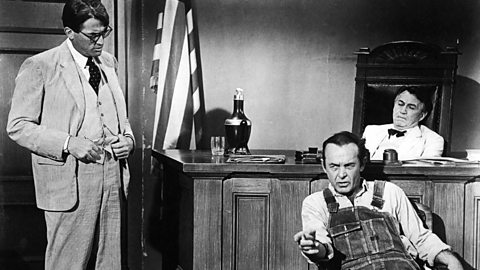
To Kill a Mockingbird play: A tale for these times. audio
Andrea Davy stars as Calpurnia in Aaron Sorkin's first version of the play. The Midlands-based actor speaks to Karen Gabay about its relevance in 2026.

Witness History: To Kill a Mockingbird. audio
Louise Hidalgo speaks to Gregory Peck's son Carey about the film of Harper Lee's novel, To Kill a Mockingbird.
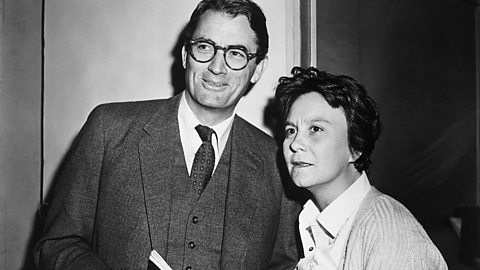
In Context: To Kill a Mockingbird (pt 1/3) video
Andy Kershaw examines the historical context of Harper Lee’s novel To Kill a Mockingbird, explaining that the author drew on the only perspective she had experienced – that of a southern white woman.

In Context: To Kill a Mockingbird (pt 2/3) video
Andy Kershaw paints a picture of the society inhabited by Harper Lee when she was writing her novel, To Kill a Mockingbird.
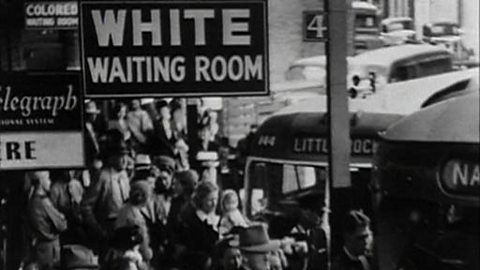
In Context: To Kill a Mockingbird (pt 3/3) video
Andy Kershaw looks at how Martin Luther King's mobilisation of the black population of America affected the nation's response to Harper Lee's novel, To Kill a Mockingbird.
More on To Kill a Mockingbird
Find out more by working through a topic
- count1 of 5
- count2 of 5
- count3 of 5