
The Arctic Ocean - Examining the pack ice

Locations
The Arctic Ocean
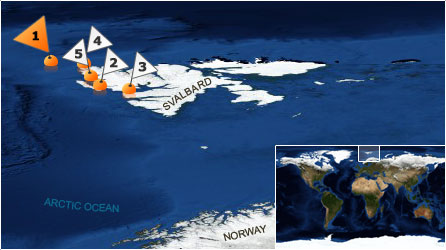
Location map
Introduction
With much of it covered in ice all year round and with no daylight from October to March, the Arctic Ocean is one of the world's most remarkable oceans. It's home to a multitude of unique life forms, all highly adapted to cope with the extreme and seasonal conditions. The impacts of climate change are more strongly felt here than anywhere else in the world.
Examining the pack ice
Overview
The frozen pack ice in the Arctic Ocean makes it one of the most inaccessible oceans in the world. For this reason, most scientific research on pack ice is carried out remotely using satellite imagery and computer modelling. So any opportunity to examine the ice physically will be beneficial to scientific research.
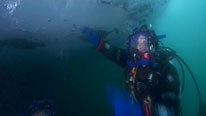
Working out the ice's age is crucial to understanding how well the ice cap as a whole is faring. Any ice that's existed for more than one year, known as multi-year ice and usually more than 2m thick, is a good sign. Any ice less than 2m thick with high salinity levels (salt leaches out of ice over time) is almost definitely first year ice.
| Importance: | Finding out the age of ice first hand will enable scientists to determine the quality of data they receive from satellite imagery and computer modelling. |
| Dive category: | Diving under drifting pack ice is one of the most hazardous forms of diving possible. It must only be attempted by highly qualified and experienced dive teams. |
| Access: | Very few people have been this far north. A site like this can be accessed only by an ice-breaker or by air. |
Interesting for
- Sea ice
- The National Snow and Ice Data Center of Colorado University gives a thorough account of sea ice.
- All about sea ice
- Decline of the Arctic sea ice
- An animation of the Arctic sea ice taken by NASA satellites in 2007.
- 2007 Arctic sea ice
- Climatic importance of polar ice packs
- Wikipedia explains about the polar ice packs and their climatic significance.
- Polar ice packs
BBC related content
- Oceans 360° experience: The Arctic pack ice
- Oceans ultimate dives: Tooni Mahto's ice dive
- Oceans image gallery: The Arctic Ocean
- Oceans Arctic expedition: Under the pack ice
- BBC News: Arctic ice thickness 'plummets'
Episode region
BBC iD
BBC iDBBC navigation
BBC links

BBC © 2014The BBC is not responsible for the content of external sites. Read more.
This page is best viewed in an up-to-date web browser with style sheets (CSS) enabled. While you will be able to view the content of this page in your current browser, you will not be able to get the full visual experience. Please consider upgrading your browser software or enabling style sheets (CSS) if you are able to do so.
