
The Arctic Ocean - Arctic's underwater fauna

Locations
The Arctic Ocean
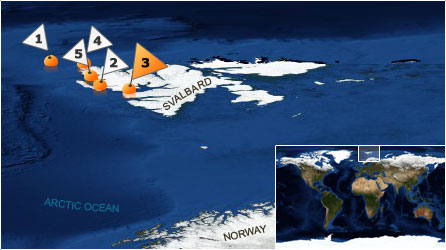
Location map
Introduction
With much of it covered in ice all year round and with no daylight from October to March, the Arctic Ocean is one of the world's most remarkable oceans. It's home to a multitude of unique life forms, all highly adapted to cope with the extreme and seasonal conditions. The impacts of climate change are more strongly felt here than anywhere else in the world.
Arctic's underwater fauna
Overview
At around 78 degrees north, warmer waters are brought to the freezing Arctic Ocean by the Gulf Stream and the North Atlantic Drift. The nutrient-rich water helps create a sea floor full of colour and life; a stark contrast to the monochrome existence above the water.
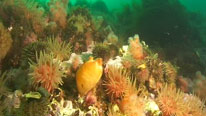
Although the temperatures here are only just above freezing there is an abundance of colourful species usually associated with much warmer waters. Alongside the dark greens of the kelp there are deep red soft corals, that filter feed on the nutrient-rich water, and bright pink anemones, that catch small animals that float by in the moving water. A startlingly beautiful sight that shows there is far more to the Arctic than just snow, ice and barren landscapes.
| Importance: | Where warmer waters meet the Arctic there is an abundance of colourful underwater fauna. |
| Dive category: | This is an open water dive suitable for people with considerable experience dry suit diving in cold water. |
| Access: | Although in the remote Arctic, the site is relatively close to Svalbard's capital, Longyearbyen. So access is easier than the other dives on the Oceans Arctic expedition. |
Interesting for
- Anemones in the Arctic
- The Arctic Ocean Diversity project gives an overview on the species of anemone that can be found in the Arctic.
- Sea anemones and other cnidarians
- Soft corals
- Wikipedia explains what soft corals (Alcyonacea) are.
- Alcyonacea
- Ocean currents that bring life to the Arctic
- WeatherOnline gives a summary of what the Gulf Stream is and how it occurs.
- North Atlantic Drift (Gulf Stream)
BBC related content
- Oceans presenter biography: Philippe Cousteau
- Oceans presenter biography: Lucy Blue
- Oceans Arctic expedition: Arctic fauna adds colour
- Oceans image gallery: The Arctic Ocean
Episode region
BBC iD
BBC iDBBC navigation
BBC links

BBC © 2014The BBC is not responsible for the content of external sites. Read more.
This page is best viewed in an up-to-date web browser with style sheets (CSS) enabled. While you will be able to view the content of this page in your current browser, you will not be able to get the full visual experience. Please consider upgrading your browser software or enabling style sheets (CSS) if you are able to do so.
