
The Arctic Ocean - Walrus colony, Poolepynten

Locations
The Arctic Ocean
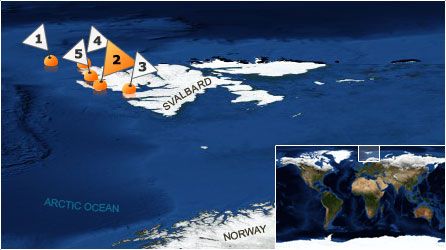
Location map
Introduction
With much of it covered in ice all year round and with no daylight from October to March, the Arctic Ocean is one of the world's most remarkable oceans. It's home to a multitude of unique life forms, all highly adapted to cope with the extreme and seasonal conditions. The impacts of climate change are more strongly felt here than anywhere else in the world.
Walrus colony, Poolepynten
Overview
The walrus, one of the iconic Arctic species, was hunted for three centuries around Svalbard almost to extinction. In 1952, when it was made a protected species, there were only about 100 left. Since then populations have grown steadily across the Arctic and there are now about 2,000 living around Svalbard.
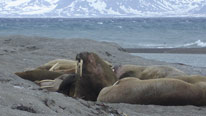
The walrus lives up to 40 years old and can grow up to 1,500kg. A binge eater, it can consume over 50kg of clams a day. One theory suggests that the species could be one of the few which benefits from the changing Arctic climate in the short term. The retreating ice could open up more feeding grounds, with warmer waters potentially increasing clam populations in the area.
| Importance: | The Arctic walrus is recovering well after being hunted close to extinction. |
| Dive category: | If atempting to dive with walrus it would be advisable to use a cage as they are extremely large and unpredictable. |
| Access: | The site is very remote and is hard to access for members of the general public. Permission from the Governor of Svalbard is required to be able to cage dive. |
Interesting for
- The iconic Arctic animal
- This article by the Norwegian Polar Institute gives a thorough overview on the walrus of Svalbard.
- Walrus
- Walrus hunting
- The Svalbard Museum gives an account of the walrus hunting carried out in Svalbard's past.
- 2007 Arctic sea ice
BBC related content
- Oceans presenter biography: Paul Rose
- Oceans presenter biography: Tooni Mahto
- Oceans Arctic expedition: A day on walrus beach
- Oceans Arctic expedition: Walrus safety
- Oceans image gallery: The Arctic Ocean
Episode region
BBC iD
BBC iDBBC navigation
BBC links

BBC © 2014The BBC is not responsible for the content of external sites. Read more.
This page is best viewed in an up-to-date web browser with style sheets (CSS) enabled. While you will be able to view the content of this page in your current browser, you will not be able to get the full visual experience. Please consider upgrading your browser software or enabling style sheets (CSS) if you are able to do so.
