Character overview
The cast of characters in Macbeth is not particularly large but each has an important part to play in the unfolding drama. Many of the characters are from the Scottish ruling class. Other characters are servants or soldiers and even supernatural beings.
The central characters, the Macbeths, have a strong influence over the lives of the other characters and, in their turn, are influenced by the words and actions of others.
Main characters
- Macbeth
- Lady Macbeth
- Banquo
- Macduff
- The Witches
Secondary characters
- King Duncan
- Malcolm
- Donalbain
- Fleance
- Lady Macduff
- Young Macduff
- Lennox
- Ross
- Angus
Minor characters
- Siward
- Young Siward
- King Edward
- The Macbeths' servants (Porter, Doctor, Gentlewoman, Seyton)
- Hecate
- Old Man
Macbeth
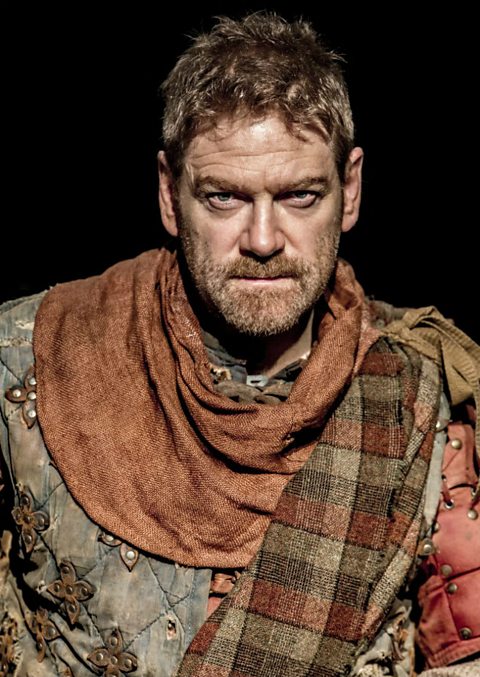
Macbeth is a complex character who changes throughout the course of the play. He is clearly a brave warrior and leader at the start of the drama, but he falls victim to the Witches' predictions. It is unclear whether they plant ideas in his mind or whether they simply highlight thoughts he has already had. In a series of A speech performed by a character, often depicting that person thinking or talking aloud to his or herself. he repeatedly questions himself about his motives for killing the King but is eventually persuaded to continue by his forceful wife.
Having committed murder he finds himself caught in a spiral of evil from which he can see no escape. His actions become less heroic and more cowardly as he continues to murder and terrorise others in order to hold on to his power. Towards the end of the play, when he realises that he is doomed, he briefly returns to his old heroic self.
| How is Macbeth like this? | Evidence | Analysis |
|---|---|---|
| Ambitious | ||
| At the start of the play, Macbeth is Thane of Glamis. He quickly becomes the more powerful Thane of Cawdor and then murders his way to become and remain King of Scotland. The Witches' predictions seem to waken the ambition already in him and he is spurred on by his wife. | The prince of Cumberland: That is a step / On which I must fall down, or else o'er-leap, / For in my way it lies. Stars, hide your fires; / Let not light see my black and deep desires, / The eye wink at the hand. Yet let that be, / Which the eye fears, when it is done, to see. (Act 1, Scene 4) | Macbeth is clearly worried by the strength of his own ambition which he refers to as black and deep desires. He knows there will be obstacles in his way but is determined to get round them. He just hopes that nobody will see what he is up to which is why he wants the stars to stop shining. |
| Brave | ||
| At the start of the play, Macbeth shows that he is a mighty warrior when he leads the Scottish troops to victory over an invading force. Duncan, the King, rewards him by making him Thane of Cawdor. At the end of the play, when he knows he is about to die, Macbeth regains some of his old bravery, as he faces Macduff in single combat. | For brave Macbeth-- well he deserves that name – / Disdaining fortune, with his brandished steel, / Which smoked with bloody execution, / Like Valour's minion carved out his passage / Till he faced the slave, Which ne'er shook hands, nor bade farewell to him, / Till he unseamed him from the nave to th'chaps, / And fixed his head upon our battlements. (Act 1, Scene 2) | The Captain describes Macbeth's actions on the battlefield particularly when he seeks out and kills the traitor Macdonwald. The Captain uses a number of strong verbs and adjectives to show how brave Macbeth has been: 'brandished', 'smoked', 'carved', 'unseamed', 'fixed'. |
| Changeable | ||
| Macbeth keeps changing his mind about whether to murder Duncan or not. This is particularily so in th early part of the play. His ambition conflicts with his sense of loyalty and morality. Lady Macbeth is key to persuading him and keeping him determined. | We will proceed no further in this business. / He hath honoured me of late, and I have bought / Golden opinions from all sorts of people, / Which would be worn now in their newest gloss, / Not cast aside so soon. I am settled and bend up / Each corporeal agent to this terrible feat. (Act 1, Scene 7) | Macbeth has just spent a difficult time convincing himself that killing the King is wrong. He tells Lady Macbeth that he will not carry out the deed. Within the space of a couple of minutes she argues the case for Duncan’s death and Macbeth is, once again, set on murder. |
| Guilty conscience | ||
| Throughout the play, Macbeth is tormented by thoughts of the evil things he has done. However, he is caught in a spiral of evil and does not seem able to stop himself. | (seeing the GHOST) Avaunt, and quit my sight! Let the earth hide thee! / Thy bones are marrowless, thy blood is cold; / Thou hast no speculation in those eyes / Which thou dost glare with. (Act 3, Scene 4). | Banquo's ghost appears to Macbeth alone, showing his overactive imagination triggered by a guilty conscience. Although he is now a king, Macbeth cannot command his own emotions and feels irrevocably set on this course of action. The court thinks he is going mad. |
Lady Macbeth
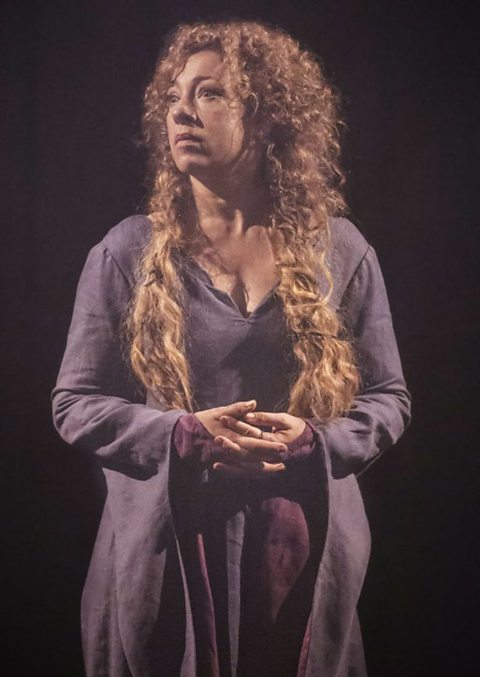
Lady Macbeth is even more ambitious and ruthless than her husband. As soon as an opportunity to gain power presents itself, she has a plan in mind. She uses her influence to persuade Macbeth that they are taking the right course of action and even takes part in the crime herself.
For a while she is able to suppress her actions, but eventually she becomes unable to deal with the guilt of what she has done. She becomes unable to sleep, and mentally unstable, eventually dying in tragic circumstances.
| How is Lady Macbeth like this? | Evidence | Analysis |
|---|---|---|
| Ambitious | ||
| Lady Macbeth is, perhaps, even more determined than her husband. She can only be Queen if he becomes King so when he hesitates she displays enough ambition for both of them. Once she has worked out a plan, nothing will turn her from that course until her ambition is fulfilled. | Glamis thou art, and Cawdor, and shalt be / What thou art promised; yet do I fear thy nature, / It is too full o'th'milk of human kindness / To catch the nearest way. Thou wouldst be great, / Art not without ambition, but without / The illness should attend it. (Act 1, Scene 5) | Lady Macbeth's determination to succeed is clear here. She is insistent that Macbeth will become King ('shalt be what thou art promised') However, she recognises that he is 'too full o'th'milk of human kindness' and that this could stand in their way. It is interesting that she describes the necessary ruthless streak as an 'illness'. This suggests that even at this stage she knows what she is doing is wrong. |
| Cunning | ||
| To the outside world, Lady Macbeth seems like the ideal supportive wife but this is part of her ability to be deceptive. When Macbeth expresses doubts, she uses every trick she can think of to make sure he carries out their plan to murder Duncan. When he hesitates, she is there to urge Macbeth on. | All our service, / In every point twice done and then done double, / Were poor and single business to contend / Against those honours deep and broad wherewith / Your majesty loads our house. (Act 1, Scene 6) | Lady Macbeth welcomes Duncan to her home and flatters him so that he will not suspect a thing. She almost overdoes it when she exaggerates 'In every point twice done and then done double’. The word 'double' also links Lady Macbeth to the evil of the witches - they use the word repeatedly in one of their spells. |
| Conscience-stricken | ||
| Lady Macbeth seems to go from being someone with no conscience at all to someone who is overwhelmed by feelings of guilt. She cannot bear to think of what she has done and eventually dies alone and unmourned even by her husband. | Out, damned spot! Out, I say! One, two. Why then 'tis time to do't. Hell is murky. Fie, my lord, fie, a soldier, and afeard? What need we fear? Who knows it, when none can call our power to account? Yet who would have thought the old man to have had so much blood in him? (Act 5, Scene 1) | As the guilt-stricken Lady Macbeth sleepwalks, she remembers all the evil things she and her husband have done and tries to wash imaginary blood from her hands ('Out, damned spot: out, I say!'). In particular, she recalls the night of Duncan's murder and the part she played in persuading her husband to act. She is also aware that she will be going to hell for her sins. |
Banquo
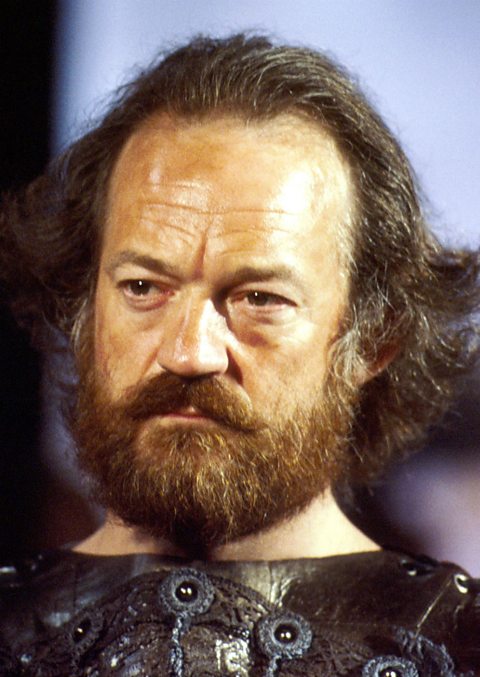
Banquo is another general in King Duncan's army and Macbeth's best friend. While both men have ambitious thoughts, Banquo is more cautious and does not resort to murder to get what he wants.
Banquo is aware that the Witches' predictions may be tricking Macbeth into evil actions, and is the first to suspect Macbeth of murder. He dies while protecting his son, Fleance, and comes back as a ghost to haunt Macbeth.
| How is Banquo like this? | Evidence | Analysis |
|---|---|---|
| Noble | ||
| Banquo is in many ways Macbeth's opposite. He is kind and caring, loyal and trustworthy. Like Macbeth he fights bravely for King Duncan but does not involve himself with the murder plot. When he and Fleance are attacked his first thought is to keep his son safe. Banquo displays all the character traits that go to make up someone who would be regarded as a truly noble person. | Our fears in Banquo / Stick deep, and in his royalty of nature / Reigns that which would be feared. 'Tis much he dares, / And to that dauntless temper of his mind, / He hath a wisdom that doth guide his valour / To act in safety. There is none but he / Whose being I do fear. (Act 3, Scene 1) | Macbeth considers what it is about Banquo that gives him cause for concern. He states that Banquo has a 'royalty of nature' or nobility about him which actually makes Macbeth afraid of him. He also acknowledges that Banquo has 'valour' (bravery) and 'wisdom' without feeling the need to take unnecessary risks. |
| Questioning | ||
| Banquo seems far less ready to believe the Witches than Macbeth and is suspicious of their motives. He realises that the things they predict/suggest may cause his friend to come to harm. Although, like Macbeth, he is ambitious, he thinks more carefully about the consequences of any action. | That, trusted home, / Might yet enkindle you unto the crown, / Besides the Thane of Cawdor. But 'tis strange, / And oftentimes, to win us to our harm, / The instruments of darkness tell us truths; / Win us with honest trifles, to betray's / In deepest consequence. (Act 1, Scene 3) | Having listened to the Witches' predictions, Banquo recognises that Macbeth has been given the spark that will have lit up his ambitious streak ('enkindle'). He also realises that the predictions are temptations which only reveal part of the truth ('honest trifles'). This is in order to set a trap for something of greater significance ('to betray's in deepest consequence'). |
Macduff
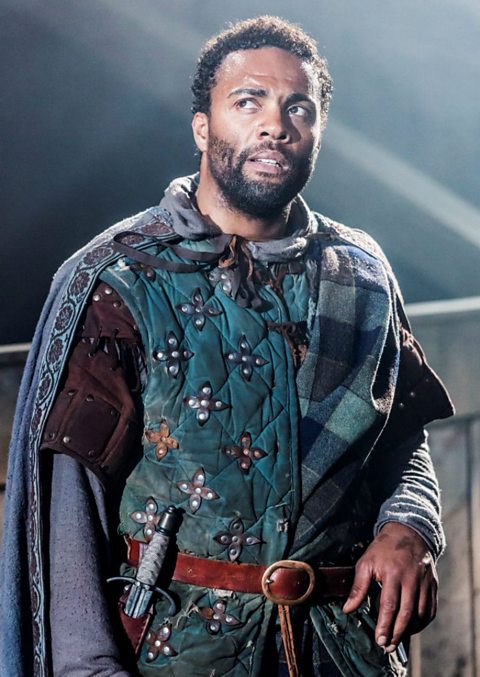
Macduff, the Thane of Fife, is Macbeth's deadly enemy. He discovers Duncan's body and becomes Malcolm's chief supporter, following him to England to support him in raising an army against Macbeth. When he learns of the murders of his wife and family, Macduff feels guilty about leaving them and driven by a need for revenge.
According to the Witches' prediction, Macduff is the only one who can stop Macbeth. The two men meet face-to-face on the battlefield and Macduff kills Macbeth.
| How is Macduff like this? | Evidence | Analysis |
|---|---|---|
| Loyal | ||
| Macduff's first loyalty is to his king and country. It is he who discovers Duncan's body and reveals the full horror of the murder. He follows Malcolm (the rightful king) to England and becomes his right-hand man supporting him in his bid to regain the throne. | Macduff, this noble passion, / Child of integrity, hath from my soul / Wiped the black scruples, reconciled my thoughts / To thy good truth and honour. Devilish Macbeth / By many of these trains hath sought to win me / Into his power, and modest wisdom plucks me / From over-credulous haste; but God above / Deal between thee and me, for even now / I put myself to thy direction (Act 4, Scene 3) | Malcolm tests Macduff's loyalty by pretending to be a worse human being than Macbeth himself. Macduff refuses to give up his loyalty to the Scottish royal family. Malcolm reveals his deception and contrasts the 'integrity' and 'good truth and honour' of Macduff with that of 'Devilish Macbeth'. He finishes by saying that he completely trusts Macduff – 'I put myself to thy direction'. |
| Revengeful | ||
| Macduff wants to rid his country of the tyrant Macbeth and vows to help Malcolm achieve this. When he learns of the murder of his family he becomes even more determined to take revenge. He and Macbeth come face-to-face on the battlefield and Macduff is victorious. | O, I could play the woman with mine eyes / And braggart with my tongue! But gentle heavens, / Cut short all intermission. Front to front / Bring thou this fiend of Scotland and myself; / Within my sword's length set him; if he scape, / Heaven forgive him too. (Act 4, Scene 3) | Macduff is actually a man of few words preferring to get on with things. He could sit around crying about his loss ('I could play the woman with mine eyes') or making great speeches about his intentions ('braggart with my tongue'). Instead he cannot wait for the moment ('cut short all intermission') when he and Macbeth come face-to-face and he can be avenged. |
The Witches
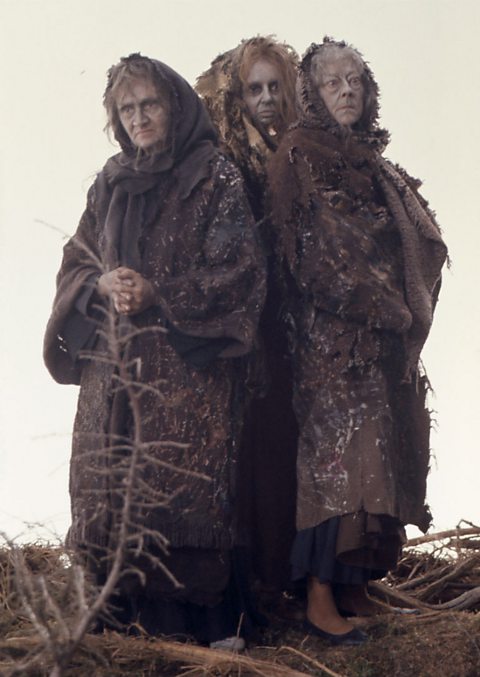
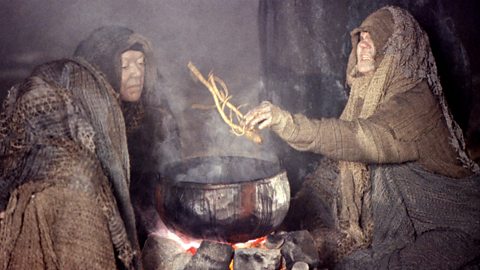
Although there is clearly more than one of them, the Witches may be seen as seem as a single character; they are often referred to as "The Weird Sisters".
Their predictions drive matters forward though they never actually suggest direct action. Rather, they plant ideas in Macbeth's mind and let his ambition do the rest. Many of their predictions are Something that could be interpreted in more than one way..
| How are the Witches like this? | Evidence | Analysis |
|---|---|---|
| Supernatural | ||
| The Witches are clearly unlike any other characters in the play. Their physical appearance, their style of speech, their actions and their apparent ability to predict the future sets them apart from the humans they seek to control. | Round about the cauldron go; / In, the poisoned entrails throw. / Toad, that under cold stone / Days and nights hast thirty-one / Sweltered venom sleeping got, / Boil thou first i'th'charmèd pot. / Double, double, toil and trouble; / Fire burn, and cauldron bubble. (Act 4, Scene 1) | The Witches meet around one of the most well-known symbols of witchcraft – a cauldron. Into this they throw all manner of foul and evil objects ('poisoned entrails') and cast a spell. Although it is not clear what the spell is for, it is obvious they are up to no good. The Witches' chant is in a different rhythm to the way the other characters speak – this also suggests their supernatural nature. |
| Ambiguous | ||
| When the Witches make their predictions, they only say what will happen and not how it will happen. Macbeth falls into their trap and believes that he is safer than he actually is. | THIRD APPARITION: Be lion-mettled, proud, and take no care / Who chafes, who frets, or where conspirers are. / Great Birnam Wood to high Dunsinane hill / Shall come against him. MACBETH: That will never be. (Act 4, Scene 1) | The Witches have conjured up three ghostly visions that make ambiguous predictions. Macbeth is told that he need not fear anything ('take no care who chafes, who frets, or where conspirers are') until a forest of trees uproots itself and moves. As this seems to be a physical impossibility Macbeth instantly dismisses it ever happening ('That will never be'). The prediction will come true – but not quite in the way Macbeth expects. |
Secondary characters
- King Duncan – the rightful king of Scotland, he is noble and well-loved, but too trusting. The Thane of Cawdor launches a rebellion against him; he replaces this enemy with Macbeth, who also deceives him.
- Malcolm and Donalbain – Duncan’s sons. The elder, Malcolm, is the more significant character as it is he who is chosen as the heir to Duncan’s throne. He goes on to lead the forces against Macbeth and indicates he will be a good and just king who can restore order to the land ravaged by Macbeth’s tyrannical rule.
- Fleance – Banquo’s son. His role is largely symbolic, as he represents the threat Macbeth feels from the prophecy given to Banquo; his escape from Macbeth’s murderers shows Macbeth cannot outrun nor rearrange fate.
- Lady Macduff and Young Macduff – Macduff’s family represent innocence, domesticity, and a portion of the natural order, as well as showing a man’s role to be important in the home as well as on the battlefield. Their murders further damn Macbeth, making him truly monstrous to the audience and setting Macduff on a course for specific revenge against him.
- Lennox, Ross, Angus and other thanes – the other lords variously bring messages, inform the audience of events occurring offstage and model the behaviour the thanes were supposed to demonstrate: loyalty, kinship and so on. They also reflect the public opinion of Macbeth throughout the play, from brave warrior to murderous tyrant.
Minor characters
- Siward and Young Siward – English nobility who aid Malcolm in his campaign against Macbeth; Malcolm calls them ‘uncle’ and ‘cousin’ respectively, suggesting they may have been relatives.
- King Edward – the wise and good king of England, said to be able to heal illness with his touch.
- Porter, Doctor, Gentlewoman, Seyton – various servants of the Macbeths. The porter is used as comic relief, and many of his references are either bawdy jokes or topical references that audiences in Shakespeare’s time would have recognised.
- Old Man – an incidental character who is used in casual discussion to emphasise the unnatural occurrences in the wake of Duncan’s murder.
- Hecate – the ancient Greek goddess of witchcraft, who oversees the last stages of the witches’ plot.
Test your knowledge of the characters in Macbeth
Macbeth performed
The BBC Television Shakespeare - Macbeth. video
Watch the tragedy by William Shakespeare about how ambition can corrupt.
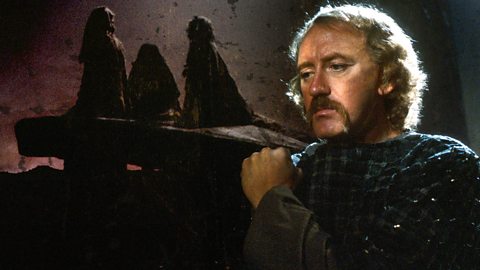
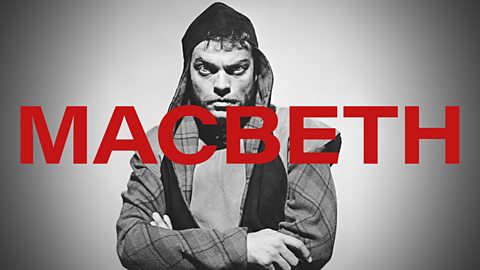
Orson Welles's Macbeth. video
Orson Welles's classic film version of Shakespeare's play.
Macbeth on Radio 4. audio
Listen to David Tennant playing the tyrannical Scottish King.
Further study
Macbeth - Characters part 1. podcast
Jean Menzies and Carl Anka discuss the characters of Macbeth and Lady Macbeth.

Macbeth - Characters part 2. podcast
Jean Menzies and Carl Anka take a look at some more of the characters in Shakespeare's Macbeth - Banquo, Macduff and The Witches.
Macbeth characters - a musical summary. video
This animated music video provides useful information (and important quotes) about the characters in Shakespeare’s play, Macbeth.
More on Macbeth
Find out more by working through a topic
- count4 of 5
- count5 of 5

- count1 of 5