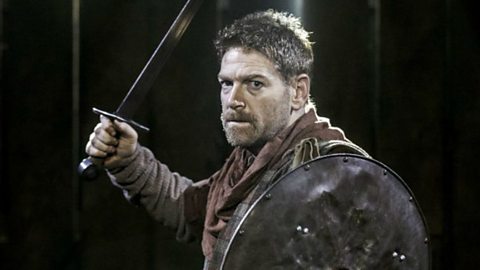
The form of William Shakespeare's Macbeth
Ancient Greek theatre developed and defined the idea of A type of drama in which characters undergo suffering or calamity and which usually ends with a death. A sad or catastrophic event causing suffering or death. – a story in which the The chief character in a novel, film or play. (main character) is noble and successful except for one In tragedy this refers to a defect in someone's character that leads them to a bad end. or character defect. That flaw or defect will cause their downfall through the course of the play, accompanied by much death and unhappiness. This character is usually referred to as the A heroic character who makes an error of judgement that leads to his downfall..
These The type of play Shakespeare is writing — such as tragedy, comedy or history — and the key features that come with that form, including being written for performance through dialogue, character interaction and theatrical techniques. can be seen at work in Macbeth. The protagonist is clearly Macbeth himself, a thane of the Scottish nobility. His fatal flaw is his ambition, and this drives the action forward. Macbeth is basically a good man who goes wrong. He is driven by a need for power, which eventually sets him on a path to his own destruction.
The structure of William Shakespeare's Macbeth
The play is divided into five In drama, an act is a section of the performance, usually made up of a number of scenes., although it is probable that Shakespeare himself didn’t organise it in this way for performance, and that editors imposed this structure on the play when first publishing it.
It is worth noting the following aspects of structure which may bear some relevance to the controlled assessment topic:
- The structure is cyclical (circular) in some ways – it begins and ends with battle; in the beginning Macbeth murders a traitor and in the end he is murdered as a traitor himself, having become what he used to hate and fight against.
- The play begins not with the named The chief character in a novel, film or play., but with the witches, suggesting they are important and have an element of control. Macbeth does not actually appear at all until scene three – before the audience sees him, they hear of his courageous exploits in battle, which sets him up as a brave and noble hero.
- It is worth considering how the timing of the witches’ appearance to Macbeth and Banquo is so close to Macbeth receiving the news of his promotion to Thane of Cawdor, yet occurs before this news arrives. They tell him something unlikely which is confirmed as real moments later – this affirms their power to him and makes him believe that if they know his past (Thane of Glamis) and immediate present (Thane of Cawdor), then perhaps they know his future also.
- The play covers the rise and fall of Macbeth, and yet the scene which could be considered the ‘high point’ of his rise – his crowning as king – occurs offstage. The audience learns about it by overhearing two lords and an old man discuss it. The murder of Duncan is unseen and only relayed to the audience by a shaken Macbeth; the death of Lady Macbeth, likewise, occurs offstage, heralded only by women crying out.
These are significant moments, yet all unseen – why?
Perhaps Shakespeare wants focus to stay on the motives and consequences of each event; perhaps how a play is presented in performance, including where actors stand, and move, how the set, lighting and props are arranged, and how these help tell the story on stage. such scenarios in the From the time of King James I (1603–1625). English periods traditionally use the Latin version of the monarch’s name. Jacobean literally means “of James". theatre was deemed difficult, anticlimactic, or unnecessary; maybe they retain more shock value if they remain unseen. In the case of the crowning, Shakespeare may mean us to understand it is a sham, and the ceremony deserves no direct attention – it means nothing because Macbeth murdered to get the crown.
Language and dramatic methods in William Shakespeare's Macbeth
You will need to comment on language and dramatic methods in the controlled assessment, and analyse how and why they are used. You will need to consider your topic carefully and analyse the most relevant scenes to that topic – below are some more general ideas to help you write meaningfully about the use of language and dramatic methods in the play.
Rhythm and rhyme
Shakespeare often uses different types of speech for different characters – this is known as the structure of the language. The lines of most significant Shakespearean characters are mainly composed in Unrhymed poetry which uses a certain number of beats per line. – unrhymed One ‘iamb’ is a two-beat combination: an unstressed syllable followed by a stressed (emphasised) syllable, making a ‘da-DUM’ pattern, like a heartbeat. Pentameter means five of these two-beat units per line, making ten syllables altogether.
You may be familiar with iambic pentameter from poetry as it is a commonly used poetic metre (arrangement of rhythmic beats). One ‘iamb’ is a two-beat combination: an unstressed syllable followed by a stressed (emphasised) syllable, making a ‘da-DUM’ pattern, like a heartbeat. Pentameter means five of these two-beat units per line, making 10 syllables altogether.
Macbeth’s first line in the play is an example of this:
| So foul | and fair | a day | I have| not seen|
| da-DUM | da-DUM | da-DUM | da-DUM | da-DUM |
Blank verse was used to show a character of importance and worth, but even significant characters’ speech can deviate from this rhythm at times of extreme emotion, or when a character is in dialogue with another character. The short, A way of speaking or writing that feels broken into short, sharp, quick parts, creating a choppy or urgent effect. exchanges of Macbeth and Lady Macbeth when they meet immediately after the murder are a good example of such deviations, showing both their back-and-forth communication and the tension of the situation.
The witches often speak in shorter, simpler rhythms and In poetry, a pair of lines that rhyme and have the same length and metric pattern., making them seem eerie and unnatural and giving their speech a chanting quality like a spell. Lady Macbeth’s sleepwalking A speech by a single person, speaking alone, often revealing their private thoughts or something about their past or personality.in Act 5, Scene 1 is in Ordinary language both spoken or written; different from poetry (which does not reflect everyday speech patterns).(unarranged or disorganised rhythms, akin to normal speech), like an unfiltered stream of consciousness that shows her control breaking down. Prose is also used for less important characters like the porter, allowing him to ramble comedically without the confinement of a set rhythmic structure.
Soliloquy
A A speech performed by a character, often depicting that person thinking or talking aloud to his or herself. is a speech given by a character which reveals their inner thoughts. It usually happens when the character is alone, or at least speaking in an ‘aside’ that is not overheard by other characters, meaning it is a way of the writer showing the truth of a situation from that character’s perspective. In a play like ‘Macbeth’, with its themes of deception and outward appearance not matching inner reality, soliloquies are hugely important in enabling the audience to see what is really going on. This often helps to create When the audience knows something that the characters don’t. in the play, allowing the audience to see things that other characters do not – Duncan’s pleasure at Macbeth’s hospitality, for example, which the audience knows will be the scene of his death. Significant soliloquies in Macbeth include:
- Macbeth’s deliberations in Act 1 over the witches’ prophecies and whether he should kill Duncan
- Lady Macbeth’s reaction to her husband’s letter in Act 1, Scene 6
- Macbeth’s dagger hallucination in Act 2
- Macbeth's obsession over the prophecy about Banquo in Act 3
- Macbeth's muted reaction to Lady Macbeth’s death in Act 5, Scene 5, when he speaks of life’s ultimate meaninglessness
Foil
Macduff forms a dramaticA character who contrasts with another character to highlight key points about them. for Macbeth – meaning he is a character who exposes aspects of Macbeth’s character by contrasting with him. Macduff serves his king well but does not seek glory or hold personal ambition like Macbeth does; he is loyal to Scotland while Macbeth is self-serving; he is a man with a family he feels are 'precious' to him, while Macbeth is childless and obsesses over his lack of an heir for reasons of power, not affection.
Macduff refuses to act deceptively, the way Macbeth does – he shuns Macbeth’s coronation rather than attend the crowning of one he suspects to be a murderer, and he avoids Macbeth’s invitations instead of showing up and pretending loyalty. Lady Macduff’s role as submissive wife and nurturing mother is also a foil for the ambitious Lady Macbeth; however, both end up being “left behind” in some way by their husbands, and both end up dead, to very different reactions by each husband.
Symbolism
The two main A literary device where an object, person, place, or event represents something beyond its literal meaning. used in the play are blood and sleep. Blood already symbolises violence and death, but it comes to also symbolise guilt – literal blood-stained hands from the murder of Duncan become symbolic ones. Even in her sleep, Lady Macbeth recognises that the A metaphor is a word or a phrase used for dramatic effect, to describe something as if it were something else. blood won’t ever wash off. Sleep symbolises innocence, peace and renewal – when Macbeth kills Duncan he thinks he hears a voice say he 'doth murder sleep' and that he will 'sleep no more'. In later scenes his paranoid plots, hallucinations and violent reactions are hallmarks of a lack of sleep; the literal effect of this is further heightened by the symbolic meaning of never knowing peace or rest again.
Repetition
Repetition is significant because it emphasises something – by analysing what is repeated you can comment on the effect the writer was trying to achieve. Repeated words or phrases may be close together, such as in Macbeth’s soliloquy in Act 5, Scene 5, when he hears of Lady Macbeth’s demise; 'Tomorrow and tomorrow and tomorrow' uses repetition to emphasise how monotonous and flat life feels to Macbeth now, showing he sees every day in the same way: a joyless space, repeating until death.
Tomorrow and tomorrow and tomorrow
Creeps in this petty pace from day to day
To the last syllable of recorded time,
And all our yesterdays have lighted fools
The way to dusty death. Out, out, brief candle!
Act 5, Scene 5
In contrast, repetitions may be further apart, even in different scenes, creating an echoing effect through which the writer makes a point about two characters or events being similar to each other in some way. One example of this is Macbeth’s opening line in the play, in which he echoes the 'foul' and 'fair' imagery used by the witches two scenes beforehand. This shows he is already open to their influence and sets up a connection between them and him.
More generally, there are specific words repeated many times across the play, often tying in with overarching themes. The main ones to look out for in your analysis are 'blood' (a major symbol in the play, but also having clear associations with violence), 'sleep' (another symbol used throughout), 'night' (associations with darkness and evil), 'time' (which can relate to both the predicted future and the ‘timing’ of actions), and 'nature' (a theme throughout the play, relating to the disruption of the rightful order of the world).
Fair is foul, and foul is fair;
Hover through the fog and filthy air.
Act 1, Scene 1
Imagery
Lady Macbeth famously advises her husband to 'Look like th’ innocent flower, / But be the serpent under’t', using the common imagery of a snake as deceitful and treacherous. There is a lot of animal imagery in Macbeth, because it is evocative and easy to understand:
- The witch advises Macbeth to be brave by saying 'Be lion-mettled'.
- Macbeth conveys his troubled psyche to Lady Macbeth by describing his mind as 'full of scorpions', suggesting his thoughts are stinging and poisonous.
- Macbeth also claims he would rather wrestle wild animals than deal with Banquo’s ghost.
Even more than animals, birds feature throughout the play as metaphorical representations of events, characters, and even moods:
- Lady Macbeth imagines a raven (a bird that is large, black, and often associated with death) which 'croaks the fatal entrance' of Duncan to her home.
- When the old man relates the unnatural events that indicate the disturbance caused by Duncan’s murder, one of them is that 'A falcon tow'ring in her pride of place / Was by a mousing owl hawked at and killed'. This is not only an unusual event, but symbolic of the story. A falcon was considered a royal bird, while Macbeth is sometimes associated with an owl in the play – a bird that hunts and kills under cover of night.
- Perhaps the most evocative bird imagery comes from the character of Lady Macduff, who is angered with Macduff for leaving the family unprotected and says 'the poor wren, / The most diminutive of birds, will fight, / Her young ones in her nest, against the owl'. This imagery not only predicts Macbeth’s attack on them (the owl again), but suggests the family’s weakness and innocence by comparing them to birds. Before Lady Macduff’s little son is killed, the murderer taunts him by calling him an 'egg', which relates to the metaphor of the birds in the nest and helps to suggest how young and fragile he is.
Test your knowledge of form, structure and language in Macbeth
Further study
Macbeth - Characters part 1. podcast
Jean Menzies and Carl Anka discuss the characters of Macbeth and Lady Macbeth.

Macbeth - Characters part 2. podcast
Jean Menzies and Carl Anka take a look at some more of the characters in Shakespeare's Macbeth - Banquo, Macduff and The Witches.
Macbeth characters - a musical summary. video
This animated music video provides useful information (and important quotes) about the characters in Shakespeare’s play, Macbeth.
Macbeth performed
The BBC Television Shakespeare - Macbeth. video
Watch the tragedy by William Shakespeare about how ambition can corrupt.
Macbeth on Radio 4. audio
Listen to David Tennant playing the tyrannical Scottish King.
Orson Welles's Macbeth. video
Orson Welles's classic film version of Shakespeare's play.
More on Macbeth
Find out more by working through a topic
- count4 of 5
- count5 of 5

- count1 of 5
- count2 of 5