 | 13 November 2014 |

| |
| BBC Homepage | | |
| |||
| Contact Us | | |
World War 1You are in: Hereford and Worcester > World War 1 > Contrasting memorials 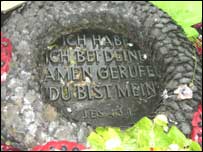 Bronze wreath Langemarck German Cemetery Contrasting memorialsby Megan Stanley Megan, from the Chase High School in Malvern, writes about the difference between the German and British war cemeteries. On our last day in Belgium we went to a German war cemetery. It was one of the only German cemeteries in Belgium and France, as most of the bodies that could be found would have been moved back to Germany at the end of the war. The Langemarck German cemetery started as a collection of just a few graves in 1915, but as more bodies were located they were sent to Langemarck for burial.  Megan Stanley I think that the German cemetery was one of the most moving ones that we visited, as the amount of bodies that were there was unbelievable. There was a huge mass grave, known as the Comrades' Grave (Kameraden Grab), in the middle of the cemetery, where roughly 25,000 men are buried. Two of the men buried in this mass grave were British soldiers whose bodies were found among the Germans. At the back of the cemetery there is a bronze sculpture of four soldiers, that watch over the cemetery and mourn for the soldiers that were killed. When we entered the cemetery, the sculpture stood out the most, so we all rushed to take pictures, but when we looked at our cameras the sculpture was just an outline against the sky. The mass grave was the other main part of the memorial, and had a bronze wreath in front of it, with the words 'Ich Habe Dich Bei Deinem Namen Gerufen Du Bist Mein', which translates into 'I have called you by name: you are mine'. [Editors note: This is a quote from the Old Testament. Isaiah Chapter 43, verse1.]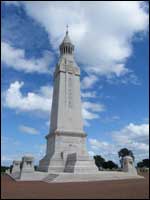 Memorial at Notre Dame de Lorette The cemetery also had lots of head stones, but unlike the British and French cemeteries and memorials, which were made from white stone, the German cemetery and memorial was all made from black stone. I think that the black stone was a nice idea, because it shows the darkness of what happened, but the white stone symbolizes strength and peace. One of the other memorials that we visited was the Vimy Ridge Memorial. This was the memorial that was made by the French and the Canadians to remember all of the people that died fighting on Vimy Ridge. The Vimy Ridge memorial has two main parts, the two pillars symbolize France and Canada. There are six statues at the top of these pillars that symbolize; Knowledge, Gallantry, Sympathy, Truth, Justice and Peace. There are also two statues at the back of the memorial, a man and a woman, representing the men and women that were in mourning for the men that were killed during the war. last updated: 16/10/2008 at 10:30 SEE ALSOYou are in: Hereford and Worcester > World War 1 > Contrasting memorials
|
| | About the BBC | Help | Terms of Use | Privacy & Cookies Policy |



 Watch the