 | 13 November 2014 |

| |
| BBC Homepage | | |
| |||
| Contact Us | | |
World War 1You are in: Hereford and Worcester > World War 1 > Making the connection 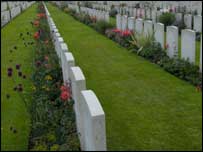 WW1 gravestones Making the connectionby Hannah Lillis Hannah, from the Chase High School in Malvern, writes movingly about how one grave gave her a new understanding of the Great War. We actually spent most of our time in France, because that's where the majority of the fighting took place. We visited a lot of cemeteries and memorials and some actual battle sites too.  Hannah Lillis I personally found it a bit hard, not to comprehend, but to first start connecting with what actually happened. I think it was because it all happened so far back, that sometimes it all just felt like a very vicious fairy-tale. All the names and graves, although voluminous, just didn't seem to have been real people. The way the whole trip was conducted, the silence, but also deeply mournful way every site we visited was conveyed, made me feel like I should have some kind of epiphany, and suddenly realise how many people have died and how sad, how truly horrific the whole event really was. I felt a bit disrespectful just going and gazing at places like Menin gate, which has 54,896 names of soldiers whose bodies were never found, and not feeling sad or bitten by the loss. It made me feel like some kind of clueless tourist, just coming and looking for fun - something which I really didn't want to be. A few years back, when I was about 10, my mum got really interested in researching her family tree. On Saturdays, we used to go down to the family history centre in Worcester, and spend the morning looking at all the microfiches, finding out all the birth certificates and drawing them out with black lines and little boxes for what became a very vast, and still continuing project. One name that kept coming up, and which my mum researched extensively, was Westbury - a family on my Grandmother's side, who originally came from Tamworth, a town which we visited once to search for more information. Before we went, we were told that if we had relative who were buried near to where we were visiting, providing that they weren't buried too far away, it might be possible that we could go and visit them and pay our respects. 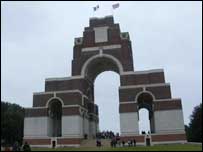 Thiepval memorial My mum found out that we had a relative who was buried near to where we were, and, with a few exchanges with our group leaders, I found out that it was in fact possible to visit. It was the last day by the time we had the chance to visit, and I was given a little cross with a poppy to place by the grave. One the leaders, Mrs Renger, suggested that I could write a sentence or two on the cross to add a little personal touch and as the cross would stay there a lot longer than we could. The cemetery was off a long stretch of road, through some trees and down a little track. When we got there, the cemetery was being renovated so the grass was a perfect green. The graves were a perfect, noble white against the grass, and the whole area, which some 2,000 graves, was silent. Using the reference number from the commonwealth war graves website, we scanned the area until we found it. It looked like any other of the thousands of graves I'd seen over the past five days, only this one was strangely different. It had a name, George Allen Westbury, which I recognised. I thought back to all the time I'd spent with my mum, the microfiches, my grandparents, myself, and suddenly I did feel a connection, I suppose it's a bit selfish really, but it's like a bit of me, a bit of my heritage that died out there, 90 years ago. He was 19 when he died, a year older than my sister. A year older. Oh my god. I can't imagine my sister dying. However much I hate her sometimes, I'd probably cry my eyes out for years and years. And that would happen not only to me, but to my friend's family, and their friends. And it would keep happening, in countries and countries and years and years, before it finally ended, only to start again, more horrible than before. I didn't know this man in front of me, but I thought I was going to cry. Fine, I'll never fully get how many people died in the whole war, how horrific it was and how many lives it cost. But I kind of get it, and that 'kind of' is enough for me, I know there's more, and that's the horrible part. But what matters is I know, I understand, I comprehend. 11th November 1917. George Allen Westbury. We will never forget. last updated: 12/06/2009 at 14:43 SEE ALSOYou are in: Hereford and Worcester > World War 1 > Making the connection
|
| | About the BBC | Help | Terms of Use | Privacy & Cookies Policy |



 Watch the