 | 13 November 2014 |

| |
| BBC Homepage | | |
| |||
| Contact Us | | |
World War 1You are in: Hereford and Worcester > World War 1 > Reasons for fighting 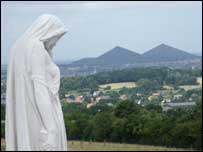 The figure represents Canada in mourning Reasons for fightingby Jenna Roberts Jenna, from the Chase High School in Malvern, believes the soldiers from each side fought for the same reason. Before I went to Belgium, World War I really was just World War I - a topic in my history text book - a title I wrote and underlined many times in my exercise book in my History lessons.  Jenna Roberts I knew the facts and the figures. I knew the game plan. I knew exactly what happened, who'd made it happen, why it had happened. It was all black and white and was fixed in my brain in little clots, to get as many points as possible in my History exam. When I went to Belgium, World War I came to life. The 20,000 men I knew died on the first day of the Somme were now laid out in front of me. It was literally incomprehensible to stand at the entrance of a cemetery and take in the sheer number of gravestones before you. We visited roughly nine cemeteries that week, each one as poignant as the first and yet you knew it wouldn't be the last. 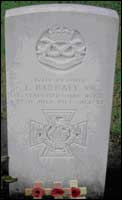 Headstone from a British grave You could tell if it was a British World War I cemetery, if you pulled up in your coach to lines and lines of white gravestones. Proud, white gravestones, standing to attention in their rows and rows, names and symbols and dates carved onto their bodies. There was a sense of triumph and nobility about the British cemeteries and peacefulness – an odd peacefulness. I think it is odd that these cemeteries are now places of serenity, when they were once places of such conflict and aggression. The thing that became more touching throughout the week wasn't the number of gravestones, because after all gravestones are just gravestones, it was the fact that there was a man under each gravestone, and there were so many gravestones, and so many men. Literally hundreds, thousands, millions of men died in WWI, and the thing that struck me the most was the fact that each of these men had a story. 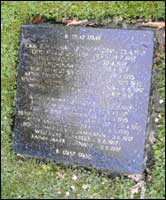 German gravestone Each one had a mum and a dad and a best friend and a girlfriend, or possibly a wife, or even children. Each one had a life, and had lived a life, and had had birthdays, and Christmases, and had been to school, and played in the street with their mates when they were little, and eaten tea with their families on Sundays. And then there were the men who had a life, but hadn't had a chance to live it. The ones that weren't really men, that were boys. There were some as young as fourteen, fifteen. On the last day we visited a German cemetery in Langemarck, the only one in the salient. It was very different to the British cemeteries - there was nothing triumphant or glorious about them. The graves were black, they weren't white and noble, and they lay flat on the ground. It upset me that their graves were presented like that - I'm not sure if it was the way the Germans wanted them to be displayed, but I think their graves should've been upright and white too. The German soldiers weren't the enemy, it was the German generals - the Germans making all the big decisions. They were fighting for their country, for their peace and for their freedom, and the British soldiers were fighting for that exact same thing. last updated: 16/10/2008 at 09:54 SEE ALSOYou are in: Hereford and Worcester > World War 1 > Reasons for fighting
|
| | About the BBC | Help | Terms of Use | Privacy & Cookies Policy |



 Watch the