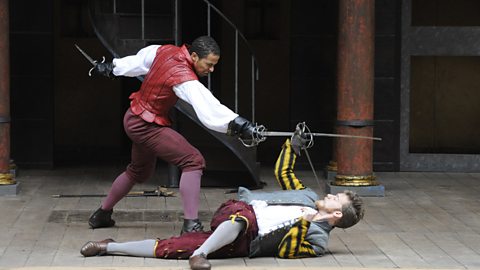
Use of form in Romeo and Juliet
Ancient Greek theatre developed and defined the idea of A type of drama in which characters undergo suffering or calamity and which usually ends with a death. A sad or catastrophic event causing suffering or death., a story in which the The chief character in a novel, film or play. (main character) is noble and successful except for one In tragedy this refers to a defect in someone's character that leads them to a bad end. or character defect which will cause their downfall throughout the course of the play, accompanied by much death and unhappiness. This character is usually referred to as the tragic hero.
Romeo and Juliet is certainly a tragedy, but it doesn’t fit this traditional definition as neatly as many of Shakespeare’s other plays. The play is named after the two main characters rather than one tragic hero, and they both undertake actions that create and inform the tragedy of the play’s story. There is a recurring theme of fate and luck in Romeo and Juliet which often seems to suggest that the tragedy is created not by the personalities of the main characters but by predestination – the fate that is ‘written in the stars’ for them.
On the other hand, Romeo himself does fit the definition of a tragic hero in some ways. His fatal flaw is his tendency to make rash and impulsive decisions without pausing or thinking of the consequences, and this drives the action forward. Romeo is basically a good character who acts recklessly in situations that endanger him and his loved ones. He has a passionate nature and tends to feel things intensely; once his sights are set on Juliet, he is obsessively driven to be with her at any cost. Whether one considers him a tragic hero or not, it is impossible to deny the play exists firmly in the tragedygenre.
Use of structure in Romeo and Juliet
The play is divided into five In drama, an act is a section of the performance, usually made up of a number of scenes., although it is probable that Shakespeare himself didn’t organise it in this way for performance, and that editors imposed this The way the poet has organised the poem on the page eg number of stanzas, lines per stanza, breaks in between lines and stanzas. on the play when first publishing it.
It is worth noting the following aspects of structure which may bear some relevance to your controlled assessment topic:
- The play begins with another tradition from classical Greek theatre – a chorus. The chorus acts as a kind of commentator outside the main action of the play, setting things up for the audience. Here, they deliver a prologue – a kind of introduction which outlines the main themes of the play and sets the scene, describing the “ancient grudge” between Montague and Capulet. The prologue takes the Some poems adopt specific 'forms'. For example, they could be sonnets or narrative poems. Many don’t have an identifiable form. of a A fourteen-line poem, usually with ten syllables in each line., a traditional love poem of fourteen lines in length.
- The first two acts of the play are in many ways more akin to a Shakespearean comedy than a tragedy. Comedies of the time often revolved around love and marriage, involving plots wherein circumstances like prejudiced families or mistaken identities would create a barrier separating lovers who wanted to be together. The comic scenes with Juliet’s Nurse and the banter between Mercutio and Romeo all immediately precede the fatal turning point of Act 3, Scene 1, in which Mercutio and Tybalt both die. These earlier comic scenes may be intended to provide some humour to keep the audience amused before the seriousness sets in; it may also be to offset the forewarning of tragedy given by the chorus at the start, and so heighten the contrast between humour and sadness for effect. Like its lack of a typical tragic hero, this is another way in which the play is not a typical tragedy.
- The events of the play take place in under a week; Shakespeare compresses time to heighten the drama. The pace of the action mirrors the headlong rush of the teenage lovers’ relationship and helps to intensify the emotions felt by the audience as they witness love and death happen in such quick succession. It also contributes to the sense of fate and predestination that pervades throughout the play; the action hurtles along as though it is unstoppable, giving the impression that forces beyond the human society in which Romeo and Juliet live may be working towards the dramatic ending that ends both their lives and the feud between their families.
Language and dramatic methods in Shakespeare's Romeo and Juliet
You will need to comment on language and dramatic methods in your controlled assessment, and analyse how and why they are used. You will need to consider your topic carefully and analyse the most relevant scenes to that topic – below are some more general ideas to help you write meaningfully about the use of language in the play.
Rhythm and rhyme
Language structure simply means the different types of speech used for different characters.
The lines of most significant Shakespearean characters are mainly composed in Lines in a poem that don't rhyme, usually in iambic pentameter - five two-syllable feet per line. – unrhymed One ‘iamb’ is a two-beat combination: an unstressed syllable followed by a stressed (emphasised) syllable, making a ‘da-DUM’ pattern, like a heartbeat. Pentameter means five of these two-beat units per line, making ten syllables altogether. You may be familiar with iambic pentameter from poetry as it is a commonly used The rhythm of a line of poetry based on how many syllables it has and where they are stressed or emphasised – likes beats in music. (arrangement of rhythmic beats). One ‘iamb’ is a two-beat combination: an unstressed syllable followed by a stressed (emphasised) syllable, making a ‘da-DUM’ pattern, like a heartbeat. Pentameter means five of these two-beat units per line, making ten syllables altogether. Romeo’s attempts to placate Tybalt in Act 3, Scene 1 are an example of this:
| I do | pro- test | I nev- | -er inj- | -ured thee |
| da-DUM | da-DUM | da-DUM | da-DUM | da-DUM |

| but love | thee bet- | -ter than | thou canst | de- vise |
| da-DUM | da-DUM | da-DUM | da-DUM | da-DUM |
Blank verse was used to show a character of importance and worth, but even significant characters’ speech can deviate from this rhythm at times of extreme emotion or when a character is in dialogue with another character. The short, brash exchanges of Mercutio and Tybalt in the moments before they begin fighting are a good example of such deviations, showing both their provocative back-and-forth communication and the tension of the situation.
Romeo and Juliet themselves first speak in a rhyming pattern of iambic pentameter that corresponds to the rhyme scheme of a sonnet – meaning that their first conversation together literally forms a classical love poem. This instant synchronicity suggests a striking, almost magical connection between them that is elevated beyond the non-rhyming speech they use when speaking to anyone else.
Prose (unarranged or disorganised rhythms, akin to normal speech) is usually used in Shakespeare plays for less noble or important characters; in Romeo and Juliet this includes many of the speeches by Juliet’s Nurse, who can ramble comedically without the confinement of a set rhythmic structure, or the minor representatives of Montague and Capulet (Abram, Sampson, Gregory and so on) who engage in the street brawl in Act 1, Scene 1. However, prose is also used for the baser exchanges between Mercutio and Romeo, when they make bawdy jokes with each other in Act 2, Scene 4, to show their youth and friendly silliness through earthy teasing. Prose is further seen when used for many of Mercutio’s brash and provocative statements towards Benvolio and then Tybalt in Act 3, Scene 1 – the prose statements there show he is being careless with his communication and, by extension, his regard for safety and civility.
Soliloquy
A A speech performed by a character, often depicting that person thinking or talking aloud to his or herself. is a speech given by character which reveals their inner thoughts. It is usually done when the character is alone, or at least speaking in an ‘aside’ that is not overheard by other characters, meaning it is a way of the writer showing the truth of a situation from that character’s perspective. In a play like Romeo and Juliet, which requires the main characters to speak from the heart and show private emotion they must often conceal in public, soliloquys are hugely important in enabling the audience to see what is going on. Significant soliloquys in Romeo and Juliet include:
- Romeo’s first sighting of Juliet in Act 1, Scene 5, where he is astonished by her beauty
- the musings of both Romeo, when he sees Juliet again, and Juliet (when she thinks she is alone) during the “balcony scene” in Act 2, Scene 2
- Juliet’s frustrated impatience as she awaits the return of the Nurse with news from Romeo at the start of Act 2, Scene 5
- another wait for Juliet as she longs for Romeo to come to her on their wedding night before news of Tybalt’s death has reached her
- Act 4, Scene 3, when Juliet ponders the vial and its implications before drinking from it
- Romeo’s final speech to Juliet in the tomb before he drinks the poison in Act 5, Scene 3
Hyperbole
Romeo uses Check your connection, refresh the page and try again. and exaggeration to express his intense feelings, first towards Rosaline, his unrequited love, and then towards Juliet when he sees her and forgets Rosaline. His use of sonnet language – such as the religious imagery of Juliet as a “saint”, or his assertion that her beauty is “for earth too dear” – is typical of love poetry of the time, in which a male admirer would fawn over a female love and exaggerate her qualities. The fact Juliet ultimately reflects this Over-the-top exaggeration for effect.language back to him:
- shows synchronicity and harmony between them
- creates a private language between the two, which builds a closed world in which they can be together, free of their families and society
- helps to convince the audience that their love is mutual and real, despite how hastily they meet and marry
- helps to give Juliet a sense of agency and personality that makes her seem equal to Romeo – she becomes an active participant in the relationship rather than a passive recipient of Romeo’s exaggerated affection
Repetition
Repetition is significant because it emphasises something – by analysing what is repeated you can comment on the effect the writer was trying to achieve. Repeated words or phrases may be close together, such as in Juliet’s soliloquy in Act 2, Scene 2, where she muses obsessively over Romeo’s name, showing how deeply she has been thinking about him. In Act 5, Scene 5, when she is about to take the potion, Juliet again repeats “Romeo, Romeo, Romeo!” as a kind of incantation to banish her fears and give her the courage to drink the contents of the vial.
More generally, there are specific words repeated many times across the play, often tying in with overarching themes. The main ones to look out for in your analysis are references to light and dark, especially heavenly bodies like the sun and moon (both used symbolically in the play) and stars (another major symbol linked to both darkness/night and fate).
Imagery (of light and dark)
In a simple moral world one can easily associate light with hope and goodness, and dark with fear and trouble; however, in Romeo and Juliet these simple associations become more complicated. Romeo frequently aligns Juliet with sources of light – the sun, a shining jewel, stars – but daylight itself does not favour their relationship. The fact that society will not allow them to be together means they have to hide their love and they can only successfully be together by night. The two major fights that set up the tragedy of the play – the first which causes the Prince’s decree about fighting being punishable by death, and the second which takes the lives of both Mercutio and Tybalt – both occur in public streets in broad daylight, broadly associating violence and hatred with light. In contrast, Romeo and Juliet meet by night, which affords them concealment and privacy and therefore becomes associated with their love, showing an inversion of the simplistic a common (or sometimes overused) theme or device in literature of light being good and dark being bad.
- Romeo exclaims that Juliet “doth teach the torches to burn bright” when he first sees her, as a way of expressing the radiance he sees in her beauty; he also refers to her as a “bright angel” when hearing her speak alone at her window
- when anticipating their wedding night together, Juliet wishes for Phoebus, the god of the sun, to go swiftly home and “bring in cloudy night immediately”
- both lovers dread the dawning of the morning sun in Act 3, Scene 5 as it means the end of their night together and their imminent separation – as Romeo puts it, “More light and light, more dark and dark our woes”
Within the scope of these light and dark references are many examples of specific celestial imagery:
- Romeo famously compares Juliet to the sun when he sees her for the second time, aligning her to the source of life and the brightest star in the heavens and alluding to the fact that he finds her beauty both dazzling and blinding, stopping him from seeing anyone or anything else
- he likens her eyes to “two of the fairest stars in all the heaven”
- Juliet urges him to “swear not by the moon”, noting that the moon constantly changes its shape and appearance at different times; she wants his oath of love to be steadfast and true, not “inconstant” and shifting
- in her soliloquy before their wedding night, she alludes to how she wants Romeo to be “cut…out in little stars” to illuminate the night and make the world love its beauty
There are other references to the “stars” in the play; many of these relate to the theme of fate and predestination. Romeo and Juliet are referred to as “star-cross’d lovers”, indicating their relationship is destined to fail; on hearing of Juliet’s death, Romeo exclaims “I defy you, stars!”, railing against the forces of fate in his anger and grief.
From forth the fatal loins of these two foes,
A pair of star-cross'd lovers take their life;
Whose misadventured piteous overthrows
Do with their death bury their parents' strife.
Prologue
Test your knowledge of Shakespeare's Romeo and Juliet
Romeo and Juliet performed
Romeo and Juliet. video
A host of CBeebies stars and actors join Rebecca in a magical library to stage a performance of William Shakespeare’s most famous play, Romeo and Juliet.
Drama on 3. audio
Shakespeare's tragic love story. With Trystan Gravelle and Vanessa Kirby as the lovers and David Tennant as the Prince.

English Literature / Drama GCSE: Shakespeare Unlocked - Romeo and Juliet. collection
Three key scenes from Romeo and Juliet are explored by actors and directors at the Royal Shakespeare Company.
Further study
The study of Shakespeare, controlled assessment guidance. activity
Unit 3 of the CCEA GCSE English Literature qualification is a controlled assessment unit based on the study of a play by William Shakespeare.
Romeo and Juliet flashcards
Try these interactive flashcards based on quotes from Romeo and Juliet as part of your GCSE English Literature revision.

GCSE English Literature podcasts - Romeo and Juliet. podcast
Revise Shakespeare's Romeo and Juliet, learn the quotes and get the grade.

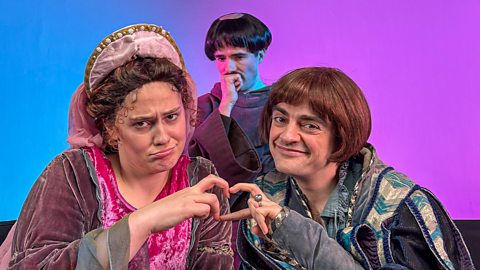
Bitesize GCSE: Literally. video
Social media parody featuring the famed Shakespearean couple, Romeo and Juliet.
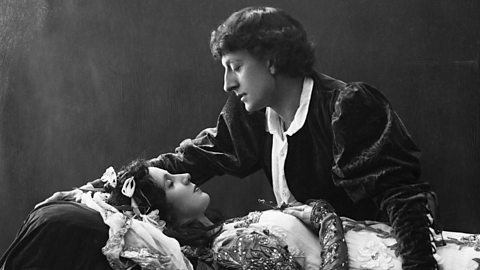
In Our Time. audio
Melvyn Bragg and guests discuss the poetry and power of Shakespeare's tragedy of two young lovers in Verona, their families divided by a bitter feud.
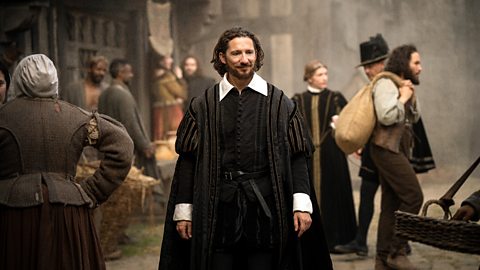
Shakespeare: Rise of a Genius. video
Love, conflict, family - nobody's done it better. Acting legends reflect on Shakespeare and the world that ignited his creativity.
More on Romeo and Juliet
Find out more by working through a topic
- count4 of 5
- count5 of 5
- count1 of 5
- count2 of 5