Summary of Romeo and Juliet
- Type of play: A type of drama in which characters undergo suffering or calamity and which usually ends with a death. A sad or catastrophic event causing suffering or death.
- Date written: Around 1595, published in 1597 (A period in European history from 1300-1600 which saw new scientific discoveries and the creation of great art. literary period)
- Setting: Verona, Italy, most likely around the 14th century
- Themes: Love, marriage and relationships, family, duty and loyalty, prejudice, violence, masculinity, youth, revenge, fate and luck, impulsivity, law and morality, duality and opposition
- Useful vocabulary: A speech used as an introduction at the start of a play., feud, A group that breaks apart from the wider group due to differing beliefs., passionate, compel, A society in which men hold the power and control., An intense but short-lived, and usually extravagant, passion or admiration for someone or something., Someone like a modern-day chemist, apothecaries knew both the healing and poisonous properties of plants., reconciliation, The belief that God has decided everything that will happen in the world and in people’s lives, A statement which contains words or phrases that contradict each other, and which raises a question about how both could be true.
The plot of Romeo and Juliet
Act I
Where a violent family feud erupts in Verona, Romeo and Juliet meet at a Capulet party and fall instantly in love, only to discover they are sworn enemies.
| Scene | Main events | Main themes and notes |
|---|---|---|
| Prologue | • A Performers who would provide extra information and comment on what was happening on stage without taking part in the action. They might narrate collectively, often to represent a community's voice or moral perspective. delivers an overview of the entire play, detailing the fight between the families, the love between the "star‑cross’d" (ill‑fated) Romeo and Juliet, their deaths and the reconciliation between Montagues and Capulets as a result. | The chorus can be a single performer or a group acting together to narrate or explain the action of the play from an external viewpoint. They are not characters within the play, but more like outside commentators – they cannot warn Romeo and Juliet about the tragic events that will unfold, despite already knowing about them. It helps to forewarn and prepare the audience for what is to come. Here, the prologue takes the form of a A fourteen-line poem, usually with ten syllables in each line. (a 14‑line poem usually about love), giving it significance and suggesting the play’s association with love. |
| 1 | • Representatives of the Montague and Capulet families begin a public brawl that causes the ruling Prince to declare that any further fighting by either side will be punishable by death. • Benvolio, a Montague kinsman who attempted to keep the peace, talks with his cousin Romeo, who has been avoiding others due to his heartbreak at being in love with Rosaline, a girl who does not care for him. | Romeo’s use of A phrase combining two or more contradictory terms - eg. 'deafening silence'. shows the confusion love causes, while his passion and melancholy at his unrequited love show he is inclined to feel things deeply, as a teenager often does. Themes: Love, family, duty and loyalty, prejudice, violence, masculinity, youth, impulsivity, law and morality, duality and opposition. |
| 2 | • Capulet, Juliet’s father, speaks with Paris, a nobleman who wishes to marry Juliet. Capulet urges Paris to wait until she is older and win her heart in the meantime, then invites him to a party at their house that evening. • Benvolio and Romeo find out from an unwitting servant that Rosaline, Romeo’s unrequited love, will be at the Capulets’ party, and resolve to go. | As seen in the exchange between Capulet and Paris, the role of love in a marriage was not always paramount. Capulet seems a little protective of Juliet here, at least in holding her back from marrying so young, but it’s clear that family duty and ties to other noble families are more important factors in marriage at the time. Themes: Love, marriage and relationships, family, duty and loyalty, youth, fate and luck, impulsivity. |
| 3 | • Juliet’s mother comes to tell her about Paris’s interest and asks what she thinks of marriage. • Juliet replies she has not thought of marriage at all but she will consider Paris if her parents want her to. | The close relationship of Juliet and her nurse is shown here, helping us understand why she feels she can confide in her more than in her own mother. Themes: Love, marriage and relationships, family, duty and loyalty. |
| 4 | • Romeo, his friends Benvolio and Mercutio and a few other partygoers head through the streets to the Capulets’ party. • As they walk, the others cajole Romeo, who lacks party spirit because of a bad dream he had; Mercutio gently mocks both Romeo and the whole idea of love itself. | Mercutio is a witty foil for a melancholy Romeo; he is established here as an outgoing and funny but slightly hot‑headed character. Romeo’s bad dream foreshadows the ill‑fated outcome of his romance with Juliet. Themes: Love, masculinity, youth, revenge, fate and luck. |
| 5 | • At the Capulets’ party, Romeo and his friends are welcomed unrecognised. He sees Juliet dancing and is struck by her beauty, renouncing his former love for Rosaline. • Romeo asks a servant about Juliet; in doing so he is overheard and recognised by Tybalt, Juliet’s cousin, who is enraged at a Montague daring to come to their house and swears vengeance on him. • Romeo approaches Juliet and asks to kiss her. They seem mutually charmed by one another; each of them only finds out the shocking truth of who the other really is after they have parted company. | Romeo uses simile and metaphor to compare Juliet to a jewel and a dove, and associates her with light among darkness, a common motif across the play. The "pilgrim" speech shared by Romeo and Juliet when they first meet forms a A fourteen-line poem, usually with ten syllables in each line. – a 14‑line love poem – that ends at the point of their first kiss. The religious imagery used by Romeo first is immediately echoed and built on by Juliet, showing them to be in harmony with each other at once. Themes: Love, family, duty and loyalty, prejudice, violence, masculinity, youth, fate and luck, impulsivity, duality and opposition. |
Act II
Love deepens as Romeo and Juliet secretly confess their feelings and rush into a hidden marriage.
| Scene | Main events | Main themes and notes |
|---|---|---|
| Prologue | • The Performers who would provide extra information and comment on what was happening on stage without taking part in the action. They might narrate collectively, often to represent a community's voice or moral perspective. clarifies the intense feelings of Romeo and Juliet, and the difficulty of their situation, before explaining that despite the challenges they face, they are about to meet again. | The chorus speaks again in the form of a A fourteen-line poem, usually with ten syllables in each line. (as in the prologue). It is their last appearance, and it is used to mark a kind of turning point in the story for the audience, underscoring the fact that the characters’ feelings are strong enough to overcome the obstacles in their way. There is some speculation that this short interlude was only included in order to give the actor playing Romeo time to prepare for the next scene. |
| 1 | • Leaving the party, Romeo wants to turn back. He makes the fateful decision to withdraws and disappears. • Benvolio and Mercutio call but cannot find him. Benvolio says he saw him go over the Capulets’ orchard wall; Mercutio says they should go on without him. | Mercutio speaks of Rosaline as Romeo’s "mistress", seemingly unaware he has already forgotten her in favour of Juliet. His bawdy allusions in this section contrast with Romeo’s apparent earnestness; this may be an attempt to show the difference in their attitudes to love and highlight Romeo’s feelings as real. Themes: Love, duty and loyalty, masculinity, youth, fate and luck, Acting without thinking something through.. |
| 2 | • Romeo sneaks back to the Capulets’ garden and overhears Juliet lamenting that she is in love with him, a Montague. • He appears and confesses his feelings for her. While both are aware that the enmity between their families is a huge obstacle to them being together, they express their love for one another and promise to marry. | Romeo personifies Love as an agent helping him, and illustrates his feelings with metaphors, including references to Juliet as the "sun", a "bright angel" and other sources of light. This forms part of the recurring light/dark imagery throughout. Juliet uses repetition of "name", musing over Romeo’s identity obsessively, which shows both her strong feelings for him and her despair at their families’ animosity. She also notes their relationship is "rash" and "sudden", Hint at something that will happen later and have greater significance. how they will be helplessly swept along by both circumstances and poor decisions. Themes: Love, marriage and relationships, family, duty and loyalty, youth, fate and luck, impulsivity, Where a character, setting or theme shows two contrasting or opposing qualities; such as good and evil, existing at the same time within a single entity. and opposition. |
| 3 | • Romeo goes straight to Friar Lawrence, a trusted priest in Verona, to speak with him about marrying Juliet. • Friar Lawrence is initially doubtful, noting Romeo’s past intense feelings for Rosaline and chiding him for seemingly replacing one shallow obsession with another. However, he agrees to marry them later that day, spurred on by his belief that the marriage might bring an end to the destructive feud between Montagues and Capulets and foster peace in Verona. | Friar Lawrence muses on the properties of plants and how nothing in nature can be all good or all bad; this highlights both his overall wisdom and his slightly dubious reasoning in helping the young couple marry covertly against their families’ wishes. Themes: Love, marriage and relationships, family, duty and loyalty, violence, youth, fate and luck, impulsivity, law and Morality is the belief that some behaviour is right and acceptable and that other behaviour is wrong, duality and opposition. |
| 4 | • Mercutio and Benvolio discuss Romeo’s failure to come home last night, and note that Tybalt Capulet has sent a letter to Romeo’s home. Mercutio bets it is a challenge to fight, and relates Tybalt’s fearsome skill with a sword. • Romeo joins his friends and engages in some bawdy banter with Mercutio before Juliet’s nurse arrives to speak with him. She implores him not to break Juliet’s heart; he replies by telling her to let Juliet know they can be married that afternoon if she comes to meet him. | Despite the mention of Tybalt foreshadowing violence, there is comedy in this scene, both in the dramatic and sometimes silly persona of the nurse, and in the jesting between Mercutio and Romeo. Mercutio states "now art thou Romeo", suggesting Romeo’s recent lovestruck moping has made him unlike his real self – another suggestion that love has great power to alter reality. Themes: Love, marriage and relationships, prejudice, violence, masculinity, youth, impulsivity, law and morality, duality and opposition. |
| 5 | • Juliet waits anxiously at home to hear whether Romeo has kept his promise. When the nurse returns, she teasingly keeps Juliet waiting for the message by complaining and going off on tangents. • Juliet’s coaxing eventually yields the news she has hoped for: that she can meet Romeo that afternoon under the pretence of going to confession and they will then marry. | The nurse creates further comedy in this scene, teasing Juliet by making her wait tediously for the news she so desires. These comic moments and the brief happiness of the marriage that follows only serve to contrast with and heighten the tragedy that will soon occur. Themes: Love, marriage and relationships, family, duty and loyalty, youth. |
| 6 | • Friar Lawrence and Romeo await Juliet. The Friar listens as Romeo speaks of his passion for her, and warns him against love that is too extreme. • Juliet arrives and the two affirm their love for one another, then exit to be married. | Romeo personifies death, just as he did love, and fatefully says it may do as it likes so long as he can be with Juliet – another example of foreshadowing. Themes: Love, marriage and relationships, family, duty and loyalty, youth, fate and luck, impulsivity, duality and opposition. |
Act III
Where violence takes over the story: Mercutio and Tybalt are killed, Romeo is banished, and the tragedy truly begins.
| Scene | Main events | Main themes and notes |
|---|---|---|
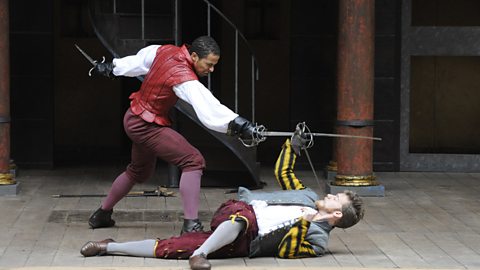
| 1 | • Mercutio and Benvolio are approached by Tybalt, who is looking for Romeo. Mercutio is in a hot-headed mood, and tries to provoke a fight. • Romeo arrives and, aware he is now related to Tybalt, submits peaceably to Tybalt’s insults, refusing to engage in a duel. Mercutio is incensed and fights Tybalt instead. Romeo tries to part them and Tybalt stabs Mercutio, who dies. • Enraged and heartbroken by the death of his friend, Romeo fights Tybalt and kills him. Benvolio urges him to run away, aware he will be executed for what he has done. • Montagues and Capulets converge on the scene, demanding justice. The Prince agrees Romeo will not be executed for what he did, but instead will be banished from the city forever. | The turning point of the tragedy, in which the passion of violence overturns the passion of love and ends in two deaths. It is especially poignant that Romeo’s direct intervention for peace is what gives Tybalt the means to kill. Mercutio curses both “houses” before he dies; this could be him lashing out impulsively at those who have caused his death, or an expression of fate and its influence in the play. Ultimately, it shows that even his loyal ties to the Montagues don’t stop Mercutio from understanding that the pointless feud has cost him his life, and that the senseless violence will punish both sides. Themes: Love, marriage and relationships, family, duty and loyalty, prejudice, violence, masculinity, youth, revenge, fate and luck, impulsivity, law and morality, duality and opposition. |
| 2 | • Juliet waits for Romeo, longing to be with him on their wedding night. Her nurse enters, grief-stricken, and reveals that Tybalt is dead at Romeo’s hand. • Juliet feels distraught at her cousin’s death and rages at Romeo for killing him, but then regrets her disloyalty to her husband and notes that her deepest grief at this catastrophe is felt for Romeo’s banishment. • The nurse promises to bring Romeo to Juliet for a final goodbye before he must leave the city. | Juliet’s anguished oxymorons upon learning of the fight that afternoon illustrate the intense conflict and anguish she feels. Her grief for Tybalt’s death, her anger and sense of betrayal at Romeo’s responsibility for it and her ultimate sense of loss at his imminent banishment are overwhelming. Themes: Love, marriage and relationships, family, duty and loyalty, prejudice, violence, masculinity, youth, revenge, fate and luck, impulsivity, law and morality, duality and opposition. |
| 3 | • Hiding with Friar Lawrence, Romeo learns he is banished rather than sentenced to death. He considers this a torture as he will be parted from Juliet when everyone else can still be with her. • Friar Lawrence attempts to reason with him that all is not lost, but Romeo refuses to be comforted. • The nurse arrives and shares that Juliet is equally distraught but still wants to see her husband. Friar Lawrence tells him to go and comfort her, but to ensure he leaves the city early next morning to avoid any trouble. | Friar Lawrence’s counsel again seems wise, but Romeo will not listen as he is consumed by grief, guilt and the imminent loss of his love. His worry at Juliet’s reaction to his murder of her cousin is relieved a little when he hears she still wishes to see him; alongside this, the Friar’s assurances that in time the Prince may relent and let him return keep Romeo from the suicide he had just threatened to carry out. Themes: Love, marriage and relationships, family, duty and loyalty, violence, masculinity, youth, fate and luck, impulsivity, law and morality, duality and opposition. |
| 4 | • Paris calls late at the Capulet home to inquire after Juliet. Her parents note she is grieving upstairs and won’t come to see him. • Capulet states that Juliet will do whatever he tells her to, and sets forth his intention that Juliet should marry Paris in three days. Paris willingly accepts the offer and Capulet instructs his wife to inform Juliet about her impending marriage before going to bed. | Ironically, it is shown that Capulet only brings Juliet’s wedding date forward so drastically because her mourning is so profound and he feels that the wedding will cheer her up. He mistakes her deep grief over Romeo for upset at the loss of her cousin, and unknowingly seeks to repair sadness caused by separation from her husband by quickly providing her with a new husband. Themes: Love, marriage and relationships, family, duty and loyalty, fate and luck, impulsivity, law and morality, duality and opposition. |
| 5 | • Having spent their wedding night together, the newlyweds must part company at the break of dawn to ensure Romeo’s safe passage out of the city. They are reluctant to be apart but Juliet’s nurse informs them her mother is on her way to visit her in her room; they make haste to avoid detection and Romeo takes his leave. • Juliet’s mother informs her that her father has arranged for the marriage to Paris to take part in three days. Overwhelmed with emotion, Juliet refuses; her father is enraged at her defiance and threatens her, while her mother rejects her pleas for help. • After the dramatic confrontation with her parents, Juliet turns to her nurse for comfort and advice. The nurse advises her to abandon her relationship with Romeo and agree to marry Paris. • Juliet feels betrayed and angry, but conceals her feelings and says she will go to confession that afternoon with Friar Lawrence. | While Romeo has associated Juliet with brightness and light since the moment her saw her, the pair now dread the coming of the day – not just as an end to their only night together, but as a harbinger of their indefinite separation as Romeo leaves. This is a continuation of the light/dark imagery seen in the play. Capulet’s anger at Juliet’s refusal to do what he says indicates the typical status of a patriarch at this time – he expected to have absolute control over all members of the household. He uses pejoratives against her and the A metaphor is a word or a phrase used for dramatic effect, to describe something as if it were something else. “my fingers itch” is a threat of physical violence – a far cry from his initial proposal to Paris that they give Juliet two more years to be ready for marriage. The nurse’s advice at the end convinces Juliet that the nurse can no longer be trusted and that she is now utterly alone. Juliet uses the concept of family duty as cover for seeking help from the Friar – she pretends she feels guilty for going against her father’s wishes and should make up for this sin by going to confession. Themes: Love, marriage and relationships, family, duty and loyalty, prejudice, violence, masculinity, youth, revenge, fate and luck, impulsivity, law and morality, duality and opposition. |
Act IV
Juliet takes control by agreeing to Friar Lawrence’s risky plan to fake her own death and escape a forced marriage.
| Scene | Main events | Main themes and notes |
|---|---|---|
| 1 | • Juliet arrives at Friar Lawrence’s cell while Paris is there discussing the upcoming wedding. Paris is happy to see her, despite her somewhat cool and evasive replies to him, and kisses her before leaving to allow her time for confession with the Friar. • Juliet unleashes the emotional turmoil she has been concealing, threatening suicide to convince the Friar of how desperate she feels her situation to be. • He is sympathetic and offers her a solution, but he stresses that it is a desperate one and will require courage and strength from her. She willingly agrees. • His plan is to give her a potion that makes her seem dead for 42 hours; when her grieving family has placed her in her tomb, he will send Romeo to fetch her as she awakes from the potion, and they can escape together. | As Romeo did before her, Juliet now threatens to kill herself in front of the Friar if she cannot be with her love. The list of scenarios she produces to detail the terrible things she would rather suffer than marry Paris serves to illustrate her resolve. The Friar’s previously-shown knowledge of plants and potions is used to lend credibility to the solution he gives her; he emphasises it will test her bravery, using the A statement which contains words or phrases that contradict each other, and which raises a question about how both could be true. that if she is desperate enough to take her own life, she can use death (or the appearance of death) to cheat death. Themes: Love, marriage and relationships, family, duty and loyalty, prejudice, violence, masculinity, youth, revenge, fate and luck, impulsivity, law and morality, duality and opposition. |
| 2 | • At the Capulet house, wedding arrangements are underway, led by Juliet’s parents. • Reassured by the Friar’s plan, Juliet returns home and acts the part of a dutiful daughter – she asks her father’s forgiveness, and relates that she saw Paris at Friar Lawrence’s and was pleasant to him. • Capulet is so pleased by Juliet’s show of obedience that he decides to have the wedding the next day instead of the day after, and heads off to tell Paris. | Capulet happily notes Juliet’s seemingly improved attitude on returning from Friar Lawrence, and remarks that the city owes the Friar a great deal. This is an Happening in the opposite way to what is expected and maybe causing amusement because of it. statement in several ways – after all, Friar Lawrence has just conspired with Juliet to avoid the wedding Capulet wants, and her obedience to her father is only an act. Ultimately, Friar Lawrence’s actions will help to end the feud between the Capulets and Montagues, so the city may indeed owe him thanks in some ways – but his culpability in the terrible deaths involved will also be undeniable. Themes: Love, marriage and relationships, family, duty and loyalty, masculinity, fate and luck, impulsivity, law and morality, duality and opposition. |
| 3 | • Having laid out her best clothes for the wedding, Juliet bids her nurse to leave her alone, saying she must pray hard to ask forgiveness and have her new marriage blessed. • Alone, she takes out the vial and speaks her fears – that it won’t work and she will have to marry anyway; that it might be a poison the Friar has given her to hide the secret marriage he performed; that she might wake up before Romeo comes and be left alone to suffocate in the airless tomb; or that the ghosts of her ancestors, and particularly Tybalt, will haunt her and drive her insane. • Overcoming these thoughts by uttering Romeo’s name, she drinks and falls onto her bed. | Juliet’s A speech performed by a character, often depicting that person thinking or talking aloud to his or herself. here is full of questions, underscoring her doubts and fears over the course of action she is about to take. The vivid and macabre imagery of death and decay she imagines emphasises the horror she feels she may face, but she overcomes this by repetition of Romeo’s name, invoking her husband to calm herself and showing her love to be stronger than her fear. Themes: Love, marriage and relationships, family, duty and loyalty, youth, fate and luck, impulsivity, duality and opposition. |
| 4 | • It is early in the morning and the Capulet house is busy with preparations for the wedding. • Amid the chaos, Capulet tells the nurse to go and waken Juliet. | Themes: Marriage and relationships, family, duty and loyalty, impulsivity. |
Act V
Where a fatal misunderstanding leads to Romeo and Juliet’s deaths, finally ending the feud at a terrible cost.
| Scene | Main events | Main themes and notes |
|---|---|---|
| 1 | • Romeo’s servant Balthasar arrives in Mantua to give him the terrible news that he saw Juliet being buried in the Capulet family tomb. • Romeo is distraught. He sends Balthasar to hire some horses for their return to Verona. He then heads to an Someone like a modern-day chemist, apothecaries knew both the healing and poisonous properties of plants., who he bribes into selling him a strong poison illegally. | Romeo begins the scene with a tale of a pleasant dream he had in which Juliet found him dead but revived him with a kiss, foreshadowing the scene in the tomb which will follow shortly. Themes: Love, duty and loyalty, prejudice, youth, fate and luck, impulsivity, law and morality. |
| 2 | • Friar John had been tasked with delivering Friar Lawrence’s letter to Romeo informing him that Juliet was not really dead – he returns to Friar Lawrence’s cell. • Lawrence greets him and asks for news from Romeo, but John explains he was prevented from delivering the letter because authorities detained and quarantined him on suspicion of being in contact with a plague victim. He produces the undelivered letter – Romeo clearly remains uninformed. • Friar Lawrence, sensing catastrophe, sets out for the tomb to free Juliet himself. | Friar John’s catastrophic failure to deliver the letter to Romeo is not his fault, but a hugely unlucky and coincidental occurrence over which no one could have control – an example of how the theme of fate and luck occurs in the play, seemingly working against the happy union of Romeo and Juliet. Themes: Fate and luck, law and morality. |
| 3 | • Paris visits Juliet’s tomb to lay flowers and witnesses the arrival of Romeo, who begins to open the tomb. Paris identifies him as Tybalt’s killer and tries to arrest him; Romeo fights back and Paris is killed in the duel that follows. • Romeo goes to Juliet in the tomb and takes the poison, kissing her as he dies. • Friar Lawrence arrives at the tomb and sees Balthasar, who hung around anxiously despite Romeo telling him to leave. He explains Romeo is inside and the Friar hurries in. • Juliet awakes to see the Friar. He explains Romeo is dead and tries to make her leave with him but she refuses; startled by the approaching guards, Friar Lawrence flees. • Juliet frets that there is no poison remaining for her, then finds Romeo’s dagger and uses it to kill herself, dying with Romeo. • The guards arrive, detaining the Friar and Balthasar who explain the tragic situation, helped by a letter Romeo wrote for Balthasar to give to his father. The Prince arrives, as do the Capulet parents and Romeo’s father, and the two sides are united in grief, their feud finally reconciled. | The final scene reveals not just the deaths of Romeo and Juliet, but those of Paris and even of Romeo’s mother, who is revealed to have died of a broken heart over her son’s banishment. Romeo’s rival for Juliet, the two warring families and the Prince all converge on the tomb, representing forces that have kept Romeo and Juliet apart – but for all their strength, the forces now can never separate the two. The extent of the carnage is such that it ironically transforms the world of opposition between Capulet and Montague into one of unity, in which Romeo and Juliet could have been happily united. Their love is shown to have triumphed over hatred, vengeance and violence, but their tragic deaths are a heavy loss and the play ends on a suitably solemn note in tribute to this. Themes: Love, marriage and relationships, family, duty and loyalty, prejudice, violence, masculinity, youth, revenge, fate and luck, impulsivity, law and morality, duality and opposition. |
Test your knowledge of Shakespeare's Romeo and Juliet
Romeo and Juliet performed
Romeo and Juliet. video
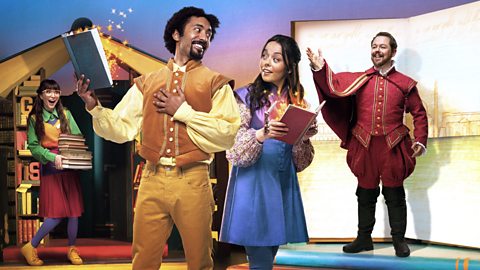
A host of CBeebies stars and actors join Rebecca in a magical library to stage a performance of William Shakespeare’s most famous play, Romeo and Juliet.
Drama on 3. audio
Shakespeare's tragic love story. With Trystan Gravelle and Vanessa Kirby as the lovers and David Tennant as the Prince.

English Literature / Drama GCSE: Shakespeare Unlocked - Romeo and Juliet. collection
Three key scenes from Romeo and Juliet are explored by actors and directors at the Royal Shakespeare Company.

Further study
The study of Shakespeare, controlled assessment guidance. activity
Unit 3 of the CCEA GCSE English Literature qualification is a controlled assessment unit based on the study of a play by William Shakespeare.
In Our Time. audio
Melvyn Bragg and guests discuss the poetry and power of Shakespeare's tragedy of two young lovers in Verona, their families divided by a bitter feud.
GCSE English Literature podcasts - Romeo and Juliet. podcast
Revise Shakespeare's Romeo and Juliet, learn the quotes and get the grade.

More on Romeo and Juliet
Find out more by working through a topic
- count2 of 5
- count4 of 5
- count5 of 5