The controlled assessment
The controlled assessment theme for Unit 3: The Study of Shakespeare changes every year. Current themes can be found on the CCEA website. Recent examples of themes for study have included forgiveness, ambition, and power – the topic will be general enough to apply to a wide range of Shakespeare plays.
The choice of play and the specific wording of the question you will answer is up to your class teacher.
Questions can be left fairly open regarding the theme, such as:
- Examine the way Shakespeare presents the theme of family in Romeo and Juliet.
Alternatively, the theme may be explored through a more specific focus, for example:
- Which is the more powerful force in Romeo and Juliet: love or hate?
The following essay questions are examples that not only touch on relevant themes/potential controlled assessment topics, but also try to frame the focus in a way that makes for an interesting argument in your essay. Consider how you might answer the following theme-based questions about Romeo and Juliet:
- How does Shakespeare use forgiveness to in Romeo and Juliet?
- Examine how Shakespeare presents family and family relationships in Romeo and Juliet.
- In what ways do individuals clash with society in Romeo and Juliet, and what are the consequences of these clashes?
- How does Shakespeare represent death in Romeo and Juliet?
- Is secrecy and concealment always a destructive force in Romeo and Juliet?
- To what extent can the characters of Romeo and Juliet be considered powerless victims of fate?
- Analyse how Shakespeare presents masculinity in Romeo and Juliet, with reference to the characters of Romeo, Mercutio and Tybalt.
For further information about the controlled assessment unit itself, look at The study of Shakespeare, controlled assessment guidance.
Example essay
Here are the opening paragraphs of an example essay written in answer to the following question:
Examine how Shakespeare presents family relationships in Romeo and Juliet.
Read carefully and note how the writer of the piece:
- Demonstrates their knowledge of the overall play
- Incorporates small amounts of relevant context
- Proposes an answer to the question – that family relationships are shown to be more about duty than love – which they then consistently support throughout the essay with relevant points and evidence
Be aware that there is no ‘correct’ answer to the question – the writer’s argument here is based on the evidence they have analysed, and would be judged on how well they seem to have argued their point and weighed up their conclusions.
Q: Examine how Shakespeare presents family and family relationships in Romeo and Juliet.
A: Shakespeare’s tragedyRomeo and Juliet revolves around the idea that it is only the love between two young people from rival families that can heal an “ancient grudge” between the families. The deaths of Romeo and Juliet are strong enough to ultimately create peace when the law could not, but their deaths are a tragic loss to their families, and ironically it is the families who create the conditions that make their children feel that death is their only option. The families keep up the “grudge” between them even though neither can remember how it began; they maintain a world of division into which each new generation is expected to show undivided loyalty to their own side, and contempt or even violence to the other. Children are expected to do their parents’ bidding even if it costs them their individual happiness, and to function as representatives of the family before considering their individual needs or wishes. In the course of the play, Shakespeare presents the Montague and Capulet families as entities who are more concerned with pride and status than love, and shows how the family relationships strain because of this.
In both Shakespeare’s time and the Italian middle-ages setting of Romeo and Juliet, traditional gender roles were strongly in place meaning women’s primary purposes in life were supposedly to marry, provide children, tend the house and submit to their husband’s will. Paris’s desire to marry Juliet is good news for the patriarch of the Capulets, particularly since she is his only child; Paris is nobly born and related to the Prince, so a marriage into his family will raise the social status of the Capulets, giving them greater access to high society and meaning possible increased opportunities to gain wealth, power and favours. Initially in Act 1, Scene 2, when Paris proposes to marry Juliet, Capulet defers, noting her young age, and suggests she be allowed two more years of childhood before she is expected to become a wife. Paris notes that many girls are married at her age (indeed Juliet’s own mother states later in the play that she wasn’t much older than Juliet when she married and had children) but Capulet retorts that being married too young can ruin a young woman; he notes the hopes he has for Juliet and urges Paris to win her heart, saying he will only allow the marriage if she agrees to it. This all suggests that he is a caring and attentive father, aware of the social customs around marriage but equally valuing his daughter’s happiness – a positive father figure and a good family leader.
However, Capulet seemingly has a major change of heart after Tybalt’s death and gives the go ahead for the marriage to take place almost immediately. His rationale is said to be the feeling that a wedding will take Juliet’s mind off her intense grief (thought to be for Tybalt but known by the audience to be separation from Romeo), but the suddenness is almost ridiculous to a modern audience. His refusal to allow Juliet a few days to grieve, let alone the two years he previously afforded her to mature, before marrying suggests not just an insensitivity to her feelings. It seems he may have a feeling of urgency to secure the family status in the wake of the death of one of its foremost heirs – he wants to go ahead with the marriage to the nobleman to gain power and security for the family who have just lost a young and important family member. His need to save face, show off to Verona and climb the social ladder all overrides his earlier care for Juliet and her position, showing he is willing to put the outward appearance of success for the family above the internal happiness of the family members.
This essay could then go on to:
- Analyse the behaviour and attitude of Capulet towards Juliet when she defies his wishes, paying close attention to Act 3, Scene 5, and link this to their family relationship and his motives to have her married so soon.
- Contrast Juliet’s close relationship to her nurse with the more distant relationship she has with her own mother, showing how her real family is less loving and deserving of her trust than a hired member of staff.
- Examine how Tybalt’s personal pride and obsession with family honour leads him to seek out Romeo for a duel, deny his attempts at reconciliation, murder Mercutio (thereby forfeiting his own life under the Prince’s new law) and be killed himself as revenge. Romeo cannot yet reveal their new familial relationship to Tybalt but begs to avoid bloodshed; Tybalt allows his perception that Romeo insulted his family to overrule his common sense, self-preservation and human empathy, showing how his blind family loyalty causes catastrophe.
- Look at a possible counterargument – for example, that their secret marriage technically means Romeo and Juliet are now themselves a family unit, strongly devoted to each other and to happiness and unity – before thinking of ways to debunk this argument, such as noting that Romeo and Juliet are deemed “star-cross’d” (unlucky and fated to never be together) from the start, which suggests they will never get to create and thrive in a loving family unit. This ultimately shows that no close and loving family relationships exist in the play.
Romeo and Juliet performed
Romeo and Juliet. video
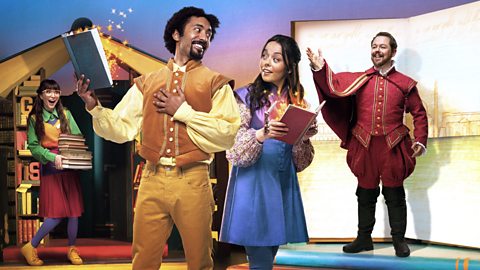
A host of CBeebies stars and actors join Rebecca in a magical library to stage a performance of William Shakespeare’s most famous play, Romeo and Juliet.
Drama on 3. audio
Shakespeare's tragic love story. With Trystan Gravelle and Vanessa Kirby as the lovers and David Tennant as the Prince.

English Literature / Drama GCSE: Shakespeare Unlocked - Romeo and Juliet. collection
Three key scenes from Romeo and Juliet are explored by actors and directors at the Royal Shakespeare Company.

Further study
The study of Shakespeare, controlled assessment guidance. activity
Unit 3 of the CCEA GCSE English Literature qualification is a controlled assessment unit based on the study of a play by William Shakespeare.

In Our Time. audio
Melvyn Bragg and guests discuss the poetry and power of Shakespeare's tragedy of two young lovers in Verona, their families divided by a bitter feud.
GCSE English Literature podcasts - Romeo and Juliet. podcast
Revise Shakespeare's Romeo and Juliet, learn the quotes and get the grade.

More on Romeo and Juliet
Find out more by working through a topic
- count1 of 5
- count2 of 5

- count4 of 5