How can archives be used to find out more about the past?

Archives are a collection of records and information such as newspapers and photographs that are stored in places like libraries or museums.
Archives are an invaluable opportunity for us to explore the past.
Photos, newspapers, letters, audio and video footage can all offer us the opportunity to learn more about significant (important) events or people that have lived before us.
They are mostly primary sources (a first-hand piece of evidence of an event) that can be used to help us answer questions and better understand the history in our local area.
Remember: If you do explore your local history, make sure you go with a trusted adult.
Important words
Important words on how archives can teach us about the past.
| Keyword | Definition |
|---|---|
| Archive | A collection of records and information that is stored somewhere. |
| Archivist | Somebody works with, collects and takes care of old documents. |
| Preserved | Something that has been kept safe. |
| Primary source | A first-hand account or original piece of evidence from an event or time period. |
| Significant | Someone or something of importance or meaning. |
Watch: What is an archive?
Explore how to use sources in archives to learn more about the past.
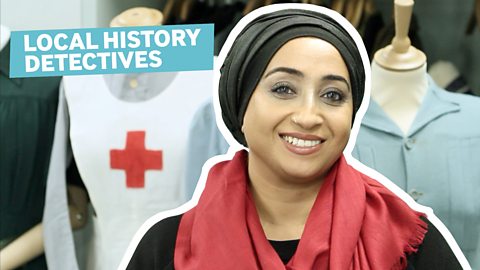
Holly: I have a question for you. Who do you think kept the people of York safe during the Second World War?
Soldiers, police, firefighters? Well maybe the last person you imagine would be an ordinary teenage girl. Meet Joan Maw - hero of York.
Imagine it's a dark October evening and you've just sat down after having your tea when suddenly an almighty explosion shakes the whole house.
Well, that's what happened to Joan, an ordinary teenager who helped people to safety during the smoke and confusion after 4 bombs hit her community.
And how do we know all of this? Archives. I'm at the York City Archive. Archives are an amazing way to explore the past. I mean, just look at this place.
Archives are collections of letters, records, newspapers, photographs, audio, film and more that help us see into the past. They're like a window into the past for historians and history detectives like us, in order to answer questions like: ‘what happened that night of the raids over York?’
Now let's look at some pieces we found to help us discover Joan and her actions on that October night.
So back to the night of the bomb, Joan is living at 41 Elmfield Avenue, which is just over there with her mum and dad. We know this because it's recorded in the 1939 census.
As we can see from the UK National Archives Bomb Census, the Luftwaffe had dropped four bombs in the Malton Road, Sefton Avenue, Elmfield Avenue area at about half past 10 at night. The explosion shakes the whole area and unfortunately, two of Joan's neighbours are killed in the blasts.
After some digging, we found this description in the Yorkshire Post the following morning:
‘In addition to the two fatal cases, people who were sitting in their houses at the time suffered cuts from falling glass, most of which had been forced inwards.’
Joan was a part-time air raid warden, and we know this because of the air raid protection report. The ARP was an important tool during the Second World War as it documented plane sightings and bombings.
These reports were hugely important and more reliable than the newspapers because they were not restricted. They went directly to the government so that they knew what was happening and where.
Joan's neighbour, William, was also a part-time air raid warden. In the report, Joan receives a special commendation for assisting the evacuation of people in the locality, which was high praise, and that's quite rare in these reports. So we know Joan must have done a really good job.
‘Hang on!’ I hear you cry. What on earth is an air raid warden?
Well, fortunately I can tell you exactly what an air raid warden is because we have so much archival evidence that tells us about them.
Joan and William would've handed out gas masks and guided people to safety during bombing raids. They would almost certainly have helped to search for people in the aftermath of the bombings and in the evenings they would patrol the streets, checking windows and buildings to make sure no light escaped, which would make it easier for the enemy bombers to spot targets.
Finally, we found another very valuable source of information, a letter from a Mr. E Sykes to the ARP office in which he says:
‘My warm appreciations of the help and assistance received from the personnel of the ARP who helped with the two fatal cases.’
Mr. Sykes singles out some unnamed women for praise, including ‘the lady driver of the ambulance’ - a lady ambulance driver!
So, we've used all the archive sources, the photographs, the newspaper cuttings, the official documents, and all the objects to piece together the jigsaw to answer what happened and who kept people safe that night of the bombings in York.
And the picture is so much bigger than we could have imagined.
You might have your own archive centre in your town, or maybe your local library has some records.
The National Archive has a website with over 37 million records in it. So, think of it as like the archive of all archives.
You can download items and find out about people in history where you are from.
So what mystery do you want to solve in your local town? It's time to get to work History Clue Crew.
What are archives?

Archives are a collection of information that are often known as records.
These records may be old maps, photographs, video or sound footage.
They are carefully preserved (something that has been kept safe) and allow us to better understand the history in our local community, schools or even in our own families.
They are usually a primary source of evidence that can be used by historians and people to deepen their knowledge and understanding of significant historical events and people.
People who look after archives are called archivists.
They sometimes wear white gloves to protect documents or books.
Are archives only found in libraries?

Archives can be found in many different places.
There is the National Archives in London which contains more than 11 million records from history up to 1000 years ago!
Archives can also be found in places of worship such as churches, as well as libraries and in schools.
Many families have informal archives which may be a collection of old photographs and documents.
Technology has helped to make archives more accessible by being available online and therefore gives people the ability to access archives from their own homes.
Technology has also enabled archivists (somebody who works with, collects and takes care of old documents) to preserve precious documents from history.
How do archives help historians?

Archives are incredibly useful for historians as a primary source of evidence to better understand a time period or significant event.
The National Archives suggest that the Magna Carta is called the most important document in history.
The Magna Carta was created in 1215 to make peace between an unpopular king, and the people who were against him. It is significant because one of the principles in the Magna Carta was that nobody was above the law, not even the King. From reading it, historians learned about laws, religion and how people felt about royalty in Medieval England.
However, not all pieces of evidence in an archive tell the whole story by themselves. When using some newspapers, historians have to be mindful of bias, this means that they may only share a one sided view.
Historians must also be careful when using more modern archives, they may uncover unknown history about people or places that are important and sensitive to families who may still be alive.
Think like a historian
Have a look at the thinking points below and think about your answer to each question. You could even write them down on a piece of paper or discuss them with somebody else if you want to.
How do archives offer us a window into the past and how people used to live?
How do archives provide information on different aspects of life? Where can they be found?
Archives are an invaluable primary source. They can tell us about events. With a trusted adult, you could use the internet to explore some of the archives from your local area.
Archives can be found schools or even in personal archives in people’s families. With a trusted adult, could you explore some of the archives from your own family? Do you have a birth certificate or passport from when you were younger?
Activity: Quiz
Grown-ups corner
Are you a parent, carer or teacher?
Take a look at some of the links below on KS2 History which are packed full of knowledge, videos, quizzes and activities.
KS2 History: Ancient Voices
BBC Bitesize for Teachers

KS2 History: Ancient Egypt
BBC Bitesize for Teachers
KS2 History: Noor Inayat Khan - Britain's first muslim war heroine
BBC Bitesize for Teachers

Horrible Histories: Raid and Trade game! game
Play Horrible Histories: Raid and Trade KS2 History
More on Local history
Find out more by working through a topic
- count7 of 10

- count8 of 10

- count9 of 10

- count10 of 10