Has World Cup signalled end of chaos at corners?
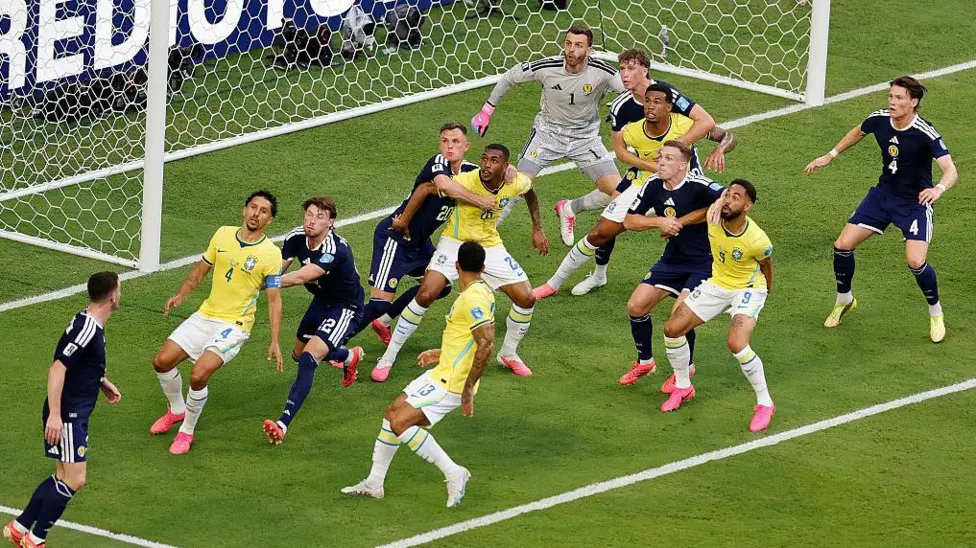
Fifa referees' chief Pierluigi Collina told coaches before the World Cup he did not want to see excessive holding in the penalty area
- Published
"If the goal is illegal, then Arsenal won't be English champions."
Former Liverpool boss Jurgen Klopp was speaking after Germany had a goal disallowed during their World Cup tie with Paraguay.
Jonathan Tah thought he had given Germany a 2-1 lead in extra time, only for the video assistant referee to intervene, with Waldemar Anton adjudged to have blocked goalkeeper Orlando Gill.
It was a tactic reminiscent of one used by Arsenal last season - leading to a record 19 goals from corners as they won the Premier League.
"They've scored 60% of their goals that way," Klopp said of the Gunners - exaggerating for effect.
But what is true is there has been a clear difference in approach in the refereeing of corners at the World Cup.
Wrestling seemed to be endemic towards the end of last season, with players thrown to the floor and - at times - as many as 16 camped in the six-yard box crowding the goalkeeper.
BBC Sport has been told there was a feeling at the top levels of refereeing that corner kicks had turned into a "fight scene" and this was "not real football".
We have not seen the same level of skullduggery at the World Cup.
But what has Fifa done to combat it, and could it mean we see a difference in the Premier League next season?
Prepare your referees, and be strict
The messages from Pierluigi Collina - Fifa's head of referees - before the World Cup were simple.
To coaches: there will be a focus on blocking and holding. To referees: be prepared to be strict.
There would be zero tolerance of any off-the-ball moves that were designed to stop an opponent getting to the ball and led to goals.
Holding would still happen - it cannot be eradicated from a contact sport - just not to the same extent. Referees, for instance, have still needed to stop corners to speak to players who are grappling.
When it comes to goalkeepers, it seems Collina expects an exclusion zone in the six-yard box.
The VAR intervention to disallow Germany's goal may have seemed soft to anyone who watches Premier League football.
For Collina, it was the perfect example of what he had been drilling into his officials. Anton stood in a position that meant the goalkeeper would inevitably walk into him. The German held his position - a deliberate blocking tactic.
Spain had a goal disallowed in similar fashion, with Pau Cubarsi penalised for a foul on Austria goalkeeper Alexander Schlager.
"At least they are consistent, but it's the extreme opposite," said former Germany midfielder Thomas Hitzlsperger on BBC One. "We watch the Premier League every week and this is so different.
"None of the goalkeepers are protesting. Fifa changed their approach and any contact is in favour of the keeper."
Does the change have any impact of the value of corners? The stats would seem to suggest so.
In the Premier League last season, goals from corners came at an average of 0.49 per match - near enough one every other game. The Bundesliga and the Champions League were close behind on 0.46.
At the World Cup the figure is 0.34 - on a par with the other top-five European leagues, which also have a lower threshold for intervention inside the penalty box.
But it is still higher than the 0.20 in Qatar four years ago.
How can football's lawmakers fix the corner chaos?
- Published2 March
How Collina uses semi-pro players to train referees
Collina's attention to detail at this World Cup has been exhaustive.
The 51 referees and 88 assistant referees are based at a state-of-the-art camp in Miami, Florida.
Fifa has a sourced a large group of players of semi-professional standard who are drilled in the playing patterns and set-piece routines of the national teams.
Take Thursday's match between France and Morocco.
Referee Facundo Tello and his team will travel to the training centre and be put through exercises involving two XIs, who will perform drills to mimic the playing style and tactical approach of the quarter-finalists.
Where do teams place their players on set-piece routines? Where do they make runs? Is anyone in a blocking position?
Referees are given feedback on the decisions they make, and take that into the game.
This is much easier for Fifa to do in a tournament format, of course, with referees in a controlled, intensive training environment.
It is probably necessary, too. Officials cannot be expected to know how all 48 international teams are going to play.
Collina believes it is hugely important to use real scenarios, not just dossiers and diagrams. His referees can get a tangible feel of how key match situations might play out.
Premier League referees do get a detailed breakdown of how teams play, but of course they will see them in action every week - either in person or on television.
Could the Premier League replicate Collina's plan?
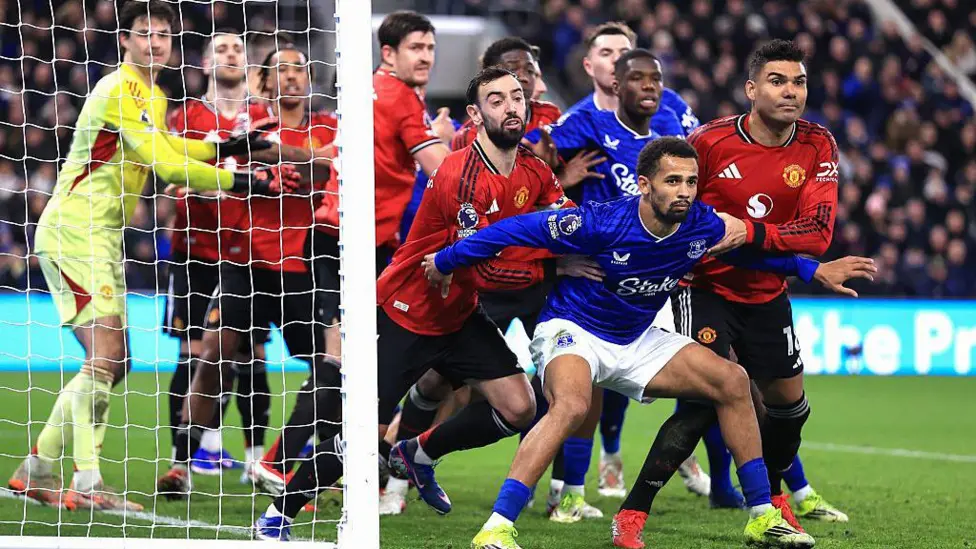
Players from both sides were camped inside the six-yard back when Everton met Manchester United in February
In February, after a particularly fractious game against Manchester United, Everton boss David Moyes said "referees really don't want to get involved in any of it".
It is a two-way street, of course. Managers and players have their own responsibility for the way they behave and the tactics they use.
So what can the Premier League do about it? It has promised an "enhanced recognition of clear holding actions".
But has the World Cup created unrealistic expectations?
BBC Sport understands Premier League referees will not take the same hard-line approach.
The Germany and Spain goals would still not be disallowed were they scored in the Premier League.
Physicality is important to the English game, but there is still a feeling among officials that what happened last season cannot continue.
"There is a line in between where they can manage it a little bit better," former Chelsea defender Cesar Azpilicueta told BBC One.
"In England especially, you have more contact - you are used to it. There is something in between where everybody can feel a bit happier."
Fans are always sceptical about any new initiative at the start of a season, with many thinking it will last a few weeks before drifting away.
Collina believes the only way to get results is to be strict - to lay out the situation to coaches and be ready to enforce the rules when necessary.
But with only one VAR penalty awarded for holding - given by the Premier League's Jarred Gillett when Croatia faced Portugal - has this really been tested?
Are coaches at the World Cup reacting to Collina's warnings and toning down their tactics. Or are they simply not giving corners quite the same focus as club managers?
Premier League referees cannot weigh in with a raft of penalties in the first few weeks of the season as that would be unsustainable.
The counter argument is it would change behaviour - but it is unlikely the media narrative would work in the referees' favour.
Collina's approach is perhaps OK over a 104-game tournament in which most teams will only play about four matches.
It's a very different proposition for a full domestic campaign.
Coaches will always be looking for the marginal gain - ways to push the boundaries to score a crucial goal. And tweaking their routines week to week.
Premier League referees need to find a way to find a reset while respecting the physical nature of the game.
It is not easy.
Related topics
- Published18 July
- Published1 April