'Parents shouldn’t fear their children not coming home from a race'
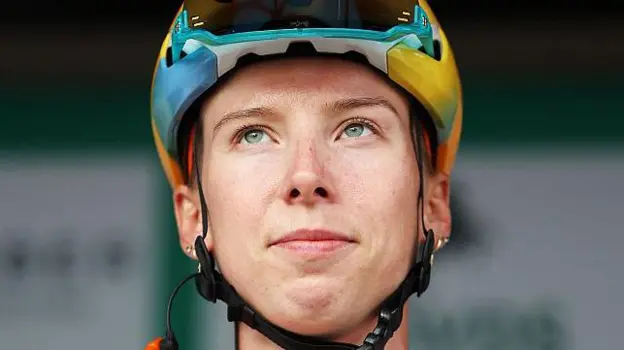
Wiebes has more than 100 career race victories
- Published
Parents should not be scared their children might not come back from a race following the death of Finlay Tarling, says the winner of stage one of the Tour of Britain Women.
Dutch cyclist Lorena Wiebes (SD Worx - Protime) sprinted to take the opening stage in Cockermouth.
Before the race began, there was a touching tribute to the British 19-year-old who died last week in a high-speed collision with a van, which had strayed on to the road during the eighth stage of the Volta a Portugal.
As the 114 riders lined up to set off on the first stage in Cockermouth, a photograph of Tarling was projected on to a large screen and a minute's applause rang out around the packed centre of the market town.
After her win, Wiebes said: "Most of these riders have family at home. Your parents shouldn't be scared that you are not coming back from a race.
“It cannot happen again, and it's happened already too many times," the 27-year-old added.
Safety has been on the minds of every rider since the teenager's death stunned the cycling community.
The Tour of Britain is a smaller event in the cycling calendar - similar to the Volta a Portugal. But they both use 'rolling roadblocks', where police and officials travel in front of and behind the peloton.
However, several roads were completely closed off in the Cockermouth town centre.

Riders united in a minute's applause in tribute to Fin Tarling
British rider Hayley Simmonds, holder of three British time trial records, has been vocal about safety for cyclists, particularly after she was involved in the abandonment of the Tour of the Pyrenees in 2023.
At the time, riders complained roads were not closed to traffic for the three-day race in south-west France.
Several teams pulled out before governing body the UCI officially cancelled the race with the unhappy organisers describing the women as "spoiled children".
"Our response at the time was, 'No, we just expect to be safe'," Simmonds said.
"When you go out on your bike, you expect to get home safely.”
Recalling the event in 2023, the DAS Hutchinson rider said: "We were riding along a road and suddenly there was a car moving towards us in the opposite direction, coming towards you.
"And then you're half thinking about that, half thinking about the race, and no race is worth losing your life over.
"And that's why on stage three, we chose not to race. But it shouldn't come down to riders having to stop in the middle of a stage and have a discussion about whether they feel safe on their bikes or not."
So what's the answer? While races in road cycling are set up by independent organisers, the UCI oversees most of the events and can set standards for race management.
Simmonds agrees action needs to be taken by the sport's governing body.
"I don't think it's necessarily right or fair to say that the responsibility lies solely with one particular party. But ultimately, they should have some set of mandates that say we need proof that rider safety has been considered, and we need proof that the roads will be safe to ride on.
"I think you need real collaboration between the UCI and the race organisers. The UCI needs to be asking questions of the race organiser. Like, what group have you got doing the road closures and looking after the race? Do they actually have legal authority to stop all traffic? Do drivers have to respect that?”
Following the fatal crash involving Tarling, the UCI issued a statement saying it was "deeply saddened, and extended its deepest condolences to Finlay's family, friends, and team-mates", but has not made further comment since then.
Tarling family heartbroken as riders pay tribute to British cyclist
- Published4 days ago
'Fury' at Tarling death as cycling union calls for better helmets
- Published4 days ago
Tarling death shows risks of smaller races - Vaughters
- Published1 day ago
The Tour of Britain is run under rolling road closures, with marshalling and traffic management teams operating throughout.
Jonathan Day, event director of British Cycling Ventures, said: "It's understandable that people will be thinking about safety at events following what happened to Finlay.
“We take safety at the Lloyds Tour of Britain extremely seriously, and the race has an excellent safety record.
“We have a highly experienced organising team supported by an equally experienced police central escort group."
It’s an event Hannah Barnes knows well. In 2017 she finished third overall - but her most prestigious win was at the final stage in 2015.
She said: "I think the Tour of Britain has always been renowned for how seriously they take it.
"I've never felt unsafe. But that's because I trust the British police, and also you can see what goes on behind the scenes.“
Barnes said every cyclist on the start line will have been thinking about the tragic events of last week.
"Even if you aren't from Britain or you didn't know Fin personally, it's still one of your fellow cyclists. I've been thinking about him every day, about his family and the team, so I think for them to have a tribute beforehand is really important."
For the first time the Tour of Britain Women features five stages, achieving full stage-count parity with the men's race. It ends on Sunday, 23 August.

Wiebes' SD Worx - Protime team held off multiple attacks before she sprinted to victory on the 158.9km opening stage
