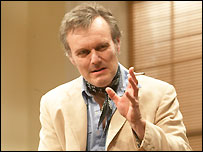
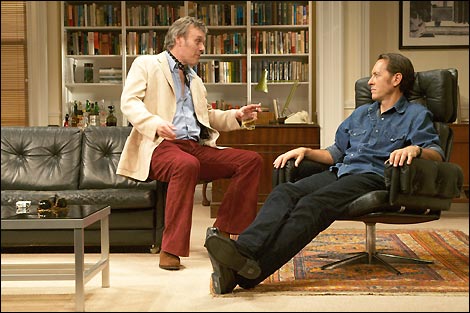
It could just be first-night nerves but the visible expiration of air by Richard E Grant during the curtain call of the opening night seemed to suggest this fine actor's first stage appearance for the best part of 10 years had been a bit of an ordeal. He needn't have worried. The play - set in that period when the world seemed to change irrevocably, the mid 1970s - stands up well, while his own performance as Simon Hench, the sophisticated, Wagner-loving publisher, is rarely less than spot on. Hench is something of a cold fish - an Oxford-educated stuff shirt who appears to effervesce middle-class values while stoically keeping his family, friends and especially the lodger, at arm's length. They, by contrast, have other plans and the central tension of this highly-engaging play revolves around this potentially explosive conflict. An array of unsympathetic characters, ranging from the utterly hedonistic Jeff to the self-seeking Davina serve to unravel Hench's idyllic, trouble-free universe, to reveal a shallow world of meaningless tawdry one-night stands and unsatisfactory relationships. Vanity Fair meets Dante by way of Hogarth. Central to Simon Gray's play is his extraordinary use of language. Throughout, his characters cast caution and tact to the wind, giving utterance to their innermost damning thoughts, sparing no-one's feelings along the way. Many of us might know all too well, the sentiments Gray's characters give voice to, few of us us would perhaps express them verbally with such apparent sangfroid - an effect which proves somewhat disarming, dramatically. 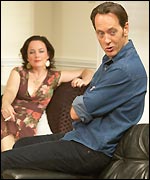 | | Richard E Grant as the laconic Simon |
Richard E Grant grows into the role of the laconic Simon throughout the performance. If understatement is his watchword for the first act, he more than makes up for this with a captivating performance in the second. His squirming facial contortions as his disagreeable partner Beth confronts him with a few home truths - he knows all too well of her long-term affair while taking a perverse delight in her ignorance of his knowledge - are superb. There are also fine performances from a supporting cast which includes local boy Anthony Head as the thoroughly obnoxious Jeff. Unpleasant he may be, but no more so than the ghastly, self-promoting, bra-eschewing Davina, well played by a less than inhibited Amanda Ryan. David Bamber is a suitably unnerving Wood, Hench's creepy ex-schoolmate who reappears with ghastly homo-erotic tales of tawdry life in a minor public school, while Peter Wight is a very credible Stephen - Hench's rather more garrulous brother. Amanda Drew as Beth and David Bamber as Wood, the lodger, both give fine performances and the direction by Simon Curtis is crisp and sharp, aided by Simon Higlett's excellent pure 1970s set. A fine performance then, although one is left with a disconcerting feeling of guilt in taking so much perverse pleasure from such a disagreeable array of grotesque characters. |