Summary

  1. 252,756 miles into the universepublished at 08:58 BST

    Jenna Moon
    Live editor, beaming from London
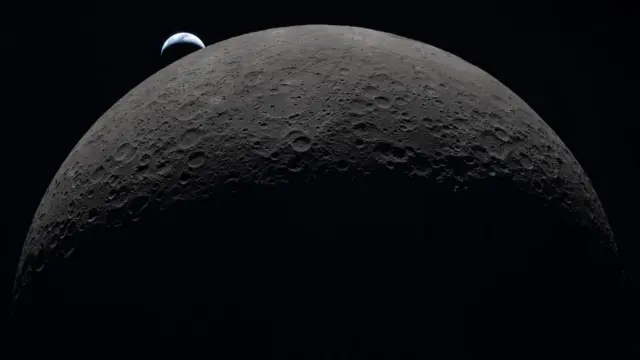
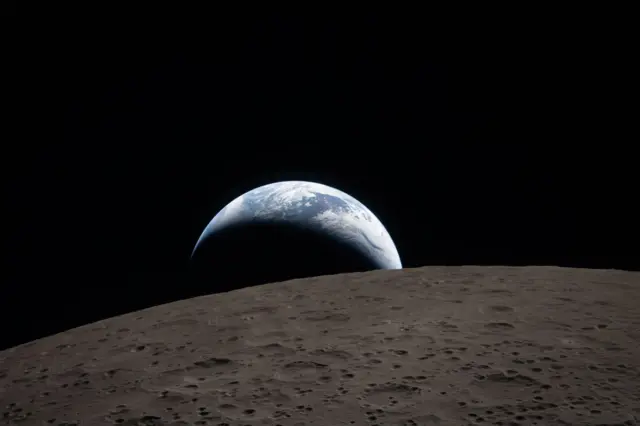
    Earth sets at 6:41 p.m. EDT, April 6, 2026, over the Moon’s curved limb in this photo captured by the Artemis II crew during their journey around the far side of the Moon. Orientale basin is perched on the edge of the visible lunar surface. Hertzsprung Basin appears as two subtle concentric rings, which are interrupted by Vavilov, a younger crater superimposed over the older structure. The lines of indentations are secondary crater chains formed by ejecta from the massive impact that created Orientale. The dark portion of Earth is experiencing nighttime. On Earth’s day side, swirling clouds are visible over the Australia and Oceania region.Image source, NASA
    Image caption,

    You're in this photo

    From a dramatic lift-off to a "textbook touchdown", it's been the trip of a lifetime for Artemis II's four-person crew.

    Commander Reid Wiseman, pilot Victor Glover and mission specialists Christina Koch and Jeremy Hansen are the first people to travel to the Moon in more than half a century. They are now safely home, having splashed down in the Pacific Ocean after a 10-day journey.

    Nasa's Artemis missions aim to return humans to the Moon's surface by 2028 - an ambitious target by any estimate. But this mission, which saw the astronauts fly around Earth's closest neighbour, sets the stage for future lunar landings.

    It's the start of a new era of space exploration, one that Nasa hopes will lead to a dedicated "Moon base".

    The crew have travelled deeper into space than ever before. The Moon has been examined in close detail, sketched, photographed, and recorded by voice memos. "No adjectives" could really capture what they saw, Glover said.

    The rest of us down here on Earth got to join along for the ride, experiencing Moon joy alongside the crew in the cosmos.

    For more on this story, you can head to our news article, or catch up with our podcast 13 Minutes. Thanks for travelling through space with us.

  2. A journey to the Moon and back again - a recap of the Artemis II missionpublished at 08:26 BST

    Jacob Phillips
    Live reporter

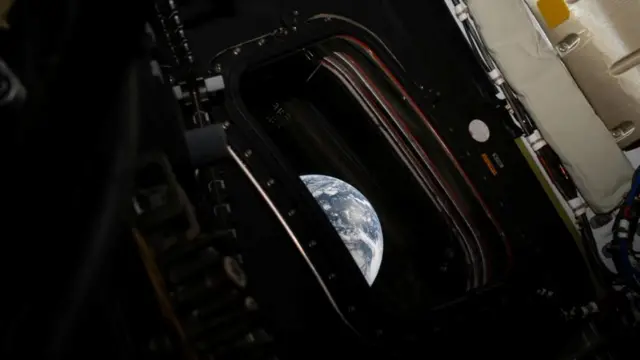
    A semi circle of the Earth peaks out of a window on the Orion capsule.Image source, Reuters

    The Artemis II crew travelled further from Earth than anyone before them, and as Commander Reid Wiseman put it, "saw sights no human has ever seen".

    Here’s a look back at some of the key moments from the mission:

    First, liftoff.

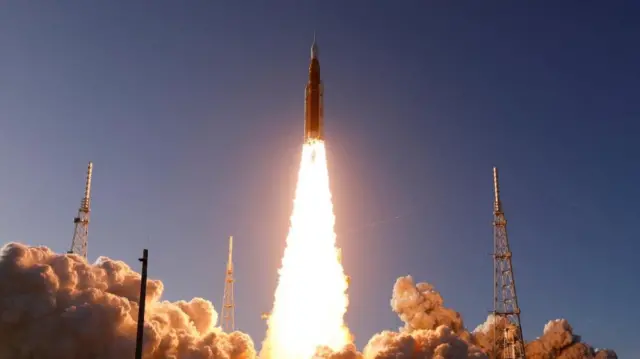
    The Space Launch System rocket, with the Orion spacecraft on top, blasted off from Florida on 1 April.

    The astronauts orbited Earth before heading towards the Moon on the second day.

    On the sixth day, humanity returned to the Moon for the first time since 1972, as the crew circled behind it. At their furthest point, the spacecraft travelled 406,771 km (252,756 miles) from Earth.

    The astronauts lost contact with Earth for 40 minutes while behind the Moon, spending time photographing craters and ancient lava flows, and describing its colour and texture.

    After witnessing a solar eclipse, Orion headed back. The crew continued their research and even listened to David Bowie.

    After just over nine days inspace, the four astronauts returned to Earth, landing within a mile of Nasa’s target site in the Pacific Ocean.

  3. SpaceX, Blue Origin and a real race back to the Moonpublished at 08:06 BST

    Pallab Ghosh
    Science correspondent

    SpaceX has been handed a much larger role in Nasa’s future Moon plans.

    But the company is under pressure: The company's Starship must prove it can complete a full mission profile within the next couple of years, and it is running behind Nasa’s ideal schedule.

    Blue Origin, meanwhile, has secured its own Nasa lander contract and is closing the gap fast, flight testing its New Glenn rocket and pitching a rival architecture for later Artemis missions. The result is genuine competition for who shapes the long term Moon economy.

    For now, Orion and SLS handle launch and re-entry, while commercial heavy lifters vie to move crews and cargo beyond Earth orbit. How quickly SpaceX can get Starship fully operational – and how rapidly Blue Origin can catch up – will help decide what the next decade of lunar exploration looks like.

  4. Artemis II mission was a triumph. Now comes the hard partpublished at 07:44 BST

    Pallab Ghosh
    Science correspondent

    Nasa's Artemis II mission has successfully sent four astronauts sweeping around the far side of the Moon and landed them safely back home.

    The Orion spacecraft performed admirably and the images the astronauts captured have delighted a whole new generation about the possibilities of space travel.

    But does this mean that the children enthralled by the mission will be able to live and work on the Moon in their lifetimes? Perhaps even go to Mars, as the Artemis programme promises?

    It seems churlish to say, but looping the Moon was relatively easy. The really hard part lies ahead, so the answer is "maybe, maybe not".

    Nasa has kept its 2028 target for a first Artemis Moon landing in part for political reasons - it now aligns with President Trump's renewed space policy, which calls for Americans to be back on the lunar surface by 2028 – a deadline that falls within his current term of office, due to end that year.

    Independent analysts don't believe the target is realistic. But Congress has backed the date with billions of dollars of taxpayers' money, partly because there is a new competitor on the horizon.

    Read more about the new space race here.

  5. Artemis II's history-making crewpublished at 07:27 BST

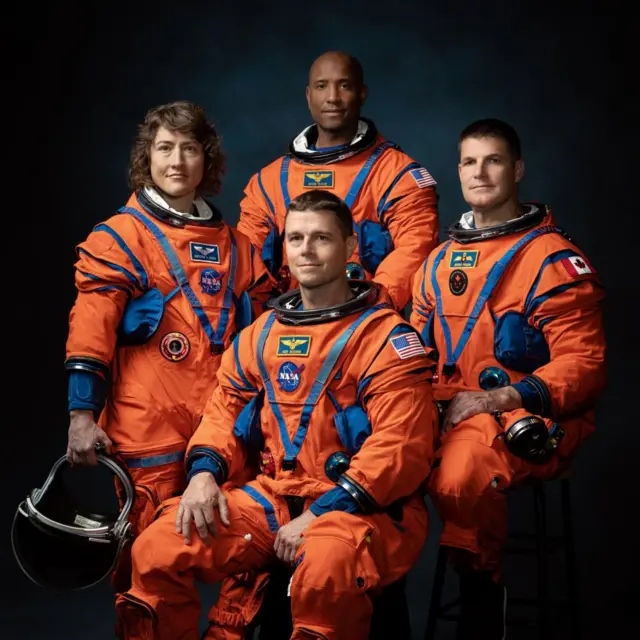
    Four astronauts are seen in their orange spacesuits arranged for a professional picture. The suits have blue detailing and they are positioned in front of a dark blue background.Image source, NASA/EPA
    Image caption,

    From top, clockwise: Victor Glover, Jeremy Hansen, Reid Wiseman and Christina Koch

    Welcome home, Artemis II crew! The team is the first to visit the Moon in more than half a century - let's take a quick look back at the astronauts that made this historic trip.

    Reid Wiseman, the mission commander, is a former US Navy pilot and test pilot. He became a Nasa astronaut in 2009 and spent 165 days on the International Space Station (ISS) in 2014.

    The ship's pilot, Victor Glover, lived on the ISS from November 2020 to May 2021 and was also the pilot of SpaceX Crew-1. He holds three master's degrees and is now the first Black astronaut to fly on a Moon mission.

    Mission specialist Christina Koch holds the record for the longest single spaceflight by a woman (328 days on the International Space Station) after becoming an astronaut in 2013. She is now the first woman to travel around the Moon.

    The other mission specialist is Jeremy Hansen, the first Canadian to go to the Moon. He previously lived underwater for seven days as part of his aquanaut work with Nasa.

    You can read more on the four astronauts and their stories here.

  6. A minute-by-minute guide to the splashdownpublished at 07:11 BST

    Jacob Phillips
    Live reporter

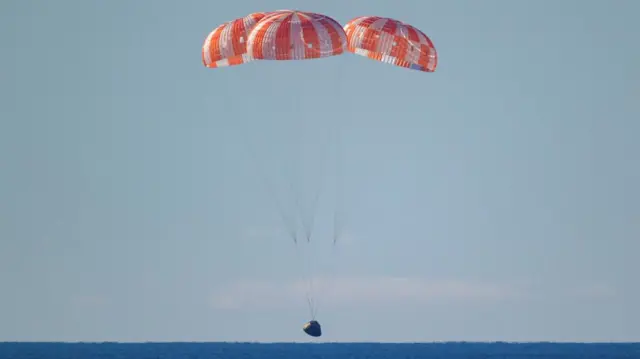
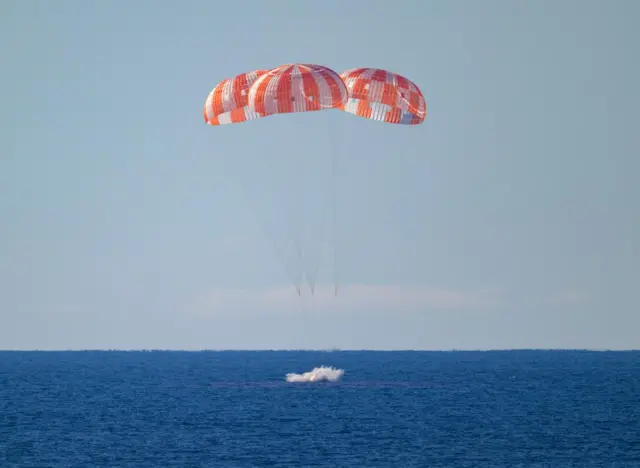
    The Orion capsule moments before it lands in the Pacific Ocean. Three red and white parachutes can be seen slowing the spacecraftImage source, Bill Ingalls/Reuters

    Just 14 minutes after re-entering the Earth's atmosphere the Artemis II crew splashed down in the Pacific Ocean off the west coast of the US.

    Here's a minute-by-minute breakdown of how it happened:

    23:33 GMT (00:33 BST; 19:33 EDT) - The Orion capsule separates from the service module, which has been used to steer the astronauts around the Moon and back to Earth. The service module then harmlessly burns up in the Earth's atmosphere.

    23:53 - The Orion spacecraft reaches Earth's atmosphere, hurtling at 35 times the speed of sound towards the splashdown site. There is a scheduled six-minute communications blackout with the astronauts as plasma builds up around the crew's capsule.

    00:03 - The first parachutes are deployed to slow and stabilise Orion at 23,400 feet (7,132m).

    00:04 - Orion's three main parachutes are deployed slowing the spacecraft to less than 200 feet (61m) per second. Orion is now on its final descent.

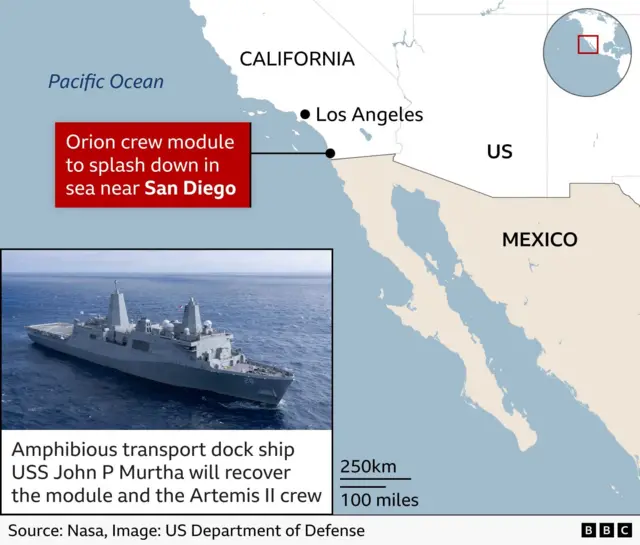
    00:07 - Splashdown. The crew land right on schedule in the Pacific Ocean off the coast of San Diego. Nasa later says the capsule landed within a mile of its target.

    00:34 - The astronauts exit the spacecraft for the first time in 10 days and are safely moved to an inflatable boat.

    00:56 - The Artemis II crew are hoisted into US helicopters and flown to the USS John P Murtha, where they receive medical check ups.

    Map of the west coast of North America showing the planned splashdown location of Nasa’s Orion crew module. The Pacific Ocean is on the left, with California labelled at the top and Mexico to the south. Los Angeles is marked along the California coast. A red label points to an area offshore near San Diego that reads “Orion crew module to splash down in sea near San Diego.” An inset photograph shows a large grey naval vessel, identified as the amphibious transport dock ship USS John P Murtha, which will recover the Orion module and the Artemis II crew.
  7. Jeremy Hansen's daughter is expecting ‘the greatest story of all time’published at 06:49 BST

    Jasmine Sandhar
    BBC Newsbeat

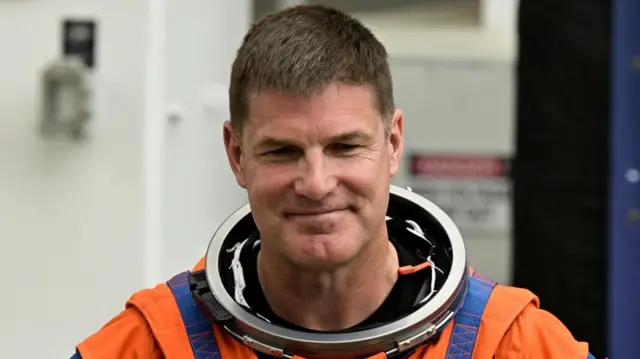
    Canadian astronaut Jeremy HansenImage source, Reuters
    Image caption,

    Canadian astronaut Jeremy Hansen

    As splashdown time approached earlier, the family of Canadian astronaut Jeremy Hansen were waiting along with the rest of the world to see the Artemis II crew return from their historic mission around the moon.

    Ashley Hansen, one of the astronaut's twin daughters, told BBC Newsbeat that her mum and brother watched the splashdown from Mission Control, while she watched in Montreal, Canada with her sister.

    “I’m just going to give him the biggest hug. I think that we're all just going to be astonished he did it,” says Ashley.

    The 20-year-old says the family have had a special saying since they were children.

    “[It’s] I love you to the moon and back,” explains Ashley.

    “We've been saying that since we were little kids. In 2023, when the mission was announced, our dad had custom necklaces made with each of our family's birthstones in the necklace.

    “It's a crescent moon and it says 'moon and back' on it, which I think is so precious considering the mission that he's on right now.”

    Ashley says once her family is reunited they will sit down to chat with her dad about his adventure from start to finish.

    “I reckon that's going to be the greatest story of all time,” she adds.

  8. $100bn and rising: The cost of this Moon missionpublished at 06:38 BST

    Esme Stallard
    Science reporter

    Four years ago, Nasa estimated that $93bn (£69bn) would be spent on Artemis between 2012 and 2025 – much higher than previous estimates.

    Even though the programme officially started in 2017, it started building the rocket much earlier.

    But according to the most recent audit report costs have risen since then.

    Although harvesting the resources of the Moon could bring potential economic reward this is a long way off.

    But Nasa argues the programme in its current form brings considerable benefits to the US economy. The latest data from the organisation shows it employs nearly 20,000 people generating $75.6bn of economic output.

    The second argument is that the US cannot afford to lose out to its rivals.

    In a 2024 hearing by the Committee on Science, Space and Technology to assess Nasa’s programmes, the Chair, republican representative Frank Lucas said:

    "I remind my colleagues that we are not the only country interested in sending humans to the Moon. The Chinese Communist Party […] has stated its ambition to have human astronauts on the surface by 2030.

    "The country that lands first will have the ability to set a precedent for whether future lunar activities are conducted with openness and transparency or in a more restricted manner."

  9. 'This is the Artemis generation', space educator sayspublished at 06:23 BST

    Shaimaa Khalil
    Reporting from a watch party in Los Angeles

    A woman wearing a black leather jacket, a cross necklace, and a hat smiles for a photoImage source, BBC/Shaimaa Khalil
    Image caption,

    Pam Leestma

    Space educator Pam Leestma has been teaching people about the cosmos for 43 years.

    Watching the Artemis II landing in Los Angeles at the Columbia Memoria Space Center was a nerve-wracking and thrilling experience, she says.

    “The six minutes of blackout I was praying real hard and holding my breath and just [knew] that Nasa was doing everything right," she said as the big screen continued to beam the recovery mission.

    Leestma, now retired, gives space talks to children. She says this mission feels like one generation passing its knowledge to the next.

    "I was in tenth grade when Neil Armstrong walked on the moon, and this is the next generation, the Artemis generation," she adds.

    Especially during an uncertain time in the world, events like these can bring people together, Leestma says: "This is the greatest example of how countries can come together in a peaceful way."

  10. Pictures show historic splashdown for Artemis II crewpublished at 05:59 BST

    Nasa has released images of the Orion crew returning to Earth.

    The images show the series of events from the deployment of the module's parachutes to the astronauts walking across the flight deck of the USS John P Murtha for assessment at the medical bay.

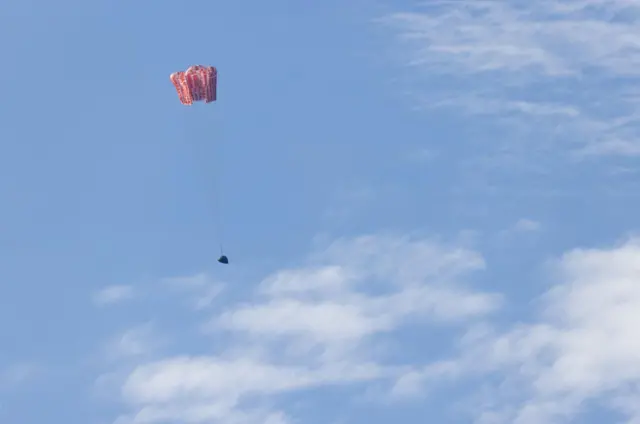
    Nasa’s Orion spacecraft seen with its main parachutes deployed against a blue sky.Image source, NASA/Joel Kowsky
    Image caption,

    The Orion spacecraft with its main parachutes deployed

    The Orion spacecraft lands in the Pacific Ocean off the coast of California, with the dark blue ocean visible underneath the light blue sky. The module's main parachutes are protruding from it.Image source, NASA/Bill Ingalls
    Image caption,

    The moment the Orion spacecraft splashed down into the Pacific Ocean

    Nasa astronaut Victor Glover is seen being hoisted onto a Navy helicopter following the return of the Orion spacecraftImage source, NASA/Joel Kowsky
    Image caption,

    Victor Glover is hoisted onto a Navy helicopter

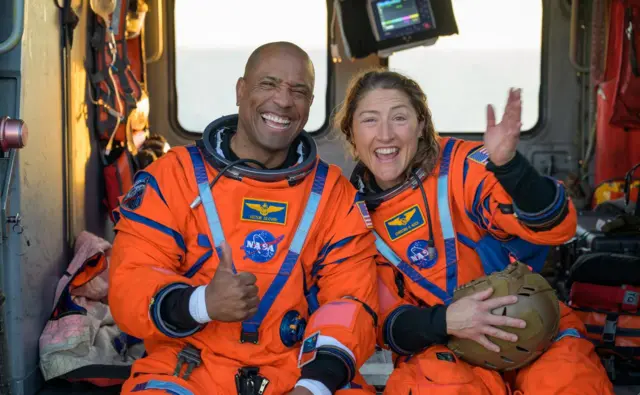
    Victor Glover and Christina Koch smile for a photo. Glover is doing a thumbs up sign and Koch is gesturing towards the camera. Both are smiling.Image source, NASA/Bill Ingalls
    Image caption,

    Victor Glover and Christina Koch pose for photos while sitting on the flight deck of the USS John P Murtha

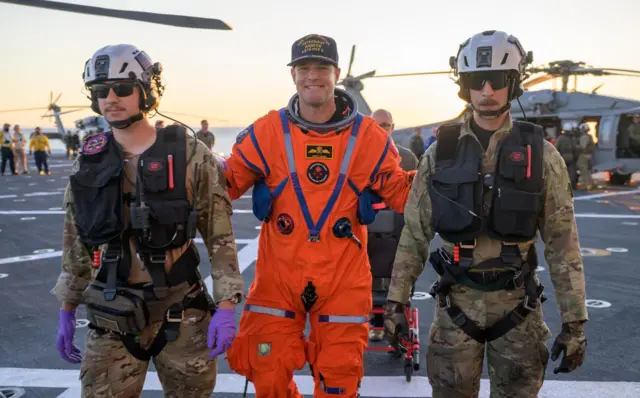
    Jeremy Hansen is escorted by rescue personnel off the flight deck of the USS John P Murtha. He is smiling.Image source, NASA/Bill Ingalls
    Image caption,

    Jeremy Hansen leaves the flight deck following his return

  11. Back to Earth: What happens to the Artemis II astronauts now?published at 05:37 BST

    We're yet to hear from the astronauts themselves since they left the Orion capsule - and we might not for a while yet.

    Spending time in space will have been physically gruelling for the Artemis II crew, and they've all got to undergo medical checks.

    After that, the focus will turn to reuniting them with their families.

    Nasa officials say the four astronauts are due to return to Mission Control in Houston on Saturday, local time.

    Then there's a White House trip, and even further missions to the Moon, on the cards for them.

    Read more about what the Artemis II astronauts may get up to next here.

  12. In photos: Artemis II from liftoff to splashdownpublished at 05:20 BST

    A view from the surface of the Moon. The Earth sets below the Moon's horizon.Image source, NASA

    The crew of Artemis II are safely back on Earth after a successful splashdown, completing their historic loop around the Moon.

    Nasa released stunning images taken from the far side of the Moon during the mission.

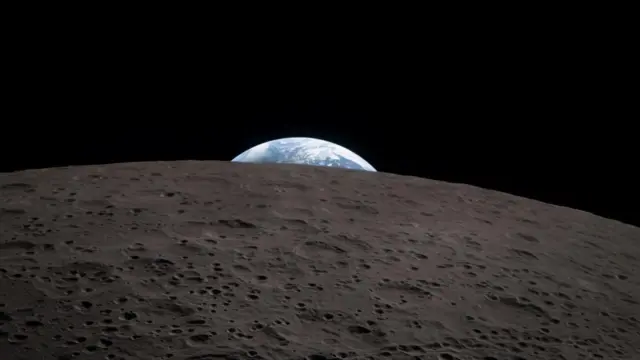
    One of the most spectacular is this photo, which Nasa has called Earthset. It shows the Earth slowly setting behind the Moon's horizon - a mirror image of the famous Earthrise photo taken during the Apollo 8 mission.

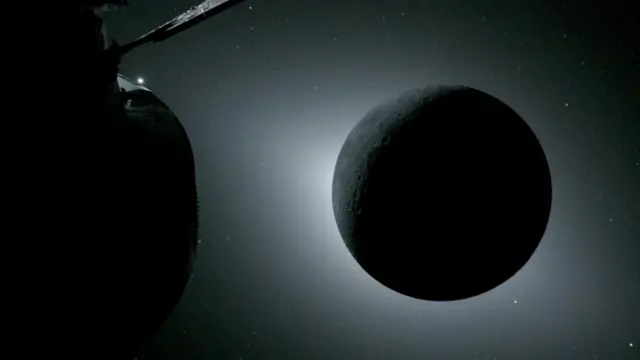
    Another image shows the Moon fully eclipsing the Sun. Incredibly, the crew had this view of a total eclipse for nearly 54 minutes as they passed behind the Moon.

    From inside Orion the astronauts could see the Earth as a crescent slowly growing smaller behind them as they continued on their 250,000 mile (400,000km) outward journey.

    Covering that distance from the Earth to the Moon would take them four days.

    See more of the remarkable images they captured here:Artemis II’s spectacular Moon mission, from launch to dramatic splashdown

    A view of the Moon eclipsing the sun from spaceImage source, NASA
  13. Cheers at watch parties across the countrypublished at 04:54 BST

    Milestones in the Artemis II mission have been closely watched across the globe, and today's return was no different.

    Crowds gathered at a watch party at the Air and Space Museum in San Diego, California - near where the crew splashed down - to observe the making of history.

    A man and a child nervously look on amid a crowd gathered to watch the Artemis II mission returnImage source, Reuters
    A child dressed in Nasa costume cheers as the Artemis II mission returnsImage source, Reuters
    Crowds cheer and film as the Artemis II mission returnsImage source, Reuters
    A picture showing crowds gathered at the San Diego Air and Space Museum to watch the returnImage source, Reuters
  14. Nasa panel gives assessment of successful Artemis II missionpublished at 04:47 BST

    Joe Coughlan
    Live reporter

    Nasa Orion program manager Howard Hu (right) listen to Nasa flight director Rick HenflingImage source, Getty Images
    Image caption,

    Nasa Orion program manager Howard Hu (right) listen to Nasa flight director Rick Henfling

    The post-splashdown press conference has just wrapped up following the successful return of the Orion crew.

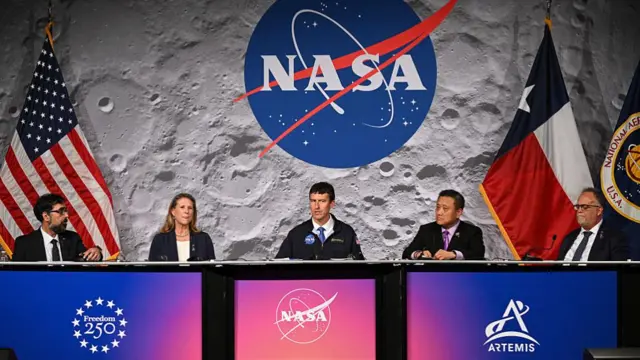
    • Howard Hu, Nasa Orion program manager, said today marks the "start of a new era of human space exploration", with entry flight director Rick Henfling saying the next mission - due next year - is "right around the corner"
    • The Artemis II mission crew travelled 700,237 miles reaching a peak velocity of 24,664 mph during the journey, according to Henfling
    • Highlights of the mission were also recalled, with acting associate administrator Lori Glaze describing the observed solar eclipse as a "totally unique experience"
    • Following the stunning initial images we received from the crew in space, Lori Glaze says the team has "gathered a lot of data" to be analysed in the coming weeks
    • Hu also gave some touching personal remarks, saying that today was "thousands of times" better than Star Wars - a film he recalls going to see with his late father
  15. Glaze praises solar eclipse as 'totally unique experience'published at 04:31 BST

    The moon appears completely dark with sunlight appearing around its edgeImage source, Reuters
    Image caption,

    The view of the solar eclipse from the Orion spacecraft

    Lori Glaze says watching the Orion crew observe a solar eclipse during their lunar fly-by was a "totally unique experience".

    She says she feels "so proud" to have experienced the moment alongside the astronauts. You can see some of those images here.

    This brings the post-splashdown press conference to an end.

  16. Artemis II a 'challenge' for further successful missions, says Glazepublished at 04:25 BST

    The bright blue disk of the Earth pokes beyond the moon's surface, which takes up half the picture frameImage source, Reuters

    Lori Glaze says she would like the Artemis II mission to be seen as a "challenge", with Nasa aiming to land on the Moon twice in 2028.

    She calls on the rest of the space industry to "come with us" to achieve the goal.

  17. Nasa associate administrator looking forward to 'seeing his friends again'published at 04:24 BST

    The panel are sharing their personal highlights of the mission.

    Rick Henfling cites his as the naming of the two craters, while Amit Kshatriya's wish is a little more down to Earth - he's just looking forward to seeing his friends again.

  18. 'Important step' in the history of Nasa, Kshatriya sayspublished at 04:20 BST

    The Space Launch System (SLS) rocket with the Orion crew capsule, lifts off, creating a thick column of red flame as well as black smokeImage source, Reuters

    Amit Kshatriya is asked if he has a message to Nasa in 50 years and how he hopes the history books will remember this mission.

    He says he hopes the mission will be remembered for the significance of its achievement.

    "This is going to be an important step and hopefully history is kind to us as a result."

  19. Kshatriya: Artemis II is an 'inflection point' for Nasapublished at 04:15 BST

    Amit Kshatriya says Artemis II has been the "most important human space flight mission" Nasa has done in many decades.

    He says today is the end of a long journey and represents an "inflection point" for Nasa.

    Nasa officials give a press conferenceImage source, Getty Images
    Image caption,

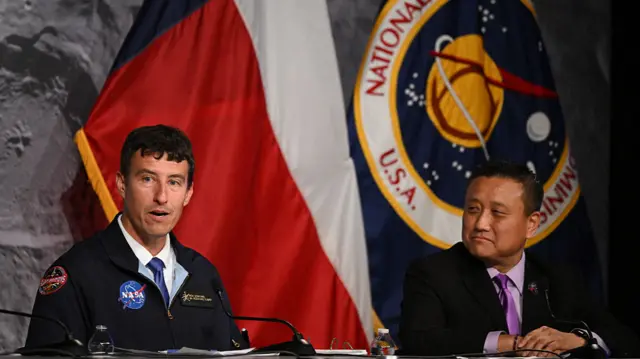
    Amit Kshatriya, left, says future Artemis missions will make a moon base possible

  20. Nasa gains 'confidence' to perform similar missions, says Kshatriyapublished at 04:10 BST

    Amit Kshatriya says this is a huge step to "build confidence" in Nasa being able to perform similar missions.

    He says the biggest objective of the Artemis II mission was to prove a crewed flight was possible.

    He adds it's possible to feel "paralysed" by risks when planning such missions.