Themes in About a Boy
Nick Hornby raises several themes in the novel, and the three principal ones are:
- Isolation
- Adulthood
- Depression and mental illness
Isolation
Will and Marcus both live in London, a huge, bustling city. It is impossible to know everyone, but each area has its own community, and within that community people form various groups, made up of work colleagues, family and friends. Hornby has set the novel in and around Holloway, in north London, which is an area he knows and loves (Hornby lives in nearby Highbury).
At the start of the novel Marcus and his mother have only been living in London for two weeks, and Marcus finds it very different from Cambridge, where he used to live. He thinks that Holloway has nice bits and ugly bits. The book looks at the way that we all need our own communities for companionship, love and support. If we try to resist belonging to such a group, we find ourselves isolated. Will thinks that if he keeps a distance between himself and the outside world, never allowing himself to become too close to another person, then he will not be hurt or disappointed.
On the other hand, Marcus feels afraid because he only has his mother, and after her failed suicide attempt, he desperately tries to bring other people into their network so that, in the event of her trying again, he will not be left alone. Therefore, Hornby shows two different forms of isolation – one where the person is afraid to bond with others in case he gets hurt; the other where a person is desperate to form bonds with others in case he gets hurt.
How is the theme of isolation shown in the novel?
In About a Boy, Nick Hornby explores isolation through:
- the way that Marcus views the world
- the way that Will views the world
| How does Hornby show this? | Evidence | Analysis |
|---|---|---|
| Marcus feels isolated even in his own home | ||
| At the start of the novel Marcus wonders why Fiona is sad. | “… he didn’t know. His mum was sad, he knew that – she cried a lot now, more than she did before they moved to London – but he had no idea whether that was anything to do with boyfriends.” | Marcus is too young to understand about his mother’s depression. He just knows that she is sad and that he cannot help her. He wonders whether the reason is the fact that Fiona’s relationships never seem to last very long. The reader can see that it is because of her depression that her relationships are short-lived, and not the other way round. |
| “What could be wrong with her that he wouldn’t know about? She was in work so they weren’t poor […] What else made you cry, apart from money? Death?” | When Marcus is not in school, he spends most of his time worrying about his mother, and this cuts him off from other people as he does not know anybody in whom he can confide. | |
| Marcus is isolated outside the home too | ||
| Marcus is bullied at school and on the way home. | “‘What you singing, Fuzzy?’ He’d done it again. He’d been thinking of one of his mum’s songs, a Joni Mitchell one about a taxi, but it had obviously slipped out again. They all started humming tunelessly, throwing in nonsense words every now and again, prodding him to get him to turn around.” | Marcus is an easy target for bullies as he looks different from other boys because of his old-fashioned clothes and haircut. He is also prone to start singing aloud at inappropriate times. Although nobody has physically hurt him, the constant low-level bullying is making Marcus feel very lonely. |
| Marcus takes matters into his own hands and acts to isolate himself further | ||
| Marcus plays truant for the first time in his life. | “He just walked out the way he had come in, and kept on walking […] he felt different, better, as if he’d let go and he was now falling through space.” | When Mrs Morrison, the head teacher, accuses him of not trying hard enough to avoid being bullied, Marcus cannot take it any more. He thinks that he must isolate himself from everyone else because he is the only person on whom he can depend. For the reader this is a sad realisation. There should be a network of people waiting to help Marcus. |
| Marcus tries to extend his network of people | ||
| Marcus realises that he needs more than just his mother in his life. | “Two wasn’t enough, that was the trouble. He’d always thought that two was a good number, and that he’d hate to live in a family of three or four or five. But he could see the point of that now: if someone dropped off the edge, you weren’t left on your own.” | Marcus decides to arrange matters so that his mother and Will get together. As he is only a child, he does not really understand that two adults who are introduced will not necessarily get on. In fact, Fiona and Will are not at all suited to one another romantically. |
| Marcus realises that you need more than just one person | ||
| Marcus comes to hero-worship Ellie, thinking that she can protect him from all the bad things. | “Once again, Marcus was left with the feeling that Ellie didn’t have to do what she had just done, and that she had brought the trouble she was in upon herself. He was tired of it. It wasn’t real, and there was enough real trouble in the world without having to invent things.” | At first, when Ellie takes Marcus under her wing, Marcus feels protected and he thinks that she is amazing. As time passes, Marcus comes to see that it is not possible to depend wholly on just one person, because everybody has weaknesses and faults and might break down at any time. On the day of Kurt Cobain’s suicide, Marcus finally understands that Ellie is no more in control of her life than Marcus is of his. This is when he realises that we all need a lot more than just one person to depend upon. |
| Will is isolated by his own choices | ||
| Will watches other people’s lives from the outside. | “Now, though, it was easy. There was almost too much to do. You didn’t have to have a life of your own any more; you could just peek over the fence at other people’s lives, as lived in newspapers and EastEnders and films and exquisitely sad jazz or tough rap songs.” | Will makes the choice of living his life vicariously, and is secretly frightened of being hurt or let down. He does not realise – but it becomes obvious to the reader – that because his childhood was lacking in love and affection, he has built a protective wall around himself in order to avoid further disappointment. |
| Will watches the fallout from Fiona’s suicide attempt | ||
| After Fiona tries to kill herself, Will goes to the hospital with Suzie and Marcus. | “… You had to live in your own bubble. You couldn’t force your way into someone else’s, because then it wouldn’t be a bubble any more. Will bought his clothes and his CDs and his cars and his Heal’s furniture and his drugs for himself, and himself alone” | Will does not have much sympathy for Fiona. He considers that she has not done a good job of looking after herself because she needs other people to help her with Marcus and her problems. He congratulates himself on his self-sufficiency. |
| “… It had all been very interesting, but he wouldn’t want to do it every night.” | As he leaves the hospital he tells himself that he is grateful that he has no such problems, not realising that it is these everyday problems which make us part of the human race. | |
| Will warns himself not to get involved with anybody | ||
| When Will has a drink with Fiona, she tells him that he has a responsibility to help Marcus. | “… Why did these people want to make things so hard for themselves? It was easy, life, easy-peasy…” | Will is becoming more involved in Marcus and Fiona’s lives, and when he sees how messy it can become, his automatic reaction is to back out. He considers any relationship at all to be risky. |
| “But I’m on my own. There’s just me. I’m not putting myself first, because there isn’t anybody else.” | When Fiona tells him that he is being selfish and cannot see Marcus again unless he promises to help him, he does not understand why she is being so unreasonable. | |
| Will is still tempted to remain isolated at the end of the novel | ||
| Will feels afraid when he is in a serious relationship with Rachel. | “Wanting Rachel so much still frightened Will. At any time, it seemed to him, she might decide that he was too much trouble […] She might die, suddenly, without warning […] He felt as if he were a chick whose egg had been cracked open […] All he knew was that there was no going back” | Once Will is in an established relationship with Rachel, the woman of his dreams, he has to think seriously about what living among other people, rather than alone, means. |
| Will accepts that being involved with people is risky but rewarding | ||
| At the end of the novel, Will looks at Marcus and analyses how both of them have changed. | “[They] had had to lose things in order to gain other things. Will had lost his shell and his cool and his distance, and he felt scared and vulnerable, but he got to be with Rachel […] and Marcus had lost himself, and got to walk home from school with his shoes on.” | Will understands that as an adult, he should have realised that we all need to let go of our desire to be in control of our lives. He also sees that Marcus, as a child, needs support from the people around him, in order to let him find his own way in life. |
Adulthood
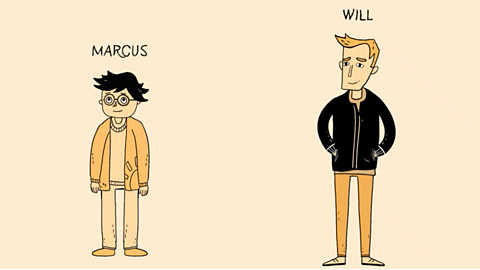
The theme of adulthood and growing up runs through the novel. We are able to see how Will views himself and the world around him. He is a 36-year-old man and, with his life experience, should really be more analytical about people and situations. However, it could be said that he refuses to grow up and is more like a child trapped inside a man’s body.
By contrast, we also see the world through Marcus’ eyes, and he is so weighed down by worry and responsibility that he seems more like a man trapped inside a 12-year-old’s body. Gradually, as the novel unfolds, we see the two characters exchange roles, until Will eventually accepts that he is a grown-up with commitments to other people, and Marcus learns to accept that adults are not his responsibility and that he is not to blame for other people’s failings, such as his mother’s depression. At the end, Will is a normal adult and Marcus is a normal child.
How is the theme of adulthood shown in the novel?
In About a Boy, Nick Hornby explores adulthood through:
- showing how Marcus gradually sheds all his worries and becomes a normal child
- showing how Will learns to accept responsibilities and becomes a normal adult
| How does Hornby show this? | Evidence | Analysis |
|---|---|---|
| Marcus has a lot of worries at the start of the novel | ||
| Marcus is worried about being bullied. | “‘You’ll get used to it,’ his mum said as he was eating his cereal, probably because he was looking miserable.” | Marcus is eating his breakfast before leaving for school. He knows that he must face bullies every day, in and out of school, and he needs an adult to sort it out for him. His mother should be the one who does this, but she is so weighed down with her own concerns that she hardly notices that her son is so miserable. The fact that he is eating his cereal seems to emphasise the fact that he is only a schoolboy, because it is repeated in the book as part of his morning routine. |
| Marcus has to cope with his mother after her suicide attempt | ||
| When Fiona comes home from hospital, Marcus feels a huge burden of responsibility for her, and she does not realise this. | “He couldn’t speak. He didn’t know what to say. He didn’t cry either. It was much too serious for that. So he just stood there.” | Marcus feels abandoned by his mother when she takes an overdose and tries to kill herself. He does not know how to react. Marcus reacts in a mature way, even though he cannot understand why this has happened. Any other child might not realise how serious the suicide attempt was, but Marcus knows that it is an enormous thing that will have consequences which stretch into the future. |
| “… everything he looked at seemed to have something about death in it, and he didn’t want to watch anything about death. He didn’t want his mum to watch anything about death, come to that, although he wasn’t sure why.” | When Marcus goes to rent a video, he feels a responsibility towards his mother, wanting to shield her from the evils of life. This is normally what a parent would be expected to do for their child. | |
| Marcus dresses in a very old-fashioned way | ||
| Marcus seems to have no idea about fashion. | “… Marcus came round just after midday, in the hairy jumper Fiona had given him for Christmas and a disastrous pair of canary-yellow cords that might have looked cute on a four-year-old.” | Most small children simply wear what their parents put on them but, as they grow older, they generally develop their own sense of fashion and become quite choosy. Marcus is more like an old man, in that he is happy to wear whatever is provided for him. It signals that he has far greater worries in his life than his clothes. |
| “He dressed better – he had won the argument with his mother over whether he should be allowed to go shopping with Will – and he had his hair cut regularly…” | At the end of the novel Marcus is far more like a normal teenager and this is largely to do with Will explaining to Fiona that Marcus was a target for the bullies in his unfashionable clothes. | |
| Will shows his immaturity by doing questionnaires in magazines | ||
| Will buys a lot of magazines. | “Will didn’t know how seriously you were supposed to take these questionnaire things, but he couldn’t afford to think about it; being men’s–magazine cool was as close as he had ever come to an achievement, and moments like this were to be treasured.” | Most men aged 36 do not take the results of magazine questionnaires seriously. It is a sign of Will’s lack of maturity that he does so, and it also shows how much time he has on his hands because he has never had a job. |
| Will feels that he is the right person to help Marcus | ||
| Will realises that Marcus has no idea about topics which are of interest to other boys his age. | “Marcus needed help to be a kid, not an adult. And, unhappily for Will, that was exactly the kind of assistance he was qualified to provide. He wasn’t able to tell Marcus how to grow up, or how to cope with a suicidal mother, or anything like that…” | At this point in the novel, it is starting to dawn on Will that he is not the same as most men of his age. He is not yet concerned that he is more informed about issues which are of interest to young people, but as the novel progresses he does see that he needs to grow up and be more of a responsible adult-figure. |
| Rachel makes Will see that he needs to have more purpose in his life | ||
| Rachel tells Will that he could very easily be depressed. | “‘There’s always a new Nirvana album to look forward to, or something happening in NYPD Blue to make you want to watch the next episode.’ ‘Exactly.’ ‘That’s the point? NYPD Blue? Jesus.’ It was worse than he thought.” | Although Rachel seems to be congratulating Will on being able to cope without other people or even a job, she actually makes him see that his life is pretty aimless. He loves her so much that he wants to be the best he can be for her, and this is when he begins, at last, to behave as a grown man. |
Depression and mental illness
In About a Boy, Nick Hornby explores some aspects of mental health or well-being. Through the character of Fiona, Hornby looks at the way people with depression try to cope with everyday life while they may be feeling helpless or even suicidal. Hornby himself has experienced depression.
Hornby has a son, Harry, who has Autism is a neurodevelopmental condition which often involves differences in thinking patterns, sensory processing, communication and social interactions. Because autism affects people differently, some people don't need a lot of help, but others might need extra support throughout their life., and he was directly involved in the foundation of a charity – TreeHouse Trust – while trying to find specialist education for him. Marcus could be described as being mildly autistic; he does not get jokes or sarcasm and usually takes everything he hears literally, which is a typical response for somebody who is autistic. It is important to understand that autism is not an illness or a mental health condition, but rather a difference in how the brain processes information. However, it can cause a lot of difficulty and sadness for autistic people when society fails to recognise or understand their differences and accommodate them. Some of the difficulty Marcus experiences may be due to this, if he is on the autistic spectrum.
Through Fiona and Marcus, Hornby demonstrates that mental health issues are just another aspect of life, as common as any other problem.
How are the themes of depression and mental well-being shown in the novel?
- In About a Boy, Nick Hornby explores depression and mental health through Fiona’s depression and how it has an impact on her and the people around her.
- It isn’t confirmed in the novel whether Marcus actually has autism or not, but there may be some exploration of this theme regarding Marcus and some of his autistic traits – namely, his failure to understand sarcasm and his discomfort with ‘small talk’ (trivial, everyday conversation).
| How does Hornby show this? | Evidence | Analysis |
|---|---|---|
| Fiona experiences depression | ||
| Marcus shows how Fiona is behaving from Marcus’ point of view. | “He didn’t want to watch any of the soaps, because soaps were full of trouble, and he was worried that the trouble in the soaps would remind his mum of the trouble she had in her own life.” | Hornby allows the reader to track Fiona’s descent into a new bout of depression through Marcus’ eyes. She is feeling sad at first, and Marcus grows increasingly alarmed as she seems to become sadder. |
| “One Monday morning his mother started crying before breakfast and it frightened him. Morning crying was something new, and it was a bad, bad sign.” | Every few days, there is a more sinister indication that Fiona’s depression is worsening. Marcus is unable to do anything as his mother cannot explain to him why she feels this way. | |
| Fiona calls in sick to her work, but Marcus cannot see how she is sick. | “When he got home his mother was lying on the floor with a coat draped over her, watching children’s cartoons. She didn’t look up.” | Hornby shows how difficult it is for other people to understand how to help somebody who is depressed. Marcus is beside himself with worry, but at the same time he feels resentful that his mother is not looking after him. |
| “His mum was half on and half off the sofa: her head was lolling towards the floor. She was white, and there was a pool of sick on the carpet, but there wasn’t much on her – either she’d had the sense to puke away from herself, or she’d just been lucky.” | Fiona takes an overdose of pills and would have died if Marcus, Suzie and Will had not come home when they did. Marcus is aware that everything has changed, because his mother has proved that she would rather be dead than be with him. | |
| Marcus finds his mother’s suicide note to him. | “A big part of me knows that I’m doing a wrong, stupid, selfish, unkind thing. Most of me, in fact. The trouble is that it’s not the part that controls me any more. That’s what’s so horrible about the sort of illness I’ve had for the last few months – it just doesn’t listen to anything or anybody else. It just wants to do its own thing.” | In this note, Hornby describes how depression feels. The reader sees that Fiona is controlled by the illness, and is able to sympathise with her, even when Marcus is traumatised by it. As time moves on, he begins to understand that his mother is learning to live with her depression and sees that it is nothing to do with him or his behaviour. |
If you choose to write about some of Marcus’s more autistic-coded behaviours, it is extremely important to understand that autism is not a mental illness, simply a mental difference.
Test your knowledge of the themes in About a Boy
Further study
Bookclub. podcast
James Naughtie and a studio audience meet novelist Nick Hornby to discuss About a Boy – his insight into laddishness, masculine wish-fulfilment, fear and love.

Listed Londoner. audio
Nick Hornby was born in 1957, in Surrey. His dad, Sir Derek Hornby, was the chairman of London and Continental Railways. Before becoming a novelist, he worked as a secondary school English teacher.

World Book Club. podcast
Nick Hornby talks to an audience about his book Fever Pitch – about being an Arsenal football fan. Presented by Harriett Gilbert.

More on About A Boy
Find out more by working through a topic
- count5 of 5
- count1 of 5

- count2 of 5