Form
The form of a text is the type of text you are reading or watching. The Some poems adopt specific 'forms'. For example, they could be sonnets or narrative poems. Many don’t have an identifiable form. of Philadelphia, Here I Come! is a dramatic play, which means the text we study is the script used by actors and directors to perform the play in front of an audience.
Philadelphia, Here I Come! is a A play or novel that blends elements of both comedy and tragedy, making it both sad and funny.. Private’s sarcastic comments can be funny, but they also highlight the lack of communication between father and son.
The relationship between Gar and S.B. doesn’t change at all through the play, even though we realise there are many feelings that go unspoken between them.
So despite the frequent comic episodes, much of the A type of drama in which characters undergo suffering or calamity and which usually ends with a death. A sad or catastrophic event causing suffering or death. in the play lies in the fact that it is the study of a family where communication has completely broken down.
In order to analyse form you must:
- consider what aspect of form you are looking at
- think how Friel has used this for effect
- think how this could impact the audience
Structure
The The way the poet has organised the poem on the page eg number of stanzas, lines per stanza, breaks in between lines and stanzas. of a text refers to the way in which events are organised inside the play as a whole. Philadelphia, Here I Come! does not have a plot as such, the action is all in one evening in the present time and takes place over a few hours.
On his last night in Ireland a series of visitations – some real and some in his imagination – force Gar to confront the choices he has made. The structure is linear, but because many of the events we are shown happened previous to this evening Friel uses the When a writer includes a scene from the past to help explain something in the current story. device.
The action therefore jumps back and forth as we see events from the past in flashback. This emphasises the importance of the past to what is happening now. It also helps to explain the lead up to Gar’s decision to emigrate.
However, the comedic fantasies of Private as he imagines Gar as a company president and looks forward to the promises of America means that both the past and the future become important on this night.
The events of the play are organised into three episodes. There is an interval at the end of Episodes I and II. Episode III is divided into two parts. This structure has various different effects:
- Firstly, it means that tension is built up as the evening goes on. Even though the action is over a short time, the intervals keep the audience on edge, wondering if Gar will go or not.
- It also means that as the tension rises the pace of the play quickens.
- As we get nearer the end of the play it puts pressure on Gar to communicate properly with his father on what will be their last night together.
The conclusion of each episode is also important. Episode I ends on a nostalgic note, with both Public and Private singing “Philadelphia, Here I Come” as Gar Something that outwardly appears one way, but underneath there's the hint of something different. looks forward to his departure. This hides the fact that the singing is an avoidance tactic to escape his thoughts of Kate Doogan and his mother.
Episode II ends with thoughts of Kate Doogan again. But this time there is more tension in Gar’s desperate plea – shouted to himself but addressing S.B. – to “Say something, father!”
Episode III, Part One concludes on an apparently calmer note as the “slow curtain” closes on S.B. and the Canon’s draughts game. But the conversation they are having about whether there’s “hope” for S.B. seems to have a double meaning. When the Canon says “You’re not too late yet” we immediately link this to the time running out for S.B. to communicate with his only son.
Therefore, the episodes are structured to gradually build up a sense of urgency as we hope that the two men will reach out to each other before it is too late.
Language and dramatic methods
Language refers to the choices in style and vocabulary made by the writer.
As Philadelphia, Here I Come! is a play, the language can be split into The words said by a character in a story or play. and stage directions. The dialogue is realistic and it can:
- add personality to the characters
- help the audience understand their motivations and relationships
- move the action forward
The stage directions tell the actors what to do on stage or how to say their lines. In Philadelphia, Here I Come! the stage directions give information about the physical appearances of the characters and setting, highlighting aspects of how the actors should look, speak and move.
When analysing the language Friel uses, it’s useful to examine:
- What are the ideas Friel is trying to get across?
- How has he chosen particular words to reflect this?
- What effect does this have on the audience?
In order to analyse language you should:
- Choose a section from the text to analyse and then select a quote from it. Make sure that it is relevant to the question and the point you want to make.
- Consider how the quote reflects character/theme/context. If the quote contains a language device or dramatic method (such as repetition, A metaphor is a word or a phrase used for dramatic effect, to describe something as if it were something else., slang or a note about staging such as lighting) then name the method.
- Explore in detail the impact specific words or phrases have upon the audience.
- Evaluate how effective the author's choice of language is.
Stage directions
The stage directions are the part of the script. They are often in brackets or italics.
Stage directions tell the actors how they are to move or speak their lines. While they do not form the dialogue of the play, they are obviously important as they inform us what the writer intended the audience to see on stage.
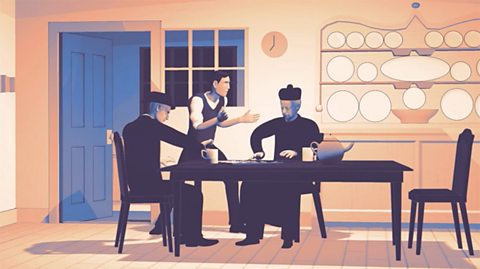
For example, the stage directions in Philadelphia, Here I Come! often show us that the dialogue is not what it seems. This is apparent when S.B. seems unconcerned about his son’s impending departure, but the stage directions indicate his real feelings may be different when they inform us that the newspaper he has been concentrating on “has been upside down” all along.
Use of dialogue
Friel’s use of dialogue changes depending on character and situation. The boys and – at times – Gar speak in Donegal The language or dialect spoken by the ordinary people of a country or region.. This creates realism as it is the speech pattern we would associate with young men living in this rural area. Other characters - such as Senator Doogan and Master Boyle – speak the A form of speech that lays claim to a grammatical 'correctness' and clear pronunciation, avoiding slang and valuing precision. of educated men. Gar Private’s language is quite poetic at times, especially when he evokes memories of or mentions his mother. When he reminisces about his time with the boys he uses the The use of language to create images and pictures in the reader's mind. of alchemy: “just the memory; and even now, even so soon, it is being distilled of all its coarseness; and what’s left is going to be precious, precious gold …” We see vivid description in his childhood memory of his father, ‘just the two of us fishing on a lake on a showery day – and young as I was I felt, I knew, that this was precious, and your hat was soft on the top of my ears – I can feel it – and I shrank down into your coat – and then, then for no reason at all except that you were happy too, you began to sing’. This description is rich in sensory detail, showing the importance of this memory to Gar as he prepares to go.
Use of monologue
Private’s A speech delivered by a single character in which he or she is thinking out loud. obviously show the internal monologue of Gar, but at times Friel also uses monologues to show Madge’s feelings. Her final monologue is important as we see how she too will miss Gar. This monologue also contributes to the tragedy in the play as she concludes by surmising “And when he’s [Gar] the age the boss is now, he’ll turn out just the same. And although I won’t be here to see it, you’ll find that he’s learned nothin’ in-between times.” Her prediction of the cycle of men who are frightened of showing emotion leaves us with little hope for change at the end of the play.
Split character
Brian Friel uses an experimental dramatic technique in the play. He creates Gar Private – who can’t be heard by the other characters – to allow us access into Gar’s thoughts and feelings. The only one who hears Private is Gar Public, who never looks at him. The use of internal monologue allows us into Gar’s private thoughts. Here sentences are sometimes reduced to fragments, jumping from one thing to another and left unfinished as our own thoughts often are, adding to the realistic quality of the drama. Through this innovative dramatic device, Friel explores the complex contradictions of personality and the ‘I’ we show to and hide from other people.
Flashback
The past is important in this play and through flashback we see Gar reviewing the significant events that led to his decision to emigrate. He remembers his love of Kate Doogan, but also his interview with her father – the superior Senator Doogan – and how he bottled out of asking him for Katie’s hand in marriage. He recalls too when his aunt, Lizzy Sweeney, visited and how she was desperate for Gar to come to Philadelphia so she can mother him. She cries “My son, Gar, Gar, Gar …” as she throws her arms around him. These two incidents are re-enacted, with the action of the play shifting between past and present showing how they are linked. Lizzy’s visit coinciding with Kate Doogan’s wedding day brings all Gar’s emotions together, overwhelming him so much that he decides to emigrate.
Silence
Friel’s use of silence between the characters emphasises the distance between them. Because of Gar Private’s incessant commentary, it is often easy to forget that there is actually silence on stage if you remove what are essentially Gar’s internal thoughts. Private’s long monologues often hide the lengthy silences when father and son are on stage together. These awkward silences contrast with the memories S.B. has of when Gar was a child and S.B. “couldn’t get a word in edgeways with all the chatting he used to go through” – showing that there used to be much affection and companionship between them. Here S.B. poignantly echoes Madge’s sarcastic comment earlier in the play that “A body couldn’t get a word in edgeways with you two!” – highlighting how little they say to each other these days.
Poetic refrain
Gar repeatedly recites the opening lines from Edmund Burke’s Reflections on the Revolution in France, a piece of writing critiquing the French Revolution that was criticised for idealising pre-Revolutionary France and the governing royal family. Perhaps this is a piece of writing that he remembers from studying “Arts” for “one year at University College”, and so the repetition of it throughout the play may highlight his regret at not pursuing his studies. On the other hand, Friel may have intended to show this as another form of escape for Gar as he seems to repeat these lines to distract himself from thoughts and feelings he wants to avoid. Considering the piece of writing he is quoting, perhaps Friel also uses an A quick reference - often to an image, character or place - from a work of literature or music or mythology. to remind us of how Gar may be idealising the past – for example in his memories of Kate Doogan or the boys.
Steam of consciousness
The fragmented nature of some of the dialogue – in particular that of Gar Private – shows Gar’s confused state of mind as he recalls the past, imagines the future and deliberates over whether he is making the correct choice. The disjointed sentences, exclamation marks, dashes, The omission of a word or words usually indicated by three dots. and A conclusion or statement that does not logically or correctly follow from the meaning of the statements that led to it. in Private’s monologues show the reality of the thinking process. They also convey what Gar is going through. While the real characters sit on stage in silence, this internal aspect of Gar’s personality is in turmoil.
Title
The title of the play combines the lyrics of the song California, Here I Come by Al Jolson and the name of the American city, Philadelphia, that Gar is emigrating to. Although the exclamation mark in the title suggests enthusiasm and excitement at the impending journey, the original song is in fact about missing one’s home. Lyrics such as “California, I’ve been blue / Since I’ve been away from you” and “California, here I come / Right back where I started from” show a person longing to go back to where they came from. Perhaps Friel is using the title ironically to portray Gar’s Having mixed feelings or contradictory ideas about something or someone. attitude towards emigration.
Test yourself
Further study
The Opening of Translations. video
The tricky opening of Brian Friel's play Translations at the Guildhall in Derry.

Last Word. audio
Matthew Bannister talks about the life of playwright Brian Friel, among others.

Obituary: Brian Friel
BBC News NI Arts Correspondent Robbie Meredith looks back at the career of 'the Irish Chekhov', Brian Friel.

More on Philadelphia, Here I Come!
Find out more by working through a topic
- count1 of 5
- count3 of 5


