Applicable context
Brian Friel was born in Tyrone in 1929 and trained as a teacher in Belfast, teaching maths before beginning his writing career. 1964’s Philadelphia, Here I Come! was his first great success, and the first of his many plays set in the fictional town of Ballybeg, Donegal.
Emigration from Ireland had been going on for centuries, reaching its highest numbers during the Great Famine in Ireland in the mid-1800s; it is well established that more people have emigrated from Ireland to live abroad since 1700 than the highest ever existing population of the country (8.5 million people, just before the famine). Traditionally an agricultural land with little industry and a long history of colonialism and its associated social issues, Ireland seemed to offer little to those who wanted a better life; the ongoing loss of its young people and their potential only made it harder to change the society left behind. America in the 1960s was seen as a land of money and opportunity; this contrasts with the nature of Ballybeg as a place lacking in job opportunities for its young people. In creating the fictional Ballybeg, Friel was reflecting the real Ireland from which a great proportion of young people emigrated in search of work and a new life.
The 1960s is often generally portrayed as a turning point in western society, with greater freedom and the beginnings of more modern attitudes to things like the roles of women and the influence of religion. However, Ballybeg (and Ireland in general) is shown to be very far away from these social revolutions. The Catholic church still held great power over Irish society even when it failed in its supposed mission to support and protect its congregation, as shown in Gar Private’s frustration with the Canon’s lack of communication in the play. Women were treated as second class citizens and expected to be concerned only with caring for others, as Madge does. Even someone like Kate, who is young, wealthy and well educated, cannot make her own decisions about who she should marry; it’s made clear by her father that she is expected to marry the ‘respectable’ man chosen by him and prioritise money and status over love. Friel shows how Ireland is slow to catch up with the rest of the world, and how this reinforces the decision of many young people to leave.
Themes in Philadelphia, Here I Come!
Themes are ideas that run all the way through a literary text. By analysing them you can better understand the writer's intentions.
Friel uses the tiny fictional town of Ballybeg as a setting for the play. The close, sometimes closed-off nature of small-town life, contrasted with the promise of opportunity elsewhere, allows him to explore a variety of themes.
The main themes in Philadelphia, Here I Come! are:
Communication
Love
Escape
Memory
Philadelphia, Here I Come! is a tragicomedy. It's about a young man's coming of age and it's the study of a family where communication has completely broken down.
The theme of coming of age shows in Gar O'Donnell’s difficult separation from his family and his first steps towards making a new life by escaping to America.
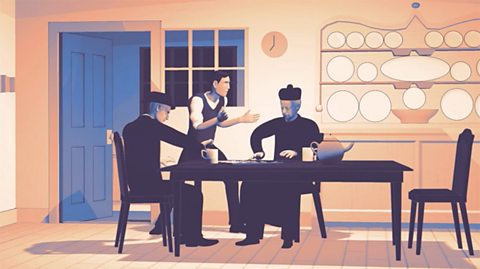
Gar is the only son of a father, S.B. O'Donnell, who, even though he can’t express his love, or any feeling at all, totally depends on Gar.
Gar recognises this dependence during their final conversation, when he tells S.B. about things that need done in the shop.
As for S.B., he tries to convince himself he'll be okay. "I’ll manage rightly", he says to Madge, the old housekeeper.
It seems that both characters can only communicate through Madge.
Brian Friel uses an innovative dramatic technique in the play. He creates Gar Private, who can’t be seen by the other characters, and the only one who hears 'Private' is Gar Public, who never looks at him.
With this dramatic technique, the audience sees and hears Gar’s 'alter-ego' – his conscience.
Private’s sarcastic comments can be funny, but they highlight the lack of communication between father and son.
Madge knows the problem:
A body couldn’t get a word in edgeways with you two!
Through Private, we see Gar escaping into flights of fancy. But these get him nowhere, and his problems stay the same. He repeatedly recites a poem to try to avoid painful memories.
Gar's friends, "the boys", also use escapist fantasy to make their lives bearable, especially when they fool themselves that girls fancy them!
The past is important in this play and the idealisation of the past is achieved through the dramatic techniques of flashback and internal monologue, like when we see Gar reviewing the significant events that led to his decision to emigrate.
He remembers his love for Katie Doogan but also his interview with her father, the superior Senator Doogan, and how his cowardice prevented him from asking Senator Doogan for Katie's hand.
He recalls too when his drunken aunt, Lizzy Sweeney, visited. She is desperate for Gar to come to Philadelphia so she can "mother" him.
These two incidents are re-enacted, with the action of the play shifting from past to present.
The use of internal monologue allows the audience into Gar's private thoughts, with sentences sometimes reduced to fragments, adding to the realistic quality of the drama.
As ever, Gar Private is vocal in cajoling, warning and even ridiculing Gar Public:
He’s talking to you, thick-skull.
S.B. gives the impression of not caring but again, Friel's use of stage directions indicate SB's true feelings:
sees the cases, goes over to them, touches the coat.
Madge too is upset. Friel reveals this through her monologues and in the stage directions, as in when, near the end, Madge takes the money she has saved to get her "feet done" and slips the envelope into Gar's coat pocket.
The relationship between Gar and S.B. doesn't change a bit throughout the play – tragic.
Communication
Philadelphia, Here I Come! is a A play or novel that blends elements of both comedy and tragedy, making it both sad and funny.. It is the study of a family where communication has completely broken down. It becomes clear soon after the play begins that the The chief character in a novel, film or play., Gar O’Donnell, has a strained relationship with his father, S.B. O’Donnell.
Gar, S.B. and Madge
S.B. is absent from the stage for much of Episode I, possibly to suggest that he is absent from Gar’s life. When we do see them together, much of the conversation is provided by Gar Private, who articulates Gar Public’s thoughts and feelings. This means that the stage – to the characters involved – is actually in silence. Look for examples of this and imagine the scene without Private’s commentary to see the effect.
Gar Private chats incessantly. His sarcastic comments can be funny, providing much of the play’s comedy, but they highlight the lack of communication between father and son – thereby providing much of the A type of drama in which characters undergo suffering or calamity and which usually ends with a death. A sad or catastrophic event causing suffering or death. too. It is the contradictions here that make the play a tragicomedy.
Madge – the O’Donnell’s housekeeper – recognises the problem. She also uses sarcasm when she comments, “A body couldn’t get a word in edgeways with you two!” Along with the imaginary voice of Private, Madge is often the only voice breaking the silence when Gar and his father are together. At times it seems that both characters can only communicate through Madge; for example when Gar resorts to asking Madge about his mother because S.B. gives so little away.
Like Gar’s pretence that he is excited about emigrating, S.B. also gives the false impression of not caring about Gar’s imminent departure. He makes Gar work overtime on his last day, he fails to mention that Gar is going at all and his routine continues as if there is nothing extraordinary about this – but the stage directions indicate his real feelings. We see this in Episode II when he reads his newspaper and seems to ignore Madge’s frustrations – but the stage directions note that the newspaper “has been upside down”.
Similarly in the final episode – when S.B. can’t sleep – he gets up and sees the cases outside Gar’s room. The stage directions note that he “goes over to them, touches the coat, goes back towards the table, and sits there, staring at the bedroom door”. While S.B. may not communicate his feelings, Friel shows that the impending departure is playing on his mind and that he is going to miss Gar.
In contrast to S.B., Madge seems very emotionally open. This is evident when she loses control after her frustrations and exhaustion build up. We also see it in her ability to talk openly to Gar about his mother. Yet she also hides her feelings at times. When her nephew and his wife have a baby she is delighted that they “are going to call this one Madge”. This is contrasted with her revelation in the final episode that “They’re going to call it Brigid.” Madge doesn’t bring this up in her subsequent conversation with Gar, perhaps hiding her disappointment in much the same way many of the other characters hide theirs.
Other characters
The boys too seem unable or unwilling to communicate that they will miss Gar, despite this being the last time they will see him. Their macho posturing and tales of girls and adventure – which Private’s contradictory commentary tells us is all untrue – seem to be a way to avoid talking about Gar’s imminent departure.
When Ned removes his belt and presents it to Gar as a leaving present, he is described using the adverbs“shyly, awkwardly”. This shows that even during a farewell he is uncomfortable about any kind of real affection.
Friel shows us that even in the past this problem with communication was an issue. Aunt Lizzy recalls S.B. and Maire’s wedding day, and how her “shoulders are sorta working – you know – and you couldn’t tell whether she was crying or giggling – she was a helluva one for giggling – but maybe she was crying that morning”. There seems to be a suggestion here that Maire wasn’t as happy in the marriage as S.B. and that she was perhaps trapped in a marriage with an older, rather cold man. However, because of the time and the circumstances, she just had to accept the consequences and ignore her regret.
Love
Gar, S.B. and Madge
Gar’s mother Maire died in the days following his birth, so S.B. is his only close family.
As Gar is his only son, S.B. O’Donnell totally depends on him. But he is unable – at any stage of the play – to express his love for his son or sadness at Gar’s leaving. S.B. says “I’ll manage rightly” to Madge, but we get the impression that he is trying to convince himself.
Madge tells Gar, “He said nothing either when your mother died.” This indicates that S.B. is unable to express emotion at anything – even the devastating death of his young wife. In some of his last lines in the play S.B. says “I was too old for her, Madge, eh?”, showing that he still thinks about Maire more than he lets on. Perhaps Madge is the best judge of his character when she says “just because he doesn’t say much doesn’t mean that he hasn’t feelings like the rest of us”.
Madge is the only mother figure Gar has ever known. Their easy intimate relationship is evidenced in the opening scenes of the play. Gar Private also admits, early in the play, “Madge, I think I love you more than any of them.” Gar Public does not say this aloud, so like many of the emotional feelings in the play this sentiment remains unspoken.
Madge herself is clearly upset by Gar’s departure. This is shown in her final A speech delivered by a single character in which he or she is thinking out loud.. It is also apparent in the stage directions near the end, when Madge takes the money she has saved to get her “feet done” and slips the envelope into Gar’s coat pocket.
Other characters
Gar’s romantic love for Kate Doogan is another aspect of his past life that he frequently reflects on. She is already married in the real time of the play, so we are unable to tell whether his When a writer includes a scene from the past to help explain something in the current story. is an honest depiction of what happened or whether it idealises their relationship. The flashback shows Gar to be physically infatuated with Kate; he cannot keep his hands off her. He exaggerates his desire by saying, “I’ll never last till Easter! I’ll – I’ll – I’ll bloody well burst!” The stage directions describe how he is “kissing her hair” and “catches her again” while also noting how “she avoids him”. He calls her by a variety of pet names, “my sweet Katie … my darling Kathy…”
It is also significant that at the end of Episode I – in real time and seemingly out of nowhere – he says “Kathy, my own darling Kathy –”. This shows that despite her marriage to someone else, Kate is still very much on Gar’s mind as he prepares to leave for America.
Gar recalls too when his drunken aunt, Lizzy Sweeney, visited. She is desperate for Gar to come to Philadelphia so she can mother him. Friel implies that Lizzy and her husband Con were unable to conceive when Lizzy says “we spent a fortune on doctors … but it was no good” and despite “all the love we had in us” they had no one to share their life with in Philadelphia. It is Happening in the opposite way to what is expected and maybe causing amusement because of it. that Aunt Lizzy is desperate for someone to love, but S.B. communicates so little love to his son.
Escape
Philadelphia, Here I Come! could be described as a ‘coming of age’ drama. It portrays a young man’s difficult separation from his family and his first steps towards making a new life by escaping to America – which in the 1960s was seen as a place of affluence and opportunity. In contrast to this land of aspiration, the characters reinforce the nature of Ballybeg as a place lacking in job opportunities for its young people. This reflects the real Ireland from which many young people emigrated in search of work and a new life.
Ballybeg is a fictional town. It is the setting for many Friel plays. The name comes from the Irish 'Baile Beag', which literally means ‘small town’. Even Friel’s choice of place name suggests a stultifying small town mentality, perhaps hinting at the conservative mindset of the place and its residents.
Private’s commentary in the opening scene refers to Gar “leaving the country of your birth, the land of the curlew and the snipe, the Aran sweater and the Irish Sweepstakes”. The stereotypical A literary device where an object, person, place, or event represents something beyond its literal meaning. mentioned here place Ireland in the past. This is reinforced when Private says that Gar’s plane to America will have its “snout pointing straight for the States, and its tail belching smoke over Ireland”, suggesting the future lies in America and Ireland must be left behind.
It is suggested in the play that Gar is escaping from many things – the routine life of his father, the lack of opportunity, his failed relationship with Kate Doogan, the suffocating nature of the town where he and his friends seem to have little to do and everyone knows everyone else’s business. Literally then, this move to America is an escape from all these things.
However, at times we also see Gar A metaphor is a word or a phrase used for dramatic effect, to describe something as if it were something else. escaping his thoughts of uncertainty and regret – avoiding the fact that he may not be entirely convinced that emigrating is what he really wants.
The split persona is used effectively in demonstrating Gar’s attempts to distract himself from facing reality – through Private he fantasises about becoming “president of the biggest chain of biggest hotels in the world” and about a life of “Great big sexy dames and night clubs and high living and films and dances”. Private’s visions serve to divert Gar’s thoughts from what is actually happening, but his problems remain the same.
At another point in the play, music is linked to memory when Gar Public absently sings She Moved Through the Fair, a romantic ballad which may show he is reminiscing about Kate. But Gar Private warns him to “Snap out of it, man! Get up and keep active! The devil makes work for idle hands!”
Gar’s friends, the boys, also use escapist fantasy to make their lives bearable. The boys’ tall tales of mischief and exploits with women – exposed as nonsense by Private – seem to mask the boredom and lack of opportunity Ballybeg offers these young men. One of the gang, Jimmy Crerand, has already actually escaped by emigrating.
There are suggestions that Master Boyle is an alcoholic. Perhaps he drinks to escape the suffocating life of a teacher in Ballybeg, but possibly also from his regretful memories of Gar’s mother with whom it is suggested he was in love.
Memory
Memory is a common theme in Friel’s plays. Dancing at Lughnasa for example is a memory play, told in When a writer includes a scene from the past to help explain something in the current story. by an adult narrator about his childhood. Memory was something that fascinated Friel. Philadelphia, Here I Come! has elements of a memory play as well. Although it is set in the present many of the scenes are flashbacks, and much of the The words said by a character in a story or play. references things remembered from the past.
Through these flashbacks we see memories of the events leading up to Gar’s decision to leave. His encounter with Senator Doogan, Kate’s marriage to Francis King and the visit from Con and Lizzy on the day of Kate’s wedding. The flashbacks give us background to Gar’s motives for leaving and help explain his Having mixed feelings or contradictory ideas about something or someone. about the move.
However, it is his present thoughts about these events which are important on the night he prepares to leave. Gar Private admits that being rejected by Kate was “a sore hoke on the aul prestige, eh?” Although he never admits it to any other character – including Kate – Gar Private says: “in the privacy of the bedroom, between you and me and the wall, as the fella says, has it left a deep scar on the aul skitter of a soul, eh?”
Private also recognises, in hindsight, that Gar’s decision to go was based on a combination of worrying that he will turn into his father and his feelings about Kate Doogan’s wedding day. Referring to Aunt Lizzy, he says “She got you soft on account of the day it was” and “because she said you were an O’Donnell – ‘cold like’.” The memories Gar has here reinforce his regrets at how things have turned out, and his uncertainty as to whether leaving is what he actually wants.
Memories haunt the characters throughout the play. We see this when Gar poignantly finds a newspaper in the old suitcase. This reminds him – and us – that it hasn’t been used since his parents honeymooned in Bundoran, a beach resort in Donegal. This is one of many occasions in the play where we find out about Maire O’Donnell, a character only shown to us through the memories of others. Lizzy and Madge reveal some aspects of her character but it is obvious – because of S.B.’s unwillingness to open up – that there is a lot Gar does not know about his mother.
These moments in the play are therefore emotionally loaded. This can be seen for example in the use of music – the dramatic A German classical pianist and romantic composer. His romantic music is elegant and light and his chamber works intense and dramatic violin concerto which is playing as Gar discovers the old newspaper.
We also see the theme of memory explored in the mismatching recollections that Gar and S.B. have of Gar’s childhood. Gar’s very vivid memory of fishing with his father in a blue boat shows a moment of “great, great happiness, and active, bubbling joy” from his childhood. S.B. contradicts this memory – much to Gar’s frustration.
However, it does seem to get S.B. thinking about Gar’s childhood as later in the scene he speaks – in a more lengthy piece of dialogue than we have seen from him before – of a memory of he and Gar “as happy as larks … him dancing and chatting beside me”. He recalls that Gar was wearing a “wee sailor suit as smart looking on him”, which Madge contradicts with “He never had a sailor suit.” However, this contradiction does not deter S.B., who insists Gar did have a sailor suit.
These memories and the importance they have for the characters – even if they are not accurate – show the ongoing affection they have for each other. Tragically, this affection has gone unspoken for many years.
Test yourself
Further study
The Opening of Translations. video
The tricky opening of Brian Friel's play Translations at the Guildhall in Derry.

Last Word. audio
Matthew Bannister talks about the life of playwright Brian Friel, among others.

Obituary: Brian Friel
BBC News NI Arts Correspondent Robbie Meredith looks back at the career of 'the Irish Chekhov', Brian Friel.

More on Philadelphia, Here I Come!
Find out more by working through a topic
- count1 of 5