How have LGBTQ+ communities been celebrated?
Pride Month is a time to celebrate acceptance, equality and raise awareness of issues affecting the LGBTQ+ community. Taking place in the UK every June, Pride Month has continued to evolve through the generations.
Commemorating the Stonewall Riots - monumental protests that helped grow a movement for gay rights - Pride has been celebrated for over half a century in the UK. The UK's very first Pride march took place in 1972 - but how has LGBTQ+ history been commemorated over time?
Here, BBC Bitesize takes a look at just five ways LGBTQ+ communities have been celebrated. You can find out more below.
1. Plaques
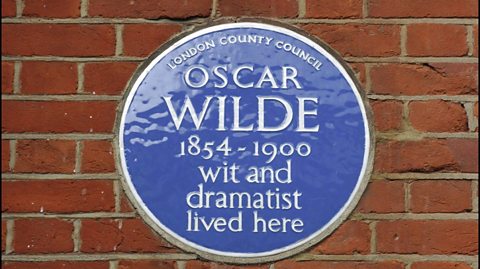
You may have noticed the blue plaques installed on certain buildings across England. These renowned historical markers are currently awarded by English Heritage, and are the oldest scheme of its kind in the world.
Many LGBTQ+ figures have been recognised with a blue plaque, whether for helping challenge public perceptions of sexuality and gender, or for significant contributions to their fields. Recipients of the blue plaque include the writers Radclyffe Hall, EM Forster, Virginia Woolf and Oscar Wilde, as well as the artist and activist Derek Jarman and the mathematician and computing pioneer Alan Turing.
English Heritage installs up to 12 new plaques each year. As a result, a number of plaque projects have been created to celebrate people that the wider public may not have otherwise known. These initiatives pay tribute to notable luminaries, such as The Black Plaque Project's recognition of the first openly gay professional British footballer, Justin Fashanu, and The Rainbow Plaques Project's marker for the lesbian diarist Anne Lister.
2. Pride marches
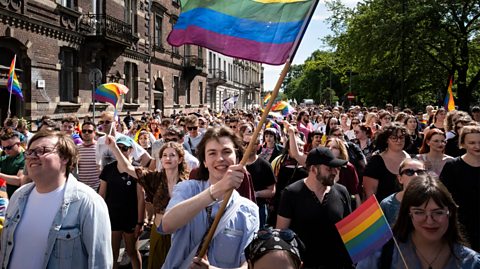
On 28 June 1970, a group of LGBTQ+ activists organised a march to demand civil rights in the streets of New York City. This protest is now recognised as one of the first Pride marches.
The parade was sparked by the Stonewall uprising a year earlier, when a group of LGBTQ+ people rioted following police raids on a gay bar called the Stonewall Inn. This kickstarted what is commonly acknowledged as the beginning of the modern LGBTQ+ rights movement.
Pride marches soon began to take place worldwide, often against a backdrop of homophobia. The oldest, and now largest, Pride march in Southeast Asia is the Metro Manila Pride in the Philippines, which started as an organised commemoration of Stonewall’s 25th anniversary in 1994, and has carried on since its formal establishment in 1996.
Shortly after there was a 1999 march in Kolkata, India, which began with barely 15 participants, all of whom were men. In 2015, Kingston, Jamaica held Pride JA, the first Pride celebration in the English-speaking Caribbean, a symbolic event for LGBTQ+ campaigners in the island nation.
3. Memorials
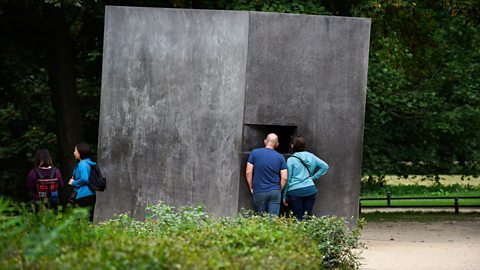
Many LGBTQ+ people have been commemorated for their achievements, and public memorials play a significant role in bringing communities together. In 2008, Berlin commissioned a monument to remember the thousands of LGBTQ+ people imprisoned in concentration camps in Nazi Germany. The memorial, a concrete cube structure, has a small window, where visitors can watch a short film depicting a same-sex kiss.
A decade later the Brazilian artist, Estúdio Guto Requena created a sculpture called, ‘My heart beats like yours’, set in São Paulo’s iconic Praça da República. It celebrates the first meeting of the LGBTQ+ activist community which took place in 1978.
Just off Manchester’s Canal Street is Sackville Gardens, home to a number of memorials, including a life-size Alan Turing statue and the Transgender Remembrance Memorial. It also has the Beacon of Hope sculpture, a permanent memorial for all people living with or who have lost their lives to AIDS or HIV. There are more AIDS memorials throughout the UK including in Brighton, the bronze sculpture 'Tay’.
4. LGBTQ+ History Month
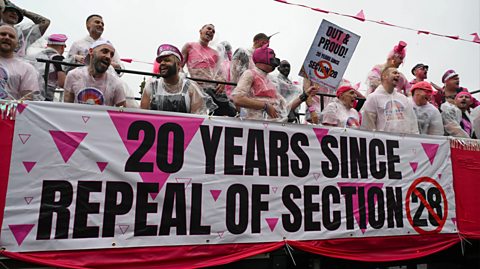
The UK’s LGBTQ+ History Month takes place every February and aims to promote equality and diversity. This includes educating people on laws, such as Section 28, which has played a key role in shaping identities.
Section 28 was a controversial piece of legislation introduced by Margaret Thatcher’s Conservative government in 1988. Its purpose was to prevent local authorities from ‘promoting homosexuality.’
Under this law, schools were unable to teach anything about LGBTQ+ life during lessons. It was repealed in Scotland in 2000 and in England and Wales in 2003, with LGBTQ+ History Month beginning shortly after in 2005.
5. Flags
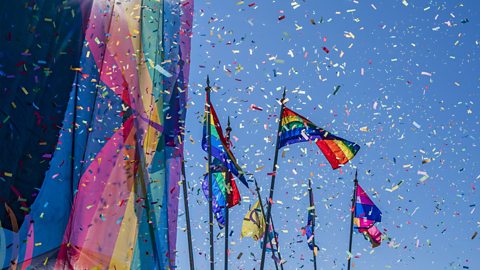
Over the course of history, symbols have become increasingly important to the identity of LGBTQ+ groups, with everything from the pink triangle to the A labrys is a double-headed axe which has featured in Greek and Roman mythology. It was adopted as a symbol of strength by the lesbian community in the 1970s. used to communicate reclamation or representation. Perhaps one of the most universally recognisable of all these being the rainbow flag.
The openly gay artist and drag queen, Gilbert Baker, designed the first rainbow flag, which was flown for the first time on 25 June 1978 during the San Francisco Gay Freedom Day parade. Baker would later reveal that he created the symbol of pride for the community with the help of the first openly gay elected official in the US, Harvey Milk.
To celebrate the rainbow flag's 25th anniversary, Baker broke his own world record by making a gigantic flag for Key West Pride in 2003. The banner was 1.25 miles long and stretched sea to sea from the Gulf of Mexico to the Atlantic Ocean. The flag was later cut into sections that were distributed to more than 100 cities around the world!
This article was published in June 2022 and updated in May 2026
