Roses are red, violets are blue...
If someone gave you a bouquet of red roses on Valentine’s Day, it would be fair to assume they liked you romantically.
But have you ever stopped to wonder why that is? Why do we associate flowers with hidden meanings, and how do we instinctively know so many of them?
The Victorians had a word for communicating with flowers: floriography. Here, BBC Bitesize explains what that is and how it was used.
Think you speak the language of flowers fluently? Test yourself with our IYKYK quiz below.
What is floriography?
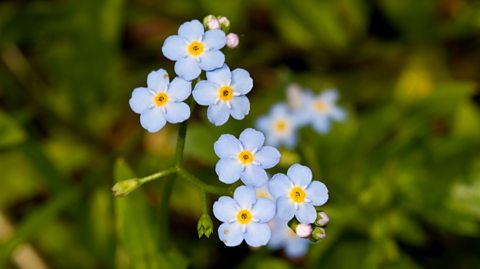
In this coded language, flowers convey different emotions depending on their type, colour and arrangement. Giving someone a bouquet with lots of different flowers could communicate a complex message.
Floriography was at its most popular in Britain during the 19th century, when strict social etiquette often meant it was difficult to express feelings aloud. Flower dictionaries were even published to help people make sense of it.
However, there was no universally accepted set of meanings. Two dictionaries could have different interpretations of the same flower, and a meaning that was agreed at one time could change later on.
Where did floriography come from?
The idea of using flowers to communicate was nothing new by the 19th century. It’s been practised for thousands of years in cultures around the world. Many of the meanings recognised by the Victorians – and by us today – date back to the ancient world.
You might have heard of narcissus, or its more common name, the daffodil. In Ancient Greek mythology, Narcissus was a good-looking but arrogant young man who fell in love with his own reflection when he saw it in a stream. Refusing to leave it, Narcissus wasted away and turned into the flower named after him.
Daffodils have bowed heads, which is said to represent Narcissus staring down at himself. In Victorian floriography, though, they had multiple meanings – ranging from vanity and egotism to unrequited love, affection and the coming of spring. You can imagine how confusing that might be…
In Britain, we know flowers were associated with meanings centuries before the Victorians got their hands on them. In William Shakespeare’s Hamlet, Ophelia mentions different flowers and herbs as a comment on the corruption of the royal court: daisies for innocence and false appearances, fennel for flattery and deceit and violets for loyalty, commenting: ‘I would give you violets, but they withered all when my father died.’
In artist John Everett Millais’ 1850s painting of Ophelia, which depicts her drowning after falling into a stream, she is surrounded by roses, forget-me-nots, poppies and violets. In the Victorian language of flowers, these symbolised beauty, pain, remembrance and faithfulness, reflecting the character’s tragic fate.
How did floriography become popular in Britain?
By this time, the idea that flowers had meanings had been popular in England and France for decades, and books called floriographies were being published. These acted as flower dictionaries and claimed to translate the language.
The first British floriography was published in 1825, written by botanist Henry Phillips. He drew inspiration for the different meanings from an earlier French book as well as Shakespeare, Ancient Greece and the Romans, but adapted some of them to fit in with Victorian society. For example, the peony had once meant love and passion, but Phillips toned his definition down to mean shyness and reserve.
He wasn’t the first to bring the concept of flower communication to Britain, though. It’s believed poet Mary Wortley Montagu started that process when she brought a Turkish tradition called sélam back to England in 1718.
In this tradition dating back to the 14th century, people sent love letters made up of objects like flowers and jewels that each had hidden meanings, creating a poetic message.
In 19th century Britain, people were becoming more interested in the scientific study of plants. This was also a society in which open displays of strong emotions like love or hatred were heavily discouraged. It was frowned upon for unmarried people to verbally declare their feelings for each other.
If you’ve read any Regency or Victorian literature or watched period dramas like Bridgerton, you may know that fans played a role in communication. For example, if a lady drew her fan across her cheek, it meant 'I love you'. Floriography fell into a similar category.
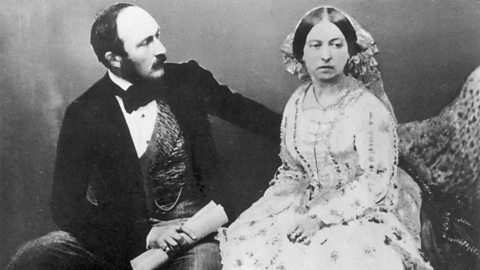
Two famous adopters of flower communication were Queen Victoria and Prince Albert. Orange blossoms, representing virtue and fertility, were a particularly prominent symbol in their marriage. Victoria wore a garland of them on her wedding day instead of a tiara, and Albert gave her jewellery featuring the flowers to mark important milestones.
What did different flowers mean in floriography?
Learning the symbolism behind different flowers became a popular hobby in this period. Young women from wealthy backgrounds were often taught flower arranging as part of their training in social etiquette and crafts.
In Jane Eyre, by Charlotte Brontë, Jane looks out at a garden while her closest friend is gravely ill. Many readers at the time would have picked up on hidden meanings behind the flowers in it. Snowdrops and crocuses meant hope and cheerfulness, while auriculas and pansies symbolised modesty and thoughtfulness. They suggest a contrast between life and death, hope and despair.
But as we’ve already seen, it wasn’t just the type of flower but its colour and how many you were given that mattered.
Red roses symbolised love because they were associated with the Ancient Greek and Roman goddesses of love, Aphrodite and Venus. One red rose meant a declaration of love, and if it had thorns, it meant love at first sight.
Multiple flowers suggested strong feelings. In general, giving single flowers showed simplicity and straightforwardness, with bouquets of different flowers used for more complicated and nuanced messages. Red flowers, as you might have guessed, usually meant passion and affection. Pink was linked with grace and joy, yellow with happiness and white with purity and innocence.
Now that you’ve had a crash course in the language of flowers, why not take the quiz below to find out how you would have fared using these Victorian codes?
Take the quiz
Do we still use floriography today?
The fact that we still give roses to loved ones on Valentine’s Day and wear poppies on Remembrance Day shows the language of flowers still holds meaning – even if we’re able to express our emotions much more freely now.
You might have heard of birth stones, but did you know there are also birth flowers? The idea is that each month of the year is linked with a seasonal flower that has a symbolic meaning. The tradition has its roots in Ancient Rome, where birthdays were often celebrated with gifts of flowers and decorated altars.
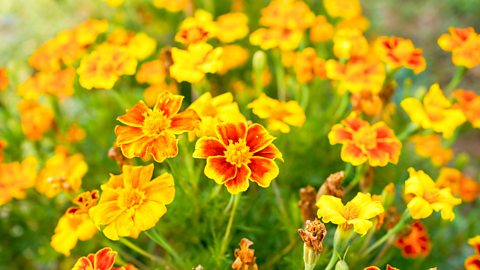
We still give flowers meaning in relation to death as well as birth. You might know the story that we wear red poppies on Remembrance Day - which commemorates the end of the First World War - because they were the first flowers to grow on the battlefields, and because their colour came to represent blood.
But did you know this meaning goes back to Greek mythology? Poppies were associated with Hypnos and Thanatos, the gods of sleep and death respectively. During the Napoleonic Wars in the early 19th century, people noticed that the flowers grew over soldiers’ graves, and poets like John Keats used them to represent sleep and peace.
So, it seems we still link flowers to our identities and emotions – even if we don’t do it in exactly the same way as the Victorians.
This article was written in August 2026
