"Let them eat cake!"
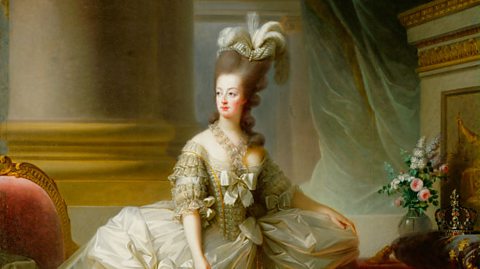
You might have heard this phrase before. It’s long been attributed to Marie Antoinette, who was queen of France from 1774 to 1792 – but historians don’t believe she ever said it.
It all goes back to the French Revolution, when those who opposed the monarchy portrayed the queen and her husband, King Louis XVI, as cruel and out-of-touch with the struggles of ordinary people.
By October 1793, both the king and queen had been executed, and a new era in French history had begun. One of the key dates in this period, 14 July, is still celebrated as a national holiday called Bastille Day.
Here, BBC Bitesize takes a look at the history of the French Revolution, why it was so important and why people all over the world still mark the anniversary of one of its key moments.
What was the French Revolution and what caused it?
Taking place over a period of 10 years, from 1789 to 1799, the French Revolution was a time of huge political, social and economic change. It saw the French monarchy overthrown, a republic established and the rise of Napoleon Bonaparte.
It wasn’t the only revolution that took place in the late 18th century. Britain’s 13 American colonies declared independence on 4 July 1776 during the American Revolutionary War, which ended in 1783. In 1791, the people of Saint-Domingue – now Haiti – revolted against French colonial rule, which was overthrown in 1804.
But the French Revolution is considered one of the most violent and most significant in terms of its impact on Europe. Scholars still debate its causes. Many of them affected other countries, but were felt more strongly in France than elsewhere.
For example, higher living standards meant people were living longer. Europe’s population doubled between 1715 and 1800, with France having the highest population – at 26 million in 1789 – of any European country.
More people meant the need for more food and goods, but there were high prices and economic crises in Europe from 1770 onwards. In France, crops failed around the country in 1788 because of a summer drought followed by severe rain. The price of bread soared and then, when rivers froze during winter, water mills couldn’t run to make flour. This only made the problem worse.
Like in other parts of Europe, the feudal system had been declining in France since the medieval period. Under this structure, the monarch owned all the land, but gave parcels of it to nobles in exchange for their military service. In turn, peasants farmed the land and paid taxes to their landlords. France still had an absolute monarchy, meaning Louis had complete control over France and there was no parliament, constitution or equivalent to Britain's Magna Carta.
Now, though, there was a class of common people who were richer than peasants but who weren’t aristocrats, such as merchants and lawyers. They wanted political power and the rights of landowners. Meanwhile, peasants – most of whom were still poor and owned no land – were becoming more aware of how their situation compared. They were less willing to support the feudal system.
Rulers around Europe were also taxing their nobles to pay for expensive wars. By 1789, Louis was almost bankrupt because of France’s support for the colonies in the American Revolutionary War. This caused discontent amongst the aristocracy.
The year 1789 marks the end of what is known as the Age of Enlightenment. Intellectuals and philosophers argued for reason, science and liberty, and against the authority of absolute monarchs. These ideas spread quicker in France than anywhere else in Europe thanks to writers like Voltaire and Jean-Jacques Rousseau.
What happened during the French Revolution?
By 1789, all of this was coming to a head.
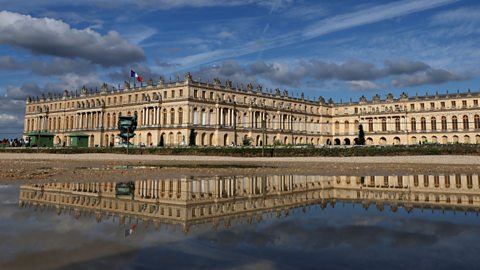
On 5 May, a group of representatives from the clergy, the nobility and the lower classes met at the Palace of Versailles – King Louis’ main residence. This group was called the Étates-Général, and it hadn’t met since 1614. They were meeting now to settle a dispute over tax, which Louis wanted to levy on the nobility to solve his financial issues.
But it got off to a difficult start, because its members became divided over voting rules. Members of the Third Estate – the lower classes – declared themselves the National Assembly, threatening to go ahead without the others.
On 20 June, they occupied the king’s tennis courts and vowed not to leave until they had given France a new constitution. Louis gave in on 9 July and ordered the estates to come together, but he was gathering troops.
Late July to early August is known as the Great Fear, a period of rioting and panic driven by food shortages and rumours that nobles were destroying crops to starve the masses. Fear was also stoked by news of the Storming of the Bastille – more on that below.
Later that month, on 26 August, the Assembly issued the Declaration of the Rights of Man and of the Citizen. Similar to the American Declaration of Independence, the document stated all men were born free and equal, and that power should belong to the nation rather than a king. Louis refused to sanction it, causing Parisians to march to Versailles and force him and his family back to the capital.
Fast-forward to September 1792, and a new assembly called the National Convention abolished the monarchy. They declared France a republic – a form of government in which power is held by the people and their elected representatives, not a monarch.
On 21 January 1793, Louis XVI was executed for treason. Marie Antoinette was executed later that year, on 16 October. A period known as the Reign of Terror ensued, when the new government took action against those they considered their enemies. Tens of thousands of people were executed. This was spearheaded by Maximilien Robespierre, who was overthrown and executed himself in July 1794.
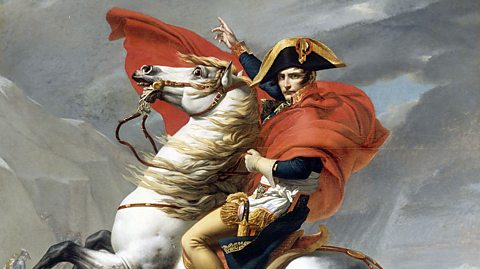
Four years later, in November 1799, military leader Napoleon Bonaparte overthrew the Directory – the government that had replaced the Convention after Robespierre’s death – and declared himself France’s leader. He would later name himself Emperor Napoleon I.
What impact did the French Revolution have?
While the Revolution had a huge impact on France itself, it also had consequences for much of the rest of Europe, including Britain.
In the midst of the turmoil at home, France was also fighting the French Revolutionary Wars from 1792-1799. These began when it declared war on Austria and Prussia, in what is now Germany. The next year, France declared war on Britain and the Netherlands. Having been defeated by Napoleon, Austria made peace with France in 1797.
Eventually, France expanded its control into ‘satellite republics’ in the Netherlands and Italy. This prompted an alliance between Austria, Britain and Russia, which pushed France out of Italy in July 1799. This was the year in which Napoleon became leader.
With this came the beginning of a new phase in the conflict, which became known as the Napoleonic Wars. France was now the dominant power in Europe. Despite its navy being crushed by Britain at the Battle of Trafalgar in 1805, a series of victories on land meant that by 1809, most of Europe between the English Channel and the Russian border was either controlled by France or allied with it.
The turning point came when Napoleon tried to invade Russia in 1812. When he and his Grand Army arrived in Moscow to find it abandoned and a huge fire broke out, they retreated during a harsh winter. Out of an initial roughly 600,000 men, it’s believed 400,000-500,000 were lost to battle, capture or disease.
Two years later, Napoleon had lost what remained of his power in Germany and Poland. On 30 March 1814, Allied forces captured Paris. Napoleon abdicated – meaning he gave up his power – and was exiled to an Italian island. The wars finally ended at the Battle of Waterloo in 1815, after which Napoleon was forced to abdicate a second time and was exiled again.
What is Bastille Day and when is it?
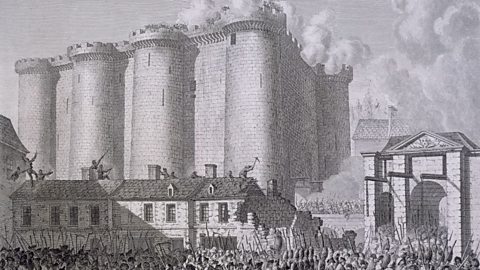
Back to Bastille Day, which is celebrated on 14 July every year to mark the anniversary of the Storming of the Bastille in 1789. But what was the Bastille, and why was it attacked?
The Bastille was originally a medieval fortress to protect Paris during the Hundred Years’ War, but became a state prison in the 17th century. It was used to hold political prisoners as well as some prisoners awaiting trial. If someone was held there on the king’s orders, they couldn’t appeal.
While it was rarely used and was actually due to be demolished, the Bastille had become a symbol of the monarchy’s rule by 1789. When unrest broke out, a mob demanded the weapons and ammunition that were stored at the prison so that they could defend against Louis’ troops. The guards refused, and the attackers stormed the prison, releasing seven inmates.
This became one of the defining early events of the French Revolution and is seen as the end of the ancien régime – the old order. Citizens began tearing the prison down by hand the day after the attack, selling pieces of it as revolutionary souvenirs. It was completely demolished in 1791, leaving an open space now known as the Place de la Bastille.
How is Bastille Day celebrated?

This day is so important in France that it became an official holiday in 1880 known as La Fête Nationale. There are speeches, military parades, fireworks and parties. The phrase ‘vive le 14 juillet’ - ‘long live 14 July’ can often be heard ringing out.
The holiday is also celebrated outside France, particularly in places with large French populations like Toronto in Canada. Street fairs, wine tastings and French music are common ways of marking the day, as well as games of pétanque (French boules).
While not all former French colonies celebrate Bastille Day, some blend in their own cultural traditions. For example, in French Polynesia the whole month of July features singing, dancing and drumming performances. In Pondicherry, India, military veterans take part in a march, wreaths are laid and the French and Indian national anthems are sung.
And yes, in case you were wondering, the British indie pop band Bastille is technically named after Bastille Day, which is the birthday of its frontman, Dan Smith.
