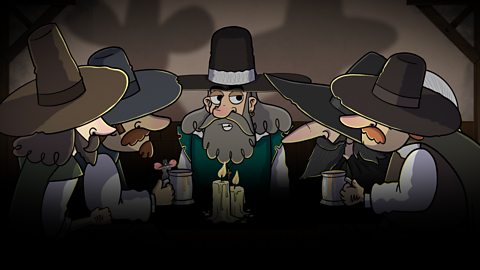
Aim
To introduce the topic of the Great Fire of London in 1666 and learn about the main reasons why it spread.
The teaching notes and assembly framework below have been developed for holistic use across curricula areas, including History, English, Drama and Music.
The video
Something's burning,
something's burning…
fetch the ketchup,
fetch the ketchup…
BBQ! BBQ!
It's burnt and it's crispy
Before ovens were invented,
all food had to be cooked on fires.
My grandma told me that, and hergrandma told her…
all the way back to a rat who
lived over 350 years ago,
in the time of the Great Fire of London.
This is her story.
It all began in London -
the country's capital city.
There she is!
The story starts on Pudding Lane,in the the home
of Thomas Farriner,
a baker who lived with his
family above the bakery.
Electricity and gas central
heating hadn't been invented yet.
Thomas Farriner used fire
for light, heating and
of course - baking.
(YAWN)
The bread's ready - let's put out all.the candles before.we go upstairs?
Aw dad - it takes aaaages
to snuff out the flames.
(PAUSE)
If only somebody would.invent electric lights,
it would be a lot quicker.
Well, c'mon hurry up then.
The oven fire is already out.
(PAUSE).
If only
somebody would invent electric ovens,
it would be safer too.
But while they slept, a spark
must have jumped out of the oven
…the fire spread across
the kitchen before anyone woke up.
Thomas Farriner and his family
climbed out of the window, to the
roof, and escaped to the neighbour's
house all except their maid.
All the houses in London
were so close together,
which is a very good
thing for escaping…
But it also helped the fire to
spread. The houses were made of
wood, so the fire gobbled up one
house and moved quickly to the next.
Fire! Fire! We need to
tell somebody about this…
I wish someone would invent
the telephone.
(PAUSE)
And the fire brigade…
Let's get The Lord Mayor.
Lord Mayor, Lord Mayor, wake up!
There's a fire on Pudding Lane! Bah.
I was having a lovely
dream about bread.
London is always on fire…
why are you bothering me?
Just put it out. They tried
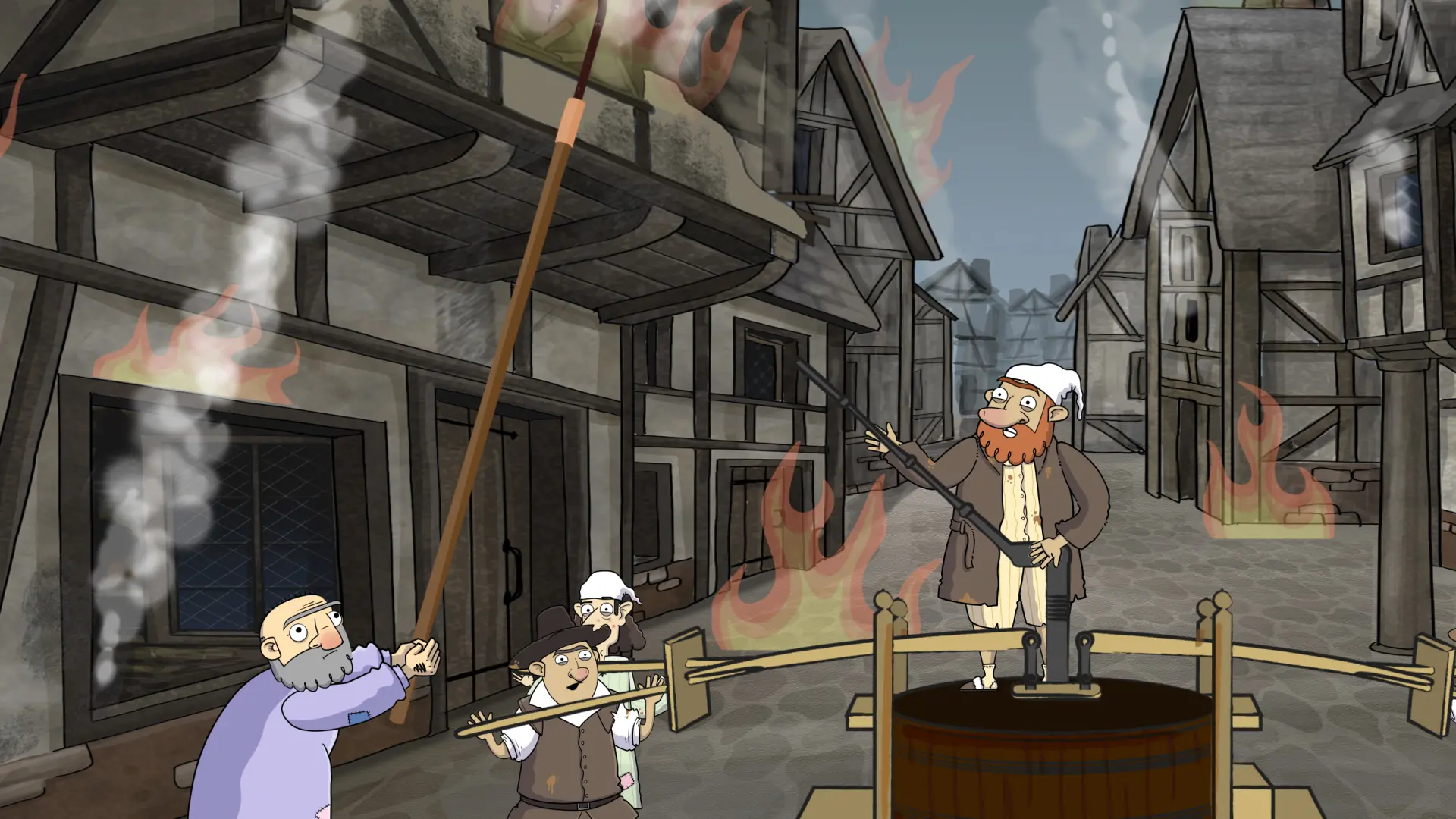
desperately to put the fire out.
As well as pouring water from
buckets, they used water squirters,
which were a bit like
giant water pistols.
They also used very basic tools.
People had to pump,
really hard to spray the water out
- and they didn't work very well.
Luckily there was one way to put out
the fire that nobody had tried yet.
It meant using something
called a 'fire hook'.
People used fire hooks to pull down the
wooden houses in the path of the fire.
If you did that, the fire would run out of
things to burn and eventually fizzle out.
But before they could use fire hooks,
the people of Pudding Lane needed to
ask the Lord Mayor if they were
allowed to - and he had to say 'yes'.
Ah, the LORD MAYOR is here.
He looks hungry…
Hello everyone. Good work, carry on!
Lord Mayor we need
you to say yes to something.
Is someone toasting
fresh bread? mmmm
We want…
Yes. Something with the toast?
To use…
Yes butter?
Fire hooks?
Yes! Butter!
Er, but no. No, no.
Definitely not the fire hooks.
If only the Lord Mayor had
let them use fire hooks!
With nothing to stop it,
the fire raged on and on.
The wooden houses were
fuel to the fire.
It was a windy day, which
blew the fire along.
It had been a very hot
summer in London,
so the wooden houses were
dry and burned easily.
It looked like nothing could stop it.
What do you think happened next?
The video begins in the present where we meet a friendly rat called Maureen. Maureen then takes us back through time to introduce one of her ancestors, a rat living in London in 1666, who describes the events of The Great Fire of London.
A spark from a bakery oven on Pudding Lane caused a fire that spread quickly because the houses were made of wood and very close together, and the weather was very hot and windy. People tried to stop the fire but the Lord Mayor initially refused more extreme measures like pulling down houses.
Eventually, houses were pulled down which created gaps to stop the fire spreading and after several days, the fire burned out but thousands of homes and other buildings were destroyed. London was later rebuilt using more robust materials like brick and stone.
Pupils will learn about the causes of The Fire, meet key individuals involved and witness how Londoners responded to The Fire.
Duration: 4’ 01”
Final words: ‘What do you think happened next?’
Video questions
You may wish to stop at relevant points during the video to pose these questions and check understanding, or wait until the end.
- Where did the fire start? What caused the fire to start there?
- In a bakery on a street named Pudding Lane
- If there were no electricity or gas in those times, how did people cook, keep warm or see at night? And why might that make fires more likely?
- Open fires were used that burned wood
- How did Thomas Farriner and his family escape the fire?
- They escaped through a window
- The video gives lots of causes, or reasons, why the fire spread so quickly. Can you remember any of them?
- The six mentioned in the video are: 1. All the houses in London were so close together, which helped the fire to spread. 2. The houses were made of wood, so the fire gobbled up one house and moved quickly to the next. 3. They also used very basic tools. People had to pump really hard to spray the water out and they didn't work very well. 4. If only the Lord Mayor had let them use fire hooks! With nothing to stop it, the fire raged on and on. 5. It was a windy day, which blew the fire along. 6. It had been a very hot summer in London, so the wooden houses were dry and burned easily.
- Why was the Lord Mayor not concerned about the fire?
- Fires were common in London at the time and he thought that it would be put out easily.
- The video ends with the Lord Mayor of London refusing to allow fire-hooks to be used. What do you think happened next?
- Over the next 2 days, the fire doubled in size and destroyed half the city of London – this video tells the next part of the story.
Key terminology
Introduce key terminology, including:
- Baker: a person who makes bread, cakes, and other food in an oven.
- Causes: the reasons why an event happens.
- Fire hook: a long metal hook used to pull down buildings so a fire could not spread (to buildings next door).
- Lord Mayor: the leader of a city who helps make important decisions.
- Overhangs: parts of a building, such as an upper floor, that stick out over the space below.
- Timber-framed buildings: houses made from wooden beams. The walls inside were made by spreading plaster over thin strips of wood.
- Water squirters: Simple hand pumps that squirted water onto fires before fire engines were invented
Resources
Assembly framework (PDF) document
Download / print the assembly framework for use
Entrance song: Here in Pudding Lane
Here in Pudding Lane
Here in Pudding Lane
Pies and puddings
And dogs and cats
Shops for this
And shops for that
Here in Pudding Lane
Here in Pudding Lane
Here in Pudding Lane
Here in Pudding Lane
Quills and candles
And wigs and hats
Pastry nibbled
By mice and rats
Here in Pudding Lane
Here in Pudding Lane
Here in Pudding Lane
Here in Pudding Lane
Night in Farriner’s
Bakery dark -
Help! Watch out
For a fiery spark!
Here in Pudding Lane
Here in Pudding Lane
Here in Pudding Lane
Here in Pudding Lane
Slideshow of images. image
Images relating to The Great Fire of London
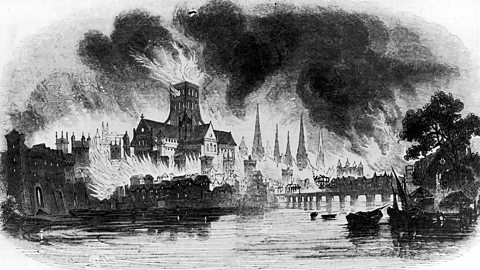
Song: London's Burning - click to play
London’s burning!
London’s burning!
Fetch the buckets!Fetch the fire-hooks! Fire, fire!
Fire, fire!
Pour on water
Pour on water
London’s burning!
London’s burning!
Fetch the buckets!Fetch the fire-hooks! Fire, fire!
Fire, fire!
Pour on water
Pour on water
London’s burning!
London’s burning!
Fetch the buckets!Fetch the fire-hooks! Fire, fire!
Fire, fire!
Pour on water
Pour on water
Pour on water
Pour on water
(Pour on water…)
(Pour on water…)
Assembly framework
1. As pupils enter
Play the video of the song: "Here in Pudding Lane".
2. Introduction
Depending on when this assembly takes places, there may have been some recent fires in the news which it is possible to talk about. It is unusual to have large urban fires in the UK, though unfortunately wildfires in the countryside are still common. Even more frequently are fires in parts of the world where the climate is hotter and drier, like America or Australia.
If that is not the case, then go straight into the assembly with:
- We are going to look at one of the most famous events in the history of the capital city of England, London. From watching the entrance song video ("Here in Pudding Lane"), what ideas do we have about what might have happened?
- The event is known as The Great Fire of London which took place a long time ago in 1666.
- The entrance song video provides some clues that tell us why there might have been more fires at that time – can you think of any reasons? (The video shows that buildings were made of wood which burned easily, and the buildings were built close together, which helped fires to spread. Open flames were common, as people used candles for light, and burned wood and coal for fires and ovens.)
3. Play the video
Duration: 4’ 01” Final words: ‘What do you think happened next?’
You may wish to stop at relevant points during the video to pose questions and check understanding, or wait until the end.
4. After the video – time to talk
Lead a discussion by asking some or all of the following questions:
- Where did the fire start? What caused the fire to start there?
- In a bakery on a street named Pudding Lane
- If there were no electricity or gas in those times, how did people cook, keep warm or see at night? And why might that make fires more likely?
- Open fires and candles were used. Sparks can escape from open fires and candles can fall over.
- How did Thomas Farriner and his family escape the fire?
- They escaped through a window - The video gives lots of causes, or reasons, why the fire spread so quickly. Can you remember any of them?
- The six mentioned in the video are: 1. All the houses in London were so close together, which helped the fire to spread. 2. The houses were made of wood, so the fire burned one house and quickly spread to the next. 3. They also used very basic tools. People had to pump really hard to spray the water out and they didn't work very well. 4. If only the Lord Mayor had let them use fire hooks! With nothing to stop it, the fire raged on and on. 5. It was a windy day, which blew the fire along. 6. It had been a very hot summer in London, so the wooden houses were dry and burned easily.
- Why was the Lord Mayor not concerned about the fire?
- Fires were common in London at the time and he thought that it would be put out easily.
- The video ends with the Lord Mayor of London refusing to allow fire-hooks to be used. What do you think happened next?
- Over the next 2 days, the fire doubled in size,and destroyed half the city of London – this video tells the next part of the story.
5. Opportunity to sing
If your assembly includes a song this is an opportunity to sing it. One option is the well-known nursery rhyme: London’s Burning..
6. Closing the assembly
The song mentions two ways that at that time they tried to put out fires:Fetch the buckets!Fetch the fire-hooks!
- What are these? How would they help to put out the fire? If the children need further prompts, ask; Can you remember from the video what fire-hooks did? Why were they not used at first to stop the fire?
- As an additional prompt, there is a very good contemporary picture (included in the resources above) which highlights ways in which fires were tackled at the time.
- Fires are not as destructive today. Why is that? What do the children know about fire engines and firefighters today?
- Have a final moment for quiet reflection
For example, Londoners had to be brave as they escaped the danger of the fire. When we face difficulties, we often have to be brave. Being brave doesn’t mean not being scared; it means doing the right thing even when things feel difficult. Being brave can helps us to deal with some of our problems.
Further activities
History: What were cities like London like at this time?
Aim: using sources to ask and answer questions
For younger children (those aged 5-7), it is not vital to know the date of the event, or the fact it was over 350 years ago in the 17th century. However, it is helpful to get a sense of this time period and how it is different from the present day. This can be done by looking at images and artefacts from the mid-17th century - for example, buildings and clothes - to give children a ‘sense of period’.
Consider this slideshow of images relating to The Great Fire. Images 2 and 3 are useful to compare and contrast the way people dressed, as well as the differences between firefighting today and in the past. Image 4 shows how the homes were close together and built from wood.
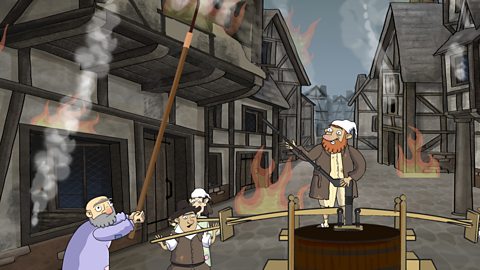
The image below, taken from the second video, shows the design of the houses in more detail. There are two aspects to point out to the children. Most houses were timber-framed buildings with plaster and lathe interiors and these are all materials which burn easily. Secondly, some houses had ‘overhangs’. At this time, a person paid for a plot of land on which to build their homes. So they could have more room, without having to pay more money for the plot, overhangs were built on the first floor, so the first floor would stick out further than the ground floor. Some people could even shake hands with their neighbours on the opposite side of very narrow streets!
English and Drama: What was it like to have your home destroyed?
Aim: develop empathy for other people
There is an opportunity to think about what it must have been like to see your home totally destroyed by fire. One hundred thousand Londoners were made homeless by The Great Fire. Consider the need for sensitivity when exploring such issues, dependent on the background and experiences of the children in the class.
This could be done through English, with children either writing a diary entry or producing a story strip with words and images, and entitled, "Before and after the fire".
There are also opportunities for drama, which may be a helpful stimulus for the children’s writing. One suggestion could be to use the Conscience Alley strategy in which one child pretends to be a Londoner fleeing their house. They can only carry one thing. Set up two lines of children facing each other and they call out suggestions, like your favourite toy or food or clothes.
In a plenary, a possible reflection question could be asked like: If your home disappeared tomorrow, what would you miss most? This could lead to the children realising that while houses and possessions are important, family, friends, and being safe matter most.
History: Subsequent lessons on the Fire of London
After the video shown in the assembly, there are two further videos:
What happened during The Great Fire of London? recaps on why the fire spread across the city and explores the involvement of some key historical figures: the Lord Mayor, King Charles II and the diarist, Samuel Pepys.
What happened after The Great Fire of London? explores what happened after The Fire was finally put out, how London was rebuilt and how we remember the event today.
Cross-curricular Opportunities
There are teachers' notes linked to this video series. Page six provides a range of cross-curricular ideas for activities in Art, Design and Technology, PSHE, Science, English, Geography and Mathematics.
Related links
Educational calendar. collection
Topical collections of BBC content to mark significant events in the educational calendar.

KS1 Music: The Great Fire of London. collection
Three songs that are an ideal way to consolidate pupils' work on this topic.
KS1 History: The Gunpowder Plot. collection
Three short animations exploring The Gunpowder Plot of 1605 - why it happened, the main events of the Plot, and the consequences for Guy Fawkes and the other plotters.