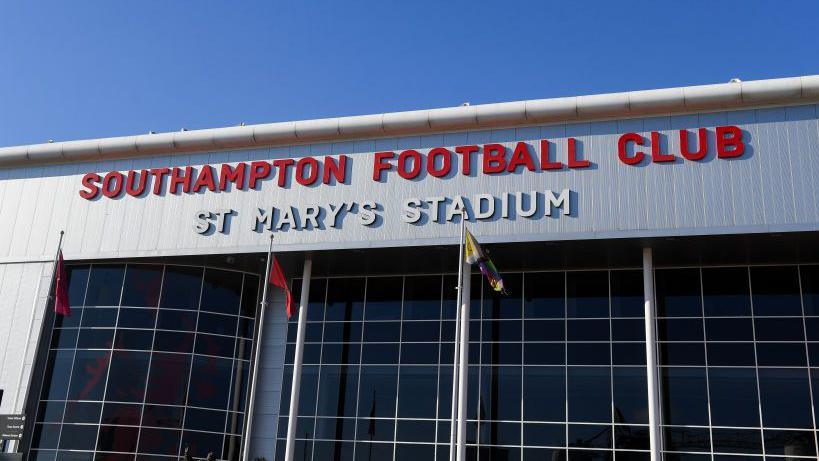
Southampton's Eckert authorised spying missions

Eckert admitted authorising the spying on rival teams
- Published
Southampton's spying on rival clubs was authorised by head coach Tonda Eckert and was a "contrived and determined plan from the top down", an independent disciplinary commission ruled.
The commission also said it was "deplorable" of the club to have used junior staff members to "conduct the clandestine observation".
Saints were expelled from the Championship play-offs after admitting observing opponents' training sessions and have been deducted four points for the 2026-27 Championship season.
Written reasons explaining the commission's finding have now been published by the English Football League.
Eckert, the club's 33-year-old German rookie boss who only took charge in mid-season, is said to have "accepted that he had specifically authorised the observations". Such spying "seriously violated" the integrity of the competition, the commission said in an explanation of why it applied such a serious sanction.
On top of the expulsion and point penalty punishments, a reprimand was also imposed on Southampton. That was not merely for the fact of the spying taking place, but because "junior members of staff were put under pressure" to be involved, the commission stated.
The whole matter only arose after a junior member of staff was spotted secretly watching Middlesbrough at their training ground.
Southampton admitted spying on three rivals' training sessions – Oxford United and Ipswich Town earlier in the season, and then Middlesbrough before the first leg of the play-off semi-finals.
Their expulsion from the play-offs meant Middlesbrough - who they beat in the semi-final – were reinstated. They will meet Hull City in Saturday's final, for a place in the Premier League.
Southampton, who initially denied any video was captured or analysed before acknowledging that was not the case, were unsuccessful in an appeal against their removal from the play-offs.
They are said to have "placed reliance" on a previous sanction handed down to Leeds United, who received a £200,000 fine for spying on opponents in 2019, but the commission pointed out that happened before the introduction of the regulations Southampton breached.
'Contrived and determined from the top down'
The first determination is perhaps the most damning. It indicated a pattern of behaviour.
The independent disciplinary commission said: "We have concluded that there was, on the part of the respondent [Southampton], a contrived and determined plan from the top down to gain a competitive advantage in competitions of real significance by deliberate attendance at opposition training grounds for the purpose of obtaining tactical and selection information.
"It involved far more than innocent activity and a particularly deplorable approach in its use of junior members of staff to conduct the clandestine observations at the direction of senior personnel.
"There was transmission and internal dissemination and analysis of footage and observations."
Southampton made submissions which they said proved the information had not altered the team selection, nor had it resulted in sporting advantage, shown by the poor first-half performance at Middlesbrough. This was rejected.
Eckert 'specifically authorised' spying
The most damning section for the Southampton head coach comes in the second determination of the judgement.
This states the German not only knew about the spying, but also had given his blessing.
Eckert was shown to have approved spying on Oxford to discover their formation after they had just changed manager.
In the case of Middlesbrough, he wanted to find out about the availability of a certain player - presumably Hayden Hackney, who had been out injured for several weeks.
The commission said: "Mr Eckert accepted that he had specifically authorised the observations to obtain information about formation (in the Oxford incident) and about the availability of a key player (in the Middlesbrough incident).
"Such information could only be sought in order to factor it into strategy, [and] whether the information confirms a strategy, is disregarded as unreliable or leads to a change of strategy does not, in our view alter the wrong which is committed when such information is sought.
"It is inherent in having information which your opponent would wish to keep private that you have a sporting advantage."
All you need to know about Southampton's spying
'Sporting advantage' a key consideration
As Southampton did not win any of the three games, there was an argument that the club had achieved no sporting success.
However, the independent commission rejected this.
It argued that "sporting advantage is different from sporting success".
By this, the commission meant that the act of trying to gain information through spying, with the intention of gaining an advantage, was a standalone consideration.
A team going on to win, lose or draw does not matter in relation to the intention.
Remorse - but only after misleading the EFL
The commission considered that Southampton had been co-operative and had shown remorse, but noted this had been "tempered by an initial misleading response".
The day after the club had sent a spy to Middlesbrough, Southampton "provided inaccurate information, suggesting that the conduct was not part of SFC's culture and that no video footage was captured, transmitted, shared or analysed, when in fact the opposite was the case".
In addition, the independent disciplinary commission said it was "unimpressed" that Southampton tried to claim members of staff did not know about regulation 127, which states a team must not try to observe an opponent in training within 72 hours of a fixture.
It noted: "The respondent [Southampton] is a member of the EFL and has agreed to be bound by the rules."
Junior staff 'put under pressure'
The commission took a dim view of interns being used to carry out the spying.
It said that an additional reprimand was required "because of the way in which junior members of staff were put under pressure to carry out activities which they felt were, at the least, morally wrong".
It added: "Such staff were in a vulnerable position without job security and with limited ability to object to, or resist the instructions given to them."
The intern who attended Oxford and Middlesbrough gave evidence and described the pressure he was placed under. He declined to spy on Ipswich Town.
A different individual was sent to watch Ipswich on 28 April, visiting Eastleigh Football Club where they were training. This was on the day of the game - eight hours before kick-off.
It was admitted that "footage and information obtained was shared" with Southampton staff.
How the sanction was reached
The EFL submitted that "a severe sporting sanction was appropriate" which should include expulsion of from the play-offs, financial penalties and points deductions.
It was deemed that a financial sanction was not required.
The breaches were broken into two parts - the offence in the league season and the separate charge for the play-off fixture.
The commission "took a starting point" of three points per incident, meaning a six-point deduction for the league season offences.
That was reduced to four points because the club had accepted the charges, showed some remorse and had offered information related to spying on Oxford and Ipswich.
For the play-offs, it was determined that the "integrity of the competition was seriously violated" and this "must result in expulsion from the competition".
The prospect of promotion to the Premier League would render any fine "meaningless", the commission decided, while a further points deduction would not be appropriate while achieving "the aim of the rule which has been breached" - a deterrent to spying.
- Published21 May

- Published21 May