Monday, 22 July, 2002 14:00 BST
Life on board | |
| 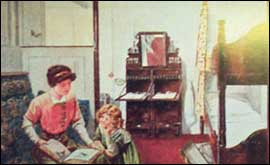 | Second Class berth as shown on a postcard.
Peter Boyd-Smith |
| | There were over 2,000 passengers on board RMS Titanic when she sailed from Southampton.
However there was a massive difference between how the different classes of passenger travelled across the Atlantic. |
| | | "I remember vaguely the enormous dining room and of course it was all very exciting for us because in those days children led a very nursery life..."
Eileen Lenox Cunningham, Survivor,Titanic Voices p109 |
Accomodation
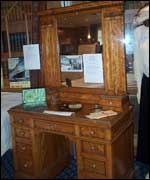 | Dressing table similar to
those used on board the Titanic
Items owned by Peter Mitchell |
First class passengers' accommodation varied from several lavishly decorated state rooms with their own sitting room, private bedrooms, parlour rooms and private bathrooms, down to a single person's large room with a bed, sofa, dressing table and washbasin.
"In the early days of emigration people travelled on sailing ships that carried cargos of mixed goods."
By the turn of the century attitudes towards transporting emigrants had changed somewhat.
"Transporting emigrants across the Atlantic was a very lucrative business…The great profits were earned in the Third class. Here the shipping companies recouped the losses incurred in first class through costs for servants, foods
and decor."
Emigrants Crossing the Atlantic p21 |
Second class accommodation would have been similar to a basic first class single person's berth although on a smaller scale. Family rooms usually combined single and bunk beds. As you can see in the picture below, a small settee would often be supplied with a writing desk and wardrobe or dressing table and washing facilities.
"Third class accommodation aboard the Titanic seemed to have been allocated almost as an after thought, it has to share the available space with the swimming pool and the squash rackets court."
The Saga of the Titanic`s Steerage Part 1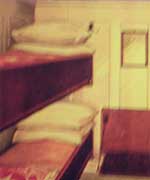 | Third class four berth cabin as shown on a postcard.
Peter Boyd-Smith |
By today's standards this would seem to be incredibly stingy. However in 1912 this would have seemed quiet a treat for many of the passengers. Then living conditions at home would often have been cramped and limited space meant that bathing in the kitchen was still the norm. The cabins would have been simply furnished usually with a small cupboard and bunk beds provided. Each room had its own wash basin connected to the fresh water tanks and there were only two bath tubs available on board for all of the third class passengers. | | | |
|
|