The thing to do for colour and atmosphere is to read Flaubert’s Salaambô while you’re there. This gives you the most bloodthirsty, passionate and historically accurate account of Ancient Carthage during the “Mercenary War”. There’s not much of the old city, as the Romans levelled every stone, and ploughed the land and seeded it with salt… such was their hatred of Carthage. Later they built their own city on the spot, but there’s not much left of that either… mostly tumbled to earth in the great earthquake of 365AD, which flattened all the cities of the North African coast.
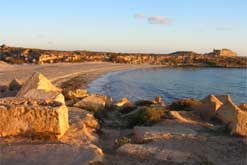
Today one of the most exclusive quarters of Tunis occupies the site, as well as an enormous presidential palace. The site of the old port is still there – or at least the sea and the land meet in the same place, but now there is a tiny lagoon surrounded by shrubbery, teeming with lovers. There were rowing-boats beached in the lagoon, and some fishermen were hauling their boat across the shingle of the harbour bar. I found myself wondering just how those Carthaginians hauled their triremes through such a narrow entrance.
But of course the lagoon is just a pale shadow of the Carthaginian harbour. There’s a green shed amongst the shrubbery which contains the museum. The museum consists of a white plaster model, made by an enthusiastic Englishman, of the great circular Carthaginian harbour. It is quite the most beautiful piece of architecture I have ever seen.