Tiger attacks in Nepal
By Emily Thurgood

Nepal has seen a remarkable rise in wild tiger numbers over the past decade, with the population tripling since 2010. It’s one of the great conservation success stories of recent times, but it hasn’t come without challenges. As the tiger population grows and human settlements continue to expand, the chances of people and tigers crossing paths are increasing. A recent study found that in western Nepal’s Bardia-Banke Complex, tigers killed more than thirty people over a five-year period. The same study looked at over 70 reports of wildlife-related incidents involving human casualties, and about three-quarters of those were caused by tigers.
As the tiger population grows and human settlements continue to expand, the chances of people and tigers crossing paths are increasing.
Many protected areas in Nepal’s lowlands – home to endangered species like the Bengal tiger, greater one-horned rhinoceros, and Asian elephant – are surrounded by human communities. Local people rely heavily on the forests for food, firewood, building materials, and space for livestock. This dependence on natural resources means that people are regularly entering the same areas where tigers live, increasing the risk of conflict.
Among big cats, tigers are the most frequent killers of humans worldwide, likely because they live in regions with high human populations. Still, attacks are relatively rare. Globally, tigers typically kill between 40 to 50 people each year, compared to roughly 350 killed by elephants.
Tigers are elusive and generally try to avoid people. As many as 80% of reported attacks may happen by accident – either because the tiger was startled, or mistook a person for a prey animal. Approximately 99% of the time, tigers don’t eat the people they attack. In the Nepal study, most victims were alone and bent over while gathering resources – a posture that could resemble prey behaviour and trigger a predatory response in tigers.
As many as 80% of reported attacks may happen by accident – either because the tiger was startled, or mistook a person for a prey animal.
The few tigers that deliberately hunt and eat people are termed “problem tigers”. These individuals are usually injured or without a territory, struggling to survive and more likely to be roaming near human settlements.
Human-wildlife conflict not only threatens the wellbeing and livelihoods of local communities, but also tiger conservation efforts. When tigers attack, fear and resentment can grow. In some cases, this leads to retaliatory killings, where people kill tigers out of fear or revenge. If not curbed, these killings could become a significant global driver towards tiger extinction.
Changing perceptions is key. Community education plays a crucial role in helping people understand tiger behaviour, the importance of conservation, and the best ways to avoid dangerous encounters. When people feel safer and better informed, they’re more likely to support efforts to protect tigers.
Nepal has shown the world what’s possible in terms of tiger conservation. The challenge now is ensuring that this success can continue – not just for the sake of the tigers, but for the people who live alongside them.
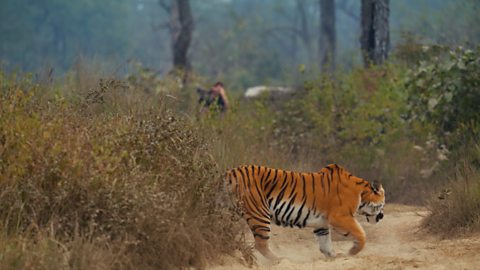
A close encounter with a tiger
Dan O’Neill’s ground-level sighting offers a fresh perspective on tiger behaviour.