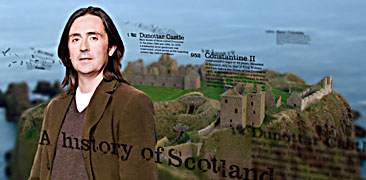
Neil Oliver reveals A History Of Scotland A History Of Scotland
Unplaced BBC TWO
 Programme copy Programme copy
Press pack
Bringing together stunning HD photography and a major new music score, A History Of Scotland takes a fresh, new, dynamic look at the past which has shaped modern Scotland. Neil Oliver, who presents A History Of Scotland, says: "The series begins with the birth of Scotland; a birth that was far from inevitable. For many centuries, our mountains and lochs were home to a patchwork of disparate peoples and tongues. So how was it that this loose confederation of tribes in the northern third of Britain came together to create a kingdom with its own culture and identity? "Scotland is my country. The story of this place means more to me than any other. For as long as I can remember, I've wanted to understand more about how we got to where we are today; why the story unfolded as it has. And it is a story which has great relevance to the modern day with the Union under the microscope and widespread debate about how the various parts of the UK go forward." Co-produced with the Open University, A History Of Scotland takes Neil on a journey into the past, illustrated by dramatic photography, which captures the best of Scotland's varied and breath-taking landscapes, iconic landmarks, monuments and historic architecture. A powerful new music score recorded by the BBC Scottish Symphony Orchestra and composed by Paul Leonard-Morgan, who has written music for series such as Galapagos, Silent Witness and Spooks, is also part of the package, along with state-of-the-art graphic maps and amazing aerials. Dr Ian Donnachie, Reader in History at The Open University and academic advisor for the series, says the University is delighted to be associated with A History Of Scotland: "The programmes help explain many of the big issues in Scotland's past. Reaching a UK-wide audience is probably a first in Scottish history and will do much to enhance the understanding of Scotland's past and the challenges the country faces in the future." In total, there are 10 hours spanning a dramatic sweep of Scottish history from the first millennium to the modern day, with the first five parts taking the story up to the Union of the Crowns in 1603, when James VI of Scotland also became James I of England, taking up the mantle from Elizabeth through the bloodline of his controversial mother, Mary Queen of Scots. The second batch of five programmes, which will be broadcast at a later point, takes the story on through the Union of Parliaments in 1707, through Scotland as a powerhouse of the industrial revolution and up to the modern day and devolution. The series begins with an episode entitled The Last Of The Free and looks at the first stirrings of identity as the tribes of a place the Romans called Caledonia first banded together to confront the legions of the Empire. It goes on to challenge ideas about heroes such as Saint Columba, William Wallace and Robert the Bruce, and reveals characters behind the scenes who were manipulating the bigger picture. There are also some interesting names to grapple with – from Calcagus to Giric and Aed – many of whom will be new even to Scottish viewers. Says Neil: "It is not about knocking heroes off their pedestals but seeing them in the context of the events and the other people of their times, digging beneath the mythology to try to get at the real motivations rather than the 'accepted wisdom' behind the stories. "Wallace and Robert the Bruce – and indeed many others – were remarkable men, but they were often brutal and ruthless." Series producer Richard Downes says: "This is an interesting time to have a series about Scotland's history. Within the last 10 to 15 years, there has been a surge of interest in the academic community, shedding new light on Scottish history and challenging perceptions and the 'mythology' of popular history. "Given this academic base, it is a terrific time to put Scotland's history in a new, fresh perspective, to get beyond the myths. At the same time, changes in the political landscape have also put renewed focus on Scotland, its people and culture, its identity and its place within Britain and beyond these shores. "This is reflected in the series in that we are looking at the history of Scotland from a modern perspective and a wider context of Scotland from its crucial part in the creation of Britain to its contribution to the wider world. "Among the events featured is the significant but largely forgotten Battle of Brunanburh. As Neil says in the series, this is one of the most important battles of British history, on a par with Hastings. Yet few people have even heard of it." The battle came at a time when there was no England and no Scotland. There were, however, two Kings – Constantine II, commander of the Northern coalition of tribes, and Athelstan in the south. They fought a fierce battle, the location of which historians still dispute, though the History Of Scotland team feels Bromburgh in the Wirral is a likely site. "In 937AD, Constantine headed south for a decisive confrontation," explains Neil. "At stake was the very future of the island of Britain. For decades after, it was known as The Great Battle. This was the mother of all Dark Age conflicts and would define the shape of Britain into the modern era. "Although Althelstan emerged victorious, the resistance of his northern alliance had put an end to his dream of conquering the whole of Britain. This was a showdown between two very different ethnic identities – a Norse/Celtic alliance versus Anglo-Saxon – and it aimed to settle, once and for all, whether Britain would be controlled by a single imperial power, or remain several separate independent kingdoms; a split in perceptions which, like it or not, is still with us today." |