
360 degree experience - Shark feeding frenzy

360° experience
Lemon sharks in 360°
This Flash application is optimised to run on a fast computer with a high speed, broadband internet connection and the latest version of the flash player.
To look around the panorama, click and drag your mouse over the image below or use the icons beneath the image.
To view this video you need to install the latest version of Flash (see Download Flash player on WebWise), and ensure Javascript is turned on (see Javascript on WebWise).
| Summary: | This video shows juvenile lemon sharks at the Bimini Biological Field Station, a scientific research centre run by shark biologist Dr Samuel Gruber. |
| Location: | The research station is about 80 km (50 miles) from Florida, USA and was filmed during the Atlantic Oceans episode. |
| Clip length: | Two minutes |
| Description: | Lemon sharks are perfect candidates for research, particularly in the area of social learning. They have also played a crucial role in the development of shark repellents. The research team has been investigating the effects of a shark repellent solution that mimics the odour given off by decomposing sharks. When a shark dies in the wild, other fish swim in to eat the flesh but shark species avoid the carcass. The repellent triggers a similar flight reaction, warning sharks to keep away. It is hoped this solution might coat the fishing lines and nets on which sharks commonly get caught. It may even be adapted for shark repellent sunscreen and wetsuits. |
| Camera: | The 360° panoramic video camera has 11 individual video lenses which record simultaneously. The lenses are housed in a "dodecahedral" camera head, encased in a waterproof plastic surround. 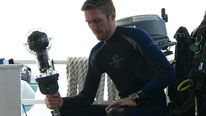 The camera is kept on the sea bed using dive weights and is permanently connected to the boat. A cable feeds images back to a viewing engine where the "blending" of all the camera image streams takes place in real time. Once this process is complete and the film is captured on a hard drive, stitching software creates "sphere movies" showing the whole environment in motion at once. Visit this specialist camera website to learn more about the technical specifications of this 360° camera. |
360° Video
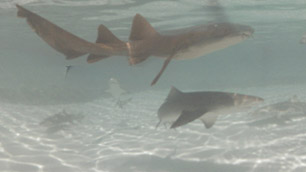
Lemon sharks in 360°
Swim with sharks on the bottom of the sea bed.
BBC iD
BBC iDBBC navigation
BBC links

BBC © 2014The BBC is not responsible for the content of external sites. Read more.
This page is best viewed in an up-to-date web browser with style sheets (CSS) enabled. While you will be able to view the content of this page in your current browser, you will not be able to get the full visual experience. Please consider upgrading your browser software or enabling style sheets (CSS) if you are able to do so.
