Summary

  1. Extreme heat event cancelled - due to extreme heatpublished at 12:15 BST

    Matt McGrath
    Environment correspondent
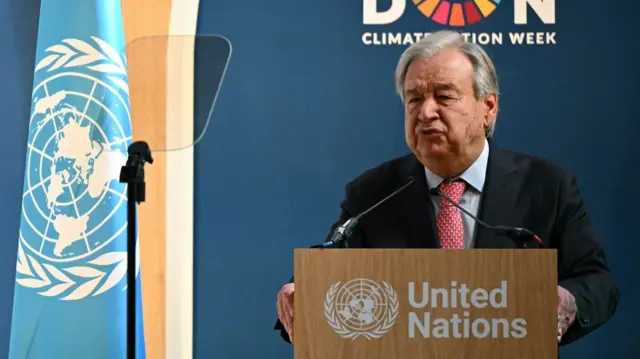
    A man with grey hair wearing a black suit with a red tie stands at a podium that reads "United Nations" behind his right is a UN flag and behind his head a sign that reads London Climate Action WeekImage source, Justin Tallis/AFP/Getty Images
    Image caption,

    Antonio Guterres, head of the UN, is one of a number of high profile guests attending London Climate Action Week

    A meeting in London on how to adapt to extreme heat has fallen victim to the very thing it was seeking to tackle.

    The session, scheduled at the London School of Economics during London Climate Action Week, was due to explore how countries and cities are responding to rising temperatures around the world.

    But organisers cancelled the event after the Met Office issued a red extreme heat warning.

    Chris Anderson from Practical Action, who was due to take part in the event, says: “We're fully in favour of the decision, for the wellbeing of attendees and panellists.

    “But it shows that extreme weather is becoming unpredictable and moving faster than people can adapt, even in the richest countries.”


  2. Effectiveness of medication could be impacted by heatpublished at 12:05 BST

    Young businessman treating asthma attack with inhalerImage source, Getty Images

    As temperatures rise, the effectiveness of medications can change.

    The Medicines and Healthcare products Regulatory Agency (MHRA) says heat damage can break down active ingredients in medicine.

    That can stop or alter how much the body absorbs when it comes to tablets, inhalers, hormone patches, insulin, blood glucose monitors and EpiPens.

    Dr Alison Cave, MHRA’s chief safety officer, says some medicines can also make you more likely to "burn in the sun, feel dizzy, or get dehydrated", especially if you’re taking diuretics or have a condition like asthma, heart disease or diabetes.

    She says most medicines need to be stored at temperatures below 25°C - but cars, trains and even bags and pockets could get warm enough to cause problems and keeping them in a cool bag could be useful.

    She adds: "If your medicine has changed colour, developed an unusual smell, changed texture, or looks different in any way, this could signal heat damage. Ask your pharmacist for advice."

  3. Analysis

    Does the warm weather have an impact on the economy?published at 11:53 BST

    Dharshini David
    Deputy economics editor

    As some trains grind to a halt - is the economy in danger of doing the same?

    The answer is no - after all, whatever the disruption, most of us are still working.

    And while events are being cancelled, that activity may simply be displaced if they are rescheduled. Equally, other forms of spending - on fans, ice cream and extra childcare if you’re dealing with school closures - may rise.

    So, however tempting, it’s impossible to put a reliable number on this.

    In big scheme of things, short-lived weather events don’t tend to shift the dial much in terms of overall GDP. But economic activity may be a bit sluggish overall for a few days as the temperature rises.

  4. From community centre to cool spacepublished at 11:49 BST

    Miho Tanaka
    Senior climate journalist

    Four women stand in a row smiling, they are holding up paintings they have made. On the left is a younger woman with brown hair wearing a blue and white shirt and white headphones in. To her left are three older women, the first is in a blue shirt and blue jeans with glasses, the second is in a white shirt with a brown sunhat and the third is in a multicoloured floral dresImage source, Gwyndaf Hughes/BBC
    Image caption,

    Local residents gather to cool down at the Engine Room

    The Engine Room in Tottenham Hale normally serves as a community centre for local residents to get together for walks, and arts and crafts.

    But this week it is serving another purpose - a “cool space”.

    One of dozens designated across the capital offering respite from heat for residents, mostly elderly people.

    The spaces have air conditioning systems, seating, free drinking water and bathrooms.

    Frederica Roberts, tells the BBC the centre offers them ‘”absolute tranquillity” away from the “hustle and bustle”.

    Her friend, Marion Wilson, jokes that spending time at the centre offers them “a relief especially with half of us that are menopausal. If you have that and you have heat, it's not good to be around us”.

  5. 'There's work to be done': Construction workers brave the heatpublished at 11:33 BST

    Rory Bibb
    Reporting from London

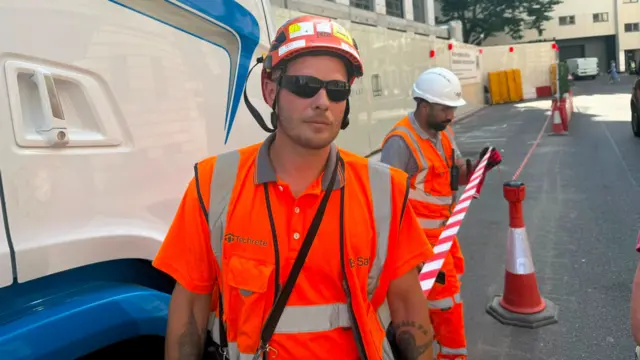
    A construction worker in a high visibility jacket, hard hat and sunglasses pictured in London
    Image caption,

    Johnny is braving the heat working outdoors like thousands of workers across the country

    Johnny is a construction worker on a site in London where temperatures are already soaring.

    He says: "It’s horrible. You’re outside all day and there’s no let up. We might be going home early, but there’s work to be done."

    "We're all hot, and we're all in the same boat. No one's dropped down, touch wood,” he adds.

    UK employers are issued health and safety advice on how to protect outdoor workers in these sorts of conditions.

    But there is no legal maximum temperature at which work has to stop as there is elsewhere, meaning it's business as usual for people in industries like construction and farming.

  6. Amber heat warning issued for Saturdaypublished at 11:25 BST
    Breaking

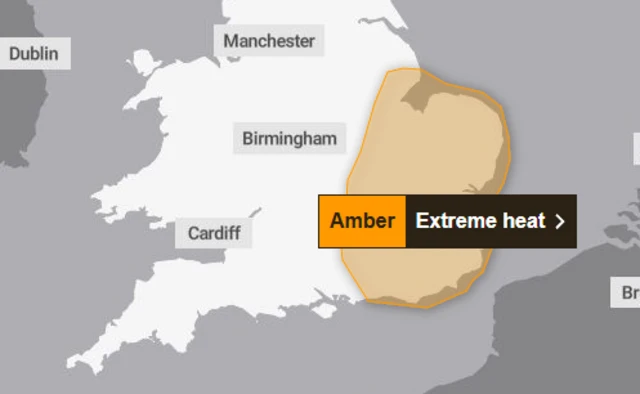
    Another amber weather warning has just been issued by the Met Office.

    It will come into effect between 00:00 and 21:00 on Saturday, covering parts of southern and eastern England.

    A Met Office graphic showing the UK and with an area coloured in orange where an extreme heat warning will come into effectImage source, Met Office
    Image caption,

    An amber weather warning has been issued for parts of England on Saturday

  7. Temperatures remain high in Europe on Wednesdaypublished at 11:24 BST

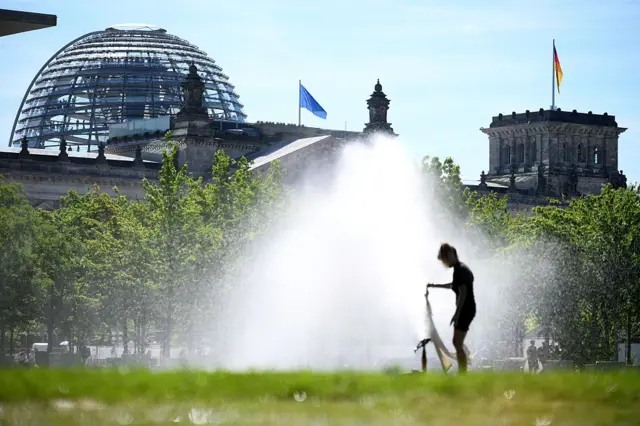
    A woman cools down outside the Reichstag in Berlin earlier todayImage source, Getty Images
    Image caption,

    A woman cools down outside the Reichstag in Berlin earlier today

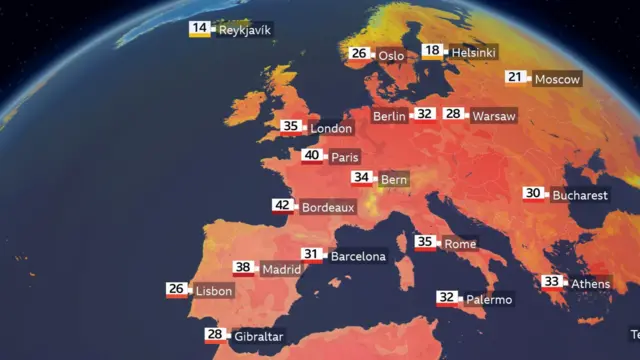
    Europe's ongoing heatwave is expected to continue on Wednesday.

    France is experiencing another day of exceptionally hot weather, with more than half the country remaining under a red heat alert on Wednesday.

    It comes after the country experienced its hottest June day since records began on Tuesday, with an average temperature of 29.8C (85.54F) recorded.

    Temperatures are expected to peak in the Netherlands and Belgium on Friday, while Germany is expected to see the mercury rise to 40C (104F) over the weekend.

    A graphic of a globe, zoomed in on Europe. The land shown in red and yellow colours, become redder in more hot areas. Temperatures are listed for major cities, with the highest being 42C in Bordeaux.Image source, BBC Weather
  8. How rare is a red extreme heat warning?published at 11:13 BST

    Ben Rich
    Lead weather presenter

    The Met Office has been issuing extreme heat warnings since 2021 – and this is only the second time that a red warning that has been issued since then.

    The first was in July 2022, when the UK set its new all-time temperature record of 40.3C.

    When the Met Office issues weather warnings it takes two things into account: how likely it is that severe weather will happen, and what impact that weather is likely to have.

    A red warning is issued when there is a high likelihood that severe weather will have a high impact, and that is definitely the case with this heatwave.

    There is a risk of health impacts across the population and a threat of significant disruption to power networks and transport services.

  9. Rail journeys impacted as red weather warning takes holdpublished at 11:08 BST

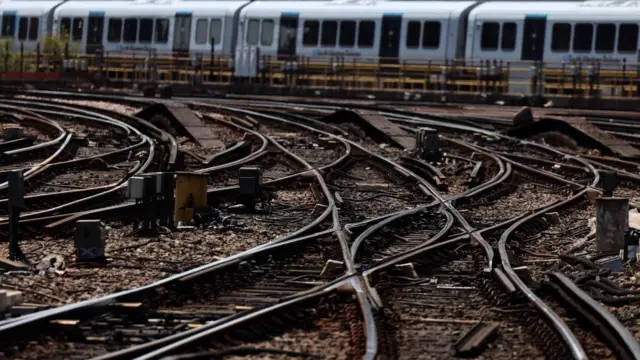
    Railway tracks at Waterloo Station in London. A train can be seen in the background, with intersecting lines visible in the foreground.Image source, EPA/Shutterstock

    The National Rail website is warning passengers not to travel to, from, or within the red weather warning zone unless absolutely necessary.

    The Met Office has previously warned that rail journeys are among the daily activities that could be impacted by the extreme heat.

    A number of rail operators have altered their services, in response to the heat, alongside warnings that there could also be short-notice changes or alterations.

    The operators listed on the National Rail website as having disruptions, ticket changes or travel advice are:

    • Avanti West Coast
    • c2c
    • Chiltern Railways
    • CrossCountry
    • East Midlands Railway
    • Elizabeth line
    • Gatwick Express
    • Great Northern
    • Greater Anglia
    • Great Western Railway
    • Heathrow Express
    • London Northwestern Railway
    • London Overground
    • LNER
    • Merseyrail
    • Northern
    • Southeastern
    • Southern
    • South Western Railway
    • Stansted Express
    • Thameslink
    • TransPennine Express
    • Transport for Wales
    • West Midlands Railway

    Grand Central, Hull Trains, Lumo and ScotRail are all operating on a normal timetable with no planned alternations, but passengers have been advised to check before they travel in case of short notice alterations.

  10. In Shetland, it's woolly dress and vest weatherpublished at 11:02 BST

    Sadaf Maruf
    Your Voice news editor

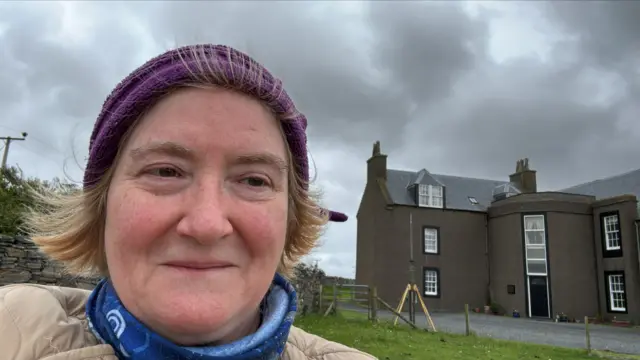
    Woman wearing beanie hat taking a selfie as she stands outside buildingImage source, Supplied

    Helen and her husband Tony live in the northeast part of Shetland, in the hamlet of Lunna.

    She got in touch with BBC Your Voice on Wednesday to say that for them it was a balmy 14C.

    She says there is a lot of mention on the news of how hot it is south, "but the forecast here is for a maximum of 15C".

    Helen who works from home in the pharmaceutical industry says, "f it got to 20C the sheep would probably lie around panting". The couple have lived in the hamlet of Lunna for 25 years.

    She says: "I’ve put on a woolly dress and a vest on today! Even though its baking hot in the south, we prefer it here by far. Just a bit of warmth every now and then would be nice though - for us 20C is tropical."

    Your Voice banner
  11. Red extreme heat warning extended by three hourspublished at 10:58 BST
    Breaking

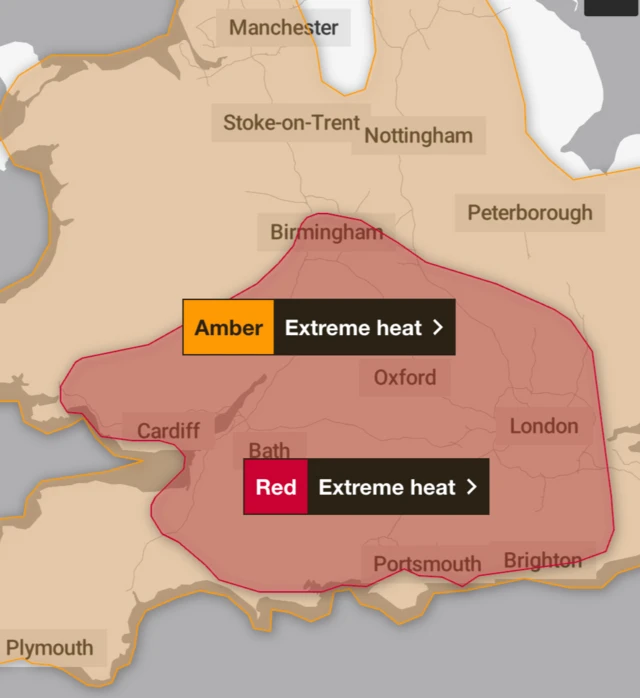
    The Met Office has extended the red extreme heat warning in place by three hours until 23:59 on Thursday evening.

    The warning has also been extended south across Dorset, Hampshire and Sussex, the Met Office say.

    It has also issued another amber warning for heat for Friday, covering eastern and central England, alongside the existing red warning.

    The Met Office red extreme heat warning has been pushed slightly further southImage source, Met Office
    Image caption,

    The Met Office red extreme heat warning has been pushed slightly further south

  12. Record heat on Tuesday in Jerseypublished at 10:36 BST

    Matt Taylor
    BBC Weather

    Jersey experienced as hottest June day on record on Tuesday.

    The Jersey Met Service reported a high of 37.2C (99F) - smashing the previous record of 33.4C, which was only set last year, by a huge margin.

    It was also their second warmest day on record.

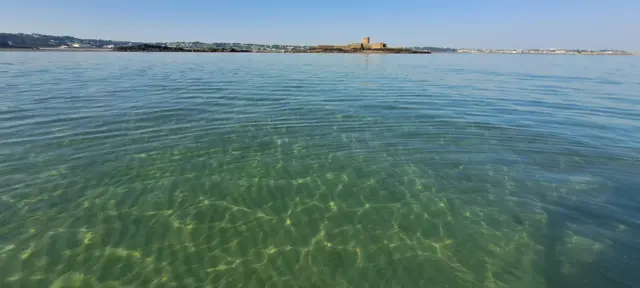
    St Aubin in Jersey earlier todayImage source, BBC Weather Watchers / Hedi
    Image caption,

    St Aubin in Jersey earlier today

  13. Early risers see a warm start to the daypublished at 10:19 BST

    It was a notably warm start this morning, although it hasn't deterred some from getting out and about.

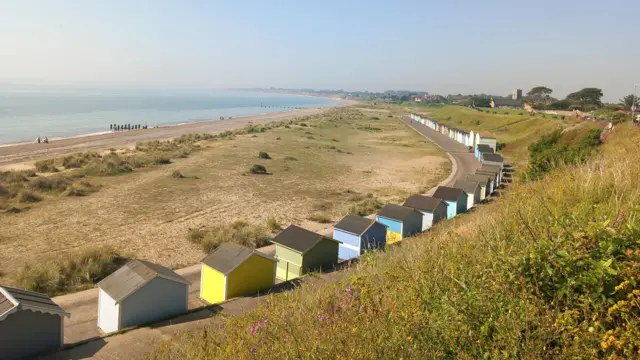
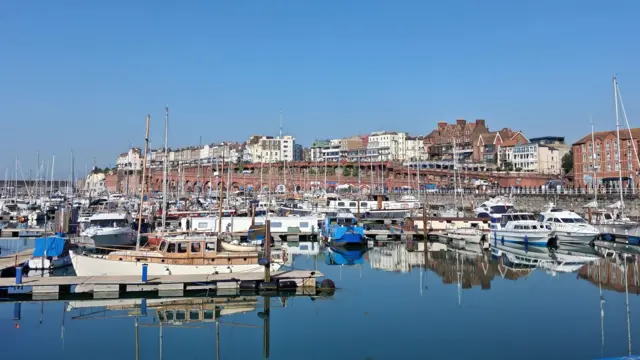
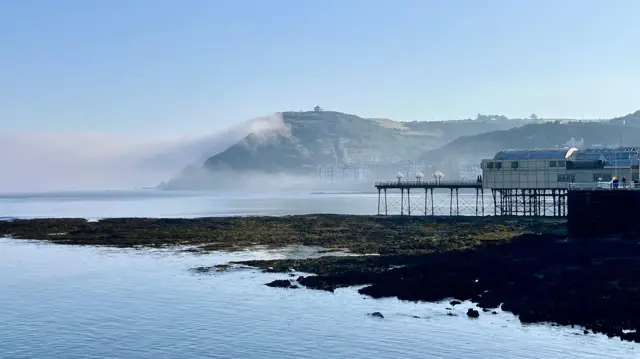
    Here are some pictures taken by BBC Weather Watchers from across the UK.

    A line of different coloured beach huts curve along a concrete road very close to the shoreline. In front of them is a dry grass field, which is dotted with a few bushes leading towards the beach and the sea in the distanceImage source, BBC Weather Watchers / Hayley85
    Image caption,

    Beach huts basking in the sun in Pakefield, Suffolk

    Several boats ranging in different colours and sizes are moored in a harbour in Kent. The sea is still and the sky can be seen reflected in the water, with a long row of buildings seen in the backgroundImage source, BBC Weather Watchers / Steve
    Image caption,

    Boats line the water in Ramsgate, Kent

    A golden labrador type dog stands in the middle of a wheat field next to a tall hedge. Trees can be seen in the middle distance above a clear blue skyImage source, BBC Weather Watchers / Philbert Nut
    Image caption,

    Clear skies and long walks in Pilton, Somerset

    A pier is stood on a headland jutting out to sea in Wales. In the distance a large cliff rises above several houses along the coastline, while a layer of fog extends from the rightImage source, BBC Weather Watchers / Kryzstof
    Image caption,

    Early morning fog settles across the coast in Aberystwyth

  14. How to stay safe while swimming outdoorspublished at 10:13 BST

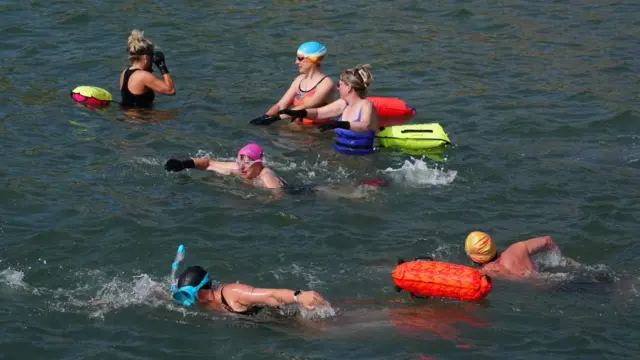
    Water safety experts have shared some simple tips with BBC News on staying safe when swimming in open water. Here’s what they told us:

    Choose a spot with a lifeguard: The best place to swim is somewhere supervised. You can find a list of UK beaches with lifeguards on the RNLI website, external, external.

    Watch videos of rip currents: A rip current can quickly pull you away from shore and out of your depth. They can be difficult to spot, RNLI says, but watching videos can help you identify them.

    Think about your swimming ability: Swimming in the sea, lakes and rivers is very different from a swimming pool, so people should think carefully before getting in.

    Keep someone on shore: Someone from your group should always stay on shore to keep an eye on those in the water and can call for help if needed.

    Avoid inflatables: If the wind changes when you’re in an inflatable, you can be blown out to sea. It’s advised to avoid them altogether.

    Get in the water slowly: Getting into cold water too quickly can cause cold water shock, which restricts your ability to move and affects your breathing. You should get in slowly and allow your body to acclimatise.

    Swimmers in North Tyneside on TuesdayImage source, PA Media
  15. More than 500 schools closed or partially closed in Walespublished at 10:05 BST

    More than 500 schools in Wales have been closed or partially closed as a result of the high temperatures.

    Closures are impacting schools across mid and south Wales - including all in Blaenau Gwent, and most in Caerphilly and Bridgend.

    Others have been confirmed in Cardiff, Carmarthenshire, Merthyr Tydfil, Monmouthshire, Neath Port Talbot, Newport, Powys, Rhondda Cynon Taf, Swansea, Torfaen and Vale of the Glamorgan.

    That's on top of at least 578 full or partial closures in England - the vast majority of them in the south of the country.

  16. Today is likely to be hotter than yesterdaypublished at 09:48 BST

    Ben Rich
    Lead Weather Presenter

    Yesterday’s highest temperature was 34.6C at Wisley in Surrey – but today is likely to be even hotter.

    Strong sunshine will lift temperatures well into the 30s Celsius with highs of 37C likely – with the hottest place likely to be somewhere to the south-west of London or in central-southern England, within the area covered by the red extreme heat warning from the Met Office.

    It is likely that the UK’s June temperature record, currently 35.6C, will be broken.

    Temperatures of 30-34C are expected across large swathes of south-west England, east Wales, the Midlands and Northern England.

    High humidity will make it feel particularly hot when combined with the strong sunshine.

    Scotland and Northern Ireland had their hottest day of the year so far yesterday, but today is likely to be cooler with temperatures peaking in the low to mid-20s.

    People walking in Hyde Park in the sunImage source, EPA
  17. Do you have any questions about the hot weather?published at 09:34 BST

    On Thursday, we’ll be running a live Q&A with correspondents and experts from BBC teams including climate and science, health, learning and identity, business and weather.

    You can get in touch in the following ways: 

    Please read ourterms & conditions andprivacy policy

    In some cases a selection of your comments and questions will be published, displaying your name and location as you provide it unless you state otherwise. Your contact details will never be published.

    A BBC graphic that says "Your Voice" in white font against a purple background.
  18. At least 500 schools in England fully or partially closedpublished at 09:20 BST

    Hazel Shearing
    Education correspondent

    There's no official data to show how many schools are closing because of the heat, so we've been looking through council and school websites to try to get an idea.

    So far we've counted at least 578 full or partial closures - the vast majority of them in the south of England.

    The total number is likely to be much higher, though, because many councils do not publish lists of schools which have to close unexpectedly due to extreme weather.

    Lots of schools are also part of multi-academy trusts, which may not appear on council lists if they're closed.

    The disruption comes just after the end of timetabled GCSE, A-level and other exams.

  19. How do weather warnings work?published at 09:13 BST

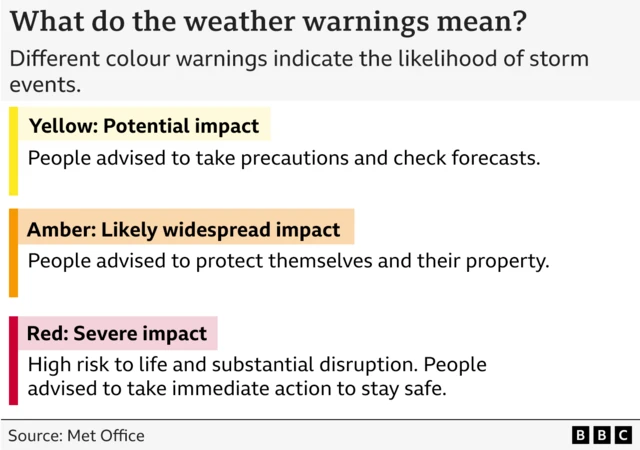
    Weather warnings are given a colour – yellow, amber or red - depending on a combination of two things; the impact the weather is likely to have and the likelihood of it happening.

    A matrix system is used to help decide on the severity of the warnings, which then helps decide the colour.

    Yellow is the lowest tier of warning, amber is a middle-tier warning and red is the most serious type of warning possible. The warning is determined by what best matches the impact of the weather against the likelihood of it happening.

    Eight different types of weather are covered: rain, snow, wind, thunderstorms, lightning, fog, ice, and extreme heat.

    A graphic showing the different types of weather warnings and what they mean
  20. What does a red extreme heat warning mean for me?published at 09:03 BST

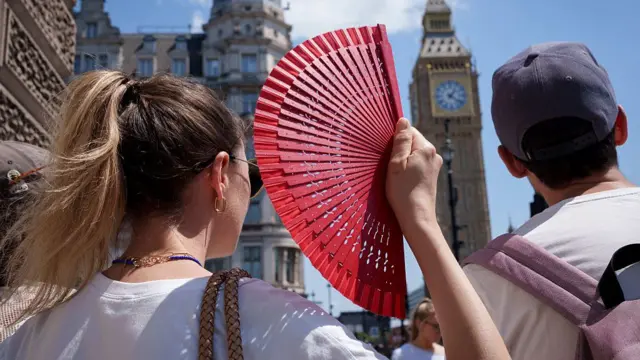
    A visitor to the capital fans herself in front of Parliament with a red fan. London's Palace of Westminster is visible in the background.Image source, Getty Images

    The Met Office's red warning for extreme heat has just come into effect, meaning an "exceptional spell" of hot and humid weather can be expected across the affected region.

    This is only the second time a red warning has been issued since extreme heat warnings began in 2021.

    Among the areas included are the East Midlands, East of England, London & South East England, South West England, Wales and the West Midlands.

    The Met Office says to expect population-wide impacts, affecting not just those who are most vulnerable to extreme heat, including serious illness or danger to life.

    The service says "substantial changes" in working practices and daily routines will be required, while there is also a high risk of heat-sensitive systems and equipment failing.

    This could result in power cuts and the loss of other essential services such as water, electricity, gas or mobile phone signal.

    Furthermore, delays on roads and road closures are expected alongside delays and cancellations to rail and air travel. Those who experience even moderate delays on such services are at risk of significant welfare issues.

    There is also an increased risk of water safety incidents, due to significantly more people visiting coastal areas, lakes and rivers.