Summary

  1. BBC Verify

    Commercial vessel movement remains restricted in Strait of Hormuzpublished at 13:08 BST

    Vessels alter course after Iran government’s Persian Gulf Strait Authority said transit through the strait isn’t possibleImage source, MarineTraffic

    By Shruti Menon

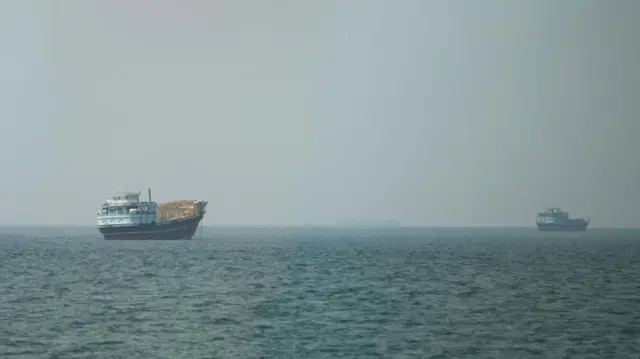
    A small number of vessels appear to be moving through the Strait of Hormuz although traffic remains restricted, according to the ships we can track on the website MarineTraffic.

    Two vessels - Wilmot and Seafaith - appear to be sailing east into the Gulf of Oman with their location transmitters switched on according to tracking data.

    Wilmot is broadcasting Pakistan as its destination without specifying a port and Seafaith is sailing to Sohar in Oman.

    Two other ships, Evalovia and Aisana, stopped transmitting their locations after previously appearing to head out of the strait. Their current locations cannot be confirmed.

    MarineTraffic tracking showed Wilmot, Evalovia and Seafaith each altered course while outbound towards the Gulf of Oman and had reversed direction. Wilmot and Seafaith have resumed their outbound journeys. Evalovia also appeared to turn back towards the Gulf of Oman before it went dark - meaning it switched off its location transponders.

    Vessels often switch off their location transmitters when there is a risk to their safety.

    Cargo ship Bayaze D and a small number of Iranian vessels appear to be sailing west through the strait likely towards ports in Iran.

  2. UK government will 'step up' ability to counter state threatspublished at 13:02 BST

    More from the recent government statement on its move to pass emergency legislation to outlaw three groups, including the IRGC.

    The Home Office said the move will step up the government’s ability to counter state threats linked to foreign powers and will hand the police "stronger powers" to deal with activity carried out by the three groups.

    "New offences for supporting and assisting these groups could result in a 14-year prison sentence," the statement adds.

    "It will now be easier to bring anyone caught working with them to justice and put them behind bars for longer."

    The government adds it has already taken "robust action" against Iran by sanctioning the IRGC in its entirety and more than 550 Iranian-linked individuals and entities.

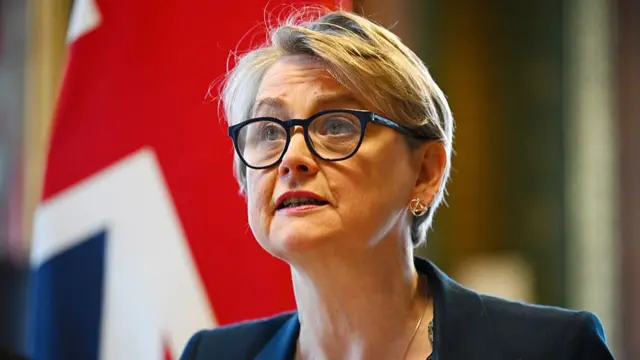
    Home Secretary Shabana Mahmood says those working for the three groups "will be tracked down and put behind bars" and vows to leave "no stone unturned to keep our country safe".

    Foreign Secretary Yvette Cooper adds Russia and Iran's use of proxy groups "to carry out state-backed activity" is "reprehensible" and the UK will take all measures necessary "to protect the British people, at home and abroad”.

  3. IRGC to be outlawed by UK governmentpublished at 12:46 BST
    Breaking

    Iran's Islamic Revolutionary Guard Corps (IRGC) is to be outlawed by the UK government following emergency legislation to crack down on foreign state-backed activity, the Home Office confirms.

    The Islamic Movement of Companions of the Right (IMCR) and Russia’s GRU Volunteer Corps (GRU) are also designated.

    If approved by Parliament later this week, those conducting acts of sabotage including arson on behalf of these groups could face life imprisonment.

    UK Prime Minister Keir Starmer said: "We will never let Britain be a playground for states who want to spread fear, division and violence on our streets."

  4. Petrol and diesel prices creeping up againpublished at 12:36 BST

    Oliver Smith
    Live business reporter

    A man holding a petrol pump next to a car.Image source, PA Media

    Earlier, the EU's energy task force said there is "no immediate security of supply concern" over oil and gas this winter.

    But, the UK's Royal Automobile Club (RAC) have released some new figures this morning showing that prices at the pumps in the UK are climbing following a resumption of attacks between the US and Iran.

    The average price of a litre of petrol had reached a high of 159.53p in May during the conflict, but had fallen back since by 9p to 150.59p at the beginning of last week. Over the weekend it’s crept up to 151.19p.

    Diesel, which had hit 191.54p a litre in April, had dropped 27p to 164.52p before climbing to 164.85p today.

    At the start of the conflict, petrol had been 132.83p a litre on average, and diesel 142.38p.

  5. Bahrain army accuses Iran of targeting civilianspublished at 12:25 BST

    Bahrain's military has again accused Iran of targeting civilians with missiles and drones.

    It says its air defences "intercepted and destroyed" several Iranian attacks this morning, adding that it remains in a state of "readiness" and "high alert" to defend itself.

    It comes after Bahrain was targeted in further tit-for-tat strikes between the US and Iran overnight.

  6. Iranian media reports fresh strikes in several locationspublished at 12:12 BST

    Iranian media has reported fresh strikes in several locations in the past hour.

    State-run IRNA cites Iran's deputy governor for security affairs in the Isfahan province as saying an attack on a military base in the city of Nain killed one person and injured seven.

    Two people have reportedly been killed and three injured in Abadan, in the country's southwest, according to the deputy governor of the Khuzestan province.

    The US has not confirmed the reports. The country's military has said it targeted dozens of Iranian military installations in a wave of strikes overnight.

  7. Jet fuel supply is stable despite volatile situation, EU sayspublished at 11:54 BST

    A plane is being refuelled on a runway during a sunny dayImage source, Getty Images

    Fewer ships transiting the Strait of Hormuz - a key supply route for imports into Europe - had raised fears of jet fuel shortages.

    In a statement released today following a meeting on Friday, the European Union's energy task force has quelled those concerns.

    The task force says the supply of jet fuel "remains overall stable so far" despite the "volatile" situation in the Middle East.

    It also says there is "no immediate security of supply concern" over oil and gas this winter.

    Gas prices are still above pre-conflict levels, although "volatility has remained relatively low and prices are significantly lower than levels seen in the 2022 energy crisis," it adds.

  8. Strait is a high-risk zone, Iran embassy in UK sayspublished at 11:42 BST

    Iran has established a temporary safe maritime corridor "free of technical and military barriers" in compliance with the Islamabad memorandum of understanding, the country's embassy in the UK has said.

    In a post on X, the embassy claims the Strait of Hormuz has turned into a "high-risk zone" for maritime traffic due to US military aggression.

    It also accuses the US of pushing vessels toward a "dangerous southern parallel route", referring to the Joint Maritime Information Center advising ships to take a route through Omani waters in the south of the strait.

    The route is described by the embassy as being "unsafe, unreliable, and prone to accidents".

    Map of the Strait of Hormuz showing two sets of alternative shipping routes. Red arrows mark shipping lanes designated by Iran, running through the northern part of the strait near the Iranian coast. Blue arrows mark routes suggested by Oman, the UN and allies, running farther south around the coast of Oman. Iran is labelled to the north and Oman to the south. An inset map shows the strait’s location between the Gulf and the Gulf of Oman.
  9. Attacks on ships reported in Strait of Hormuz in recent dayspublished at 11:16 BST

    The US says the latest round of strikes are in response to Iran hitting commercial ships in the Strait of Hormuz.

    The UK's Maritime Trade Operations (UKMTO) has reported incidents in the vital waterway in recent days:

    • 5 July: A cargo vessel reports being attacked by "unknown armed assailants" off the coast of Yemen
    • 6 July: A tanker is hit by an "unknown projectile" off the coast of Oman, causing a fire on board. No casualties are reported
    • 7 July: A tanker is struck by an "unidentified projectile" in a nearby area. It suffers structural damage but there are no casualties. Another tanker in the same place is struck by an unknown "Uncrewed Aerial Vehicle" and suffers minor structural damage
    • 12 July: A container ship off the coast of Oman is damaged, causing a fire to break out on board. The crew abandon ship and are rescued by local authorities

    Our colleagues at BBC Verify have been monitoring the movement of ships in the strait - no commercial vessels have crossed the strait since Sunday evening.

    Three small boats on the water, image is black and white. Image has a small white box around the boats and the word classified is at the top of the image in green.Image source, US CENTRAL COMMAND
    Image caption,

    The US military says its strikes are in response to Iranian attacks on vessels in the strait. Centcom shared this image of Islamic Revolutionary Guard Corps boats before they were struck by the US

  10. UK, France and Germany condemn 'reckless attacks' on ships - joint statementpublished at 10:47 BST

    The UK, France and Germany have condemned Iran's "reckless attacks" on vessels in the Strait of Hormuz and in Bahrain, Oman and Jordan.

    In a joint statement, external issued last night, before the latest round of overnight attacks, the E3 group called for the "swift and full" resumption of shipping in the strait.

    The US military said it carried out a wave of strikes in response to Iranian attacks on commercial ships in the vital waterway. Iran said it retaliated with strikes on US military bases in Kuwait, Jordan and Bahrain.

  11. 'Absolutely untrue': Iran disputes Trump's 'no nuclear' dealpublished at 10:31 BST

    Donald Trump walks in a navy suit with a gold tie. A pair of USA flags can be seen behind him.Image source, EPA/Shutterstock

    On Sunday, President Donald Trump told NBC Iran had agreed to a deal with the US during talks over the weekend.

    He said: "They agreed to a deal yesterday, a perfect deal for us. No nuclear, no this, no that, no nothing. They gave up everything."

    On Monday, Iran's foreign ministry spokesman called Trump's comments "absolutely untrue".

    Esmail Baghaei says no topic other than the Strait of Hormuz was discussed during a meeting between the two countries in Oman on Saturday.

    Mediators are continuing their efforts in negotiations between the US and Iran, he adds.

  12. 'We will not hesitate in our self-defence' - Iran foreign ministry spokesmanpublished at 10:05 BST

    Esmail Baghaei speaks while wearing a dark suit.Image source, Reuters

    Iran's foreign ministry spokesman says the US-Iran deal has "entered a crisis".

    Iranian state media quotes Esmail Baghaei as saying Iran's "defensive strikes" are solely against bases and facilities used by the US to attack the country.

    "We will not hesitate in our self-defence," he adds, saying Iran cannot allow the US to use transit in the Strait of Hormuz to harm the country's sovereignty and security.

    Baghaei says negotiations on Saturday were solely focused on the vital waterway, adding that Iran's goal was to ensure the safe passage of ships. But, he says, US pressure on Oman has hindered efforts.

    As a reminder, ship-tracking data shows no vessels have transited the strait since yesterday evening.

    On the memorandum of understanding - a 14-point deal signed on 17 June - Baghaei says Iran will not execute its commitments if the US fails to honour the agreement.

  13. UN chief warns of 'catastrophic consequences'published at 09:29 BST

    Antonio Guterres in a suit with a red tie. He is standing behind a pair of microphones.Image source, Reuters

    The UN secretary-general said on Sunday he was "deeply concerned" by the renewed military confrontations in the Gulf region, urging all parties to exercise "maximum constraint".

    In the statement, made before a further set of US strikes overnight on Sunday, Antonio Guterres warned that a return to full-scale hostilities would have "catastrophic consequences".

    He also called for the restoration of "full freedom of navigation" in the Strait of Hormuz.

    The secretary-general's comments were criticised by Iranian Foreign Ministry spokesman Esmail Baghaei, who said on Sunday that Iran's strikes on US bases in the region were a "legitimate and lawful exercise of its inherent right to self-defence under international law".

    He also called on Guterres to urge the countries in the region to stop allowing the US to use their territories "as launchpads for aggression against Iran".

  14. BBC Verify

    No ships tracked through Strait of Hormuzpublished at 09:08 BST

    By Shruti Menon

    No commercial vessels have crossed the Strait of Hormuz while broadcasting their location since yesterday evening, according to ship-tracking website MarineTraffic. Other ships may have crossed with their transmitters off.

    On Sunday, the Iranian government’s Persian Gulf Strait Authority (PGSA) said transit through the waterway "is not currently possible" due to "illegal movements of the United States military forces in the region".

    Eight commercial vessels including tankers, bulk carriers and cargo vessels, crossed the strait on Sunday - down from 21 on Saturday and 14 on Friday, according to preliminary data from maritime intelligence firm Kpler.

    Of the eight that crossed yesterday, two broadcast their positions during the transit and both had crossed before the PGSA made its announcement.

    The other six crossings recorded by Kpler were dark, meaning they did not broadcast their position while they were crossing the Strait of Hormuz.

    Our colleagues at BBC Verify will continue to monitor vessels crossing the strait throughout the day.

  15. A state of controlled escalation in the Strait of Hormuzpublished at 09:02 BST

    Barbara Plett Usher
    Reporting from Jerusalem

    Two large ships pictured in the Strait of Hormuz on 12 July.Image source, Getty Images

    The battle over control of the Strait of Hormuz has stalled movement towards ending the wider conflict.

    Iran pledged to open the strait, according to the terms of its interim deal with Washington, but it has been firing on commercial vessels it says are using an unauthorised route.

    The US military says its latest round of strikes has continued to degrade Iran’s ability to attack international shipping. And it insists that traffic is still able to flow through the strait.

    The Trump administration needs that to happen to bring oil prices down ahead of midterm elections in November.

    Attempts by mediators to resolve the dispute at the weekend failed – and it’s clear how important control of the strait is to Iran: more important than dozens of atomic bombs, senior Iranian officials have said.

    It’s believed neither side wants to return to all-out war, but analysts say they are in a state of controlled escalation.

    In our next post, we'll bring you an update on the tracking of ship movement in the strait.

  16. Major European markets open flat, shrugging off latest strikespublished at 08:50 BST

    Mitch Labiak
    Live business reporter

    European stock investors appeared to shrug off the latest news about military attacks between the US and Iran as the major markets all opened flat.

    The FTSE 100 index of the largest firms listed in London, as well as its French and German equivalents, the Cac 40 and the Dax, were all flat in early trading, not moving since Friday's close.

    US markets will open at 09:30 in New York (14:30 BST), but current bets on the future price of shares in that market suggest the S&P 500 index could be down by about half a per cent when share trading begins.

    Meanwhile, oil prices jumped at the start of trading as Brent crude - the global benchmark wholesale oil price - surged almost 5% early on Monday to over $79 (£59) a barrel.

    This Flourish post cannot be displayed in your browser. Please enable Javascript or try a different browser.

  17. The era of one-sided deals is over, Iranian negotiator said on Sundaypublished at 08:32 BST

    Mohammad Bagher Ghalibaf arrives in Switzerland for technical talks on the US-Iran ceasefire on 20 JuneImage source, Reuters
    Image caption,

    Mohammad Bagher Ghalibaf arrives in Switzerland for technical talks on the US-Iran ceasefire on 20 June

    Iran's parliamentary speaker Mohammad Bagher Ghalibaf - who has been the country's chief negotiator with the US - said on Sunday the era of "one-sided deals is over".

    He added in a post on X: "We told you: keep your word or pay the price. Reality is knocking."

    Iran's foreign ministry also accused the US of causing "the return of insecurity" in the Strait of Hormuz.

    Meanwhile, in a brief phone interview on Sunday, US President Donald Trump said to Reuters: "We're beating them up," referring to Iran.

  18. Latest strikes come days after Trump called Iran's leaders 'scum'published at 08:14 BST

    From hopes of peace, to regular attacks - here's a recap on how we got here:

    • 17 June - US and Iran sign a memorandum of understanding (MoU), supposedly putting an end to the conflict - and beginning a further 60 days of negotiations
    • 26 June - The US launches fresh strikes on Iran after Donald Trump accuses the country of a "foolish violation" of its truce, following an attack on a cargo ship in the Strait of Hormuz
    • 7 July - The US launches approximately 80 more strikes at Iran in response to attacks on ships in the Strait of Hormuz, while Iran targets US military sites in Bahrain and Kuwait
    • 8 July - Trump declares the ceasefire with Iran "over", calling the country's leadership as "scum" and "cuckoo" - see our clip below
    • 11 July - US officials demand that Iran publicly state the Strait of Hormuz is open
    • 12 July - The US launches its latest wave of attacks on Iran following further attacks in the strait, with Iran retaliating through several strikes at US bases in the region
  19. Iran attacks Oman, state media reportspublished at 07:36 BST
    Breaking

    Iran's Islamic Revolutionary Guard Corps (IRGC) says it has attacked radar systems in Oman as part of its retaliatory strikes against the US, Iranian state media reports.

    It follows earlier statements in which they said they had attacked sites in Bahrain, Kuwait and Jordan.

    The attacks came in retaliation to overnight attacks made by the US on dozens of Iranian military installations.

    A regional map highlighting Iran in white with its name in red. Surrounding countries are labeled in grey, neighbouring Iraq to the west and other Middle Eastern countries including Syria, Jordan, Israel, Gaza and Saudi Arabia, Qatar, UAE, and Oman. Bodies of water such as the Red Sea and the Gulf of Oman are marked in blue.
  20. Oil prices rise to $79 after latest attackspublished at 07:26 BST

    Mitch Labiak
    Live business reporter

    Oil prices jumped at the start of trading, following news Iran had hit commercial ships in the Strait of Hormuz, with the US then carrying out more attacks on Iran.

    One fifth of the world's oil and gas usually flows through the key waterway south of Iran which the country had effectively closed in response to the start of the US-Israel war with Iran at the end of February.

    Brent crude, the global benchmark wholesale oil price, surged almost 5% early on Monday to over $79 a barrel.

    Despite the rise, prices remain far below the near $120 a barrel peak reached during the height of the war.

    Before the conflict began, oil was trading at around $70 a barrel.

    This Flourish post cannot be displayed in your browser. Please enable Javascript or try a different browser.