Decision Time brings today's Holyrood business to a closepublished at 17:45 BST 26 May
The brings our live coverage of today's Holyrood debate and vote to an end.
Thanks for joining us.
MSPs have backed a call for the Scottish Parliament to be given the powers to hold a second independence referendum
First Minister John Swinney said during the debate that independence offered a "golden opportunity" and invited the parliament to "put Scotland's future in Scotland's hands"
His motion was supported by the Greens but opposed by Labour, Reform, Conservative and Liberal Democrat MSPs
The SNP motion was passed by 72 votes to 55
However, Prime Minister Keir Starmer has previously said he would not back the move
The brings our live coverage of today's Holyrood debate and vote to an end.
Thanks for joining us.
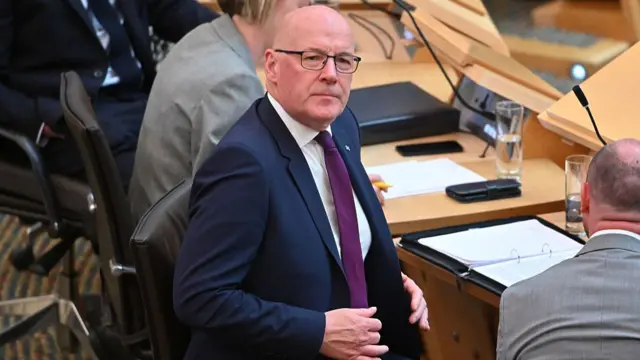 Image source, Getty Images
The motion agreed by parliament said that this month's Holyrood election result provided a "clear mandate that decisions about Scotland's future are best taken in Scotland and that mandate must be respected".
So, a victory for John Swinney. However...
The UK government would still have to transfer powers to Holyrood for a second referendum to take place.
And Prime Minister Sir Keir Starmer and Labour ministers have repeatedly said they would refuse to do so.
Swinney is now expected to raise the issue during upcoming talks with the PM.
The Scottish Parliament has backed the Scottish government's call for Westminster to agree to plans for a second independence referendum.
The proposition was backed by 72 votes to 55 at Holyrood with the backing of SNP and Green MSPs.
If you're just joining us, MSPs are now voting on amendments to John Swinney's motion which is calling on the Parliament to push forward with his plans for a Scottish independence referendum.
The final vote will follow that process, so stick with us.
Constituency MSPs - including several making their Holyrood debut speeches - are now joining the debate.
Voting and decision time will be after 17:00.
That will follow an urgent question about the impact of former SNP chief executive Peter Murrell's guilty plea to an embezzlement charge.
You can continue to follow events by clicking the Watch live icon at the top of this page.
Offord rhymes off a list of policy "failings" and says the SNP is guilty of "managed decline and mid-table mediocrity".
He adds: "Never their fault. Always victims."
Offord says there is "no appetite" for a second independence referendum and adds it should not be discussed for 10 years.
During his speech, he was heckled by MSPs for failing to table an amendment to the motion.
Reform UK Scotland leader Malcolm Offord criticises the SNP for debating matters reserved to Westminster.
He adds: "Is it any wonder two million Scots did not vote in this election?"
Offord accuses the SNP of operating a "deflection strategy" by focusing on the constitution rather than issues which concern ordinary Scots.
Cole-Hamilton continues his attack on government policy, saying Scotland was “embarrassed” last week when the Waverley paddle steamer had to rescue passengers on a broken-down CalMac ferry.
He says that was an example of the SNP government “in microcosm”.
Cole-Hamilton says taking up time in Holyrood for debates on independence “does nothing to serve constituencies”.
He adds voters “no longer have the attention or the trust in the Parliament that they used to”.
Scottish Liberal Democrat leader Alex Cole-Hamilton says there is a “performative nature” to debates over Scottish independence in 2026.
He says a section 30 order will be requested and declined by the UK government because Swinney failed in his aim to secure an SNP majority in the Parliament.
Cole-Hamilton says Holyrood only has a pro-independence majority because of the “gaming of the system”.
He says a second independence referendum is not going to improve the lives of people in Scotland, and warns the country has never “fully flexed the muscles” of devolution.
Russell Findlay says Peter Murrell admitted using £400,000 of stolen money to fund his and Nicola Sturgeon's lavish lifestyle.
He points out Swinney went on the BBC in 2021 to dismiss "valid concerns" about the SNP's finances, while Sturgeon told people to stay quiet, and "when questioned by police she repeatedly said no comment.
He ridicules the idea that Swinney - who had no clue the childhood friend he appointed as SNP CEO was plundering the party - could be trusted to run an independent Scotland.
Findlay adds that there is a "painful lack of self awareness" on the SNP benches.
Scottish Conservative leader Russell Findlay is critical about the first debate of the new session of parliament not being about the NHS, education, taxation or the "betrayal of Scotland's oil and gas workers".
He adds John Swinney only believes in one thing - "breaking up the United Kingdom".
Findlay accuses the first minister of holding Scotland back and ensuring the nation is "stuck in the grip of constitutional paralysis".
Greer says the Scottish Parliament has plenty to be proud of in the devolution era, but too many reforms are being delayed.
He says people “just want the services they use every day to work” and uses the example that people “just want someone to pick up the phone when they call their GP”.
Greer says support for independence can be grown by “maximising the use of self-governing powers” already in place.
He adds parties have the opportunity to work together to tackle serious issues, such as child poverty, and that the parliament is capable of both deciding on Scotland’s constitutional future and addressing issues “here and now”.
Scottish Greens co-leader Ross Greer says his party’s gains means parliament has an independence majority.
He says that democracy is “not a one-off event” and asks the UK government to show “respect for Scottish people and Scottish voters”.
Greer asks whether the union remains voluntary or whether it was only voluntary up until the last independence vote in 2014.
He says he respects unionism and the belief of unionists, but refuses to accept “denying” Scottish people the choice of a vote.
Sarwar says Swinney has spent more time in the last 20 years telling Scotland what he cannot do, rather than what the Scottish government can do.
The Scottish Labour leader also highlights the number of people who have been forced to pay for private treatment due to NHS waiting lists.
Scottish Labour leader Anas Sarwar gets a chance to reply and he takes the opportunity to highlight former SNP chief executive Peter Murrell's admission that he embezzled more than £400,000 from the party over a 12-year period.
Sarwar says supporters were "robbed" after investing their "hard-earned cash" in the party.
He adds the people of Scotland need an honest and transparent government.
Swinney ends by insisting Scottish independence offers a “golden opportunity”.
He says the UK government says no to a second referendum, but “we are the people, we are the people’s parliament and we say yes”.
Swinney says he will ask Parliament to confirm that the people of Scotland “have the right to decide whether the country remains in the union”.
He adds: “I invite parliament to put Scotland’s future in Scotland’s hands.”
Swinney says he wants a "progressive taxation system and compassionate social security system".
The first minister adds he wants to create opportunities for every child to succeed "regardless of where they were born".
He tells MSPs: "Child poverty has been in a scourge in Scotland for far too long."
Swinney says Westminster’s control over Scottish energy resources has been “an unmitigated disaster”.
He says “the old ways” of the UK government have failed Scotland and that Scottish energy must be in Scottish hands.
The first minister says Scotland should have “less to fear” as an exporter of energy, but prices are among the highest in Europe, which he says “does not add up”.
He adds that Scotland “has the energy in abundance, but not the power”.
Swinney highlights plans to cap bus fares at £2 nationwide and ensure people can buy their weekly shop for a "fair, affordable and reliable price".
The first minister also outlines plans to provide more childcare support and increase child support for babies under the age of one to £40 a week.
He adds he wants to ease the burden on families and offer support to renters and first-time buyers.
Swinney says Scotland was “at the forefront of the industrial revolution” thanks to a “wealth of natural resources, spirit of enterprise and openness to the world”.
He says Scotland’s workforce took pride in the “many wonders of engineering they produced”.
Swinney says the country stands on the edge of a “new era of economic transformation”.
He adds that a technological revolution through “biotech, space, precision engineering, fintech and more” is “made for Scotland to succeed”.
