Summary

How are you affected?

  1. BBC Verify

    London's Hyde Park appears significantly drier than last summerpublished at 15:45 BST

    By Thomas Copeland

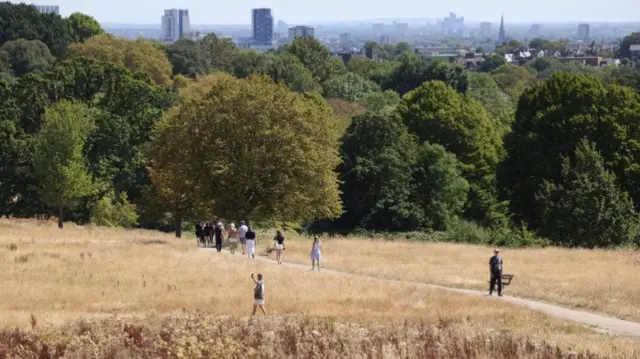
    Another impact of this hot summer can be seen in central London where Hyde Park’s Serpentine lido has been closed due to blue-green algae contamination.

    A comparison of satellite imagery shows how Kensington Gardens in particular appears significantly drier this year compared with the summer of 2025.

    This Flourish post cannot be displayed in your browser. Please enable Javascript or try a different browser.

    Satellite imagery gathered by Thomas Spencer

  2. Rain in England and Wales this month? Possiblypublished at 15:28 BST

    Simon King
    Lead weather presenter, BBC Weather

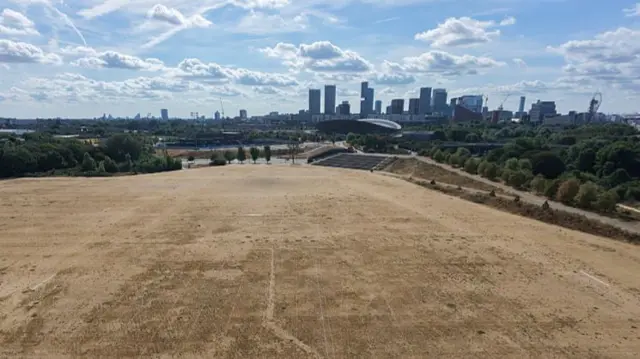
    A large brown area of grass is shown, with trees and the city's skyline visible in the distance.Image source, Getty Images
    Image caption,

    Aerial view of the dry grass of a football pitch at Hackney Marshes in London on Monday

    For England and Wales, there is no rain in the forecast through a lot of the week ahead as the next heatwave intensifies.

    We have to look towards Sunday, where there are some signs of some rain coming into the UK from the Atlantic.

    Low pressure bringing rain-bearing weather fronts will move in across Wales and southern England and - for some - a spell of rain.

    While this doesn’t currently look to be particularly heavy or persistent, there could be the first bit of proper rain for many in nearly two months.

    There could be a few showers at times across Scotland and Northern Ireland in the coming days, but these will be localised with most areas staying dry.

    Longer-range forecasts are always subject to change but there may be a little bit more into next week - but amount of rain in any location may still be highly variable.

    Beyond that, high pressure and more dry conditions look to be dominating the final week of August.

  3. Thousands of fish rescued from rivers during dry weatherpublished at 15:20 BST

    Esme Stallard
    Senior climate and science reporter

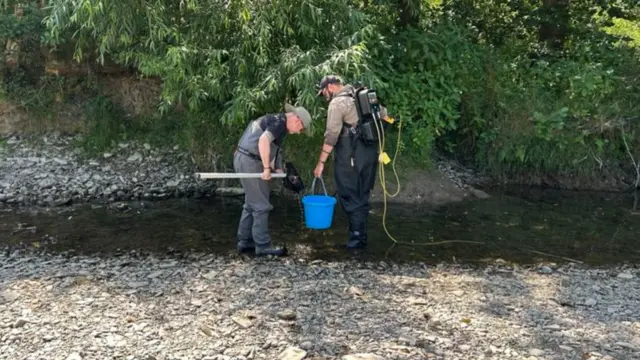
    Two men in waders stand in a low level river with a bucket.Image source, Environment Agency/UK Government
    Image caption,

    This image from the Environment Agency in July shows a fish rescue on the River Teme, which travels from mid-Wales to the River Severn south of Worcester

    Fish are becoming stranded and struggling to survive during the dry weather, the Environment Agency (EA) says.

    Pools and rivers can dry up, whilst hot temperatures deplete oxygen levels in the water and pollution can be more concentrated, external.

    Earlier this month hundreds of fish died in the River Wensum - which runs through Norwich - after heavy rainfall containing contaminants entered the river.

    The hot weather meant that oxygen levels were already reduced, with fish struggling to breathe, and they became overwhelmed by the pollution according to experts.

    The Shropshire Groundwater Scheme has been contributing the equivalent of 80 Olympic-sized swimming pools of water every day to the River Severn to help wildlife and and provide drinking water.

    If water levels cannot be increased, then fish are captured and transported in oxygenated tanks to be relocated. But the fish must be healthy enough to travel and survive relocation - sometimes the stress already endured from the hot weather means such measures are not suitable.

    Last week 650 fish including chubb, roach and minnow were moved safely from stranded positions in the River Exe at Bickleigh Mill, Devon.

  4. 'Dust becoming more of a problem at festivals'published at 15:07 BST

    BBC Newsbeat

    A young woman poses with a fan in a wooded area
    Image caption,

    Ruth Casey, 28, tells BBC Newsbeat that festival "dust has become more of a problem as the years go on"

    By Eleanor Shearwood

    As temperatures continue to rise, so do the chances of dry surfaces and levels of dust.

    And some UK festival-goers have been feeling the impact - with many wearing face coverings and boots to try and avoid the clouds of dust being kicked up.

    Ruth Casey tells BBC Newsbeat she brought a face covering to Maiden Voyage Festival in London on Saturday, as she's previously had issues at events.

    While she remembers previous years being even "worse" with dust, the 28-year-old avid festival-goer says she has noticed the problem becoming a consistent issue for music fans.

    Quote Message

    We’re definitely getting hotter summers, less rain, more dust."

    Festival-goer Ruth Casey

    She has a list of festivals she will be attending this summer abroad and in the UK and will be planning ahead for intense weather.

    "I make sure I’m taking extra precautions, suncream, drinking enough water," she adds.

    "I am still going to drink alcohol, but I’ll make sure I have a bottle of water between each drink and just making sure I am staying hydrated, keeping my sunglasses on."

    Festival goers cover their faces from the dust - three girls and two boys walk on a dusty field in London.Image source, Getty Images
    Image caption,

    Casey remembers previous years being even "worse" - this image shows festival-goers protecting their faces from dust at All Points East in London last summer

  5. Northern Ireland water supplies stable, but should be used wisely - national water companypublished at 14:54 BST

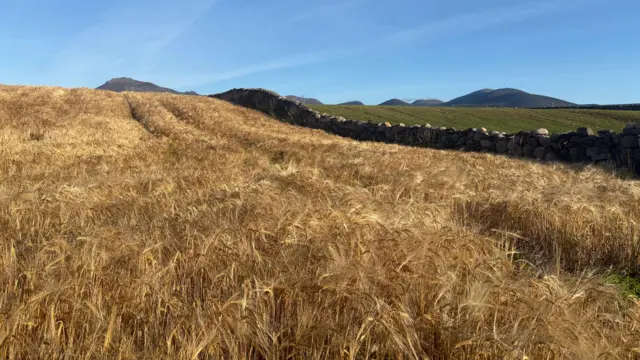
    Dry grass on some hillsImage source, Weather Watchers/Pete's Portal

    Dry conditions in England and Wales have caused drought declarations - but what's the picture in Northern Ireland?

    Northern Ireland Water says supply in the country is "in a stable position".

    "We continue to monitor reservoir levels, demand and weather conditions closely", the national water company adds.

    But it says it is still encouraging customers to "use water wisely, particularly during prolonged dry or warm periods, to help protect supplies for when they are needed most".

    Turning off taps, using a watering can instead of a sprinkler or hose, and only running full loads in washing machines and dishwashers can all help towards this, it advises.

  6. Which English regions are already in drought?published at 14:42 BST

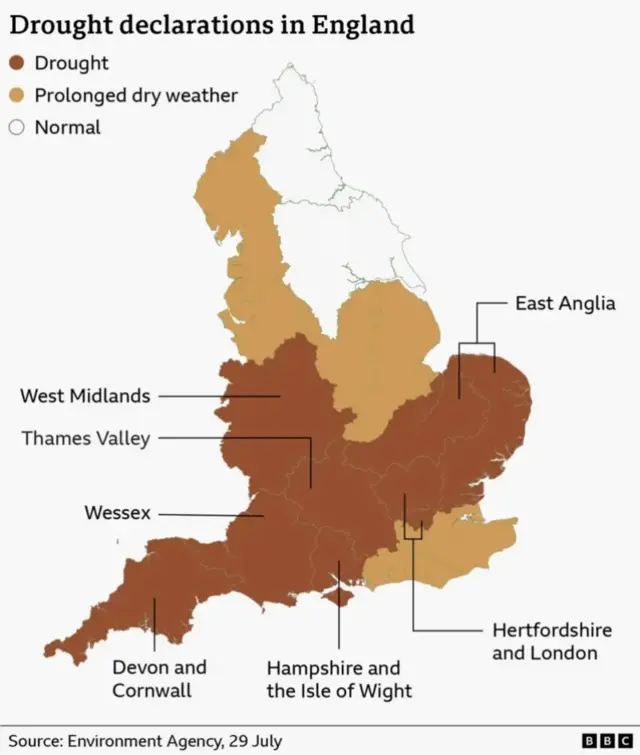
    Half of England and the whole of Wales are in drought, and parts of southern England have seen almost two months without notable rain.

    Here's a reminder of which regions in England are already experiencing drought conditions:

    • East Anglia
    • Hertfordshire
    • London
    • Thames Valley
    • Hampshire and the Isle of Wight
    • Devon and Cornwall
    • The West Midlands
    • Wessex - covering Dorset, Somerset, Wiltshire, and South Gloucestershire

    A map of England shows which areas are affected by drought declarations.

    More areas are due to be declared this afternoon by England's National Drought Group - stay with us for their update.

  7. Drought, water scarcity, heat health alert: The key terms explainedpublished at 14:35 BST

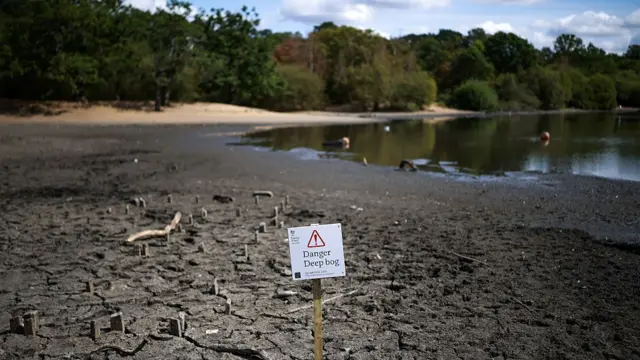
    The dried and cracked bed of the depleted Hollow Pond and Leyton flats near Wanstead, east London, on August 10, 2026Image source, Getty Images

    Various warnings have been issued relating to heat and rainfall as drought conditions are being watched closely across the UK.

    Here's a closer look at the key terms:

    Drought: There is no single definition of drought, but it typically refers to a period of prolonged dry weather that can have impacts on people, nature and the environment.

    The Environment Agency says some droughts are short and intense, caused by a hot and dry summer, while others are long and develop over multiple seasons due to low rainfall. Natural Resources Wales agrees that "every drought is different".

    Water scarcity: This is the term used by the Scottish Environment Protection Agency (Sepa) to measure drought conditions. It refers to a lack of fresh water resources to meet standard demands.

    Unlike the dry conditions in England and Wales, parts of north-west Scotland saw half a month’s rainfall over the weekend.

    Heat health alert: These are warnings from the UK Health Security Agency that temperatures across England are "likely to impact on the health and wellbeing of the population". There are four levels ranging from green (least severe) to red (most severe).

    The system is designed to help reduce illness and deaths during periods of extreme temperatures.

    Extreme heat warnings: Issued by the Met Office, amber or red extreme heat warnings can be issued across all parts of the UK if the impacts are deemed severe enough.

    The BBC understands the Met Office is considering issuing such a warning as the current heatwave intensifies.

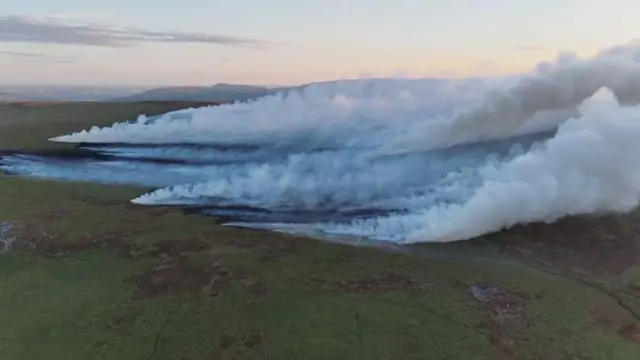
  8. Smoke seen 70 miles away as crews tackle Welsh moorland firepublished at 14:10 BST

    Oliver Slow
    Reporting from Cardiff

    Wildfires across WalesImage source, South Wales Fire and Rescue Service

    The dry conditions in Wales have contributed to several wildfires across the country in recent weeks, and crews are currently tackling a large blaze on moorland in Blaenau Gwent.

    A helicopter has been deployed to tackle the fire near Llangyndir Reservoir, Ebbw Vale, which was declared a major incident on Sunday.

    Nick Rees, from Mid & West Fire and Rescue Service, said it was "envisioning a busy week" with the potential for "wildfires across the country".

    He said one of the challenges crews are facing is the wind.

    "We are very much susceptible to the change in wind conditions, which can push the fire and particularly the smoke into different directions," Rees told BBC Radio Wales Breakfast.

  9. Wildfire severity could be 'exceptional' in parts of England this week - Met Officepublished at 14:01 BST

    Simon King
    Lead weather presenter, BBC Weather

    With bone dry conditions continuing this week there will be some concern about wildfires.

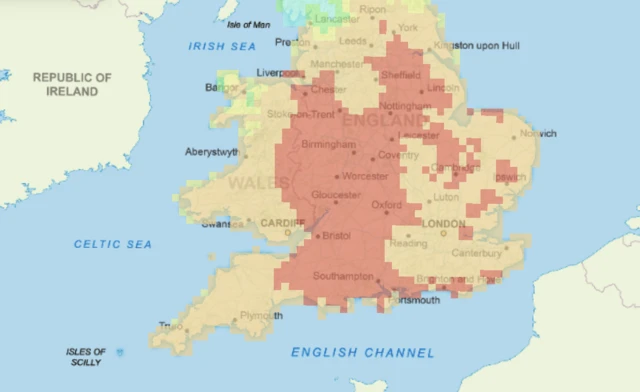
    The Met Office’s Fire Severity Index for Wednesday shows that if a wildfire were to occur in much of central and southern England it could become "exceptional" - the highest level on the index.

    Elsewhere across England and Wales the index is at level four, or "very high".

    According to the Met Office, the Fire Severity Index evaluates how severe a wildfire could become if one were to ignite under current weather conditions - but is not a prediction of when or where wildfires will start.

    A map of the UK showing the areas covered by the Met Office's Fire Severity Index.Image source, Arcgis/Natural England
    Image caption,

    The areas covered in red on this graphic indicate regions where the fire severity index is forecast to be "exceptional"

  10. 'Significant' New Forest fire as big as 140 football pitchespublished at 13:41 BST

    Media caption,

    Nenad Žilić captured footage as the fire moved towards Bratley Wood and the surrounding heathland on Sunday evening

    In England's New Forest region, crews are continuing to tackle a heathland fire after a van caught fire on a neighbouring road.

    Forestry England says the fire, which it describes as "significant", is now estimated to have affected more than 100 hectares (one square kilometre) of heathland - roughly the size of 140 football pitches.

    A heathland is an ecologically important habitat home to a wide range of wildlife and sensitive wetlands.

    In a statement, Forestry England adds the flames initially spread from the A31 to Bratley Wood but has since extended to the surrounding area.

    "Incidents like this can be devastating to all of the things that make the New Forest so special," it says.

  11. 'It was powerful to see', says man who filmed dust devil spinning through London parkpublished at 13:26 BST

    Madeleine Lake
    Live reporter

    Jimmy O'Keeffe, whose picnic was interrupted by a small whirlwind in a London park on Sunday, tells me he was "shocked and in total disbelief".

    The 35-year-old captured footage of the weather phenomenon - known as a dust devil - as it moved through Greenwich Park.

    In the video, people can be seen getting up from the ground and screaming as the whirlwind surrounds them.

    O'Keeffe tells me that it was "powerful" to see. "All the leaves were rustling and shaking next to us, and dust was everywhere."

    He added that most people stayed calm, and that fortunately his picnic food had a "lucky escape."

    The dust devil, which O'Keeffe says lasted only a few minutes, is a phenomenon which forms on warm, sunny days and is visible due to the dust or hay that they pick up and swirl around.

    These conditions are typically found in desert and semi-arid areas.

  12. How common are drought declarations in England?published at 13:12 BST

    Mark Poynting
    Climate reporter

    The frequency of drought is not easy to measure as there is no single definition.

    For example, agricultural drought is different from meteorological drought - which is just a measure of how much rain has fallen compared with average.

    The Environment Agency looks at all the different impacts before declaring a drought.

    Drought declarations are not uncommon. As a very rough rule of thumb, notable droughts have historically happened a couple of times a decade over the past 50 years - although the droughts can vary widely in duration and scale.

    This summer's drought is the third in five years for parts of England, which is unusual.

    Droughts happen naturally but scientists have said that climate change is raising the risks, with higher summer temperatures drying out soils more quickly. This can turn a rainfall deficit into a more severe and longer-lasting drought.

    Climate change is also expected to bring drier summers on average for the UK, although there has been no clear trend in summer rainfall so far.

  13. BBC Verify

    Satellite images show impact of dry summerpublished at 13:00 BST

    By Thomas Copeland

    We're analysing satellite imagery showing the impact of the lack of rain across England and Wales.

    Clywedog reservoir near Llanidloes in mid-Wales provides water to central and north-west England. Water levels have fallen in recent weeks, according to government data, and it is now considered to be "exceptionally low".

    A comparison of satellite imagery shows far more of the reservoir’s banks are exposed this summer compared with 2025 while the surrounding landscape also appears much browner.

    This Flourish post cannot be displayed in your browser. Please enable Javascript or try a different browser.

    At Stonehenge, the world-famous standing stones in Wiltshire, a side-by-side view shows how the fields around the site were green in July 2025 but are parched this summer due to the lack of rain.

    This Flourish post cannot be displayed in your browser. Please enable Javascript or try a different browser.

  14. Heat health alerts upgraded with more areas of England expected to be declared in a droughtpublished at 12:29 BST

    People walk through dry grass at Hampstead HeathImage source, EPA

    Further parts of England are expected to be officially declared as being in a drought later today as England and Wales head towards what is likely to be the fifth heatwave of the year.

    We've pulled together the latest:

    Temperatures

    Heat health alerts across most of England have been upgraded to amber this morning and will remain in place until 21:00 on Friday with the North East under a yellow warning for the same time period.

    Temperatures are forecast to peak on Thursday with possible highs of 36C in the South East and up to 35C likely across central and eastern England.

    Drought

    A drought has already been declared across Wales and in large parts of England in the wake of persistent high temperatures and a long period without significant rainfall.

    Parts of southern England have now had almost two months without notable rain, while further areas of the country are expected to also be declared in drought when the National Drought Group meets later today.

    Scotland and Northern Ireland are not experiencing the same conditions.

    Fires

    The heat and lack of rainfall have also made it hard for emergency services to get fires under control.

    The weekend saw a spate of fires across the Midlands, east of England and the South East as firefighters continue to tackle a blaze in Hampshire that began with a vehicle fire and has spread to nearby heathland in the New Forest.

  15. Analysis

    The heat records are piling up in the UK and around the worldpublished at 12:18 BST

    Justin Rowlatt
    Climate editor

    What’s really striking about this summer is not any single record, but the way these weather extremes are piling up.

    Climate change does not cause every heatwave or drought, but it does shift the odds.

    By raising average temperatures, it makes extreme heat more likely. And, when rain fails, it increases evaporation and dries soils faster.

    That creates a feedback - dry ground cools the air less, allowing temperatures to climb still higher.

    The UK is now seeing the kind of hotter, drier summers climate scientists have long projected. And this is part of a global pattern of heat.

    July 2026 was the joint second warmest July globally on record – 1.47C above the pre-industrial average – only July 2023 was warmer. And this morning the EU weather service, Copernicus, announced that Western Europe had its hottest June and July on record helping to drive the devastating wildfires we have seen.

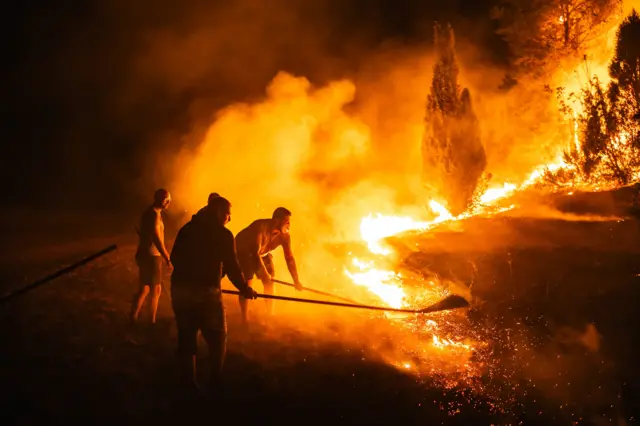
    Figures of men on the left try and bat down wildfires spreading through grassland in SerbiaImage source, Uros Arsic_AFP_via Getty Images
    Image caption,

    Locals and firefighters battle a wildfire in Deliblatska Pescara, 45 miles northeast of Belgrade, Serbia

  16. Water companies considering applying for 'drought orders'published at 12:15 BST

    Mark Poynting
    Climate reporter

    Official drought declarations are made by the Environment Agency in England, but water companies can also apply for “drought permits” and “drought orders”.

    These are designed to help them manage water resources during periods of exceptionally low rainfall.

    Drought permits temporarily modify water companies’ licences, which can allow them to take extra water from the environment such as a river.

    Drought orders go a step further and means the companies or the Environment Agency can limit who is taking water from the system and how much they use.

    It requires approval by the Environment Secretary in England.

    In last summer’s drought, 46 drought permits and two drought orders were granted.

    This summer, South West Water has already applied for a drought permit, while other companies are considering drought permits and orders, according to the Environment Agency.

  17. Canal boats are being encouraged to stay putpublished at 12:03 BST

    Matt McGrath
    Environment correspondent

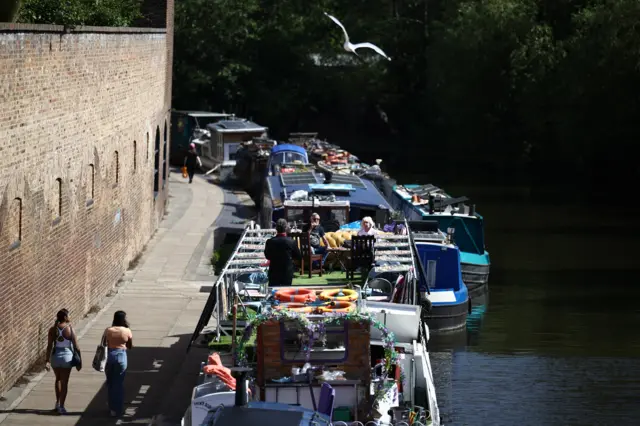
    There is a canal with numerous boats moored along the edge, some people can be seen onboard. To the left is a path and high brick wall. Two women in jeans can be seen walking along the path. The sky is not visible but it is clearly sunnyImage source, Henry Nicholls/AFP/Getty Images

    The Canal & River Trust's rule requiring boats without a home mooring to move every 14 days has been suspended until the end of August.

    The step is meant to cut non-essential journeys and, with them, the operating of locks. The trust says this uses thousands of litres of water each time a boat passes through.

    Boaters are being urged to share locks and to flag unusually low stretches so crews can top them up.

    River flows across much of the country have dropped to below normal or lower for the time of year, and reservoir stocks stood at 69% in the week to 6 August - well short of what summer would normally bring, with five reservoirs now classed as exceptionally low, according to the Environment Agency.

    That figure is now a week old and, after further dry weather, is likely to have fallen since.

    The impact on rivers is not just a British problem.

    Low water levels risk halting cargo traffic on a key stretch of the Rhine this week. The Federal Association of German Inland Navigation says this important route might no longer be fully navigable and might be split into two separate zones.

  18. How are we in a drought after such a wet winter?published at 11:55 BST

    Katie Williams
    Live reporter

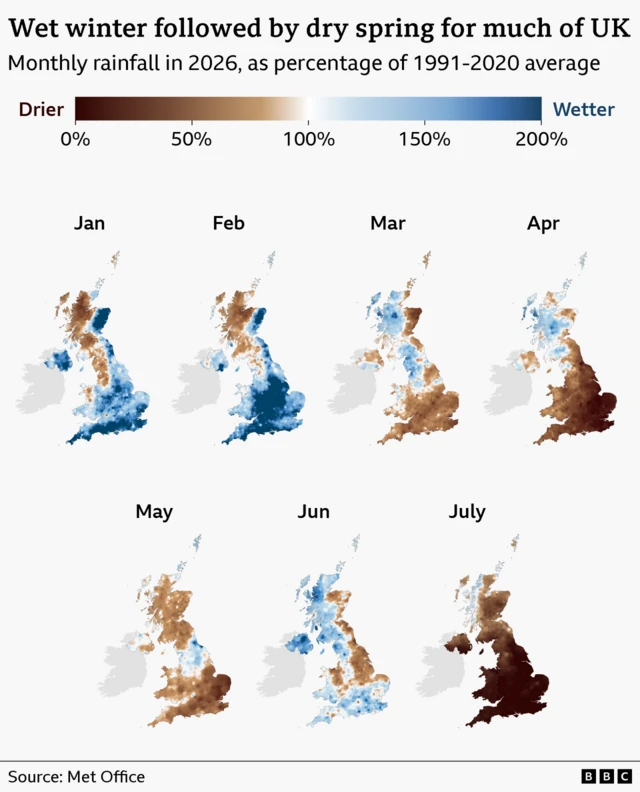
    Many parts of the UK saw record-breaking rainfall at the start of the year. It might leave you wondering why there are now hosepipe bans and drought conditions.

    I asked two experts this very question.

    "This is what climate projections warned us about", says Jess Neumann, associate professor in hydrology at the University of Reading. She references "dramatic swings" in weather conditions.

    Hosepipe bans that came into effect earlier this year weren't necessarily because water wasn't available, but because some companies simply couldn't process and treat it quickly enough to keep up with demand, she says.

    As summer has progressed, there has been "no measurable rain" in some areas with rivers "literally drying up", she adds.

    Anna Murgatroyd, lecturer in hydrology at Newcastle University, says we started the year with "really healthy reservoir stocks" but a dry spring and summer combined with "very high water demand" have made conditions "rife for drought".

    Maps showing monthly rainfall in 2026 as a percentage of 1991-2020 average, broken down month by month from January to July
  19. Met Office may consider extreme heat warnings for parts of UKpublished at 11:44 BST

    Simon King
    Lead weather presenter, BBC Weather

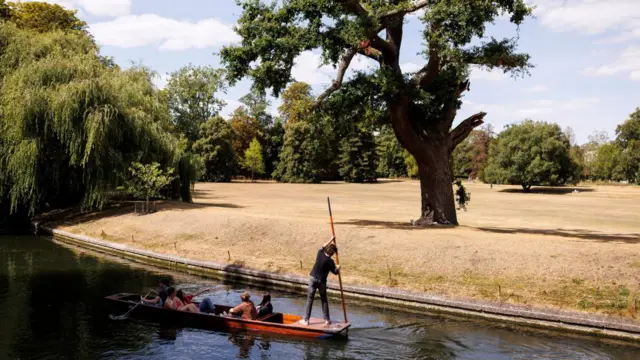
    People punting on the River Cam in Cambridge in front of dried out grassImage source, EPA

    Given the forecast temperatures this week, we understand the Met Office may be considering issuing extreme heat warnings as the heatwave intensifies.

    As we saw during the extreme heat in June, if impacts are deemed severe enough, they can issue either amber or red warnings.

    On that occasion amber warnings were issued widely across England and Wales with a rare red warning that was issued for parts of South East England as temperatures rose into the high 30s.

    These warnings, along with the UK’s health security agency heat health alerts mean that there could not only be impacts to health but also infrastructure such as power supplies and the transport network.

    We’ll of course keep you up to date if there are any warnings issued from the Met Office in the coming days.

  20. Welsh authorities dealing with 'wide-reaching impacts to the environment'published at 11:35 BST

    Oliver Slow
    Reporting from Cardiff

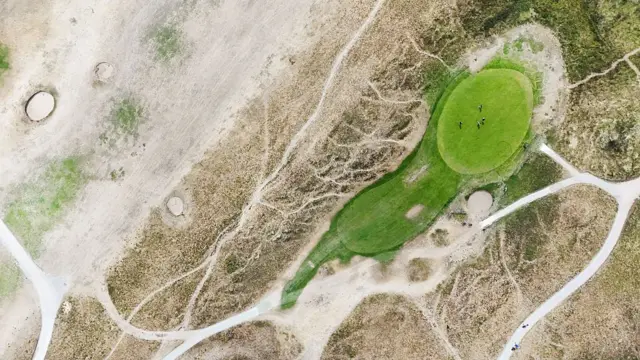
    North Wales Golf Club, August 3Image source, Getty Images
    Image caption,

    North Wales Golf Club, pictured on 3 August

    A drought was extended across the whole of Wales last week, with the hot and dry weather having widespread impacts.

    The country’s environmental body Natural Resources Wales (NRW) said sustained high temperatures had caused the condition of the natural environment to “deteriorate”, including record-low river levels, dry soils and widespread wildfires.

    It had previously announced a drought across the north and parts of mid Wales.

    NRW said its teams were dealing with reports of "wide-reaching impacts to the environment" and that "conditions across Wales' natural environment have continued to deteriorate".

    This includes drying riverbeds, fish in distress, an accumulation of algae, wildfire risk and concerns from farmers about crop growth, grazing conditions and water availability for livestock.