Summary

  • The US Supreme Court has struck down President Donald Trump's executive order limiting birthright citizenship

  • In a 6-3 decision, the justices upheld a 150-year-old precedent giving automatic American citizenship to babies born in the US

  • Trump earlier issued an order to end automatic citizenship for babies born to parents who are in the country illegally or on temporary visas

  • The ruling definitively slams the door on Trump's efforts, and there is little the president can do to reverse it, our correspondent writes

  • Opponents say the order violated the US Constitution's 14th Amendment, which says that people "born or naturalised" in the country are citizens - how it works

  • The court has also ruled that states can ban transgender athletes from women's sports in schools and struck down a ban on how campaign spending is coordinated

Media caption,
Supreme Court's birthright ruling is major blow to Trump
  1. Trump attended oral arguments for this casepublished at 16:29 BST
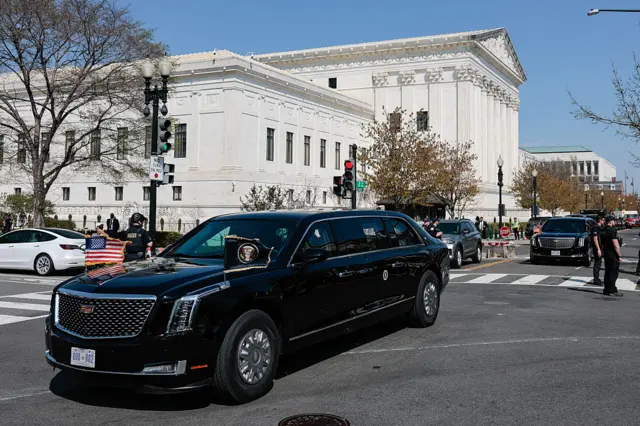
    The motorcade carrying US President Donald Trump departs the Supreme Court after President Trump attended oral arguments.Image source, AFP via Getty Images
    Image caption,

    Trump's motorcade outside the Supreme Court

    President Donald Trump has yet to respond to his loss in a case in which he has shown a strong personal interest. He signed the executive order seeking to prohibit birthright citizenship on his first day back in the White House for his second term.

    But more extraordinarily, he attended oral arguments for the case in April. He sat in the audience as his Solicitor General D. John Sauer argued on behalf of the Trump administration.

    Critics said his appearance was an improper effort to influence the court on a decision with major repercussions for his domestic policy.

    The president left after Sauer's presentation, which was subjected to intense scrutiny from the justices, suggesting that a majority of the court was unconvinced by Trump's justifications to end birthright citizenship.

    Afterwards, Trump berated the justices in public remarks saying that judges who he appointed but vote against him are "stupid people."

  2. Supreme Court slams door on Trump's effort to deny birthright citizenship to children of undocumented migrantspublished at 16:15 BST

    Anthony Zurcher
    North America correspondent

    By citing the Fourteenth Amendment to the US Constitution, the Supreme Court definitively slams the door on Donald Trump’s efforts to deny birthright citizenship to the children of undocumented migrants and most temporary foreign residents.

    According to Chief Justice John Roberts, writing for the majority, the language of the amendment – passed shortly after the end of US civil war – is clear: “All persons born or naturalised in the United States and subject to the jurisdiction thereof, are citizens of the United States”.

    Trump and his legal team had argued that undocumented migrants were not “subject” to US jurisdiction. Roberts and the court majority emphatically disagreed.

    Because the court’s majority held that the US Constitution is explicit in this regard, there is little that Trump can do to reverse its ruling – and deny birthright citizenship – short of amending America’s founding document. That is an arduous task that has only been accomplished 27 times in US history.

  3. Trump comments on court's transgender case rulingpublished at 16:12 BST

    We're waiting to hear from the president about the birthright decision, a defeat for him and his administration.

    In the meantime, he's posted on social media platform Truth Social about the transgender athletes case we reported on earlier.

    "The United States Supreme Court just RULED AGAINST MEN PLAYING IN WOMEN’S SPORTS. Wow! That takes that ridiculous situation off the table!!! President DONALD J. TRUMP," he wrote.

  4. Which justices dissented from the court's majority opinion?published at 16:02 BST

    People waliking into the US Supreme CourtImage source, EPA

    Three justices dissented from today's decision to uphold birthright citizenship: Justices Clarence Thomas, Neil Gorsuch and Samuel Alito.

    The three justices cite several reasons for disagreeing with the majority decision.

    Justice Thomas argues in his dissent that the 14th Amendment is now being "repurposed for political projects" that go beyond its "sad history" of securing equal right for freed slaves, whom he argues were entitled to citizenship because "they were Americans" with no other homeland or allegiance to another foreign power.

    Justice Alito used more dramatic language in his dissent, saying the ruling was "one of the most important decisions in the history of the Court, and in my judgment, the Court has made a serious mistake".

    He says Tuesday's ruling "confers citizenship on virtually everyone who happens to be born in this country, including the children of 'birth tourists,' women who come here solely for the purpose of giving birth to a child and then promptly return home".

    Alito argues that "careful analysis" of the 14th Amendment gives citizenship to "only those children who, at birth, owe allegiance solely to this country".

  5. Silence so far from President Trump after court defeatpublished at 15:56 BST

    Bernd Debusmann Jr
    White House reporter

    We've yet to President Trump, who is likely to be furious at being handed a defeat by the Supreme Court.

    Trump has, for years, made ending birthright citizenship a corner of his immigration policies. As far back at 2015, Trump - then still a candidate - called for an end to the practice, describing it as "the biggest magnet for illegal immigration".

    His executive order attempting to end birthright citizenship was signed within hours of his return to the White House last year, and the topic is one he has brought up frequently in both public remarks and on Truth Social.

    Just a few weeks ago, for example, he posted that the US "cannot live with the shackles" of birthright citizenship.

    "It is not economically, or otherwise, sustainable and no other country in the world, of consequence, does it," he added.

    The US president has reacted angrily in past instances in which the Supreme Court thwarted his policy objectives, such as tariffs. We are likely to hear more of that today.

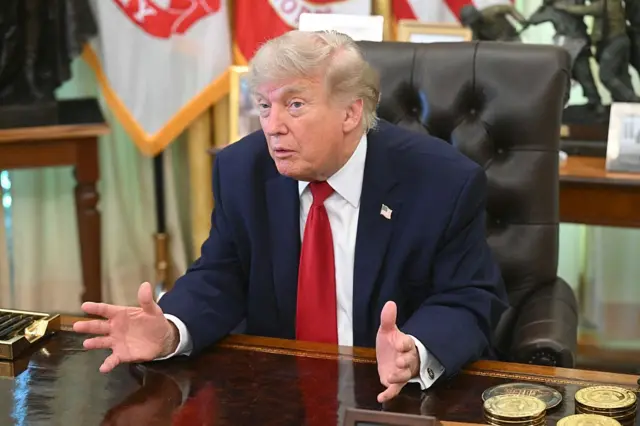
    Donald Trump sitting behind the desk in the Oval OfficeImage source, Getty Images
  6. A ruling that will be studied in constitutional law classes for years to comepublished at 15:53 BST

    Gary O'Donoghue
    Chief North America correspondent, reporting from Washington DC

    This is a ruling that will be studied in constitutional law classes for years to come. The Supreme Court — a bench reshaped by Trump himself — has delivered a clear message: the 14th Amendment guaranteeing birthright citizenship can't simply be annulled with the stroke of the Presidential pen.

    The personal and political dimension for Trump cannot be underestimated. This is a court he fundamentally reshaped — and one that has now ruled against one of the signature promises of his political career. That is not merely a legal setback — it is a pointed institutional rebuke — a slap in the face — from a bench he genuinely believed would serve not just as an ally, but as an instrument of his will.

    This is right up there with the defeat the court has already handed out on the President's attempts to impose hefty tariffs on foreign imports. That drew some searing words from Donald Trump who said two of his own appointees "sickened him" after the decision; adding they were an embarrassment to their families and disloyal to the constitution.

    He expected to lose on tariffs; he expected to lose on birthright; that's unlikely to stop him from lashing out at those on whom, not long ago, he would have heaped on the adulation and praise. Loyalty is everything to this President, and any sign that it's anything other than total is usually met with bitter vitriol.

  7. Justice Roberts says 14th amendment extended 'right to have rights' to every free-born personpublished at 15:50 BST

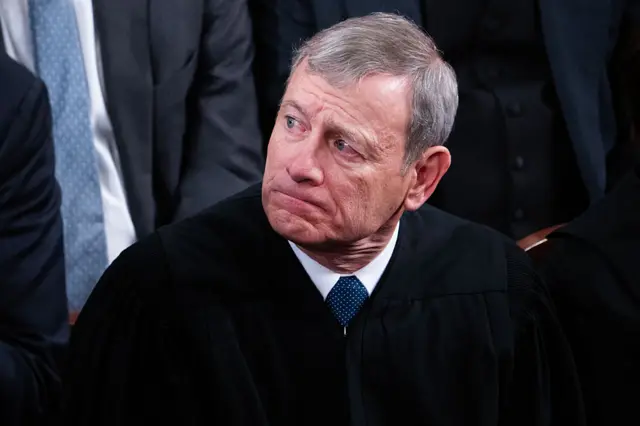
    US Supreme Court Chief Justice John RobertsImage source, Getty Images

    Today's Supreme Court decision was a 6-3 ruling in favour of upholding birthright citizenship.

    The ruling was written by Chief Justice John Roberts, who says that children born to parents who are in the US unlawfully or temporarily are "citizens at birth" under the US constitution.

    In the ruling, he invokes the history of the 14th Amendment, which was passed in the wake of the US Civil War to settle the question of the citizenship of freed, American-born former slaves.

    "Citizenship, then and now, was the right to have rights - to freely participate in our political community. The Framers of the Fourteenth Amendment extended that promise to 'every free-born person in this land,'" Roberts writes. "We keep that promise today."

  8. Supreme Court rejects Trump's attempt to deny automatic citizenship to those born to undocumented migrantspublished at 15:39 BST

    Anthony Zurcher
    North America correspondent

    The Supreme Court has rejected Donald Trump’s attempt to deny automatic citizenship to children of undocumented migrants born on American soil.

    The president and his legal team had advanced a view that had, until recently, found little support among policymakers and legal experts all the way to the highest court in the land – a remarkable achievement by itself.

    In the end, however, a majority of the nine justices were unwilling to reverse a 150-year-old court precedent and reinterpret longstanding federal law and the language of the US constitution in order to deliver a victory for Trump.

    This setback will surely frustrate the president, forcing him to look for new ways to restrict the ways undocumented migrants can enter the US. If they never reach American soil, then the citizenship of their children will never be a question.

  9. US Supreme Court strikes down Trump's order limiting birthright citizenshippublished at 15:36 BST
    Breaking

    The Supreme Court has just struck downan executive order that would have limited birthright citizenship for the children of immigrants.

    Justices voted 6-3 opinion in favour of birthright citizenship.

    We’re reading through the decision and will bring you the key details very soon.

  10. Supreme Court releases closely watched birthright citizenship decisionpublished at 15:34 BST
    Breaking

    The US Supreme Court has released its decision in the birthright citizenship case, known as Trump v Barbara.

    The decision could radically reshape who could become a US citizen.

    Stay with us as we sift through the ruling.

  11. Court issues second decision of the daypublished at 15:28 BST
    Breaking

    We still haven't heard the birthright citizenship ruling, but in the meantime, the court has released another decision.

    In this case, the court has struck down a ban on the coordination of expenditures between political parties and individual campaigns for office.

    This was a Republican-led challenge on federal limits on campaign spending, originally brought by Vice President JD Vance and other Republicans.

    The last decision we are waiting for is the birthright citizenship case.

  12. US Supreme Court upholds bans on transgender women in female school and college sportspublished at 15:23 BST

    In its first decision of the day, the US Supreme Court has ruled that states can ban transgender women from competing in female school and college sports.

    The court considered cases from students in two different states who had challenged bans on participation. The two states, Idaho and West Virginia, enacted laws that required public school and college sports teams to compete in accordance with their sex recorded at birth.

    One of the two challenges says the ban violates equal rights protections in the US Constitution. The other says it contradicts civil rights laws.

    More than two dozen states have enacted bans since Idaho did so in 2020.

    You can read more about the cases and the rulings here.

  13. Court issues first decision of the daypublished at 15:08 BST
    Breaking

    The Supreme Court has released the first decision of the day.

    The court has ruled that states can ban transgender athletes from competing in women's and girls' sports in colleges and schools.

    We'll bring you more details about this case shortly.

    We're still waiting for the birthright citizenship decision, which we'll bring to you when the court issues it.

  14. Government faces uphill battle in birthright citizenship case - legal expertpublished at 14:57 BST

    Kwasi Gyamfi Asiedu
    Live reporter

    Trump's executive order aiming to prohibit birthright citizen sought to do away with a constitutional provision dating back to 1868 and provided citizenship to enslaved people born in the US.

    "All persons born or naturalized in the United States, and subject to the jurisdiction thereof, are citizens of the United States and of the State wherein they reside," Section 1 of the 14th Amendment to the US Constitution says.

    David Leebron, professor of legal studies at Rice University and former dean of Columbia University's law school, says the executive order called into question "a very well established rule of American constitutional law - one that was adopted for very important historical purposes."

    The distinct clarity in the text and the longstanding acceptance of its meaning presents an uphill battle in the government's attempts to overturn it, Professor Leebron says.

    "I think the challenge the government has always faced here is there is no widely accepted theory of constitutional law that would uphold the government's position, including originalist and textualist theories of constitutional law."

    In just a few moments, we will learn how the nine US Supreme Court justices rule on the matter.

  15. What does it look like at the Supreme Court right now?published at 14:54 BST

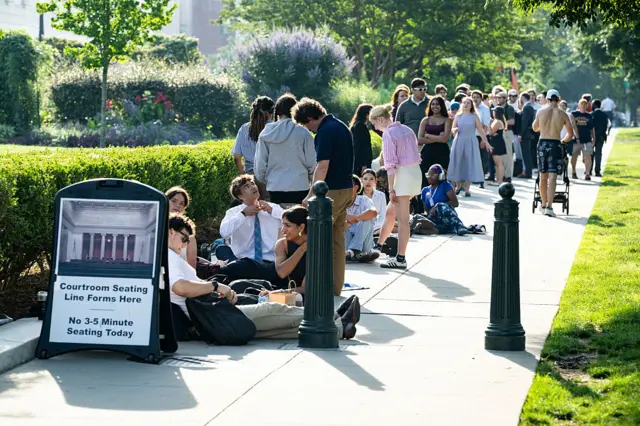
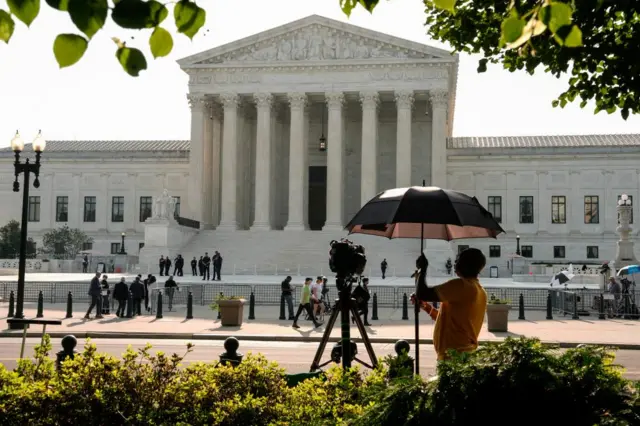
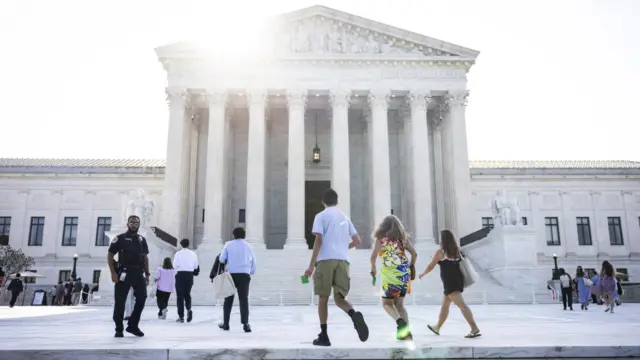
    It's a hot day in Washington DC, but a mixture of journalists, protesters and interested bystanders have gathered outside the Supreme Court awaiting the outcome of the biggest case of the court's term.

    People sit in a line on the sidewalk outside the Supreme CourtImage source, Getty Images
    Image caption,

    People wait in line to get a seat inside the Supreme Court

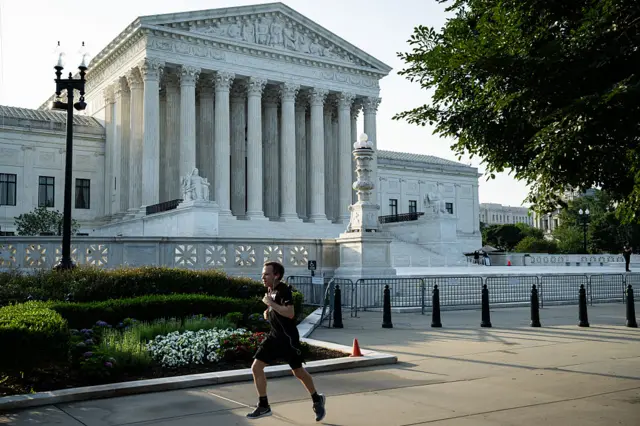
    A man runs past the Supreme CourtImage source, Getty Images
    Image caption,

    For some it's business as usual, morning runs continue despite the major news

    Man sets up TV camera outside Supreme CourtImage source, Reuters
    Image caption,

    There are dozens of television cameras outside the court

  16. How did birthright citizenship start in the US?published at 14:48 BST

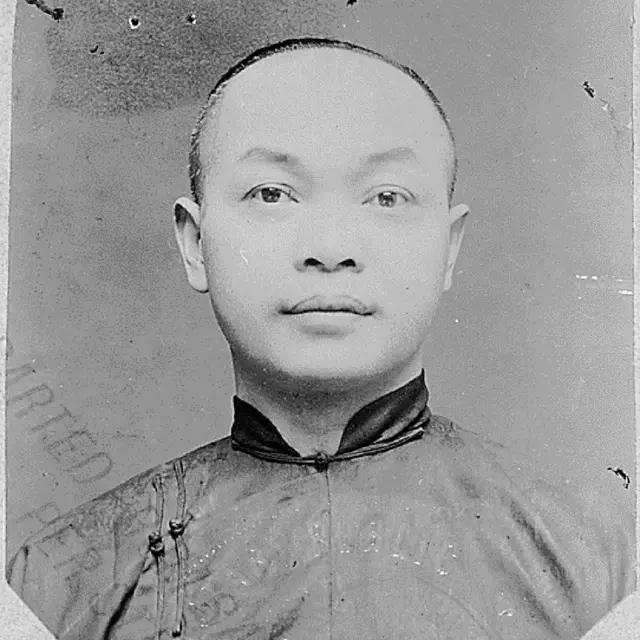
    A photo of Wong Kim Ark, which is housed in the National Archives from a federal immigration investigation case conducted under the Chinese Exclusion ActsImage source, National Archives
    Image caption,

    A photo of Wong Kim Ark, which is housed in the National Archives from a federal immigration investigation case conducted under the Chinese Exclusion Acts

    The concept of birthright citizenship, also known by the legal term "jus soli", is based in English common law and was generally accepted to apply to white men throughout early American history.

    However, it did not become part of the Constitution until 1868, when the 14th Amendment was passed in the wake of the US Civil War in order to settle the question of the citizenship of freed, American-born former slaves.

    Previous Supreme Court cases, like Dred Scott v Sandford in 1857, had determined that African Americans could never be US citizens. The 14th Amendment overrode that.

    In 1898, the US Supreme Court ruled that birthright citizenship applies to the children of immigrants in the case of US v Wong Kim Ark.

    Wong was a 24-year-old child of legal Chinese immigrants who was born in the US, but denied re-entry when he returned from a visit to China.

    Wong successfully argued that because he was born in the US, his parents' immigration status did not affect the application of the 14th Amendment.

    The court ruled in Wong's favour and outlined a few limited exceptions to birthright citizenship, such as for children of diplomats.

  17. Trump called the US 'stupid' for allowing birthright citizenshippublished at 14:40 BST

    When the court was hearing arguments on this case in April, Trump posted on social media that: "We are the only Country in the World STUPID enough to allow 'Birthright' Citizenship!"

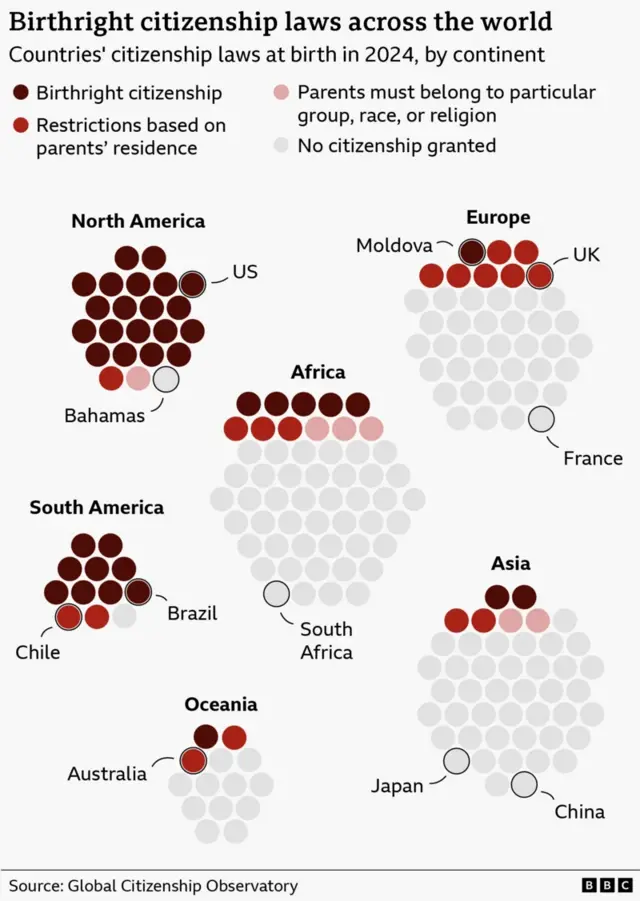
    The US is one of about 30 countries - mostly in the Americas - that grant automatic citizenship to anyone born within their borders.

    In contrast, many countries in Asia, Europe, and parts of Africa adhere to the jus sanguinis (right of blood) principle, where children inherit their nationality from their parents, regardless of their birthplace.

    • Read more about which countries have birthright citizenship here
    A graphic showing regions in the world that have birthright citizenship
  18. A reminder of how we got herepublished at 14:34 BST

    Today's case stems from an executive order President Donald Trump signed in January 2025 on his first day back at the White House.

    It sought to end automatic citizenship for children born to parents who were in the US temporarily or illegally. The Trump administration argues the order will clamp down on illegal immigration.

    Hours after Trump signed it, various lawsuits were launched by Democratic-run states and cities, civil rights groups and individuals.

    Three federal judges tried to block the order from taking effect by issuing nationwide injunctions.

    After the Supreme Court ruled against the injunctions, the case came back as a class action lawsuit - which is where multiple similar claims are brought together into a single suit.

    The court first heard oral argument on this case - called Trump v Barbara - in April.

  19. US Supreme Court to rule on birthright citizenshippublished at 14:30 BST

    Welcome to our live coverage of this year's final day of opinions by the US Supreme Court.

    The court is expected to release its most anticipated ruling - on whether the President Donald Trump can limit birthright citizenship, the law that grants those born on US soil automatic citizenship.

    The ruling could uphold or upend 150 years of precedent enshrined in the US Constitution.

    We will also hear how the court rules on transgender athletes in women's and girls' sports.

    The justices will convene at 10:00 ET (15:00 BST, 14:00GMT).