Summary

  • We've now ended our live coverage, but you can read more in our news story

  • A large wildfire approaching Reno, Nevada, could remain active for the next 48 hours due to dry and windy conditions, officials say

  • Hawk Fire Service says the fire - first reported on Saturday - could spread further north and there is no timeline for when nearly 90,000 evacuated people can return to the area

  • A state of emergency has been declared in Washoe County, north-west Nevada, as Governor Joe Lombardo calls it an "active and rapidly evolving situation"

  • One Nevada resident says the fire roared through his home and "completely levelled" two neighbouring properties

  • Officials say six people have been injured, including three emergency responders, and around 15,000 acres (23 sq miles) have been burned - satellite imagery shows the impact

  • Wildfires are common in south-west US states, including Nevada, but many of these fires develop in rural and less populated areas

Are you affected?

  1. Nevada wildfire expected to burn for two more dayspublished at 19:18 BST

    Rachel Flynn
    Live reporter

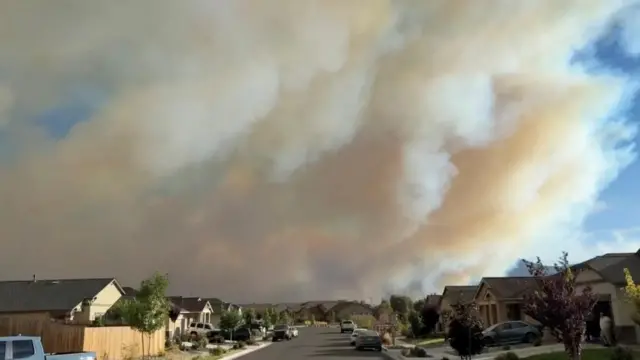
    A huge plume of smoke sits above a suburban streetImage source, Reuters
    Image caption,

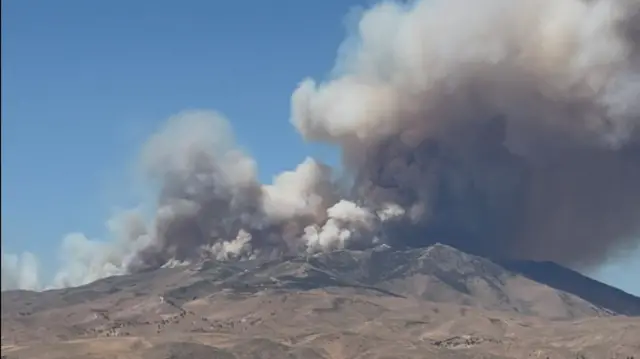
    The Hawk fire above Reno

    A large wildfire on the outskirts and surrounding areas of the city of Reno remains uncontained, officials have said.

    Hawk Fire Department said in an update on Monday that the blaze could remain active for the next 48 hours due to dry and windy conditions

    It was first reported on Saturday at 11:15 local time and since then 15,000 acres (23 sq miles) have been burned.

    Nevada is at high risk from large wildfires, BBC Weather's Matt Taylor says, due to the combination of its dry climate and abundance of invasive grasses.

    South-west winds may take the fires closer to the city by day, but a switch to south-east winds by night should help firefighters, he adds.

    Some 90,000 people are under evacuation notices, with no timeline in place for when they might return.

    Justin Davis, who lives on Penine Mountain, watched as the fire spread from the valley towards his home.

    We're ending our live coverage now, thank you for joining. You can keep up to date with the latest developments in our news story.

  2. Student describes 'apocalyptic' fire near university campuspublished at 19:07 BST

    Max Matza
    Live reporter

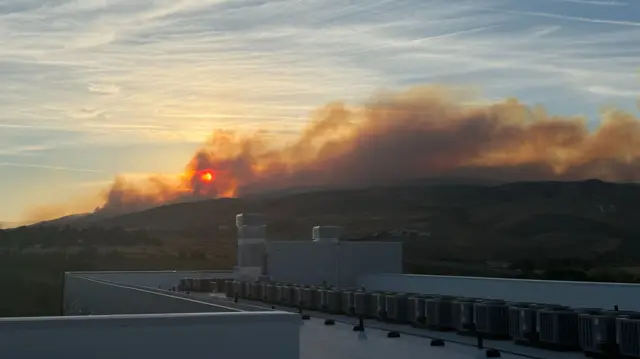
    The fire over the school on SaturdayImage source, Ava Betancourt/ The Nevada Sagebrush

    One student who lives on the border of the evacuation order in Reno says it's been strange attending the first day of classes at the University of Nevada today.

    James Wolfgang Perez says the evacuation zone is right on the edge of campus and many students don't know whether they should stay or go.

    Classes are continuing, although he says many professors have independently decided to cancel theirs, and the university has postponed many "welcome back" events.

    The smoke has died down a bit since the weekend, when fire crews could be seen operating in and around the campus, says James.

    He describes the "apocalyptic" scene of fire racing towards the campus on Saturday evening.

    "It's just been a whirlwind of a day for a lot of the folks here I've been speaking with," he adds.

  3. Wildfire continues to rage across 15,000 acrespublished at 18:51 BST

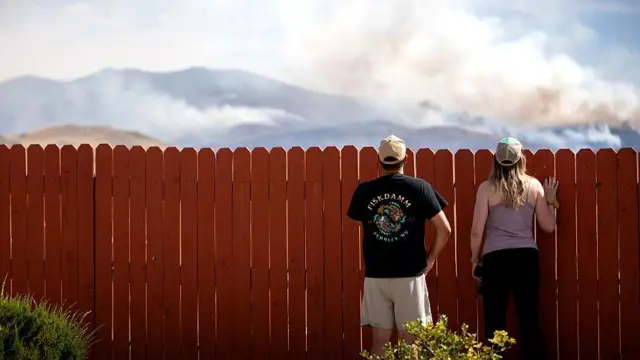
    Two people look over what appears to be a domestic fence. They are looking at where smoke is rising from hills in the background.Image source, Getty Images

    At the moment, the Hawk fire has burnt an area of more than 15,000 acres (23 sq miles), data from the Bureau of Land Management, external shows.

    Hawk Fire Service says it has deployed 14 crews, 95 fire engines, 10 helicopters and nine dozers to help fight the blaze.

    The fire remains completely uncontained, fire officials add.

  4. Man 'anxious' to see aftermath of fire after wife forced to flee homepublished at 18:41 BST

    Alex Akhurst
    BBC UGC

    Will wearing a Silver Striders shirtImage source, Will/handout

    A British man living in Reno, but currently visiting the UK, is anxious to find out what his community will look like when he returns.

    While flying to the UK, Will says he received a text from his wife telling him she had been forced to flee their home.

    “I was blown away by the number of friends reaching out to offer us places to stay," he says.

    Will, who is a trail runner, says he's devastated by the impact the fire has had on Peavine Mountain in Washoe County.

    "While there's always been fires there, one of this scale has not happened in a while and I'm really anxious to see the aftermath," Will adds.

  5. Rising number of highly destructive fires in some parts of worldpublished at 18:29 BST

    Matt McGrath
    Environment correspondent

    Despite the powerful images of wildfires coming from Reno, and the raft of fires we have had globally this year, the amount of land burned globally has actually fallen over the past two decades.

    That’s mostly down to how land is farmed, with far less controlled burning across the savannahs of Africa for example.

    But what’s rising is the number of fast, highly destructive fires in the forests away from the Tropics – especially in the American west, southern Europe and the huge northern forests of Canada and Russia.

    More of them are also reaching people as cities spread towards the tracts of forest and farm that surround them.

    Driving the fires themselves is the changing climate that is helping dry out the ground, priming trees and vegetation to burn, and extending the fire season. Reno is a good example.

    The city’s average temperature has gone up by over 4C since the 1970s, faster than any other big US city, according to Climate Central.

    The climate, and city growth, set the conditions. The spark was human, as is often the case.

    So a warming climate doesn’t necessarily mean more fires everywhere – but it does mean more of them reaching the places people live.

  6. No timeline for evacuated residents to return homepublished at 18:05 BST

    As we've been reporting, nearly 90,000 people have been urged to evacuate their homes as a large wildfire approaches Reno, Nevada.

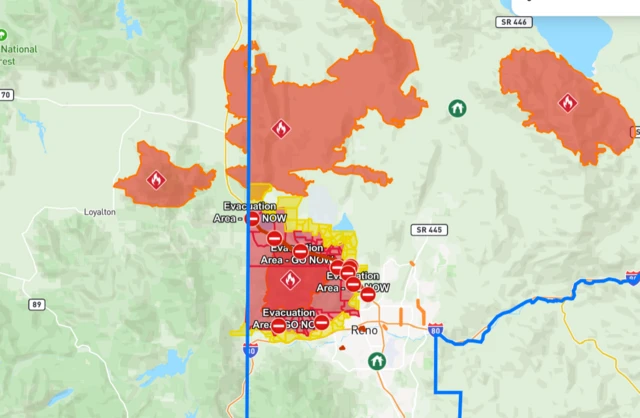
    In an update, fire officials say there's currently no specific timeline for when evacuation areas will reopen.

    "Re-entry decisions are based on conditions within the fire area and the ability to safely allow residents back into affected neighborhoods," they say.

    Several roads also remain closed, including the U.S. Highway 395, and people are being urged to check current road and evacuation information before entering the affected area.

    A map showing the evacuation area in redImage source, Handout
    Image caption,

    A map showing the evacuation area in red

  7. Fire could burn for 48 hours and may spread further north, officials warnpublished at 18:00 BST

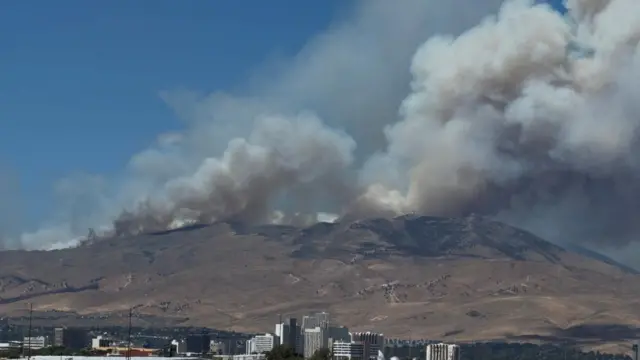
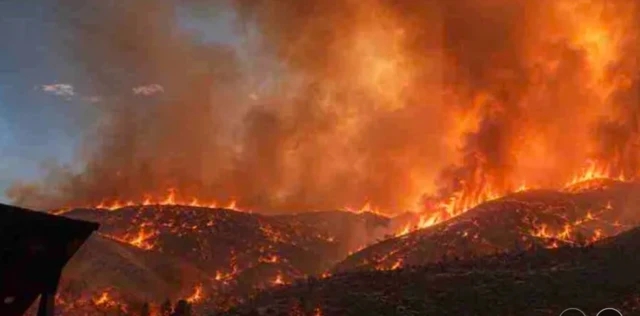
    Smoke rises from hills during the Hawk Fire burning in Washoe County, Nevada, U.S., August 22, 2026Image source, Reuters
    Image caption,

    Smoke rising from the hills in Washoe County, Nevada, as pictured on Saturday

    We've just received an update from fire officials, who are warning that the Hawk Fire has the potential to spread northeast and northwest due to "hot, dry and breezy" conditions.

    While these conditions remain subject to rapid change, officials say they are expected to keep the fire active for the next 48 hours.

    "Fire behavior was less extreme than anticipated in some areas, allowing crews to hold established lines and reposition resources to reinforce suppression efforts," officials say.

    However, "mountainous terrain, continuous fuels and critically dry conditions continue to challenge suppression efforts", officials add.

  8. Man uses water truck to save home from 'roaring' firepublished at 17:29 BST

    Max Matza
    Live reporter

    Davis took a photo of this fiery landscape around his home, before he was forced to fleeImage source, Justin Davis
    Image caption,

    Justin took this photo of the fiery landscape around his home, before he was forced to flee

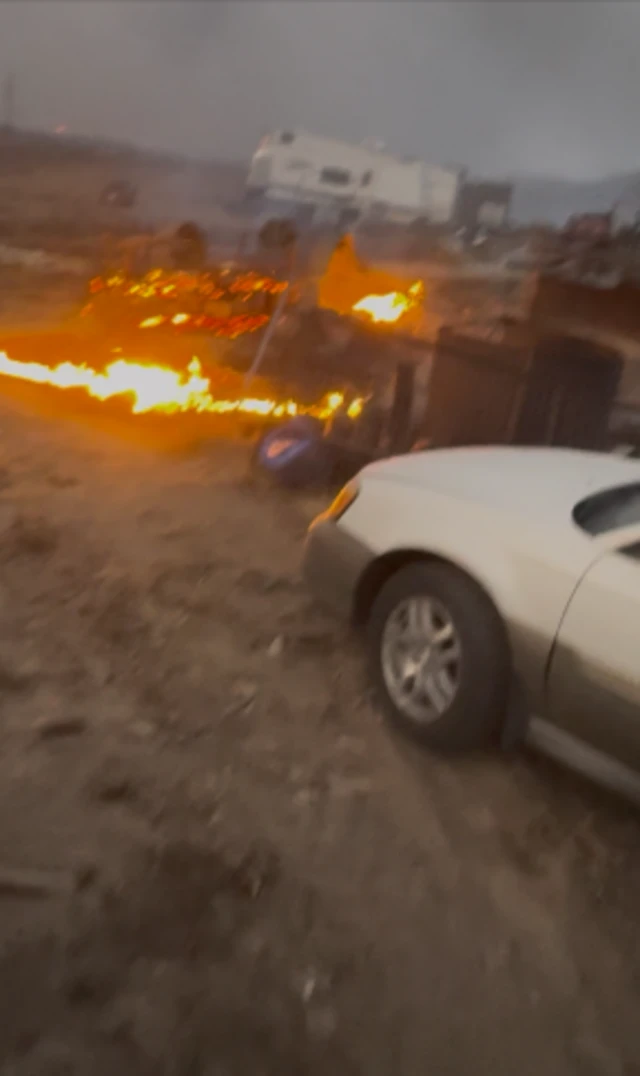
    Justin Davis, 29, who lives on Peavine Mountain in Nevada, watched as the fire spread from the valley towards his home on Saturday.

    He stayed behind with his brother and a friend until the last moment, when he says the fire began to "roar through" his property, destroying four of his vehicles.

    "On Saturday, our day turned into a firefighting day", Justin tells me.

    Justin, whose home contains a silver mine, says he bought a water truck in case a wildfire like this occurred.

    That water truck saved his home, he says, adding that both of his neighbour's properties are "completely levelled".

    "We turned on the water truck and just started spraying down the things we wanted to save," he says.

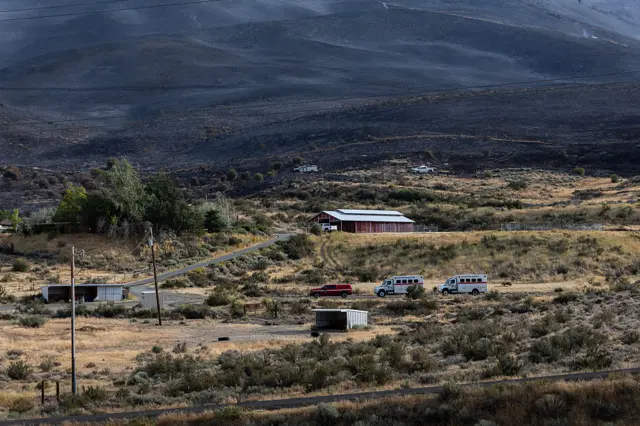
    He has since returned to his home to clean-up from the aftermath of the fire, which he says has turned the area from a "real desert landscape" into "barren, burnt land".

    Fire near vehicles at Davis' propertyImage source, Justin Davis
  9. Schools closed across Washoe County after state of emergency declaredpublished at 17:07 BST

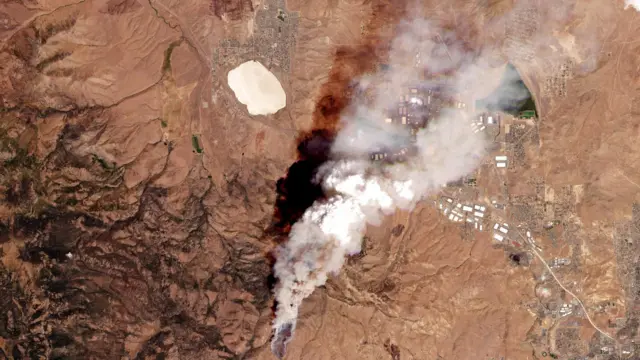
    A satellite image shows smoke rising from an area as Hawk Fire burns in Reno, Nevada, U.S., August 22, 2026Image source, Reuters

    All schools in Washoe County, except one, will be closed on Monday after a state of emergency was declared.

    "The decision to close schools is due to evacuations, impacts on regional public safety resources, and to help keep roads clear for emergency vehicles," according to a post from the Washoe County School District's Facebook page.

    The closures come following the "recommendation of public safety officials," it adds.

  10. Fire continues to grow, fire protection chief tells CNNpublished at 16:49 BST

    Chief Richard Edwards of the Truckee Meadows Fire Protection District tells CNN that Hawk fire in Nevada "continues to grow".

    "It’s over 15,000 acres. And we still have zero percent containment," he says, adding low humidity and high winds have created "extreme fire conditions".

    Winds over 40mph (65km/h) "allowed that fire to travel extremely quick and cover an area of almost six miles in less than 24 hours".

    On Sunday, "conditions were safe enough" for crews to begin damage assessment.

    Edwards says crews are attempting to notify homeowners whose buildings were destroyed.

  11. BBC Verify

    Nasa’s heat-sensing satellites pick up fire near Renopublished at 16:32 BST

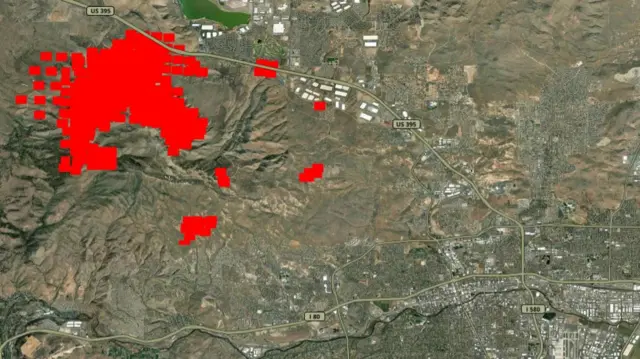
    Red rectangles showing heat from the Hawk fire as sensed by Nasa's FIRMS satellitesImage source, Nasa FIRMS
    Image caption,

    The red rectangles in this screenshot from the Nasa FIRMS website shows where it has detected heat signatures

    By Emma Pengelly

    Heat from the intense Hawk wildfire has been detected by Nasa satellites.

    The US space agency's Fire Information for Resource Management (FIRMS) platform, which monitors the Earth’s surface, detected multiple heat signatures north-west of Reno in Nevada.

    Based on data from Sunday the most intense area of heat anomalies picked up by FIRMS covered about 4,448 acres (18 sq km) across hillsides south of Route 395.

    Officials say around 15,000 acres (60 sq km) has been burned since the fire started.

  12. This kind of fire works ferociously against firefighterspublished at 16:10 BST

    Shaimaa Khalil
    North America correspondent

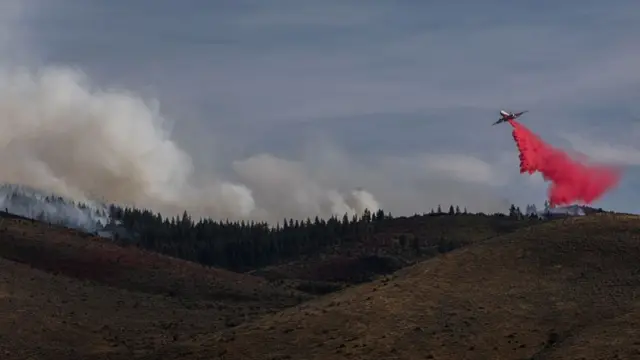
    An aircraft flies over dry land that is on fire, as a large red cloud is visible beneath the plane as it drops fire retardant.Image source, Getty Images
    Image caption,

    Over the weekend, firefighters dropped fire retardant on parts of the Hawk Fire from an aircraft

    I covered many wildfires during my time as the BBC’s Australia correspondent, including the devastating Black Summer of 2019–20.

    What we are seeing in Reno, and in fires across the western United States, is a familiar pattern: the weather working ferociously against firefighters.

    It is a double blow.

    Strong winds fan the flames, while extremely dry vegetation provides the fuel, turning the landscape into a tinderbox.

    What makes these fires so dangerous is their speed and unpredictability. Crews can be working to contain the flames in one area, only for the wind to carry burning embers ahead of the fire line.

    The blaze can suddenly jump to another location and quickly become uncontrollable.

    That is what firefighters and communities around Reno are facing now: a fire that can change direction with little warning, forcing families to flee within minutes and leaving crews constantly trying to anticipate where it will move next.

  13. Before-and-after images show fire burning in Renopublished at 15:50 BST

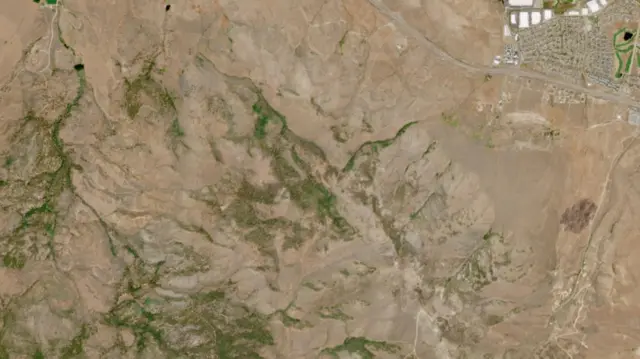
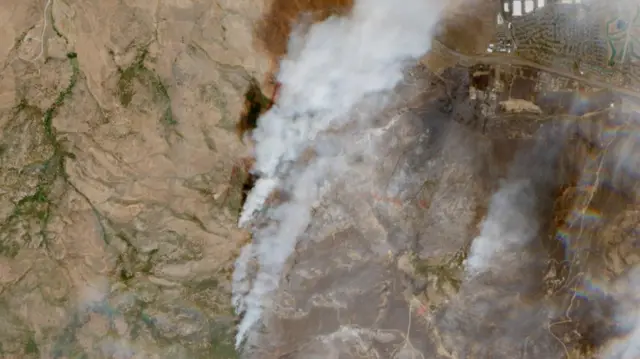
    We've just received some new before-and-after satellite pictures showing the fire burning in Reno, Nevada.

    The first image shows the Reno area before the blaze, while the second shows smoke billowing across a mountainous area, heading towards fields and a road.

    A satellite image shows an area before the Hawk Fire in Reno, NevadaImage source, Reuters
    Image caption,

    A satellite image of the outskirts of Reno

    A satellite image shows smoke rising in an area as the Hawk Fire burns in Reno, NevadaImage source, Reuters
    Image caption,

    Smoke billows as the Hawk fire burns

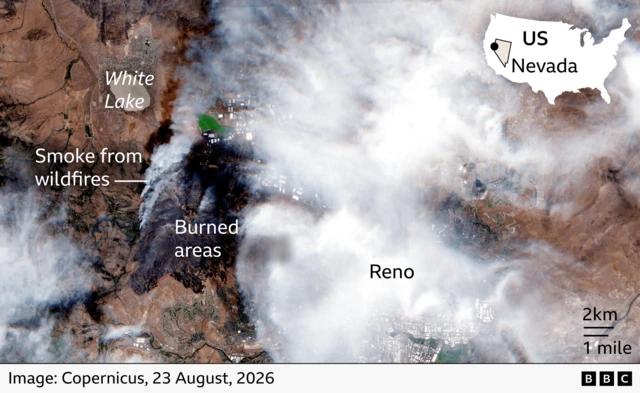
  14. Satellite imagery shows scale of scorched land near Renopublished at 15:21 BST

    Satellite imagery shows the impact of the Hawk wildfire in the high desert valley surrounding Reno in Nevada.

    Large plumes of smoke can be seen above the city and there is a large patch of scorched land between White Lake and the city.

    Officials say around 15,000 acres (23 sq miles) have been burned.

    As it stands, the immediate "go now" evacuation zone and wider "get set" area do not extend to the centre of Reno, but do affect large urban areas and part of a highway.

    Satellite image showing smoke and burned land from wildfires west of Reno, Nevada. Cloud covers much of the area around the city, but smoke from fires are visible near the charred ground near White Lake. An inset map locates the scene within Nevada in the western United States.
  15. Strengthening winds will accelerate spread, but a switch by night should help firefighterspublished at 15:00 BST

    Matt Taylor
    BBC Weather

    The fire risk remains "elevated" in north-west Nevada, as well as bordering areas of California and Oregon.

    Daytime winds will strengthen slightly from Monday into Tuesday with gusts of 25mph possible - accelerating the spread at times.

    South-west winds may take the fires closer to the city by day, but a switch to south-east winds by night should help firefighters.

    The possibility of "dry thunderstorms" in the west of the state also brings the risk of sparking further fires, as well as creating gustier winds.

    These are thunderstorms in clouds elevated high above the ground. A layer of very dry air between the cloud and the ground means any rainfall evaporates well before reaching the desert surface, meaning no soaking rains to help dampen fires, but also the added risk of lightning strikes starting yet more fires.

  16. Firefighters 'fully engaged' in tackling wildfire - the latest from emergency servicespublished at 14:41 BST

    Smoke rises from hills during the Hawk Fire burning in Washoe County, NevadaImage source, Reuters
    Image caption,

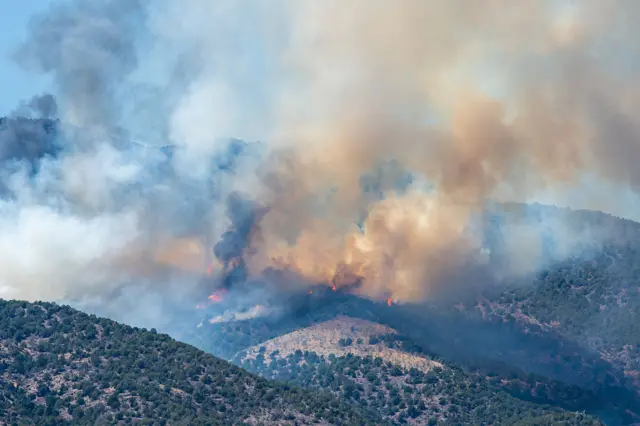
    Large plumes of smoke seen in Washoe County on Sunday

    We've not yet had an update from emergency services in Nevada today as a large wildfire is approaching Reno.

    Last night, the Hawk Fire Department said firefighters had been "fully engaged" to extinguish hotspots and keep the blaze contained.

    "Damage assessment teams are assessing structures in the affected area," the update reads, adding that homeowners would be informed if their property had been impacted.

    "Firefighters continue working around the clock to protect lives, property, and communities," it said.

    Meanwhile, Nevada's office of emergency management also said last night that the response had been a "truly collaborative effort, extending well beyond Nevada and even beyond the United States".

    "We were honored to work alongside Australian firefighters from the New South Wales National Parks and Wildlife Service (NPWS), who joined crews from across the United States in supporting the Hawk Fire response," it said.

  17. Why Nevada is at high risk from large wildfirespublished at 14:19 BST

    Matt Taylor
    BBC Weather

    The spread of wildfires is at the mercy of the wind.

    The dominant wind direction will of course dictate where the fire goes next, and the speed of the wind determines how quickly the flames spread across the landscape.

    Large fires can almost develop their own weather systems that can cause speed and direction to fluctuate greatly. Both are huge challenges for firefighters.

    Vegetation - the fuel for the fire - is also key component to why fires spread. While the sparseness of vegetation in a traditional desert landscape would normally inhibit the spread of wildfires, invasive grasses and trees are known to fill those gaps in some areas allowing fires to spread rapidly.

    Nevada is a state at high risk from large wildfires due to the combination of its dry climate and abundance of invasive grasses.

    A 2012 study by the University of Nevada stated that it can take up to 65 years for desert ecosystems to recover following wildfire.

    A wide view of Nevada grasses and hillsImage source, Getty Images
    Image caption,

    Northern Nevada on Sunday

  18. 'It came super fast': Locals describe evacuation as wildfire approachespublished at 14:04 BST

    We've been hearing from residents in Nevada who have been evacuated as a wildfire is approaching Reno.

    One woman says she is "scared to death" but is prepared to leave as soon as she is told to evacuate.

    As a reminder, around 45,000 have been urged by officials to get ready to leave.

    A man says "it came super fast, within 20 minutes we were told to get out of there and we saw the fire coming down the hill".

    You can hear more from the residents in Reno in the video below:

  19. How common are wildfires in the US?published at 13:44 BST

    Matt Taylor
    BBC Weather

    Large plumes of smoke and fire coming from the mountainsImage source, Getty Images
    Image caption,

    A fire burns through wildland vegetation south-west of Elberta, Utah on Sunday

    Wildfires are a regular occurrence in the US, especially during late summer and early autumn, with the south and the west of the country most susceptible.

    According to the National Interagency Fire Centre there are an average of around 70,000 wildfire each year.

    They also state that while there is no definite trend in the frequency of fires annually, the area of land affected each year has increased since they started tracking fires in the 1980's, with an area twice the size of California having been impacted by wildfires since 1983.

    While wildfires themselves are not caused by climate change, over 80% are started in some way by people.

    Human-induced climate change has been a key driver to increasing the risk of fire weather conditions - hotter extremes and longer lasting droughts - that help fires to take hold and spread.

  20. Emergency response to Hawk wildfire in Nevada - what we know so farpublished at 13:31 BST

    Rachel Flynn
    Live reporter

    A helicopter flying over burning hillsides with smoke and fire rising from themImage source, Getty Images
    Image caption,

    Fire seen raging on the dry hills outside Reno on Saturday

    A large wildfire is approaching Reno, Nevada, as nearly 90,000 people have been urged to evacuate their homes.

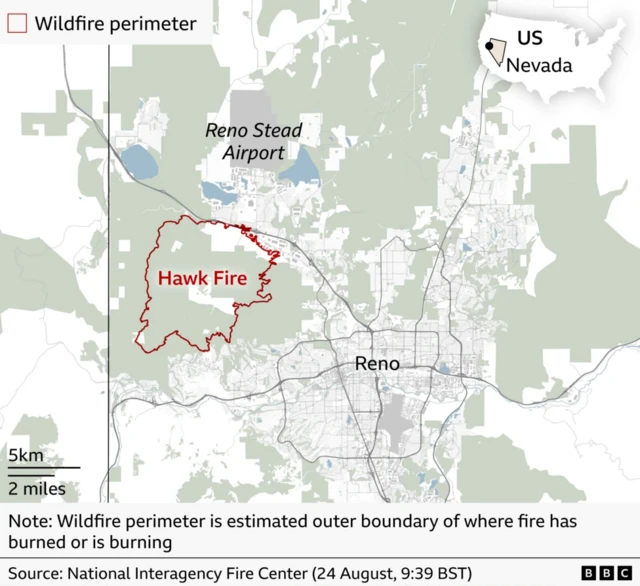
    The blaze was first reported on Saturday at 11:15 local time (18:15 GMT) and has been named Hawk fire after it was initially spotted near the Hawk Meadow Trail, to the west of Reno.

    Here's what you need to know:

    • Windy and unpredictable weather conditions in Nevada have contributed to the spread of the fire, which has not yet been contained
    • Six people have been injured, including three emergency responders
    • Officials say around 15,000 acres (23 sq miles) have been burned, as Nevada's Governor Joe Lombardo has declared a state of emergency in Washoe County
    • Around 42,000 people have been ordered to leave their homes immediately, with a further 45,000 people urged to get ready to leave
    • The immediate "go now" evacuation zone and wider "get set" area do not extend to the centre of Reno, but do affect large urban areas and part of a highway
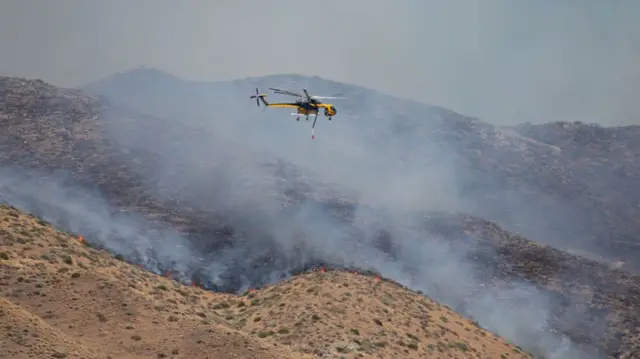
    • Large air tankers and helicopters have been flying over the affected area dropping water to try and tackle the blaze
    Map showing wildfire perimeter of the Hawk Fire west of Reno, Nevada. The area shows where the fire has burned and is currently burning in the Copperfield area near Silver Lake and Reno Stead Airport, with the city of Reno to the south-east. The perimeter covers the hills to the south of the Martin Luther King Jr Memorial Freeway towards Somersett. An inset map locates the fire within Nevada, in the western United States.