Summary

  1. BBC Verify

    At least three ships with no obvious Iran links cross the Strait of Hormuzpublished at 12:14 BST

    By Joshua Cheetham

    Earlier we reported that ship-tracking shows four Iran-linked vessels appear to have transited the Strait of Hormuz since the start of the US naval blockade.

    But not all vessels crossing the strait are connected to Iran - using ship-tracking data, we’ve identified at least three that have crossed since the start of the blockade on Monday which have no obvious links to the country.

    However, our understanding of which ships are going through the strait is complicated by the fact that some vessels may have been "spoofing" their tracking signal to hide their position. This also means some ships may have concealed the ports they called at so we cannot always say in which country they loaded or unloaded cargo.

    Crossings of the Strait of Hormuz are currently a fraction of what they were before the war when an average of 138 ships would transit the waterway each day.

    Map titled “US blockade of Iran’s Gulf coast” showing Iran’s southern coastline along the Persian Gulf, Strait of Hormuz and Gulf of Oman highlighted in red to indicate a blockade. Iranian territorial waters are shaded, with a caption stating, “No ships permitted to approach or leave Iranian coast.” Ports and major jetties are marked with purple dots, including Kharg Island and Bandar Abbas. Surrounding seas are labelled, including the Arabian Sea, and a distance scale, source credit, and BBC logo are visible.
  2. Why is Italy not renewing its Israel defence agreement?published at 11:56 BST

    Laura Gozzi
    Europe reporter

    Meloni addressing the lower house of Italian parliamentImage source, Getty Images

    Italy is not renewing its defence agreement with Israel, Italian Prime Minister Giorgia Meloni has said.

    Meloni said her government had decided to suspend the renewal, which happens every five years, "in view of the current situation”, without specifying what she was referring to.

    But relations between Rome and Tel Aviv have recently been fractious.

    Last week, Italy summoned the Israeli ambassador in Rome after warning shots were fired by Israeli forces at a convoy of Italian UN peacekeepers in Lebanon, damaging one vehicle but causing no injuries.

    And on Monday, Israel summoned Italy’s ambassador to protest comments by Italian Foreign Minister Antonio Tajani who condemned Israel's "unacceptable attacks" on civilians in Lebanon and said that “another escalation like in Gaza must be avoided at all costs".

    Other European countries have also paused or restricted arms exports with Israel. Italian opposition parties had long called for Italy to do the same. In recent years, hundreds of thousands of Italians have taken to the streets or gone on strike to protest Israel’s actions in Gaza and Meloni’s reluctance to join the growing number of countries recognising Palestinian statehood.

    Italy is the third-biggest arms exporter to Israel, according to the latest figures from the Stockholm International Peace Research Institute (Sipri).

    But that still only accounts for 1.3% of Israeli arms imports between 2021-2025. The US and Germany are the top exporters.

  3. Italy's agreement with Israel had been in place for a long timepublished at 11:43 BST

    Davide Ghiglione
    Reporting from Rome

    As we just reported, Italy's PM Giorgia Meloni said on Tuesday Italy is suspending its defence agreement with Israel, covering the exchange of military equipment and joint research.

    “In view of the current situation, the government has decided to suspend the automatic renewal of the defence agreement with Israel,” Meloni said on the sidelines of an event in Verona, according to news agency ANSA.

    The longstanding agreement, automatically renewed every five years by governments of all political stripes, had been in place long before the war.

  4. Italy suspending defence agreement with Israel - Italian mediapublished at 11:22 BST
    Breaking

    While we're keeping an eye on the situation in the Strait of Hormuz, there's breaking news from Italy.

    Italian Prime Minister Giorgia Meloni says she is suspending Italy's defence agreement with Israel, local news agencies have reported.

    She also says "every possible effort" must be made to reopen the Strait of Hormuz, speaking to reporters in Verona on Tuesday.

  5. Military action will worsen US's 'self-created problems', Iranian president sayspublished at 11:02 BST

    Iran's President Masoud Pezeshkian says Iran is ready to continue peace talks - and that diplomacy is its preferred path to resolving disputes - in a conversation with French President Emmanuel Macron reported by several news outlets in Iran.

    Pezeshkian reportedly told Macron that threats, pressure and military action are "unhelpful" and will worsen the US's "self-created problems".

    Pezeshkian added that Europe should encourage the US to adhere to international laws and regulations.

  6. Watch: How US blockade of Iranian ports works - and its riskspublished at 10:51 BST

    As we just reported, Iran-linked tankers have passed through the Strait of Hormuz, despite the US blockade being in place.

    However, the US is not, technically, blockading the Strait of Hormuz, instead aiming to blockade Iran’s Gulf ports by operating its navy in the Gulf of Oman and the Indian Ocean, rather than risk its vessels close to Iran's coast.

    The BBC's security correspondent Frank Gardner explains how it will work and its potential impacts across the globe.

  7. BBC Verify

    Four Iran-linked ships transit Strait of Hormuz, tracking showspublished at 10:27 BST

    By Joshua Cheetham and Shruti Menon

    Ship tracking data analysed by BBC Verify shows four Iran-linked ships have crossed the Strait of Hormuz despite Washington’s naval blockade beginning.

    Two of those ships had visited Iranian ports according to MarineTraffic. Its data shows a bulk carrier, Christianna, crossed the strait on Monday after the blockade began having called at Iran’s Bandar Iman Khomeini, according to ship-tracking data.

    The Rich Starry, sanctioned by the US for Iran-related trade, sailed east from Sharjah in the UAE through the strait overnight, data shows.

    The tanker Murlikishan, which is also under US sanctions for Iran-related trade, sailed from Lanshan in China and headed west through the strait overnight. According to MarineTraffic its last reported position was east of Iran’s Qeshm island.

    Another tanker, Elpis, passed the strait heading east overnight having come from the Iranian port of Bushehr, tracking shows. It is also under US sanctions and its destination is unknown.

    It is possible these ships have been broadcasting false position reports - known as “spoofing” - to disguise their locations.

    The US military has said that, from 14:00 GMT on Monday, it would blockade "all maritime traffic entering and exiting Iranian ports". It said it would "not impede freedom of navigation for vessels transiting the Strait of Hormuz to and from non-Iranian ports.

    Map titled “Iranian ports in the Gulf region” showing the southern coastline of Iran along the Persian Gulf and the Gulf of Oman. Labeled Iranian ports include Mahshahr, Imam Khomeini, Kharg Island, Bushehr, Asaluyeh, Lavan, Siri, Bandar Abbas, and Chabahar. The Strait of Hormuz is marked between the Gulf and the Gulf of Oman. Iran is highlighted in light grey, surrounding waters in blue, with a distance scale in kilometers and miles.
  8. What does the US blockade mean for Iran's oil exports?published at 10:02 BST

    Dearbail Jordan
    Senior business and economics reporter

    In March, Iran had one of its biggest months for oil exports despite the key Strait of Hormuz shipping route being virtually closed to most vessels under the threat of attack.

    Figures show that Iran exported 57.9 million barrels of last month, according to shipping analysts at Kpler. That was the fifth biggest month for oil exports from Iran over the past year and a half.

    China is a major customer of Iran and on Tuesday, its foreign ministry called the US blockade “dangerous” and “irresponsible”.

    A chart showing that Iranian oil exports have remained high despite the war. The graph shows monthly exports of crude oil barrels, October 2024 to March 2026. Levels remain fairly steady between 40 million and 60 million barrels, with a small rise in February and March 2026.
  9. Energy watchdog cuts global oil forecasts as it says 'demand destruction will spread'published at 09:47 BST

    The International Energy Agency has made large cuts to its forecasts for global oil demand and supply, citing disruption in the Middle East.

    The Paris-based watchdog says "demand destruction" - a permanent decline in consumer demand that struggles to recover - will spread as "scarcity and higher prices persist".

    Global oil demand is projected to decline by 80,000 barrels per day in 2026, a sharp contrast to last month's forecast that had predicted a 640,000 barrels per day rise.

    The IEA also expects oil supply to fall by 1.5 million barrels per day this year, compared to an increase of 1.1 million projected last month - marking the sharpest decrease since Covid-19.

    That's as oil prices saw their largest ever monthly gain in March, as a result of what the IEA calls "the most severe oil supply shock in history."

  10. Stock markets open higher on Tuesday, as oil prices fallpublished at 09:29 BST

    Dearbail Jordan
    Senior business and economics reporter

    Stock markets in Europe opened a little higher on Tuesday, buoyed by a possible second round of peace talks between the US and Iran which sent oil prices lower.

    In the UK, the FTSE 100 share index rose 0.36% in the first hour of trading. Germany Dax index gained 1% and in France, the Cac-40 rose by 0.58%.

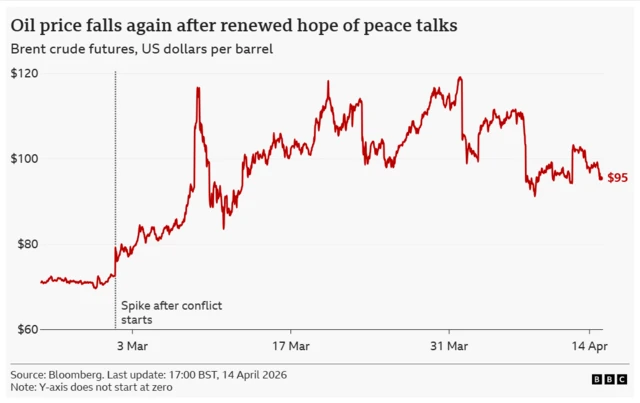
    Oil prices fell by 1% to $98.56 a barrel.

  11. 'Dangerous and irresponsible' US blockade will 'exacerbate tensions' - Chinese foreign ministrypublished at 09:21 BST

    Chinese Ministry of Foreign Affairs spokesperson Guo JiakunImage source, EPA-EFE/Shutterstock

    China's foreign ministry has condemned the US blockade of Iranian ports as "dangerous and irresponsible".

    The blockade came into force on Monday, a day after peace talks between the US and Iran broke down in Pakistan.

    Chinese foreign ministry spokesman Guo Jiakun warned that the blockade would only "exacerbate tensions and undermine the already fragile ceasefire agreement".

    "This is dangerous and irresponsible behaviour", Guo told a news conference.

    Guo said reports that China was preparing to deliver new air defence systems to Iran were "completely fabricated".

    The reports prompted US President Donald Trump to threaten to impose a 50% tariff on China's goods if it provided military assistance to Tehran.

    "If the US insists on using this as an excuse to impose additional tariffs on China, China will definitely take resolute countermeasures," Guo said.

    The BBC's diplomatic correspondent James Landale says China, which gets a large amount of its oil from Iran, "has an interest in this conflict ending and returning stability to the international market".

  12. BBC Verify

    Another US-sanctioned tanker crossed Strait of Hormuz, tracking showspublished at 09:12 BST

    By Joshua Cheetham

    BBC Verify has confirmed reports that a US-sanctioned tanker crossed the Strait of Hormuz after Washington’s naval blockade began.

    Data from MarineTraffic shows the Comoros-flagged ship Elpis is partially laden with cargo which may have been loaded at the Iranian port of Bushehr.

    Its registered owned is a Malaysian firm called Chartchemical. Shipping database Equasis reports the ship is falsely-flagged, meaning it is sailing under the flag of Comoros without that country’s authorisation.

    A screengrab from ship-tracking site MarineTraffic showing the Elpis' course from west to east through the Strait of HormuzImage source, MarineTraffic

    It last displayed its location at 10:00 local time (06:00 GMT; 07:00 BST) and has no destination recorded publicly.

    As we reported earlier, tracking data also appears to show another US-sanctioned tanker, Rich Starry, has passed through the strait and is reportedly heading for China, external, having last stopped in the UAE.

    • When announcing the blockade of Iranian ports, the US military said it would "not impede freedom of navigation for vessels transiting the Strait of Hormuz to and from non-Iranian ports"
  13. 'Six of our ships are stuck - and we don't know when the Strait of Hormuz will reopen'published at 08:58 BST

    A Hapag-Lloyd container ship, pictured in 2024Image source, Reuters
    Image caption,

    A Hapag-Lloyd container ship, pictured in 2024

    Hapag-Lloyd - one of the world's biggest shipping firms - has six vessels stuck at different points along or near the Strait of Hormuz.

    Speaking from Hamburg, Nils Haupt tells the BBC: "We keep on waiting for the opening of the Strait of Hormuz and we very much hope this is going to happen in the next [few] days - but we basically do not know."

    He also talks about the "very brave" crew on the stuck ships.

    "Being caught up in the Gulf at the moment and seeing a war around you and sometimes at night, this is a kind of traumatic experience for many of them and they are not used to it. Times are not easy for the crews."

  14. Starmer sets up new cabinet committee for impacts of warpublished at 08:39 BST

    Henry Zeffman
    Chief political correspondent

    Keir Starmer stood on a beach talking to two UK military personnel, in camouflage military uniformImage source, Getty Images
    Image caption,

    Keir Starmer spoke with military personnel and Middle Eastern leaders on a three-day trip to the Gulf earlier in April

    Keir Starmer has set up a new cabinet committee to deal with the fall-out from the war in the Middle East, in a sign that the government expects the conflict to have a lasting impact on the British economy.

    The prime minister is chairing the first meeting of the Middle East Response Committee today. Its formation is seen within government as a recognition that the crisis is likely to last for some time.

    It is fairly rare for the government to form new cabinet committees to handle specific crises. Under Boris Johnson cabinet committees were formed to handle the response to the coronavirus pandemic and to plan for a possible no-deal Brexit.

  15. Oil back under $100 a barrel - but things could get much worse, warns IEApublished at 08:26 BST

    Dearbail Jordan
    Senior business and economics reporter

    Petrol price board showing petrol at 159.9 pence and diesel at 192.9 penceImage source, EPA
    Image caption,

    Petrol prices have risen in the UK, and across the world, since the war began

    While oil prices have retreated from over $100 a barrel, the cost of crude is still 36% more expensive than it was before the Iran war began on 28 February – and it could get worse, according to the International Energy Agency (IEA).

    IEA executive director Fatih Birol suggests that current prices do not reflect the severity of what is going on in the Middle East.

    "April may well be even worse than March, because during the month of March, we have already received cargoes which were loaded well before the crisis started... and during the month of April, nothing is being loaded," he says.

    "The longer the disruption is, the more severe the problem becomes."

    Last month, all 32 members of the IEA agreed to release 400 million barrels of their oil stocks to ease supply constraints and Birol signalled that the agency would be prepared to act again.

    "400m barrels is only 20% of our resource," he says. "We have still 80% in our pocket. We are assessing the decision. If and when we decide it is the time, we are ready to act and act immediately."

  16. No legal basis to block the Strait of Hormuz - UNpublished at 08:13 BST

    The UN's maritime agency, the International Maritime Organisation, says no country has a legal right to block shipping in straits used for international transit.

    Secretary-General Arsenio Dominguez tells BBC Radio 4's Today programme it's a dangerous precedent to set.

    "I do understand there is a conflict going on there, but there is still no legal basis in international law to take any actions to block any strait used for international navigation," Dominguez says.

    "The more retaliation measures that take place, the more the concern grows for the 20,000 seafarers still trapped in the Persian Gulf and of course everyone else around the world who continues to be impacted economically.

    "The longer this goes, the longer we all will feel this impact."

    This Flourish post cannot be displayed in your browser. Please enable Javascript or try a different browser.

  17. Tanker passes through Strait of Hormuz, according to tracking datapublished at 07:23 BST

    On Sunday, President Donald Trump said the US navy would block "any and all ships trying to enter, or leave, the Strait of Hormuz".

    He later said the US would blockade ships "entering or exiting Iranian ports" from Monday.

    US Central Command confirmed the blockade of "all maritime traffic entering and exiting Iranian ports". But it said it "will not impede freedom of navigation for vessels transiting the Strait of Hormuz to and from non-Iranian ports".

    On Monday four vessels crossed the strait in the hours before the blockade came into force at 14:00 GMT (15:00 BST). All four were tankers carrying either oil, gas or chemicals, according to tracking data provided by MarineTraffic.

    On Tuesday, another tanker passed through, according to shipping data. The Rich Starry's last port of call was in the UAE and its reported destination is China., external

    The Rich Starry tanker passed through the Strait of Hormuz, according to tracking from MarineTraffic on TuesdayImage source, MarineTraffic
    Image caption,

    The Rich Starry tanker passed through the Strait of Hormuz, according to tracking from MarineTraffic on Tuesday

  18. US blockade of Iranian ports is 'grave violation' of sovereignty - Iran's UN ambassadorpublished at 06:50 BST

    Iran's ambassador to the United Nations has condemned the US blockade on Iranian ports as a "grave violation" of its sovereignty.

    In a letter to the UN Secretary General Antonio Guterres, Amir Saeid Iravani says the "unlawful" blockade "constitutes a serious violation of the fundamental principles of the international law of the sea".

    On Monday, Guterres called on "all parties" to respect freedom of navigation in the Strait of Hormuz - a critical waterway for global oil shipping.

    The US military imposed the blockade on Iranian ports from 10:00 ET (14:00 GMT) on Monday, after peace talks with Iran in Pakistan broke down.

    The US Central Command said the blockade will be enforced "impartially against vessels of all nations entering or departing Iranian ports or coastal areas", but it will "not impede" vessels in the Strait of Hormuz travelling "to and from non-Iranian ports".

    A screenshot of tracking data on MarineTraffic on Tuesday morningImage source, MarineTraffic
    Image caption,

    Tracking data on MarineTraffic, as of 06:45 BST on Tuesday, shows very few ships passing through the Strait of Hormuz

  19. Israeli and Lebanese envoys to hold rare talks in USpublished at 05:58 BST

    Yolande Knell
    Middle East correspondent, in Jerusalem

    A man sits beside piled damaged cars at the site of an Israeli strike in BeirutImage source, Reuters

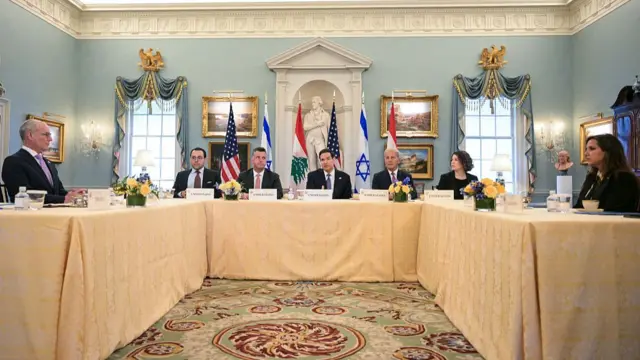
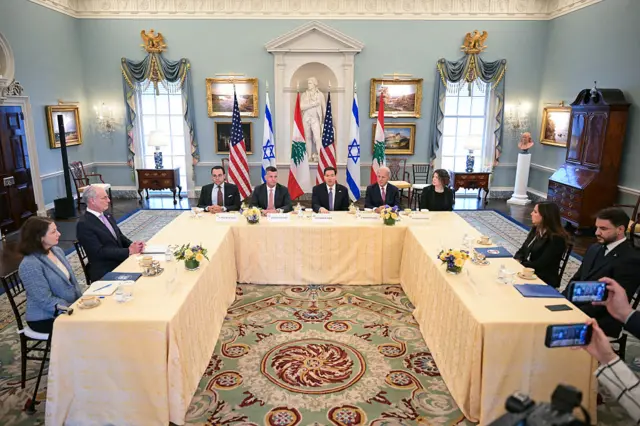
    Talks between Lebanese and Israeli ambassadors to the US are expected to take place in Washington later today.

    It will be the first time in decades that officials from the two countries – which don’t have diplomatic relations – meet face-to-face for direct negotiations.

    The US top diplomat, Marco Rubio, is expected to join these rare direct talks at the State Department. They come just days after the US and Iran failed to reach an agreement to end the broader Middle East war.

    The Lebanese and Israeli ambassadors are due to discuss the possibility of higher-level direct talks between their countries.

    The Lebanese authorities first want to broker a ceasefire in Israel’s ongoing war with Hezbollah. However, Israel has ruled that out, insisting that the Iran-backed group must be disarmed. And Hezbollah has rejected the talks and said it won't abide by anything that's agreed.

    The latest fighting between Israel and Hezbollah has been devastating for Lebanon. More than a million people have been displaced and more than 2,000 killed – including about 500 women, children and medical workers.

  20. US says 'ball is in Iran's court' as blockade of Iranian ports comes into effectpublished at 05:52 BST

    A ship is seen off the coast of SharjahImage source, Getty Images

    With the US blockade of Iranian ports now under way after weekend talks failed to reach a peace deal, Vice-President JD Vance says "the ball is in Iran's court" and Tehran has to be flexible to Washington's demands.

    Here are the latest developments:

    • Vance has accused Iran of "economic terrorism" over its blockade of the Strait of Hormuz in an interview with Fox News
    • "Well, as the president of the United States showed, two can play at that game,” he said. "If the Iranians are going to try to engage in economic terrorism, we’re going to abide by the simple principle that no Iranian ships are getting out, either"
    • The New York Times reports that Iran has proposed suspending its nuclear activity for up to five years - an offer that was rejected by the US which insisted on 20 years. The BBC has reached out to the White House for comment
    • US Secretary of State Marco Rubio will take part in Tuesday's meeting between the Lebanese and Israeli ambassadors to Washington in discuss the conflict in southern Lebanon
    • The Israeli military says one of its soldiers was killed during combat in southern Lebanon, while three others were injured
    • Oil prices dipped in early Asian trade as hopes of further peace talks between the US and Iran eased concerns about the war's escalation
    • New polling by the Hebrew University of Jerusalem points to a war-weariness among Israelis, read our full story

    Stay with us as we bring you more updates.