Summary

  • US and Iranian officials are in direct talks with Pakistan in Islamabad on bringing an end to conflict in the Middle East

  • These face-to-face talks mark an historic event, but what success will look like depends on who you ask, writes our South Asia correspondent

  • Earlier, delegations from both Washington and Tehran spoke with Pakistan's PM Shehbaz Sharif, he said he hopes negotiators will "engage constructively"

  • Our diplomatic correspondent outlines the key sticking points in negotiations

  • In a Truth Social post Trump claims Iran is "losing big" in the conflict, and says the US is "clearing out" the Strait of Hormuz - a key shipping route that has been essentially closed by Tehran

  • Elsewhere, our correspondent in Beirut writes that talks between Lebanon and Israel next week are a significant development

  • It comes as the Israeli military says it struck more than 200 Hezbollah targets in the last 24 hours

  1. 'Seize opportunity for deescalation,' Macron tells Iranian presidentpublished at 19:49 BST
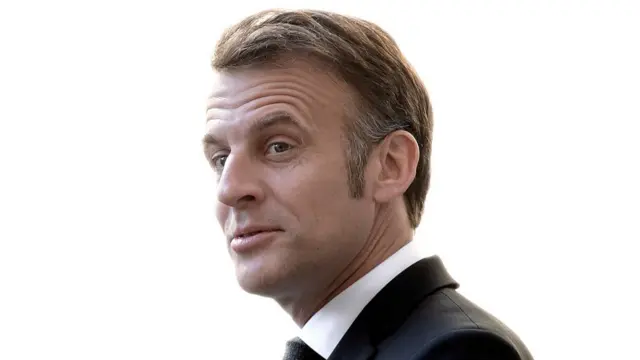
    French President Emmanuel Macron, a middle-aged man in a suit.Image source, Getty Images

    French President Emmanuel Macron says he has urged his Iranian counterpart to "seize the opportunity" to "pave the way for a lasting deescalation".

    Macron says in a post on X he spoke to Masoud Pezeshkian and pushed for an an agreement providing regional security guarantees, with all countries involved.

    He says that he pressed the need for Iran to reopen the Strait of Hormuz, and also stressed the importance of a ceasefire, including in Lebanon.

  2. Thousands of Hezbollah supporters demonstrate in Beirutpublished at 19:16 BST

    Hugo Bachega
    Middle East correspondent in Beirut

    Media caption,

    BBC's Hugo Bachega sees thousands of Hezbollah supporters demonstrating in Beirut

    Outside the Lebanese prime minister’s office in central Beirut, Hezbollah supporters gathered to protest against the prospect of direct talks with Israel, an offer by the Lebanese government to try to put an end to the war and pave the way for, many hope, lasting peace.

    The crowd chanted revolutionary slogans, carried Hezbollah’s yellow flag, the flag of Iran - the group’s main supporter - and pictures of the late Hezbollah leader, Hassan Nasrallah.

    Sara, who was waving a Lebanese flag, told me: “I'm proud to be here because Hezbollah, it's the only resistance against these evil ones, this [Israeli Prime Minister Benjamin] Netanyahu, one who is stealing our country, killing our people.”

    Followers see Hezbollah, who they call “the resistance”, as the only force able to protect them against Israel, which they say is intent on seizing Lebanese land.

    Israel says Hezbollah is a threat and that it aims to create a so-called security buffer zone along the border to protect its northern communities. In Lebanon, there are fears that this could lead to an occupation of parts of the country.

    Opponents blame Hezbollah for dragging Lebanon into conflicts, want the group to be disarmed, and support negotiating with Israel. Lebanon has demanded a ceasefire before any talks, but Israel says the war will continue.

  3. High stakes meetings in Islamabad as US and Iran gather for peace talkspublished at 18:49 BST

    Ahead of today's trilateral talks, US and Iranian delegations also separately met with Pakistani representatives.

    Here are some images from earlier today:

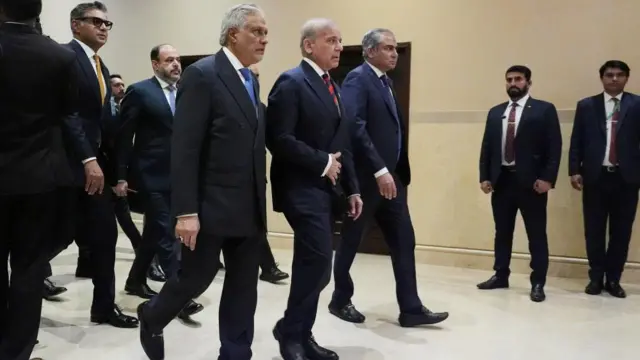
    Pakistani Foreign Minister Mohammad Ishaq Dar, Prime Minister Shehbaz Sharif, and Interior Minister Mohsin Naqvi walk side by side down a hallway with officials surrounding them.Image source, Reuters
    Image caption,

    Pakistani Foreign Minister Mohammad Ishaq Dar, Prime Minister Shehbaz Sharif, and Interior Minister Mohsin Naqvi arrive for a meeting with US Vice President JD Vance

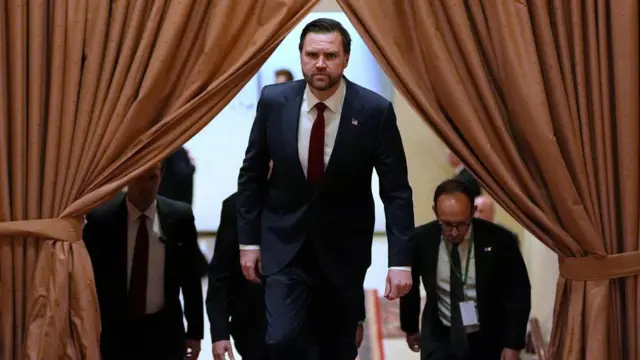
    JD Vance walks through brown parted curtains with three officials behind him.Image source, Reuters
    Image caption,

    JD Vance arrives for a meeting with Pakistan's Prime Minister Shehbaz Sharif

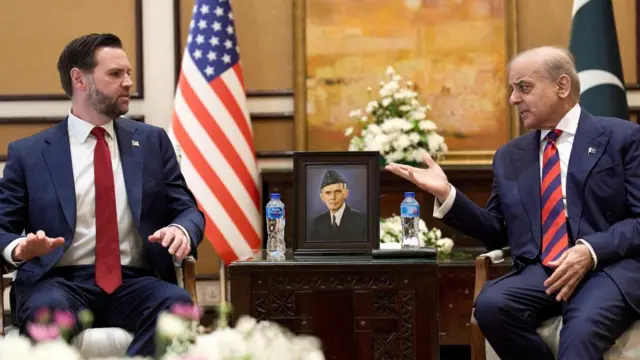
    JD Vance and Shehbaz Sharf sit side by side on chairs in a meeting.Image source, Reuters
    Image caption,

    Vance and Sharif speak during a meeting held in Islamabad, where peace talks are taking place

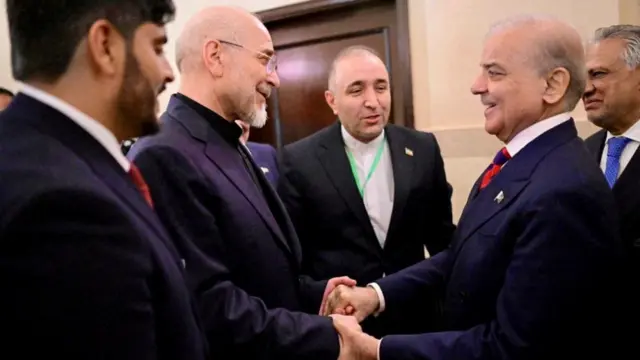
    Shehbaz Sharif grasps the hands of Mohammad Bagher Ghalibaf as other senior Iranian officials stand around them.Image source, Reuters
    Image caption,

    Sharif meets with Iranian Parliament Speaker Mohammad Bagher Ghalibaf ahead of the talks.

  4. Death toll in Lebanon passes 2,000, health ministry sayspublished at 18:23 BST

    Lebanon's health ministry says the country's death toll since it became involved in the conflict has now passed 2,000.

    The National News Agency reports that according to the ministry's health emergency operations centre 2,020 people have died and 6,436 people have been wounded since 2 March.

    The update comes after the ministry said an Israeli raid on the town of Tuffahta in southern Lebanon left eight people dead and nine injured, including five in critical condition.

  5. Centcom says US starts mine clearance in Strait of Hormuzpublished at 17:54 BST

    The US Central Command says two US Navy guided-missile destroyers have transited the Strait of Hormuz today.

    It says this is to ensure the waterway is clear of sea mines laid by Iran, in a statement on X. It names the two destroyers as USS Frank E Petersen and USS Michael Murphy.

    Centcom commander, Admiral Brad Cooper, says in a statement on X: "Today, we began the process of establishing a new passage and we will share this safe pathway with the maritime industry soon to encourage the free flow of commerce."

  6. What you need to knowpublished at 17:44 BST

    Caitlin Doherty
    Live editor

    It's just turned 21:40 in Islamabad, where trilateral talks are being held between the US and Iran with host mediators Pakistan.

    While we wait to hear if any progress in the negotiations has been made, here's what you need to know:

    • Pakistani sources and the White House confirmed face-to-face talks have been taking place between the US, Iran and Pakistan
    • It comes after delegations met separately with the Pakistani prime minister. He said he was hoping both sides would "engage constructively"
    • We haven't heard much from the closed negotiations in Islamabad, and our correspondent on the ground says information is limited - watch her full report
    • Meanwhile, Donald Trump says - in a series of Truth Social posts - that Iran is "losing big" in the conflict, and claims the Strait of Hormuz "will soon be opened"
    • Israel has said it has struck more than 200 Hezbollah targets in Lebanon in the last day, while Beirut's health ministry says six people have been killed in raids in the south of the country, with five others injured
  7. Despite proximity to talks, information we're receiving is limitedpublished at 17:17 BST

    Carrie Davies
    Pakistan correspondent, in Islamabad

    The white building just behind me is the Serena Hotel, where US Vice President JD Vance and Pakistani Prime Minister Shebaz Sharif met earlier.

    This is the closest we can get, because the security here in Islamabad is exceptionally tight.

    We're in the area that has been been designated for the media, and there are journalists from all over the world here.

    Despite being so close to the talks the amount of information we're getting is quite limited, with small bits and pieces from releases and announcements, often from Pakistani sources, to tell us what's going on.

    Watch the full report below:

    Media caption,

    BBC in Islamabad as US-Iran peace talks get under way

  8. What can we make of Trump's latest oil claims?published at 17:07 BST

    Marc Ashdown
    Business correspondent

    US President Donald Trump has hailed US oil as the "best and sweetest" in the world and says "empty ships are rushing to the US to load up" - what can we make of these claims?

    It is correct that America is the world’s top oil producer, generating between 13 and 21 million barrels per day according to the statistics expert Enerdata.

    Russia and Saudi Arabia are the next two largest producers, with between 19 and 22 million barrels per day between them.

    The claim that the US has "more oil than the next two largest oil economies combined" is stretching the truth.

    What about the claim that it is "higher quality"? Again, it is true that American shale oil is lighter than that produced elsewhere, making it ideal for refining into gasoline and diesel. So it is highly desirable, but that’s widely known already.

    The president’s earlier post appears to be a "come and get it" message to the world.

    The US already exports around four million barrels of crude a day, about a quarter of what it produces – the UK incidentally imports about 20% of its daily requirement from America.

    And the US does also sit on strategic reserves of an estimated 400 million barrels, enough to keep the country going for 19 days in the event of a crisis at current consumption levels.

    So it is debateable how much of that the president would really be willing to export.

  9. Strait of Hormuz will soon be open - Trumppublished at 17:02 BST

    A view of the vessels passing through Strait of Hormuz.Image source, Getty Images

    Donald Trump has posted on Truth Social again while high-level talks between US and Iranian delegations in Islamabad are going on.

    He repeats his assertion that the US has destroyed Iran's military, "including their entire Navy and Air Force, and everything else".

    He asserts "the Strait of Hormuz will soon be open" and repeats what he said in previous posts that empty oil tankers are on their way to the US to "load up".

    Under the conditional two-week ceasefire with Iran, Trump said he had agreed to "suspend the bombing" if Tehran agrees to reopen the strait.

    Tehran had effectively blocked the waterway after the US and Israel launched strikes on the country on 28 February.

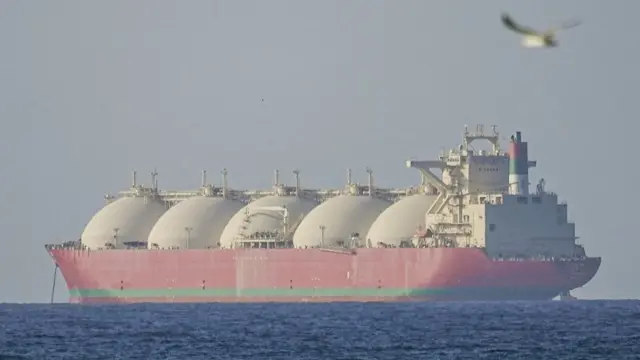
    It is one of the world's busiest oil shipping channels, which about 20% of the world's oil and liquefied natural gas (LNG) usually passes through.

  10. Kuwait says no threats affecting airspace in past 24 hourspublished at 16:38 BST

    Away from the peace talks in Islamabad, Kuwait says there have been no "threats or risks affecting the airspace" in the past 24 hours, according to its Center for Government Communication.

    This comes after Iran and the US agreed to a conditional two-week ceasefire.

    On Wednesday morning, Kuwait reported Iranian attacks damaged power and desalination plants as well as oil facilities.

  11. US confirms trilateral talks, provides more detail on American delegationpublished at 16:25 BST

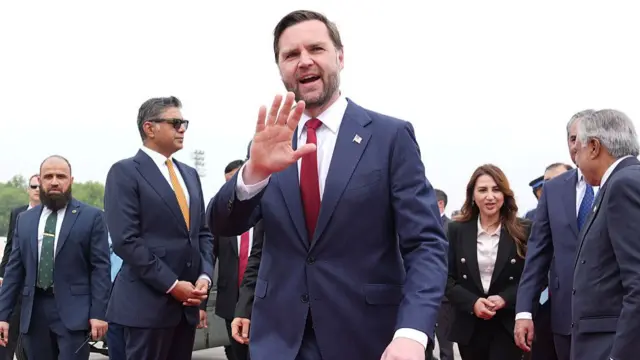
    US Vice President JD Vance waves after arriving in Islamabad, with Pakistani officials behind him.Image source, Getty Images

    A senior White House official confirms face-to-face trilateral talks between US and Iranian delegations with Pakistan are under way. Pakistan government sources earlier said the same to the BBC.

    The official provides more detail on who is in the room for the US. They say the core delegation, as we've been reporting, is made up of Vice President JD Vance, special envoy Steve Witkoff and Trump's son-in-law Jared Kushner.

    According to the senior official, the broader US delegation includes national security adviser Andrew Baker, and Asian affairs adviser Michael Vance.

    US experts on various subject areas are also present in Islamabad, according to the official, with other experts supporting from Washington DC.

  12. Analysis

    Face-to-face talks are significant, but what success will look like depends on who you askpublished at 15:51 BST

    Azadeh Moshiri
    South Asia correspondent, in Islamabad

    Earlier, we mentioned how significant the day has been so far.

    But now that sources have told us face-to-face trilateral talks are taking place, that's a historic event that Pakistan has mediated.

    These are the highest level face-to-face talks between the US and Iran since the Islamic revolution in 1979.

    It also hints at how these talks are going.

    Amid Pakistan's shuffling between rooms, it seems the Americans and Iranians have seen points in their respective proposals they think they can make progress on.

    What success will look like depends on who you ask.

    This war has sent global oil prices soaring, caused extensive damage to energy infrastructure in the Middle East, and thousands of people have been killed.

    Many would breathe a sigh of relief if an extended ceasefire and an eventual peace agreement is delivered.

    Iranians who have lived through years of sanctions may hope there will be respite for the economy. But some of the Iranians I've spoken to inside the country, even those who have fled their homes in fear, are afraid of an Iran led by the regime's new leaders, who they say are more hardline than before.

    The memory of a brutal crackdown in January, with thousands killed, is still fresh.

  13. Israel says it struck 200 Hezbollah targets in Lebanon in 24 hourspublished at 15:21 BST

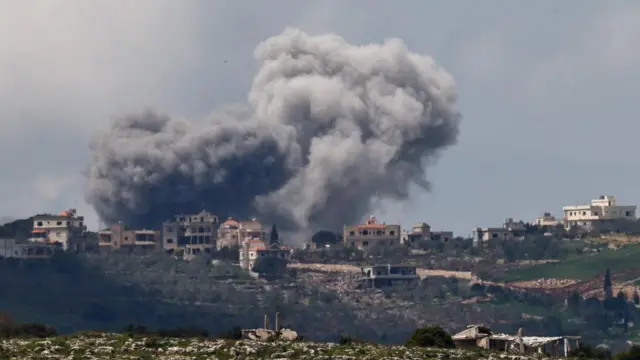
    Smoke rises following an airstrike in Lebanon, as seen from Israeli side of the border, April 11.Image source, Reuters
    Image caption,

    Smoke rises following air strike in southern Lebanon on April 11

    As direct talks between US and Iran take place in Islamabad with Pakistan, Israel says it is continuing strikes on targets in Lebanon.

    Israel Defense Forces (IDF) says it has struck more than 200 Hezbollah targets in Lebanon in the past 24 hours.

    In a statement, it says its air force is carrying out further attacks and supporting ground forces operating in southern Lebanon. The IDF also says it is targeting launchers to prevent attacks on Israel.

    Lebanon's health ministry says six people have been killed in raids in southern Lebanon, with five others injured.

    Meanwhile, Israel has warned of an aircraft intrusion in the Upper Galilee region in the north of the country. It's not clear who launched the attack.

  14. Trilateral direct talks involving Iran and US under waypublished at 14:57 BST
    Breaking

    Pakistan government sources have told the BBC that trilateral direct talks between the US and Iran, with Pakistan, are now under way.

    Earlier, we reported the talks were being held indirectly, through Pakistani mediators.

  15. Trump says he is watching fertiliser prices 'closely' during war in Iranpublished at 14:32 BST

    In a separate post on Truth Social, US President Donald Trump has also said that he is "watching fertilizer prices CLOSELY during our FIGHT FOR FREEDOM in Iran".

    He adds: "The United States will not accept PRICE GOUGING from the fertilizer monopoly!"

    • For context: According to the United Nations, around a third of the world's fertilisers - such as urea, potash, ammonia and phosphates - normally pass through the Strait of Hormuz. Data from the World Trade Organization, shows that, since the conflict began, outbound shipments of fertiliser-related products through the waterway have collapsed - read more here from BBC Verify
  16. Analysis

    Even if talks are indirect, this is a significant momentpublished at 14:19 BST

    Azadeh Moshiri
    South Asia Correspondent, in Islamabad

    We're hearing that indirect talks between the US and Iran have started through Pakistani mediators.

    Even if indirect, this is a significant moment for Pakistan, and was hard to imagine in these six weeks of war, given how far apart the two sides stand on key issues and the deep mistrust.

    If this leads to face-to-face talks that would be a tangible and historic result for Pakistan as a mediator.

    What we're watching for is whether by the end of this process, these talks deliver an extended ceasefire, any form of agreement, or even a promise to keep talking.

  17. Trump says Iran 'LOSING BIG' as talks kick offpublished at 14:13 BST

    US President Donald Trump says Iran is "LOSING BIG" in the conflict as talks in Islamabad kick off.

    In a lengthy Truth Social post, Trump claims members of the media "love saying that Iran is 'winning' when, in fact, everyone knows that they are LOSING and LOSING BIG".

    He then goes on to repeat assertions his administration has made during the conflict: "Their Navy is gone, their Air Force is gone, their Anti Aircraft apparatus is nonexistent, Radar is dead, their Missile and Drone Factories have been largely obliterated along with the Missiles and Drones themselves and, most importantly, their longtime 'Leaders' are no longer with us, praise be to Allah!"

    After referring to Iran laying sea mines, he goes on to say the US is now starting "clearing out the Strait of Hormuz as a favor to Countries all over the World".

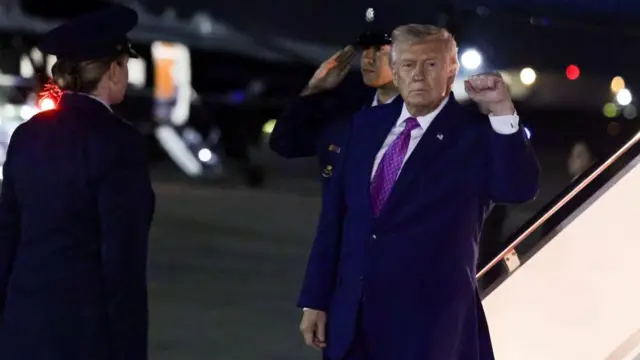
    Donald Trump, with one fist raised, pictured on FridayImage source, Reuters
    Image caption,

    Donald Trump, pictured on Friday

  18. Islamabad talks have begun, sources tell BBCpublished at 13:51 BST
    Breaking

    Sources have told the BBC that talks have now started between the US and Iran - but for the moment are still indirect through Pakistani mediators.

  19. Rarely has Pakistan found itself at the heart of significant international diplomacypublished at 13:40 BST

    Carrie Davies
    BBC Pakistan correspondent

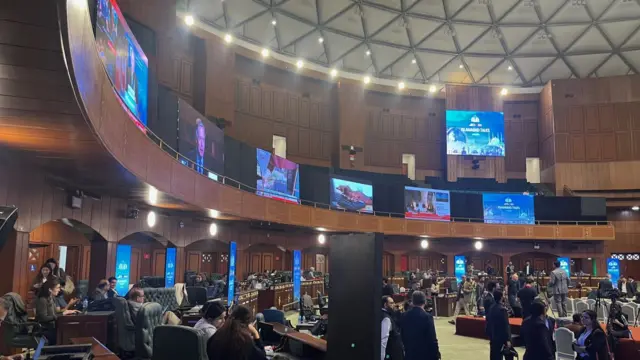
    A balcony displaying large TV screens can be seen above rows of desk chairs. Dozens of journalists can be seen working at laptops or standing near film cameras
    Image caption,

    Journalists wait at the convention centre ahead of talks

    We were taken through multiple checkpoints and escorted by armed police into the centre of Islamabad’s diplomatic area: the red zone.

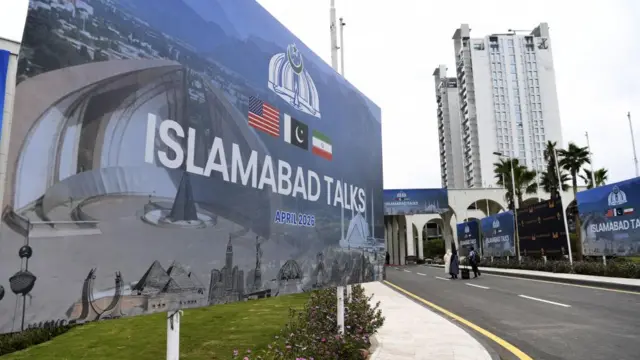
    The convention centre is surrounded by billboards emblazoned with the US, Iranian and Pakistan flags and the words "Islamabad talks", the centre full of journalists who have travelled from around the world to cover them.

    Large screens fill the centre’s auditorium broadcasting television stations from around the world covering the news from Islamabad.

    Rarely has Pakistan found itself at the heart of such significant international diplomacy.

    A blue billboard on a street corner in Islamabad that reads 'Islamabad talks'.Image source, EPA

    Across the road is the Serena Hotel where American Vice President JD Vance arrived shortly afternoon after visiting the US embassy.

    It is here, along with special envoy Steve Witkoff and Jared Kushner, that he met with Pakistani Prime Minister Shehbaz Sharif, and the interior minister, Mohsin Naqvi.

    Shariff is said to have expressed his hope that these talks would serve as a stepping stone towards durable peace in the region.

    The Iranians also met the prime minister, although no images of their meeting have been shared.

  20. Key sticking point: Iran's regional alliespublished at 13:18 BST

    Paul Adams
    Diplomatic correspondent

    Iran's network of regional allies and proxies – Hezbollah in Lebanon, the Houthis in Yemen, Hamas in Gaza and an assortment of militias in Iraq – has given Tehran regional clout, allowing Iran to exercise what is often called "forward defence" in its long-running disputes with Israel and the United States.

    Since the start of the Gaza war in October 2023, the network Iran calls the "Axis of Resistance" has been under constant attack. One part of it, the regime of the former Syrian dictator Bashar al-Assad, no longer exists.

    But Israel sees what it calls the "Axis of Evil" as representing an existential threat, which needs to be fully eradicated.

    At a time when the Iranian economy is buckling, many Iranians would also like to see their government spending less on foreign adventurism and more on making their lives easier.

    But there's little sign yet that Iran is ready to give up on its allies.