Summary

  • US President Donald Trump is threatening to impose new tariffs on Canadian vehicles on 1 January

  • Meanwhile, Canada's prime minister, Mark Carney, says Trump's latest threat is "not a surprise" and that US workers will be hurt by any increased duties on autos

  • He is preparing a response to fresh tariffs imposed by the US on Canadian goods this weekend after trade talks collapsed

  • Carney confirmed he would match Trump's tariffs "dollar-for-dollar" from 8 September, including levies on steel, dairy, appliances and electronics

  • Both countries were optimistic of a deal, but talks fell apart with each accusing the other of making last-minute changes

  • Chief US trade negotiator Jamieson Greer accused the Canadian side of wanting more in the deal

Media caption,
Canada will negotiate if US has the 'right attitude', says Mark Carney
  1. US-Canada trade war ramps up as Trump threatens auto tariffspublished at 22:19 BST

    Sakshi Venkatraman
    US reporter

    A trade war between US and Canada has escalated today as leaders on both sides of the border exchange threats.

    It kicked off after talks to reach a trade deal fell apart late on Friday, and then on Monday US President Donald Trump fired a major economic shot at Canada in announcing he would place a new 50% tariff on vehicles imported from the country.

    Here's what's happened since then:

    • Trump accused Canada of "ripping off" the US for years and being one of the "worst Nations in the World to deal with"
    • Reviving his depictions of the country to the north as a 51st state, he added that "Canada will be treated like a State no longer!"
    • Canadian Prime Minister Mark Carney said the new levies were unsurprising, but confirmed he would match Trump's tariffs "dollar-for-dollar" from 8 September
    • Carney also said he would not return to the negotiating table until the US returned first with the "right attitude"
    • US Vice-President JD Vance said Canada needed to stop "taking advantage of the US"
    • Ontario Premier Doug Ford, leader of Canada's biggest province by population,had some choice words for Trump, saying he could "kiss my ass" and Canada should put pressure on Republican-majority US states

    Meanwhile, small business owners in both the US and Canada say they are already feeling the impacts. In the US, that's through increased prices on Canadian goods, and in Canada, it means fewer orders from a major market.

    We're ending this live coverage, but you can read more about the tariffs here.

  2. Portland small business is 'literally stuck' after new tariffs imposedpublished at 21:28 BST

    Ana Faguy
    US reporter

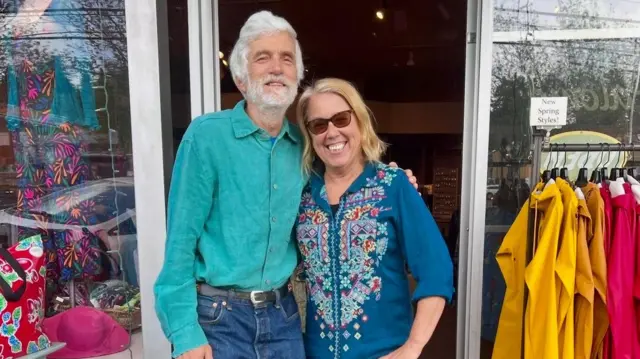
    Mike Roach and Kim Osgood outside their shopImage source, Carley King
    Image caption,

    Mike Roach and Kim Osgood

    Mike Roach and Kim Osgood, owners of Paloma Clothing in Portland, Oregon, are preparing for one of their best-selling items to potentially increase sizeably in price.

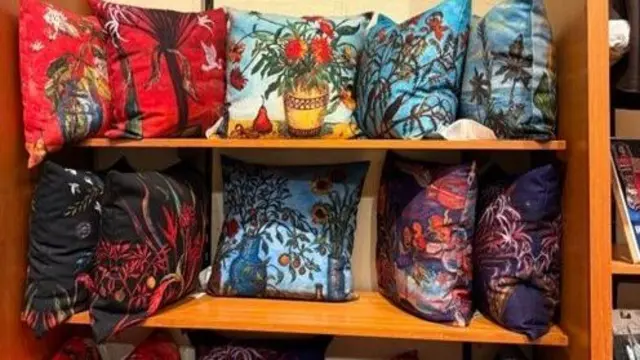
    Osgood creates designs that she has a Montreal-based company transfer onto pillows the couple sells in their store.

    Those pillows are their best-selling gift item, retailing at $59. With the newly imposed tariffs, a normal markup would bring the price of that pillow to somewhere between $86 and $90, Osgood told the BBC.

    "Gift items are really price-point sensitive; people have in their mind what they're going to pay for a gift, and they're not going to pay more than that," Roach said.

    The couple, whose shop has been operating for 51 years, say they will likely hold the original price and hope the "tariff problem," as Roach calls it, gets worked out.

    "It would be one thing if we had three months' notice; that would be something you could plan around, do some work with the vendors, but when it happens literally overnight you're really stuck," he said.

    Pillows on a shelfImage source, Carley King
    Image caption,

    Pillows for sale at Paloma Clothing

  3. Fake beards, bookbinding machines and other unexpected imports to be taxedpublished at 21:02 BST

    The range of products from Canada that will be subject to the 50% US tariff is wide and, at points, odd. While common goods like certain types of dairy, alcohol, plants and plywood will be taxed, a list published in the Federal Register also included some unexpected items, such as:

    • Ossein and bones treated with acid
    • Horsehair and horsehair waste
    • Wigs (partial), false beards, eyebrows and the like, of synthetic textile materials
    • Brewery and bookbinding machinery
    • Antiques aged between 100 and 250 years
    • Men's, women's, boys' and girls' track suits, not knitted or crocheted of man-made fibers
    • Articles of wood other than bamboo, including pencil slats and gates for confining children or pets
  4. Canada's opposition leader demands Parliament reconvenepublished at 20:52 BST

    Pierre Poilievre, opposition leader of Canada's Conservative Party, is urging Prime Minister Mark Carney to immediately reconvene Parliament to discuss the fresh trade war with the US.

    Parliament must convene, he says, to confront three urgent matters:

    1. He wants to know what specifically was in the deal that both sides abandoned when trade talks fell apart, and calls for the deal's text to be released
    2. He asks how much Canada's reciprocal tariffs on US exports will affect Canadian taxpayers, worsen inflation, and increase prices of groceries and gas
    3. He also asks to know how Canadian jobs and industry - specifically in the steel, lumber and auto sectors - will be protected from the tariffs

    "Canadians deserve answers on how trade talks collapsed, what tariffs will cost their families, and how their jobs will be protected," Poilievre says.

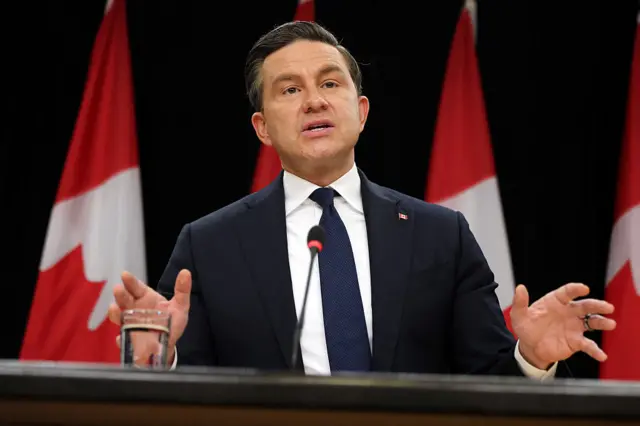
    A man in a suit gestures from behind a lectern against a backdrop of Canadian flagsImage source, Getty Images
  5. Most Canadians back Carneypublished at 20:30 BST

    Nadine Yousif
    Senior Canada reporter

    One thing that sets Prime Minister Mark Carney apart from President Donald Trump is his popularity among his electorate.

    Carney’s approval rating more than a year and a half into his mandate is a healthy 60%, according to an August national poll by Liaison Strategies. A recent Angus Reid poll suggests that 76% of Canadians feel their prime minister was right to ditch trade talks with the US.

    President Trump’s approval rate in the US, on the other hand, has fallen to 33% in recent weeks — the lowest of his presidency and a vulnerability ahead of November’s US midterm elections.

    Carney’s popularity gives him political leeway to respond defiantly to the US, with Canada’s provincial leaders and businesses backing him even if the escalation of the trade war brings pain to Canadians.

    But that doesn’t mean Canadians are not concerned about what comes next. Two in five surveyed by Angus Reid said they feared for their jobs.

  6. Canada has financial capacity to face US threats, minister sayspublished at 20:21 BST

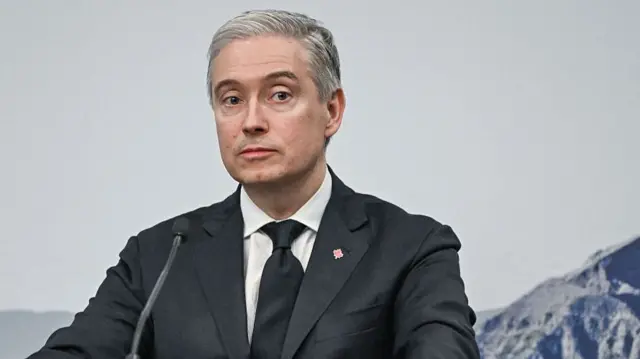
    Francois-Philippe ChampagneImage source, Getty Images

    Speaking to reporters earlier today, Canada's Finance Minister François-Philippe Champagne says his country is focused on supporting businesses through the latest round of US tariffs.

    He argues that Canada is operating from a position of strength, with the "fiscal capacity" and a very good credit rating that will help it to keep impacted businesses afloat and minimise job losses.

    Champagne adds that Canadians are realising "America has changed" and that "enough is enough".

    “When you have a close economic partner wanting to use integration as leverage in negotiations, as opposed to a basis for a win-win situation, I think it sends a message and it makes people reflect," he says.

    Champagne says that the rest of the world is taking note, and eyeing Canada as a reliable trade partner.

  7. 'Small businesses are going to get smashed by this'published at 20:14 BST

    Ana Faguy
    US reporter

    Matteo Sgaramella sits on a concrete slab with the skyline of Toronto in the backgroundImage source, Matteo Sgaramella

    Like many retailers, Toronto-based menswear brand Outclass collects orders from clothing designers months before they are due to arrive in stores.

    Products that US stores ordered in January will arrive in September but now with a new tariff.

    "If I contact them now and tell them, hey, you know, you may get an extra 50% bill from UPS on top of what you need to pay me for this shipment, they're all going to say, 'no way, don't ship it,'" Matteo Sgaramella, the company's founder, tells the BBC.

    He still has to figure out where that additional cost will go.

    "There's going to be a lot of people that go out of business because of this," Sgaramella says, but notes that only 20% of his wholesale sales and 20% of his e-commerce come from the US.

    "Big business can, you know, always find a way... but small businesses are going to get smashed by this."

  8. Trade dispute 'insane', says US couple in Canadapublished at 19:57 BST

    Eloise Alanna
    BBC News

    Taking shelter from the rain beneath the entrance to Montreal's Bonsecours Market, Kim and Harry Murphy - a married couple visiting from Delaware - say they were dismayed by the tariff tensions between Canada and the US.

    "We hate what's happening in our country," says Kim, who described the dispute as "insane". Harry adds that the couple had found themselves apologising to Canadians during their trip.

    Despite the political tensions, both say they had been met with warmth and kindness throughout their visit.

    While hopeful that relations between the two countries can eventually recover, Kim says rebuilding trust, particularly in Canada, could take time.

    Harry says he believed ties would return to normal in the future, adding that he remained optimistic about the long-standing friendship between the neighbouring nations.

    A man and a woman wearing rain gear smile at the camera, he has his arm around her
  9. Electricity and critical minerals could be key in trade war, says Fordpublished at 19:45 BST

    Two potential battlegrounds in Canada's fight against US tariffs are critical minerals and electricity, Ford continues.

    "We could put massive, massive pain on the US," he says. "President Trump underestimates us."

    Ford points out that Canada has rich reserves of certain critical minerals that can be used as leverage in trade dispute with its southern neighbour.

    He says he and Canadian Prime Minister Carney also spoke about a 25% surtax on electricity from Ontario, and Carney agreed it is on the table.

  10. Ford stands by his choice words for Trumppublished at 19:38 BST

    Speaking on a radio programme earlier today, Ford said US President Donald Trump could "kiss my ass".

    He was just asked by a reporter if Prime Minister Mark Carney told him to tone down his language. "No," the premier says, doubling down on his earlier comments.

    "I have a lot of real estate on my ass, so he has a lot of room to kiss my ass. I'm a big dude."

    Media caption,

    Watch: Doug Ford's blunt warning to Trump over Canada tariffs

  11. Ford comments are bluster, Trump writes on Truth Socialpublished at 19:34 BST

    US President Donald Trump has responded to comments made by Canadian premier Doug Ford, who is currently speaking and who said Trump was "like a bully at school" as trade talks collapsed over the weekend.

    Writing on his Truth Social platform, Trump characterises Ford's scathing remarks as "lots of 'bluster'" and calls Ontario's premier as "the less charismatic, intelligent, and overall unimpressive brother" of former Toronto mayor Rob Ford, who died in 2016.

    "Trump America has been carrying Canada for decades, but no longer! The USA. will always be far bigger, richer, and stronger than Canada," Trump says, adding that, without the US, Canada "couldn’t survive".

    "It’s where they get all of their money and, because of their current bad leadership, primarily Governor Carney, and his Flunky, Ford, they will not be allowed to keep taking advantage of the United States — Their key to survival," he says.

    "Someone should get these clowns to 'fall in line' or, the consequences for Canada will be far WORSE!"

  12. Canada needs to target Republican US states in fight against tariffs, Ontario premier sayspublished at 19:15 BST

    "Everything needs to be on the table" in Canada's fight against US tariffs, Ontario premier Doug Ford says, including specifically targeting Republican US states and "making sure America's economy feels the pain".

    "We need to use Canada's many points of leverage to create maximum impact," he says, adding: "Americans are already feeling the pain."

  13. Ontario premier says Canada will not 'roll over' for US dealpublished at 19:03 BST

    Doug Ford, premier of the Canadian province Ontario, is now speaking to the public.

    Ford says Prime Minister Mark Carney has his "full support" in walking away from a "bad deal".

    He says the US proposal would have "hurt Canadian workers and undermined Canadian sovereignty".

    Canadian leaders need to "make clear to President Trump that Canada is not for sale", he adds.

    "We're not going to roll over," he says. "We're going to stand up for our country."

  14. Canada chose to reject 'good deal', says Bessentpublished at 18:49 BST

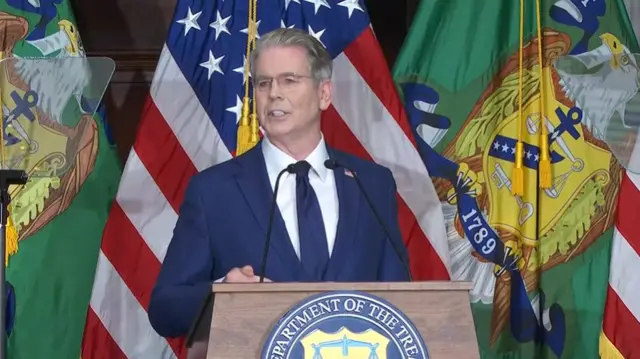
    Scott Bessent standing at a podium in front of American and other colorful flagsImage source, Reuters

    Like Canadian PM Carney, US Treasury Secretary Scott Bessent has also been speaking at a press conference, where he is asked if President Trump is still interested in making Canada the 51st US state.

    "I think he would like Canada to come to the table and negotiate in good faith. They were offered quite a good deal last week. They chose to reject it," Bessent answers, echoing recent comments from Trump administration officials blaming Canada for the failed trade talks.

    Bessent says Carney rose to power on an "anti-American, anti-Trump platform", and questions why he would reject the deal if he truly has the Canadian people's interests at heart.

  15. US felt French language laws were 'irritants' in talks, says Carneypublished at 18:41 BST

    The Canadian PM is also asked to respond to comments made earlier today by US trade representative Jamieson Greer on the role Quebec's language laws have played into the collapse of negotiations.

    The prime minister says the US made requests that he deemed "non-negotiable" about the requirement on US businesses to label their products in both English and French.

    Greer has dismissed this, telling CNBC on Monday morning that it is a "funny, fake story".

    Speaking to reporters just now, Carney says Quebec language laws have been raised as "irritants" by the US. But, he adds, to Canadians they are "fundamental rights".

    "This is not a funny fact for Canadians," Carney says to applause.

    He adds that in the last hour of negotiations, conversations around the French language, including its use by streaming companies like Netflix, were also brought up.

    The press conference at which he was speaking in Quebec has now ended.

  16. Carney says he'll return to the negotiating table - but only if the US does firstpublished at 18:36 BST

    Carney says Canada will return to the negotiating table with the US, but only under the right conditions.

    "When the Americans return to the negotiating table first with the right attitude toward our industries and a true partnership, of course we'll come to the negotiating table," he said.

    The US can't act like "Canada is a subsidiary of the United States", or that Canadian industry is going to be disadvantaged.

    "That's not something we're going to accept," Carney added.

  17. Trump's latest tariff threat is not surprising, says Carneypublished at 18:19 BST

    Prime Minister Mark Carney is now taking questions from reporters in Quebec.

    He is asked about Donald Trump's latest escalation of the trade war by threatening to increase US tariffs on cars and trucks originating from Canada to 50%.

    Carney says the threat is not a surprise, adding that it is revelatory of what he says are US intentions to destroy Canada's large industries, including its automobile industry.

    He also says that US workers will be hurt by Trump's threat to increase tariff on autos.

    "What is the message sent out to the workers in Michigan, Ohio, Kentucky, Alabama? These workers depend absolutely on Canada, their largest consumer," he says, adding that Canada buys more American cars than the EU and other countries.

    Carney says policy makers around the world should take note of Canada's actions and response to the US.

    He adds that there is a "mutually beneficial deal" that Canada and the US can come to, but it has to be one that respects Canada's sovereignty.

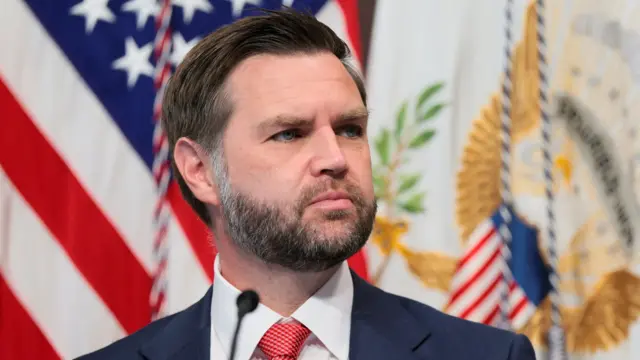
  18. Canada has one of the 'worst trade policies' in the world, says Vancepublished at 18:05 BST

    US Vice-President JD Vance says the Trump administration's objective is to get a "fair deal" for states that do business with Canada.

    Speaking a short time ago in the US state of Maine, he also accuses Canada of having one of the "worst trade policies", along with China.

    "China, you of course expect. They are our biggest economic competitor," Vance says. "I would not expect that from Canada."

    Vance adds that Canada has underinvested in its military and would be invaded by a foreign country if it were not for "the umbrella of protection provided by the US".

    On the collapse of trade talks, he says: "What happened at the very end is [Canada] came in with a bunch of unreasonable last-minute demands. I frankly thought that we had a deal."

    He adds: "We need to send a message loud and clear to the prime minister to stop taking advantage of the US."

    A close-up shot of JD Vance, who looks to the rightImage source, Reuters
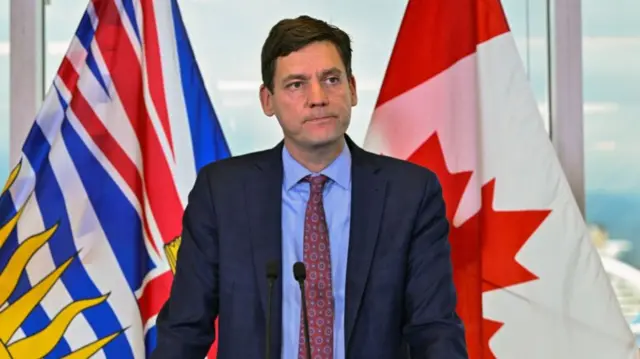
  19. Canadian premier says country must push back against Trumppublished at 17:59 BST

    David Eby, who leads Canada's third most populous province, British Columbia, tells CNN's Sara Sidner that Canada has to retaliate against US tariffs, even though it will hurt Americans.

    "I feel sorry for Americans right now that they have a president that is so disinterested in their cost of living concerns and is making them a global pariah. But we have to hit back," he says.

    Eby adds that he hopes other countries follow Canada's example and push back on Trump's trade policies.

    "At some point the rest of the world will say enough."

    David Eby stands behind a lecturn in a suitImage source, Reuters
  20. Carney's speech has endedpublished at 17:55 BST

    Mark Carney has finished speaking and we have since been hearing from other officials.

    We will bring you any important lines from their remarks, as well as answers to questions that the PM may be asked.