Summary

  1. Araghchi: Moscow and Tehran's relationship is a strategic partnership at the highest levelpublished at 15:06 BST

    Daria Mosolova
    BBC Monitoring

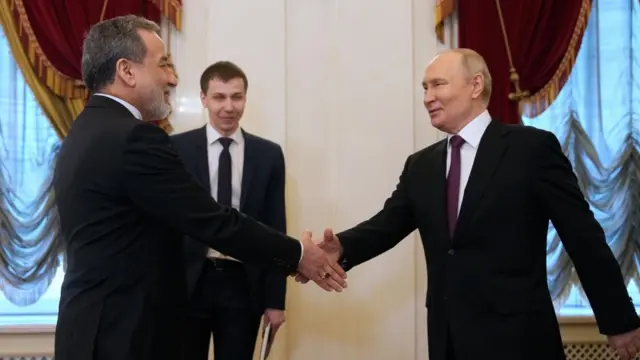
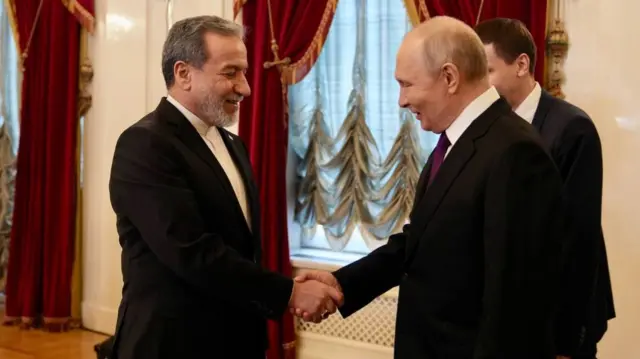
    Araghchi and Putin, both wearing dark suits, walking towards each other and shaking hands.Image source, EPA/Shutterstock

    Iran's foreign minister says relations between Moscow and Tehran represent a "strategic partnership" that will "continue to strengthen", according to remarks broadcast on Russian state television.

    The Iranian delegation meeting Putin in Russia also includes Deputy Foreign Minister Kazem Gharibabadi and Iran’s ambassador to Moscow, Kazem Jalali.

    Kremlin spokesman Dmitry Peskov says Russia was ready to offer "goodwill or mediation services acceptable to both sides" in future negotiations on a settlement with Iran.

    "We will be ready to do everything to ensure that peace, a guaranteed peace, ultimately prevails and that there is no return to hostilities", he adds.

  2. Russia will do everything to bring peace to the Middle East, Putin tells Araghchipublished at 14:41 BST

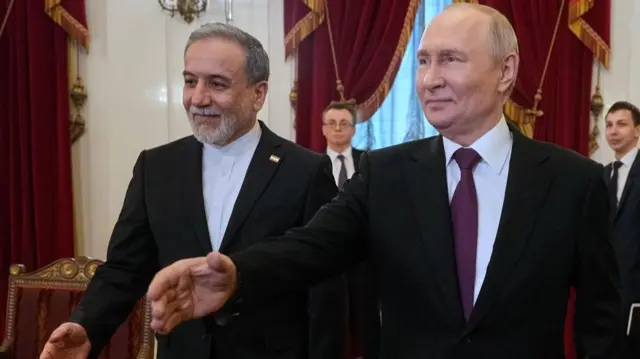
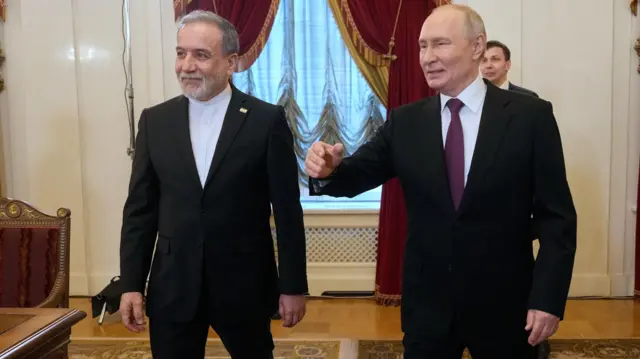
    Abbas Araghchi stands in a dark suit next to Vladimir PutinImage source, EPA/Shutterstock

    We're starting to hear reports from Russia, where a meeting between Iranian Foreign Minister Abbas Araghchi and Putin is currently under way.

    According to state-run news agency Tass, the Russian president has told Araghchi that the Iranian people are courageously fighting for their sovereignty. Tass also quotes Putin as saying that he hopes Iran will find peace after overcoming this difficult period.

    The news agency also says Putin told Araghchi that Russia "will do everything to bring peace to the Middle East as soon as possible".

  3. Iran's foreign minister meets Putinpublished at 14:28 BST
    Breaking

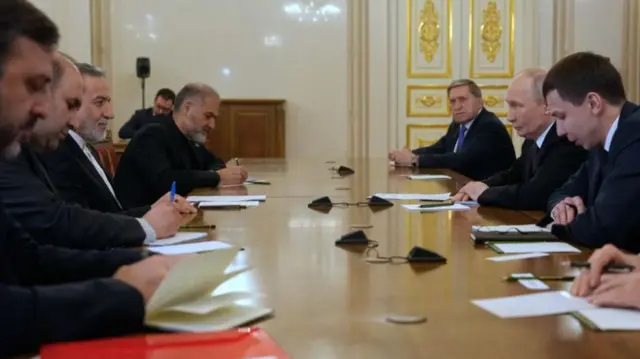
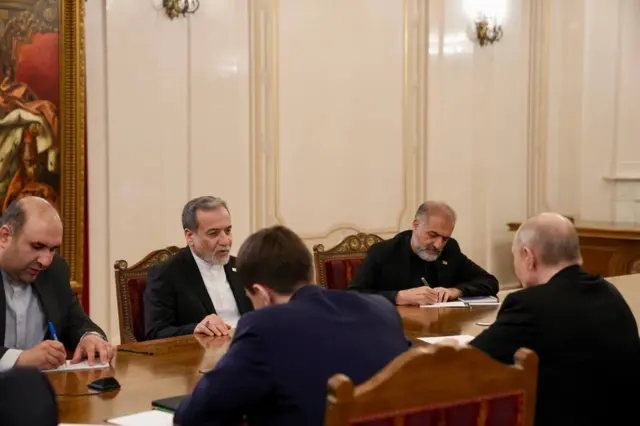
    Araghchi and Putin sat around a table with three other men.Image source, Abbas Araghchi/Telegram

    Iranian Foreign Minister Abbas Araghchi is meeting Russian President Putin in Russia.

    In images shared on his Telegram channel, Iran's foreign minister can be seen shaking hands and speaking with Putin around a table alongside delegations from the two countries.

    Putin is joined by Russia's Foreign Minister Sergei Lavrov, Kremlin aide Yuri Ushakov and Igor Kostyukov, head of Russia's GRU military intelligence agency.

    Araghchi and Putin shaking hands.Image source, Abbas Araghchi/Telegram
  4. Analysis

    Diplomacy to bring about end to Iran war has not yet run its coursepublished at 14:20 BST

    Paul Adams
    Diplomatic correspondent

    With direct talks to end the Iran war on hold, Iran’s foreign minister has been on the move for several days, visiting Pakistan twice, and Oman, before arriving in Russia.

    Speaking in St Petersburg, Abbas Araghchi blamed Washington for the failure to reach a deal.

    For his part, Donald Trump says he’s still waiting for Iran to reply to his most recent proposals.

    The news website Axios says Iran may be willing to reopen the Strait of Hormuz in return for postponing talks on its nuclear programme. There’s been no official confirmation of this from any of the parties or mediators involved.

    With a ceasefire still in place and the White House saying it’s not in a hurry, it seems clear that diplomacy has not yet run its course.

    Commenting on the current impasse, Germany’s Chancellor, Friedrich Merz, said he couldn’t see what exit strategy the US was choosing. The Iranians, he said, were stronger than previously thought and negotiating very skilfully.

  5. Starmer set to hold emergency meeting on Iran warpublished at 13:49 BST

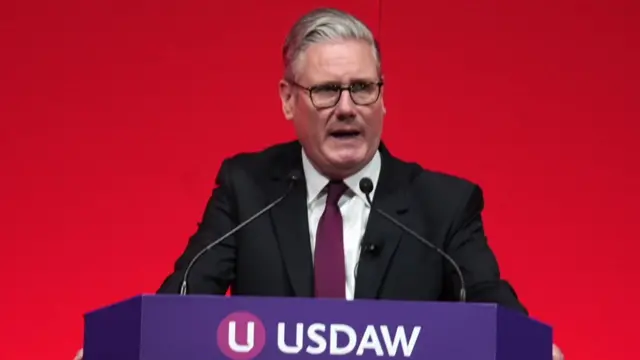
    Keir Starmer speaking at the USDAW trade union conference on 27 April 2026Image source, UK Pool

    Away from the Middle East, we can bring you the latest comments from UK Prime Minister Keir Starmer on the conflict.

    Starmer will chair a meeting of the government's emergency committee, Cobra. This involves ministers and officials and works to co-ordinate the government's response to an emerging situation.

    Earlier this morning, Keir Starmer reiterated the UK's position on the conflict in the Middle East in an address to the USDAW trade union conference in Lancashire.

    "I will never let this country be dragged into a war that is not in our interests," he said.

  6. Lebanese president takes apparent aim at Hezbollah over ceasefirepublished at 13:16 BST

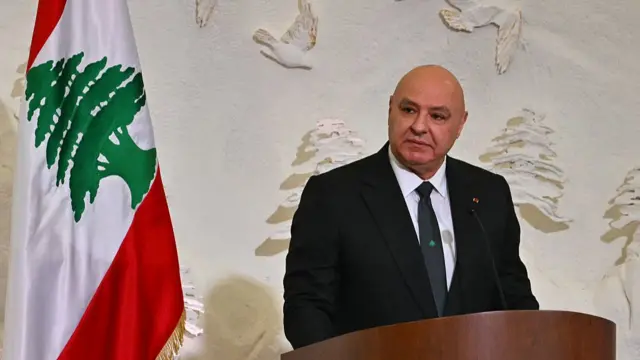
    Lebanese president Joseph Aoun pictured in Beirut on 30 November 2025Image source, Getty Images

    Lebanese President Joseph Aoun says he will not accept reaching a "humiliating agreement" in his efforts to bring about an end to the war with Israel.

    In a statement, he says he has informed the US from the very beginning of the negotiations that "a ceasefire is a necessary first step".

    He adds that Lebanon's south continues to "pay the price of others' war on our land".

    The ceasefire agreed between Israel and Lebanon has been extended by three weeks, though strikes between Israel and Iran-backed group Hezbollah have continued in recent days. Hezbollah was not a part of the negotiations to bring about peace in the region.

    Aoun says if the war was happening "for the sake of Lebanon" then he would support it, But, he says, "when the goal of the war is to achieve the interests of others, I completely reject the war".

    In what appears to be an attack on the militia group Hezbollah, who says it has the right to retaliate to Israeli threats, Aoun says: "What we are doing is not treason; rather, treason is committed by those who take their country to war to achieve foreign interests."

    • For context: Although many in Lebanon are affected by the ongoing conflict with Israel, the Lebanese government has limited influence on its resolution. Hezbollah, an Iran-backed armed group, is waging the war from Lebanese territory with many of its support base living in the south of the country, which borders northern Israel
  7. In Lebanon, the ceasefire has reduced ferocity of war but not stopped itpublished at 12:36 BST

    Hugo Bachega
    Middle East correspondent, in Beirut

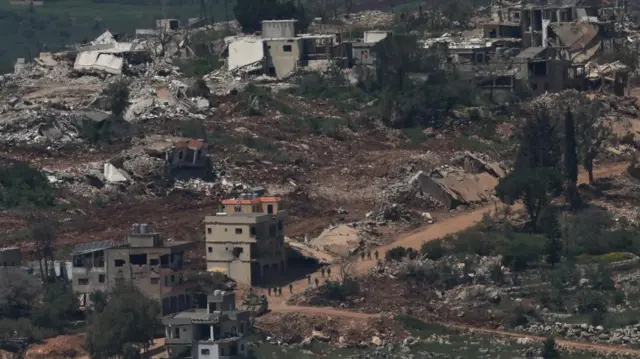
    Aerial image of buildings flattened and people walking past in Lebanon.Image source, Reuters
    Image caption,

    Image of destroyed buildings in southern Lebanon, taken from the Israel-Lebanon border on 27 April

    In parts of southern Lebanon, it is a ceasefire by name only. Israeli air strikes have continued.

    On Sunday alone 14 people were killed. This marks the deadliest day since the truce came into effect earlier this month, according to Lebanese officials.

    Residents were again forced to flee after the Israeli military issued an evacuation warning for seven towns outside the area it currently occupies.

    Israel says it is acting in response to what it describes as violations of the deal by Hezbollah, the militia and political party that is armed and financed by Iran.

    The text of the deal does give Israel the "right to take all necessary measures in self-defence, at any time, against planned, imminent, or ongoing attacks", a phrasing that is broad enough to justify any action it takes.

    The deal, however, does not stipulate a withdrawal of Israeli troops that occupy around 5% of Lebanon’s territory. Israeli officials say they aim to create what they describe as a security buffer zone along the border, to push Hezbollah away and guarantee the security of Israel’s northern communities.

    In those areas, the Israeli military has continued to carry out activities despite the ceasefire, including the large-scale destruction of houses and infrastructure, in what Human Rights Watch had previously warned could amount to war crimes. Entire communities have been reduced to rubble.

    Hezbollah is now responding. The ceasefire deal was agreed between Israel and the Lebanese state, which is not a party to the conflict.

    For the government, the priority was to stop the bloodshed and the destruction caused by Israel’s air strikes.

    Hezbollah had indicated it would abide by the deal and says it has the right to retaliate for what it says are violations by Israel. The Israeli military said on Sunday a soldier had been killed inside Lebanon in a drone attack by Hezbollah.

  8. Asian markets recovering, European exchange in holding pattern - what's the latest?published at 12:16 BST

    Emer Moreau
    Business reporter

    Two people walking past a sign that says 60537.36 and +821.18 in Japan.Image source, Getty Images
    Image caption,

    The closing figure of the Nikkei 225 Stock Average displayed outside a securities firm in Tokyo, Japan

    Asian markets are showing signs of recovery after initially being hit hard by the conflict, as their economies are heavily reliant on energy supplies from the Gulf.

    The Japanese Nikkei closed at a record high and South Korea's Kospi rose more than 2.1% on Monday.

    European stock markets are in somewhat of a holding pattern today, ahead of a busy week for investors with several large companies publishing results and several central bank meetings.

    Both the European Central Bank and the Bank of England are making decisions on interest rates this week, which traders will watch closely.

    The UK's FTSE 100 is largely flat, up just under 0.17% from opening. The pan-European Stoxx up 0.4%. France's Cac is currently up 0.6%, while Germany's Dax was up just under 0.9%.

  9. The talks so far - a timelinepublished at 12:09 BST

    Malu Cursino
    Live reporter

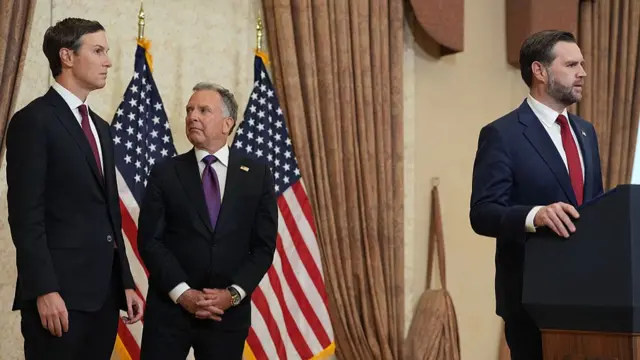
    US Vice President JD Vance (R) speaks during a news conference after meeting with representatives from Pakistan and Iran, as US President Donald Trump's son-in-law Jared Kushner (L) and US Special Envoy to the Middle East Steve Witkoff (C) watch, in Islamabad on April 12, 2026Image source, Getty Images
    Image caption,

    US Vice President JD Vance joined Kushner and Witkoff for talks in Islamabad on 11 April

    As we've just reported, Iranian Foreign Minister Abbas Araghchi is in St Petersburg on the last leg of his "timely tour of Islamabad, Muscat, and Moscow".

    These latest talks with Russia follow a breakdown in diplomatic discussions between Iran and the US after Trump cancelled his envoys' trip to Pakistan over the weekend.

    Here's a look back at the negotiations to bring about an end to the war:

    11 April: American and Iranian officials, including US Vice-President JD Vance and Araghchi, meet in Pakistan for talks that last more than 21 hours. They end without an agreement despite both sides reporting progress.

    21 April: After speculation over whether talks would continueTrump agrees to extend the ceasefire with Iran for an unspecified time, but timing of further negotiations remains unclear.

    24 April: The White House says US special envoy Steve Witkoff and Donald Trump's son-in-law Jared Kushner will be heading to Pakistan for Iran talks the following day. The Iranian government confirms Araghchi was travelling to Islamabad as part of a wider regional trip.

    25 April:Soon after Tehran's delegation leave the Pakistani capital US President Donald Trump announces his team won't attend talks, saying that flying to Islamabad would waste "too much time". Iran's top diplomat describes his Pakistan visit as "very fruitful," saying he was "yet to see if the US is truly serious about diplomacy".

    Today: Iranian foreign minister blames Washington's demands for a breakdown in talks.

  10. Importance of Iran conversation is hard to overestimate, Kremlin sayspublished at 11:45 BST

    Daria Mosolova
    BBC Monitoring

    Russian President Vladimir Putin will meet Iranian Foreign Minister Abbas Araghchi in St Petersburg on Monday, the Kremlin says.

    Kremlin spokesman Dmitry Peskov is quoted by state news agency Tass as saying the "importance of this conversation is hard to overestimate in terms of how the situation around Iran and in the Middle East is developing".

    Araghchi arrived in Russia earlier on Monday seeking support from Moscow as diplomatic efforts to end the war between the US and Iran stalled.

    Hopes of restarting talks receded on Saturday when US President Donald Trump cancelled a planned visit to Islamabad, Pakistan, by his envoys Steve Witkoff and Jared Kushner.

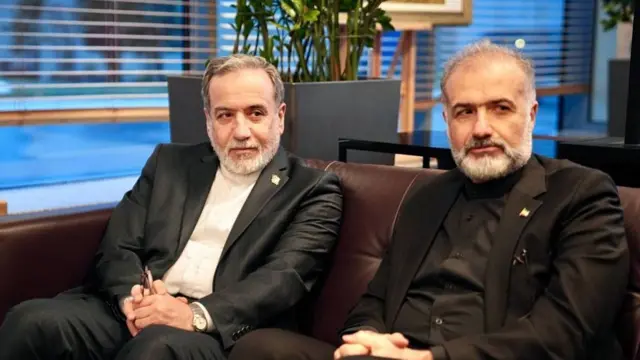
    Iranian foreign minister Abbas Araghchi in a suit sat on sofa next to a man in a black suit.Image source, Getty Images
    Image caption,

    Iranian Foreign Minister Abbas Araghchi arrived in St Petersburg on Monday ahead of talks with President Putin

  11. Israeli military says three Hezbollah members killed in strikespublished at 11:12 BST

    The Israeli military says it killed three Hezbollah members during operations in southern Lebanon on Sunday.

    In an update shared on Telegram, the Israel Defense Forces (IDF) says three Hezbollah fighters were identified approaching Israeli soldiers "south of the forward defence line".

    Israel has what it calls a “buffer zone” extending around 10 kilometres into Lebanese territory, needed, it says, to reduce the threat from Hezbollah.

    It means around 5% of Lebanon is now under Israeli military occupation.

    "Following the identification, the Israeli Air Force struck and eliminated the terrorists in order to remove the threat," the IDF says, adding that Hezbollah infrastructure in Bint Jbeil was also targeted in strikes.

    A ceasefire is currently in place between Lebanon and Israel. Hezbollah is not a signatory to the agreement, but the deal is intended to end fighting between Israel and the group.

    Despite this, Israeli Prime Minister Benjamin Netanyahu has ordered his troops to attack Hezbollah targets in Lebanon after suggesting the group's actions are "disintegrating the ceasefire".

    The Israeli leader says the agreement allows Israel "freedom of action, not only to respond to attacks, which is obvious, but to thwart immediate threats and also to neutralise emerging threats".

    Lebanon's health ministry said that 14 people had been killed in Israeli strikes on Sunday.

    Israeli soldiers operate on the Lebanese side of the border, as seen from the Upper Galilee in northern Israel, 26 April 2026Image source, EPA
  12. Lebanese health system under 'a lot of strain', doctor tells BBCpublished at 10:32 BST

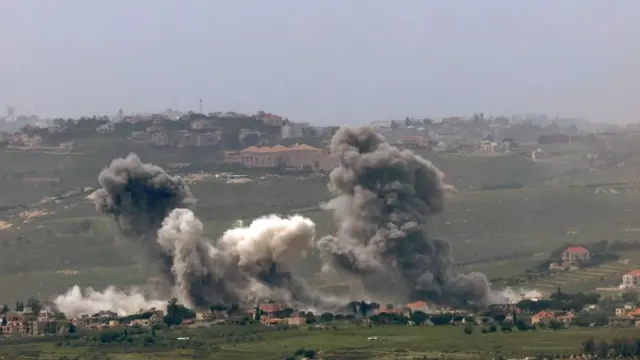
    Smoke rises from targeted areas following an Israel airstrike in the town of Arnoun, in Lebanon's southern Nabatieh province on April 26, 2026.Image source, Abbas Fakih / AFP via Getty Images
    Image caption,

    The Israeli military defended its strikes on Sunday, saying it was targeting Hezbollah operatives and sites in southern Lebanon

    Doctor and former Lebanese public health minister Dr Firass Abiad tells the BBC ongoing strikes are putting "a lot of strain" on the country's health system.

    Hospitals in Lebanon are having to manage "daily, high numbers of casualties," paired with a large number of internally displaced people, he says.

    Despite these pressures, doctors and nurses are "amazingly" still showing up to work, even if a large number of hospital staff are displaced themselves, Abiad tells BBC World Service's Newsday programme on Monday.

    He says Lebanon imports almost all of its key medical supplies, but the ministry has said it has "medications that can last up to two months".

    On Sunday, Lebanon's Ministry of Health said Israeli strikes had killed 14 people, including two children.

    The Israeli military said it targeted Hezbollah operatives and sites and it had issued an evacuation order earlier on Sunday for several villages in southern Lebanon.

  13. Oman and Iran discussed 'shared responsibility' in Strait of Hormuz - Oman's foreign ministerpublished at 09:56 BST

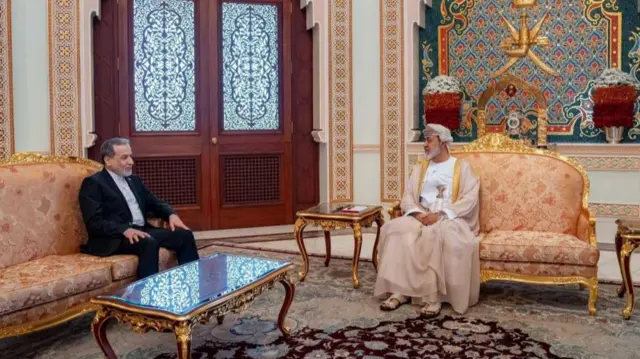
    A handout photo made available by the Iranian Foreign Ministry shows Sultan of Oman Hitham bin Tariq (R) speaking with Iranian Foreign Minister Abbas Araghchi (L) during their meeting in Muscat, Oman, 26 April 2026.Image source, IRANIAN FOREIGN MINISTRY/HANDOUT/EPA/Shutterstock
    Image caption,

    Iran's Foreign Minister Abbas Araghchi also met Oman's Sultan Haitham bin Tariq in Muscat, Oman, on Sunday

    Before heading to Russia, Iran's foreign minister visited Oman on Sunday when he held talks with his counterpart and the country's leader.

    In a post on X, Omani Foreign Minister Badr Albusaidi says he and Abbas Araghchi held a "good discussion" on the Strait of Hormuz, where they spoke about their "shared responsibility to the international community and the urgent humanitarian need to free the seafarers held for far too long".

    Iran's top diplomat has thanked his "gracious hosts in Oman".

    In a social media post, Araghchi also mentions the key shipping route, saying that their talks "included ways to ensure safe transit" through the strait.

  14. Peace discussions called off as Trump says Iran can 'call' if they want to talkpublished at 09:25 BST

    Jared Kushner and Steve Witkoff stand in suits next to each otherImage source, Reuters
    Image caption,

    Jared Kushner (L) and Steve Witkoff (R) had planned to travel to Islamabad for peace talks before their trip was cancelled

    Talks between the US and Iran failed to materialise over the weekend, after President Donald Trump cancelled a planned trip by US officials to Pakistan.

    Shortly after Tehran's delegation had left Islamabad, Trump announced on Saturday that special envoy Steve Witkoff and Jared Kushner would be wasting "too much time" by taking a flight to Pakistan's capital.

    Iranian Foreign Minister Abbas Araghchi held talks with mediator Pakistan over the weekend, saying afterwards he had shared Iran's position on ending the war but was yet to see whether the US was "truly serious about diplomacy".

    "If they want to talk, all they have to do is call," Trump said on Saturday. He suggested the US has "all the cards" while in Iran "there is tremendous infighting and confusion within their 'leadership'".

  15. Araghchi blames US's demands for talks failure as he lands in Russiapublished at 08:55 BST

    Abbas Aragchi shakes hands with official next to a planeImage source, Iranian Foreign Ministry/Getty Images
    Image caption,

    Images appeared to show Araghchi landing in Russia for talks earlier today

    Iranian Foreign Minister Abbas Araghchi says the US’s excessive demands have caused peace negotiations to fail in Islamabad, in comments to local reporters after arriving in Russia.

    Touching down in St Petersburg, Araghchi says he will consult with Russian allies about the war in the Middle East, in an interview in Persian and shared on his Telegram channel.

    As we’ve been reporting, Araghchi's arrival in Russia comes after talks with mediators in Islamabad. He told reporters that the discussions addressed the conditions under which the negotiations can continue.

    The foreign minister also mentioned the ongoing Iranian closure of the Strait of Hormuz. He said safe passage through the crucial waterway remains a global issue and calls for neighbours including Oman to work closely on their mutual interest in the strait.

    Araghchi suggested that there is a lot of common ground between Iran and Oman, and adds that agreement has been reached for further talks on the strait between the two.

  16. Oil prices continue to rise as Strait of Hormuz remains restrictedpublished at 08:34 BST

    Emer Moreau
    Business reporter

    Oil prices have continued to rise as peace talks stalled and the Strait of Hormuz remains effectively closed.

    Brent crude, the global benchmark, was trading at $107.50 (£79.45) a barrel first thing on Monday.

    Around a fifth of the world's crude oil and liquefied natural gas (LNG) usually passes through the Strait of Hormuz.

  17. Seafarers stuck in strait with 'no certainty as to when they'll return home', trade body sayspublished at 08:07 BST

    Around 2,400 seafarers remain stuck on over 105 tankers in the closed Strait of Hormuz, according to a trade association for tanker firms.

    Iran has said the key shipping route, through which about 20% of the world's oil and liquefied natural gas (LNG) usually passes, cannot be reopened due to "blatant violations of the ceasefire" by the US and Israel.

    Speaking to BBC Radio 4's Today programme, managing director of tanker trade association Intertanko Tim Wilkins describes how this closure has resulted in seafarers becoming stranded off the coast of Iran.

    Wilkins explains there is a"huge amount of anxiety, stress, and fatigue on board” as crews must manage basic supplies including food and water and practical tasks like garbage removal.

    "Many are stuck on board with no certainty as to when they'll be able to return home," he adds.

    Despite a ceasefire agreement between Iran and the US, clashes have continued over the waterways in the region.

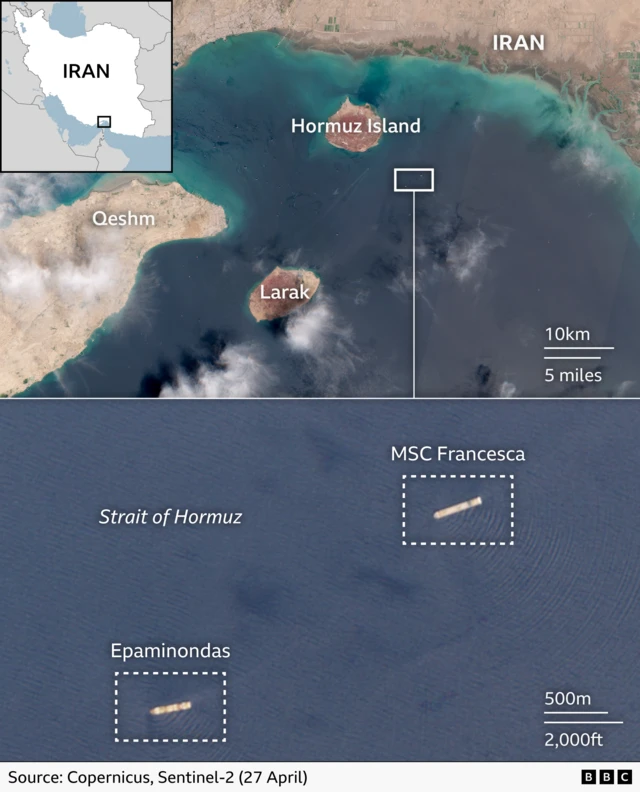
    Iran last week announced that it had seized two cargo ships in the strait for "inspection", while other vessels have reported coming under attack as they attempted to navigate the strait.

    Meanwhile, the US has intercepted multiple ships after imposing a blockade on maritime traffic entering and leaving Iranian ports on 13 April.

    Map showing where the Strait of Hormuz is in the Gulf of Oman, a key route for global oil transport. The strait lies between Iran and the peninsula of the United Arab Emirates and Oman. The map also shows countries in the wider Middle East region including Saudi Arabia, Iraq, Jordan and Israel
  18. Israeli strikes kill 14 in Lebanon amid ongoing ceasefire, health ministry sayspublished at 07:56 BST

    A wide shot of smoke rising from across the Israel border into southern LebanonImage source, EPA/Shutterstock
    Image caption,

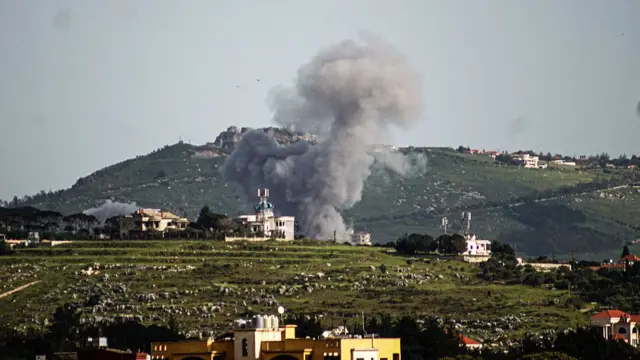
    Smoke could be seen rising in southern Israel on Sunday amid Israeli military operations in the region

    Strikes between Hezbollah and Israel in Lebanon have continued over the weekend, amid the precarious ceasefire.

    The ceasefire deal took effect on 16 April, and has since been extended by three weeks.

    Lebanon's Ministry of Health says Israeli strikes on the country on Sunday killed 14 people, including two children and two women, and injured 37.

    Evacuation warnings issued in southern Lebanon by the Israeli military were followed by aerial strikes on sites the Israel Defense Forces (IDF) claimed were used "to advance attacks against IDF soldiers".

    In a separate update, the Israeli military says a 19-year-old IDF soldier had been killed and six others injured by a Hezbollah drone attack in Lebanon.

  19. Iranian foreign minister arrives in Russia as peace talks show little progresspublished at 07:26 BST

    Adam Goldsmith
    Live reporter

    Aragchi wears a dark suit and shakes hands with officialsImage source, TELEGRAM/REUTERS
    Image caption,

    Images appeared to show Araghchi shaking hands with officials as he arrived in St Petersburg

    We’re resuming our live coverage as Iranian Foreign Minister Abbas Araghchi has arrived in Russia, following talks with other nations over the weekend.

    He is set to meet Russian President Vladimir Putin, the BBC's US partner CBS News reports.

    Araghchi's visit comes after a trip to Oman, where he says talks focused on "ways to ensure safe transit that is to benefit of all dear neighbours and the world" in the Strait of Hormuz.

    Over the weekend, the foreign minister also said he had a “very fruitful” visit to Islamabad, where he “shared Iran's position concerning workable framework to permanently end the war on Iran”.

    “Have yet to see if the US is truly serious about diplomacy,” he wrote on social media on Saturday.

    Araghchi’s comments were followed by news that Donald Trump had cancelled plans for US envoys Steve Witkoff and Jared Kushner to visit Islamabad for peace discussions with Iran.

    Both sides remain locked in a standoff over the Strait of Hormuz despite Trump's extension of a ceasefire that had been due to expire on 22 April to allow talks to continue.

    Meanwhile in Lebanon, Israel and Hezbollah continued to trade strikes amid a precarious ceasefire.

    Lebanon’s health ministry says Israeli strikes on the country on Sunday killed 14 people, including two children and two women, and injured 37.

    The Israeli military says a 19-year-old soldier had been killed and six others injured by a Hezbollah drone attack in Lebanon.