Summary

  1. 'Important that we remain apolitical', military chief tells staffpublished at 19:09 BST
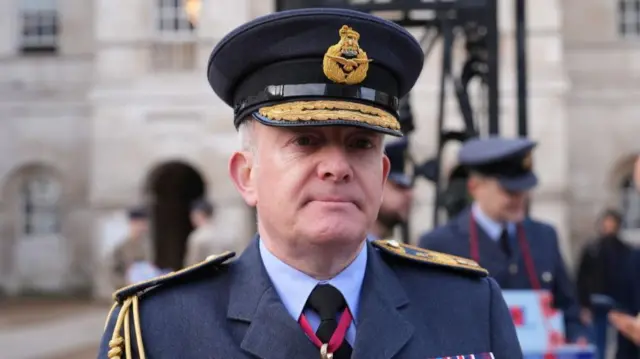
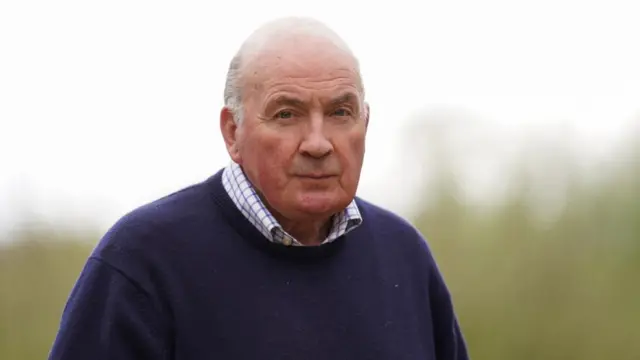
    Chief of the Defence Staff Sir Rich Knighton wearing military regaliaImage source, PA Media

    In a message to staff at the Ministry of Defence, Chief of the Defence Staff Sir Richard Knighton says: "There will be much written and said about the armed forces over the next few days.

    "It is important that we remain apolitical and are not drawn into speculation about decisions that are for ministers to make.

    "In uncertain times, it is more important than ever that we stay focused on our duty to defend the UK and its interests across the world without fear or favour."

    "The work our armed forces do matters, and it matters more than it has done for many years."

    At the bottom of the message, Knighton adds that he is looking forward to welcoming the new defence secretary.

    "For now, thank you for everything that you do for the nation. You should be rightly proud of the role you play in keeping us safe."

  2. Former Army head predicts 'continuing decline' if spending not increasedpublished at 19:02 BST

    General Lord Dannatt headshotImage source, PA Media

    The former head of the British Army says he was "shocked" about the timing of John Healey's resignation but "not surprised as to the substance".

    General Lord Richard Dannatt tells BBC News that if the chancellor does not have a "change of heart" and allocate more funding to defence spending, we will see a "continuing decline" in the UK's armed forces and and military capability.

    He says that would lead to a "withering" of the deterrent effect, which he says the UK needs "to hold back someone like [Russian President] Vladimir Putin's otherwise otherwise aggressive and expansionist intentions".

    Dannatt adds: "We've got to show that we take seriously the defence of this country... we've got to put serious amounts of money extra into this budget."

    He says not allocating more funding "absolutely increases the risk" to army personnel deployed, echoing Healey's assertion in his resignation letter that without an investment plan that "meets the moment", he would be forced to make decisions that "increase the risk to personnel on operations".

  3. Starmer says he is 'determined to rebuild our country'published at 18:43 BST

    More now from the prime minister's letter to Healey.

    Starmer says the world today "requires a serious response to build our economic resilience and our national defences".

    The prime minister says the pair "have achieved a great deal working together" and he is "proud of our record on funding".

    The defence investment plan "will allow our armed forces to transform and modernise and back them with the tools they need to change the way we fight — and to deter our enemies," the letter adds.

    Starmer says the increases in spending outlined in the defence investment plan, which is yet to be released, "will be sustainable and fair" and "will mean significant reallocations of funding from across government departments".

    He finishes the letter by saying: "Taking these decisions is never easy. I am determined to rebuild our country after years of being buffeted by crises."

  4. 'Sorry that you will not be part of work going forward' - Starmer to Healeypublished at 18:32 BST

    Jack Fenwick
    Political correspondent

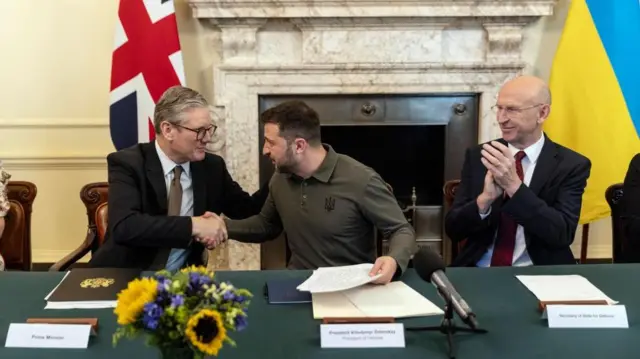
    Keir Starmer and John Healey sit in front of a fireplace with Ukrainian President Volodymyr ZelenskyImage source, The Times/PA Wire
    Image caption,

    Keir Starmer and John Healey host Ukrainian President Volodymyr Zelensky at Downing Street in July 2024

    As we've just been reporting, Keir Starmer has insisted the government’s defence investment plan “will provide the resources our military needs to keep us safe”.

    In a letter to John Healey, the prime minister said he was increasing defence spending “in a sustainable way” and said “irresponsible borrowing” would put the country’s finances “at risk”.

    The prime minister thanked Healey for his work and said he was “sorry that you will not be part of that work going forward”.

    In a direct response to Healey’s accusation that the money in the defence investment plan would not be sufficient to defend the UK against threats, Starmer said: “I will always do what is needed to keep our country safe.”

    He said Healey was “right that we have to go further” on defence spending but said the defence investment plan “does just that delivering an unprecedented increase in defence spending in a sustainable way”.

    He added: “Strong public finances are part of what keeps us safe - irresponsible borrowing only puts that at risk.”

  5. Starmer defends funding plan in response to Healey resignationpublished at 18:26 BST
    Breaking

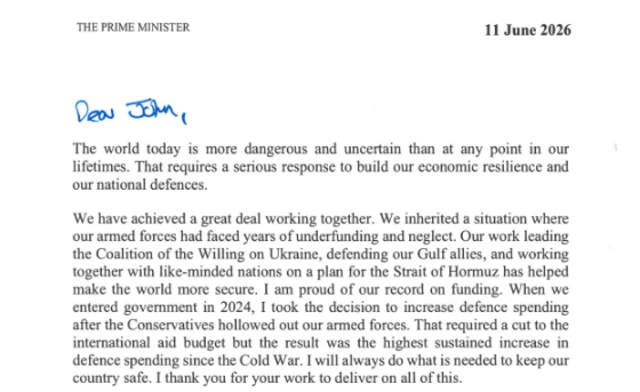
    A part of the letter sent from Starmer to John Healey, with handwritten words "Dear John" at the top in blue ink.Image source, UK Government

    Prime Minister Keir Starmer insists a key defence funding plan “will provide the resources our military needs to keep us safe”, in a letter to Healey responding to his resignation.

    In the letter, the prime minister says he is sorry to see him resign as defence secretary.

    We'll bring you more on this shortly.

  6. PM 'has my full support' after Healey resignation, says NI secretarypublished at 18:22 BST

    Jayne McCormack
    BBC News NI political correspondent

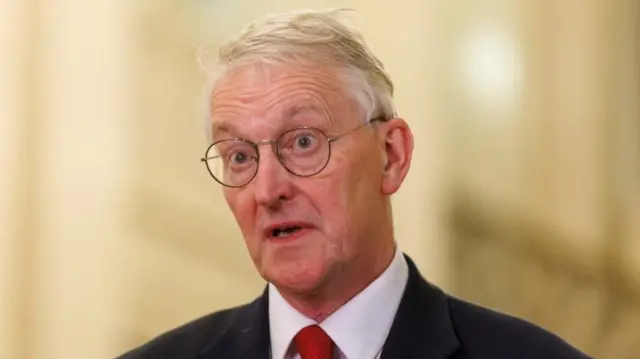
    Hilary Benn in a black suit and red tie with round glassesImage source, PA Media

    Northern Ireland Secretary Hilary Benn has defended the government's defence spending plans after John Healey's resignation.

    Speaking in Belfast, Benn says the defence investment plan "involves difficult decisions", but adds that he "would draw attention to the fact we have seen the biggest increase already in defence spending as a result of the decisions the PM has taken since the Cold War".

    "We are living in dangerous and difficult times... the PM has my full support. We need stability and he's going to carry on doing his job in the way that he has," he says.

    Benn says he has known Healey a "very long time" and wants to thank him for the role he played during his time in office, and wishes him all the very best.

  7. Fully-funded defence spending plan could boost growth, says industry bodypublished at 18:18 BST

    Jemma Crew
    Business reporter

    A fully-funded defence investment plan must be published urgently, according to the Confederation of British Industry (CBI).

    Chief executive Rain Newton-Smith, who co-chaired the government’s defence and growth taskforce last year, says this would lead to investment and jobs.

    Newton-Smith says it has the potential to be a "catalyst for growth... strengthening both our security and the long-term productivity of the UK economy".

    “We live in a precarious world where our peace and security is being tested.

    "Enhancing our national security is vital, and a government commitment to higher defence spending is a key part of this.

    "Delay carries a cost – not only to our security, but also to investor confidence."

  8. BBC Verify

    Government defence advisers warned ‘it may be necessary to go faster’published at 18:03 BST

    By Ben Chu

    The government’s strategic defence review in June 2025 set out a blueprint for a transformation of the UK armed forces over the next decade, including more investment in drones, creating a “more lethal” army and investing in the “next generation” of aircraft.

    The authors of the report specified they had made their recommendations within a framework of the government’s existing commitments for the defence budget to rise to 2.5% of GDP by 2027 and 3% in the 2030s.

    The report said: “We are confident that the transformation we propose for the harder world we now live in is affordable over 10 years, given these promised new resources.”

    However, the authors - former Defence Secretary Lord Robertson, retired general Sir Richard Barrons and ex-US national security adviser Fiona Hill - added that “as we live in such turbulent times it may be necessary to go faster”.

    Since the review was published Prime Minister Keir Starmer has said the Royal Navy will lead a multinational mission to protect commercial shipping routes in the Strait of Hormuz.

    And Robertson said in April that the government was “not willing to make the necessary investment” in defence.

  9. Analysis

    Beneath resignation lies what some see as a broader failurepublished at 17:41 BST

    James Landale
    Diplomatic correspondent

    Forget, for a moment, the here and now about John Healey’s resignation. There is a bigger picture.

    Successive governments have struggled to get a grip on defence spending. They spent less after the Cold War ended and failed to spend more as the world became more dangerous.

    To its many critics, the Ministry of Defence (MoD) failed to spend well what money it got, botching procurement after procurement, delivering late and over budget.

    Whitehall failed to resolve its internal tensions, both Number 10 and the Cabinet Office unable - or too weak - to manage repeated rows between the Treasury and MoD.

    All the while, many analysts believe politicians failed to be honest with voters about the increasing threats the UK faced, and the brutally hard trade-offs needed to address them.

    Labour MPs will admit in private more money for defence would mean less for other priorities such as net zero and transport - even health and education.

    John Healey’s resignation may reflect a current row but beneath it lies what some see as a broader failure of government and politics to address a genuine national interest.

  10. 'Not easy' to increase defence spending, Nato secretary general sayspublished at 17:28 BST

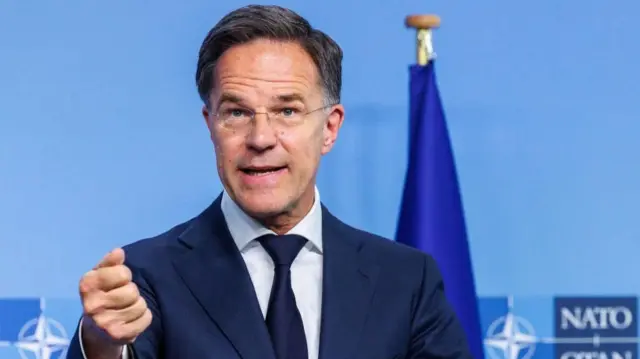
    Mark Rutte stands at a podium in a navy suit in front of a blue wall with the Nato flagImage source, EPA/Shutterstock

    Nato Secretary General Mark Rutte says he "had not heard this announcement [until the reporter's question]", but that "John Healey, I respect very much".

    Asked at a press conference in Brussels if Healey's resignation reveals some of the difficulties of ramping up defence spending for countries, Rutte says: "Of course, it's not easy, because of course there's always a trade off with other expenses."

    He adds: "The core to ask of every government in the end is keeping the country safe and a strong economy."

    John Healey had been due to attend a meeting of Nato defence ministers chaired by Rutte next week.

  11. BBC Verify

    What’s happened to UK defence spending and plans to hit the Nato target?published at 17:13 BST

    By Adam Durbin and Anthony Reuben

    The government has previously hailed its plans as "the largest sustained increase in defence spending since the Cold War". However, military expenditure has been on an almost constant downward trajectory since the fall of the Berlin Wall.

    In April, former Nato secretary general Lord Robertson, who helped author last year’s Strategic Defence Review, criticised the level of defence expenditure when compared with welfare spending.

    The UK’s working-age benefits bill was lower than for defence in the mid-1980s, but since 1990 welfare spending has been higher - often significantly so.

    Working-age benefit spend is projected to rise to around 4.3% of GDP by the end of the decade, compared with the government’s , external"ambition" to hit 3% on defence in the next parliament.

    This Flourish post cannot be displayed in your browser. Please enable Javascript or try a different browser.

    But it’s important to note the government has also committed to a Nato target to spend 5% on "national security" by 2035 - due to be made up of 3.5% on "core defence" and 1.5% on things like protecting critical infrastructure.

    Only three countries - Poland, Lithuania and Latvia - spent more than 3.5% of their GDP on defence in 2025, with Estonia and Norway close to that level.

    The UK spent 2.3% of GDP on defence in 2025 which put it just above average for Nato members, according to figures from the military alliance.

    This Flourish post cannot be displayed in your browser. Please enable Javascript or try a different browser.

  12. Healey resignation a 'grave moment', Commons Defence Committee chair sayspublished at 16:51 BST

    Headshot of Tan Dhesi who smiles at camera while standing out side

    The chairman of the Commons Defence Committee says it is a "grave moment" that a "defence secretary of his integrity and commitment has felt compelled to resign in response to the inadequacy of the proposed defence settlement".

    Labour MP Tan Dhesi says in a statement that the government must take this with the "utmost seriousness".

    The defence investment plan cannot be delayed further, he writes, adding: “It must be affordable, deliverable and fully funded, with credible timelines and proper parliamentary scrutiny.

    "Our armed forces, defence industry, allies and adversaries alike need to see that the UK is matching its words on national security with the resources required to deliver.”

  13. Analysis

    Resignation is a devastating critique of Starmer's governmentpublished at 16:24 BST

    Chris Mason
    Political editor

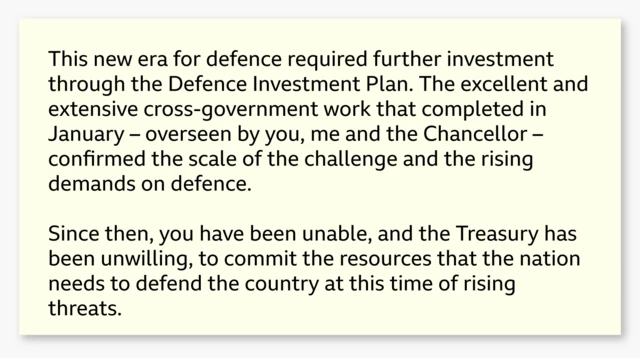
    Writing that says: "This new era for defence required further investment through the Defence Investment Plan. The excellent and extensive cross-government work that completed in January - overseen by you, me and the Chancellor -confirmed the scale of the challenge and the rising demands on defence. Since then, you have been unable, and the Treasury has been unwilling, to commit the resources that the nation needs to defend the country at this time of rising threats."

    Two words leap out of John Healey's resignation letter and they amount to a devastating – and recurring – critique of Keir Starmer's government.

    The two words are "unwilling" and "unable".

    Healey is the sixth government minister to resign since Labour's disastrous showing in last month's elections.

    His resignation comes on the day so many in Westminster expected would be when the government's long anticipated defence investment plan was published.

    It was becoming abundantly clear it wasn't going to see the light of day yet, because of rows within government about how to pay for it.

    And this just a week before Healey was due to attend a Nato defence ministers meeting in Brussels - and a week before the crucial Makerfield by-election, when Andy Burnham could return to parliament and take on the prime minister.

    Little wonder there was a desire from Starmer to get on with doing big stuff before then, if at all possible.

    But now this. An already politically weakened prime minister weakened further.

  14. Delays and underfunding putting jobs in sector at risk, says union bosspublished at 16:05 BST

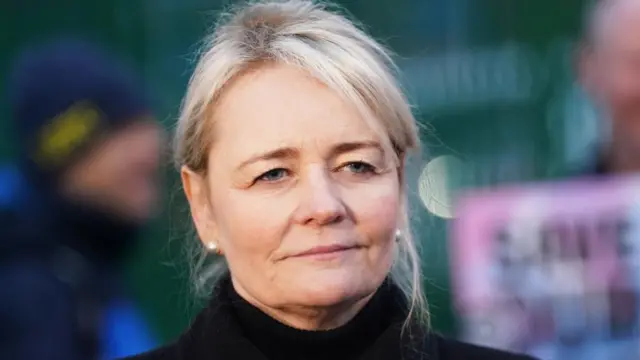
    Unite general secretary Sharon Graham pictured previously wearing black coatImage source, PA Media

    Unite general secretary Sharon Graham says John Healey's resignation letter is "devastating" and lays bare "the chaos at the heart of government".

    Delays and underfunding are "risking defence workers' jobs", she says, adding that failing to protect jobs in the sector would be a "national betrayal".

    "The government scrabbling around robbing Peter to pay Paul on such a critical plan is embarrassing and a sign of weakness," she adds.

    Graham says the government should instead rework its fiscal rules "to allow proper investment in the nation’s defence infrastructure".

  15. Healey resigns over defence spending - a recappublished at 15:51 BST

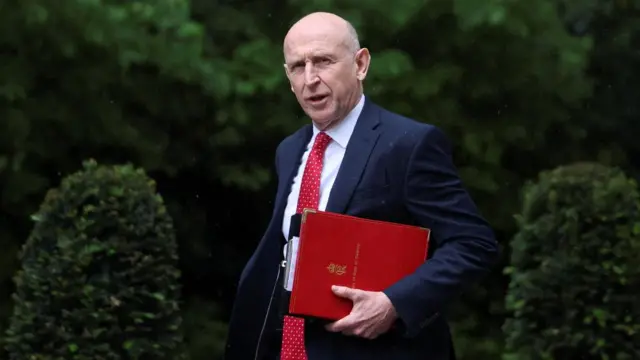
    John Healey in a navy suit carrying a small red binder.Image source, Reuters

    John Healey has quit as defence secretary, becoming the sixth minister to resign from Keir Starmer's government in the past month.

    In his resignation letter, Healey accused the prime minister of being unable "to commit the resources that the nation needs to defend the country at this time of rising threats".

    He specifically mentions the defence investment plan, which has not yet been released and is due to lay out the government's defence spending plans.

    This, he says, "falls well short of what is required for... this dangerous time".

    Henry Zeffman writes that the main emotion among Labour ministers, MPs and advisers right now is shock, with one Labour figure describing Healey as "the loyalist’s loyalist".

    While the prime minister has not yet commented, a government source says "the country is safer because of the decisions Keir Starmer has made".

    Tory leader Kemi Badenoch describes Healey's decision as "honourable", while Reform UK's Robert Jenrick says: "Good on Healey. Shame on them [the government]". The Greens and Liberal Democrats have similarly criticised the government.

  16. What are the government's defence spending commitments?published at 15:30 BST

    Katie Williams
    Live reporter

    In his resignation letter, Healey accused the prime minister of failing to commit the resources the military needs.

    Let's take a closer look at the government's defence spending commitments, and what Healey has said today:

    The government's commitments

    In February 2025, the government committed to increase defence spending to 2.5% of GDP by 2027. It also announced a change in the definition of defence spending to put that figure at 2.6%.

    As part of that commitment, the government outlined an ambition to reach 3% in the next parliament.

    Separately, the UK has committed to a Nato target to spend 5% of GDP on "national security" by 2035.

    The government says this would be made up of 3.5% of GDP on "core defence" and another 1.5% of GDP going on things like protecting critical infrastructure and ensuring civil preparedness.

    What Healey said today

    Healey said today that there are "credible ways of meeting the mid-term funding challenges", but that the financial settlement for the defence investment plan "falls well short of what is required".

    He says the extra support in the plan is "backloaded" when he believes the pressure to speed up readiness "is in the first two years".

    Healey adds that defence spending "rises to just 2.68% of GDP in 2030". As BBC Verify reports, that implies an 0.08% increase on the existing 2027 commitment.

  17. Some praise Healey's resignation, others say he ignored budget warningspublished at 15:11 BST

    Jonathan Beale
    Defence correspondent

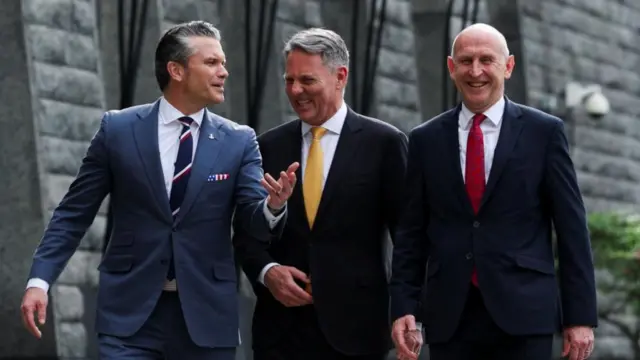
    John Healey walks alongside Pete Hegseth and Richard Marles, the three laugh togetherImage source, Reuters
    Image caption,

    John Healey alongside his US counterpart Pete Hegseth and Australian Deputy Prime Minister Richard Marles, on a visit to Singapore in May

    While there’s been praise for John Healey’s decision to resign as defence secretary, there’s been criticism too.

    Some who worked with him in the Ministry Of Defence (MoD) say he had long been warned the MoD's budget was already overcommitted - under the last government.

    When he commissioned Labour’s strategic defence review, it increased those unfunded ambitions “substantially”.

    The “hard part”, a defence source says, was always going to be getting agreement on the defence investment plan - the extra money.

    A source says Healey still believed he could somehow balance the books, that big adjustments could be made. One called that assumption “inept”.

  18. Healey resignation 'sent us reeling' - head of defence trade bodypublished at 15:01 BST

    Kevin Craven sits in front of a white wall wearing a black suit

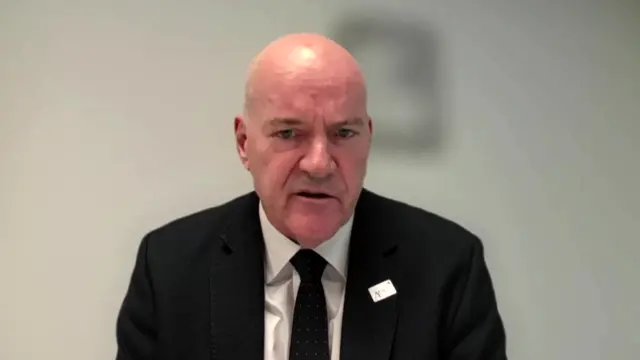
    Kevin Craven, chief executive of the ADS Group, the UK’s trade body for the aerospace, defence, security and space sectors, says Healey's resignation has "sent us reeling".

    In a statement, he says the now former defence secretary "has consistently shown himself to be an intelligent, supportive and highly principled man, who has the best interests of UK defence as top of mind in everything that he does".

    Craven adds: "His resignation today is something to lament, and is truly a damning reflection on the current state of affairs."

    He warns that the consequences of getting the defence investment plan wrong "are of a magnitude far beyond our worst fears", adding that it's "imperative that an adequately funded Defence Investment Plan is published as soon as possible".

    "It should not take the resignation of an honourable man for that realisation to sink in."

  19. BBC Verify

    The number of soldiers, ships, and fighter jets has fallenpublished at 14:52 BST

    By Adam Durbin and Thomas Spencer

    Since the end of the Cold War in 1990, the British Army has gone from having 153,000 regular soldiers to 73,790 today - only just above the 73,000 minimum recommended in last year’s strategic defence review.

    As well as the regular Army there have been reductions across the military over the same period:

    • Army reservists have gone from 76,000 to 25,770
    • The Royal Navy has fallen from 48 major combat ships (13 destroyers, 35 frigates), to 13 (seven frigates and six destroyers)
    • The Royal Air Force has dropped from more than 300 combat jets to 144

    It is important to note, however, that these newer fighter jets - 107 Eurofighter Typhoons and at least 37 F-35 Lightning IIs - are technologically superior to those in use 36 years ago.

    And uncrewed aircraft systems, also known as drones, now form an element of the UK's military air capabilities. These did not exist in 1990.

    Experts say the UK needs to invest considerably more in this military technology. Read more of BBC Verify’s analysis of the state of the UK military here.

  20. Healey has had bruising negotiations with the chancellorpublished at 14:46 BST

    Faisal Islam
    Economics editor

    John Healey’s resignation reflects some bruising internal negotiations with the chancellor over finding the money to fund the defence investment plan. The now former defence secretary confirmed that the level of spending would reach 2.68% of GDP by 2030.

    His letter also acknowledged that other departments would face some cuts against their plans. It is thought that this is a reference to the capital budgets for transport and energy, among other things. Defence spending, on heavy equipment and technology, is very capital intensive.

    A Treasury source told the BBC that Chancellor Rachel Reeves will "always do what is right and needed to keep this country safe".

    The source pointed to a "record uplift in defence spending at the spending review”, and said Reeves would be "working alongside the PM deliver billions more to fund the defence investment plan in full".

    As leadership speculation looms over the government, it is worth noting that Greater Manchester Mayor Andy Burnham previously suggested that some defence spending could be exempted from fiscal rules, as has occurred in Germany.

    His advisers have suggested this may occur over a longer time period, only after the UK balances its budget.

    The Spanish PM Pedro Sanchez, who publicly refused to meet the 3.5% Nato target, is now publicly citing this move as one of the reasons behind Spain’s strong economy.