Summary

  1. Live coverage transferring to stream-onlypublished at 18:45 BST

    Continue watching Pete Hegseth defend the US Department of Defence's $1.5tn, (£1.1tn) budget request by clicking the watch live button at the top of this page.

    We're now ending our text commentary and analysis posts, but the video stream will continue live, and we'll provide a summary of what was said when the hearing concludes.

    Hegseth is fielding questions from lawmakers about the war in Iran for the first time since the conflict began.

    Stay with us.

  2. Hegseth says Navy chief fired because of need for 'new leadership'published at 18:41 BST

    Hegseth is asked to "shed light" on the sudden firing of the US Navy secretary last week.

    The defence secretary begins by thanking the outgoing John Phelan for his work for the US military, but says, "ultimately it was time for a new leadership and a new direction as far as running fast towards those objectives. And so we made a change."

    He says that when it comes to senior officers, "you evaluate whether they're running with the mission they've been given."

    "You gotta make a change if they're not."

    Read more here

  3. Democrat questions if 'president is mentally stable enough'published at 18:38 BST

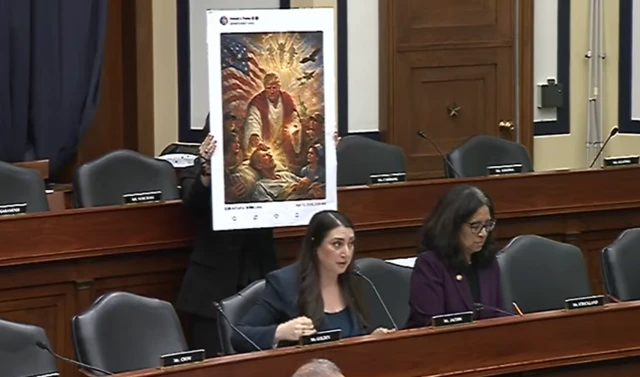
    As the committee returns, Defence Secretary Pete Hegseth and Democratic Congresswoman Sara Jacobs have had a back and forth on President Donald Trump's recent posts on Truth Social.

    An aide behind Jacobs held up two cardboard cut outs of Trump's previous posts, including the now-deleted AI post depicting him as a Jesus-like figure.

    "Do you believe that the president is mentally stable enough to be the commander and chief?"

    Hegseth responds, asking Jacobs: "Did you ask the same question of Joe Biden for four years?"

    "You did not, and I won't even engage with the level of disparagement you're putting on the commander and chief ... you want to ask that question after you and your fellow democrats defended Joe Biden who could barely speak?"

    Jacobs rebuts, arguing Biden "was not our nominee for president" in the 2024 election.

    Democratic Congresswoman Sara Jacobs with a cardboard cut out of Trump's post being held behind herImage source, US House Armed Services Committee
    Image caption,

    Democratic Congresswoman Sara Jacobs

  4. Committee pauses for recesspublished at 18:16 BST

    A recess has begun after Defence Secretary Pete Hegseth addressed the the Armed Services Committee.

    Hegseth is expected to continue speaking shortly, as earlier he said the Pentagon’s request for $1.5trn (£1.1trn) “reflects the urgency of the moment" amid the Iran war.

  5. Republican praises 'extraordinary' job by US military since beginning of conflictpublished at 18:05 BST

    We are now hearing from more Republicans who are supportive of the US war in Iran.

    Republican congressman Carlos Gimenez of Florida says he believes Iran is an existential threat to the US hence necessitating the war.

    "When someone tells me for 47 years that they want to kills us, I think I am going to take them at their word," he says.

    He says the US military has done an "extraordinary" job since the beginning of the war.

    "I support our efforts to make sure that Iran never has a nuclear weapon," he says.

  6. Questioning focuses on digging into cost of Iran warpublished at 17:46 BST

    Representative Ro Khanna digs into the costs of the last almost two months of war in Iran - Hegseth has previously today said the estimated cost is $25bn dollars so far.

    Khanna asks what the cost is when you add the cost of "buying replacement munitions and replacement air crafts" in today's dollars, due to "damage that was done to our bases".

    "That number right now reflects the total cost that we're seeing," Hegseth replies.

    The congressman asks how much Hegseth is asking for "in terms of supplemental funding" for the Iran war.

    "On Iran it would be less than 25 billion but there's a lot more we would ask for beyond just Iran," Hegseth says.

    Next, Khanna asks about the cost of a deadly strike on a girls' school in Iran earlier this year, that killed 168 people, and which Iran blamed on the US, which Hegseth refuses to answer: "That unfortunate situation remains under investigation... I wouldn't tie a cost to that."

    In response to a question about the increased cost in gas and food for Americans - which Khanna says will increase by $5,000 per year per household - Hegseth says, "I would simply ask you what the cost is of an Iranian nuclear bomb", and insists "we have an incredible economic team that's managing this".

  7. Democrat presses Hegseth and Caine on whether US is winning Iran warpublished at 17:10 BST

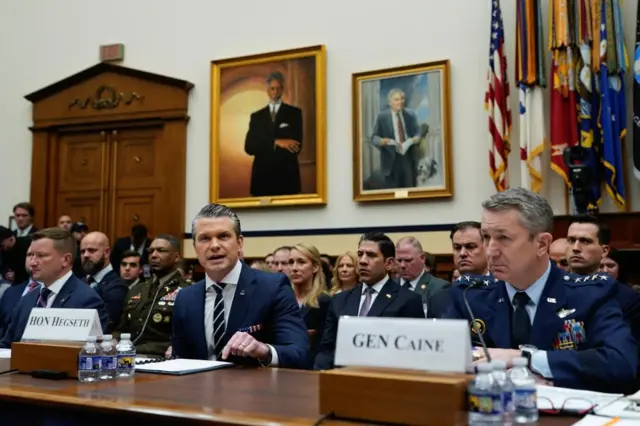
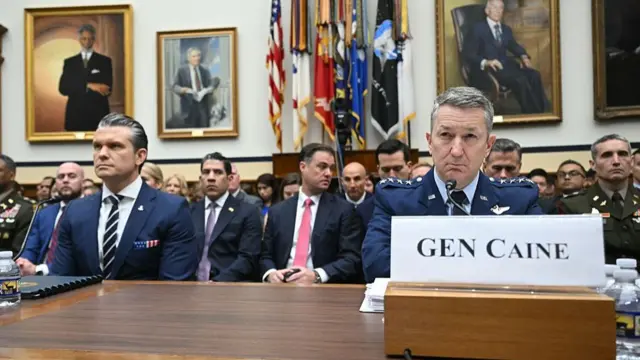
    Two men in blue suits and one in a blue military uniform sit at a desk with rows of people sat behind them and portraits and flags adourning the wallImage source, Reuters

    Democrat Seth Moulton asks Hegseth if he advised the president to launch attacks on Iran.

    Hegseth says that the US president "got every perspective possible", then turns the conversation to nuclear weapons, telling the committee to "imagine what the world would look like now" if Iran had a nuclear bomb.

    Do you think the US is winning the war, Moulton asks.

    Hegseth says "absolutely", and says it's been an "astounding military success" on the battlefield.

    Moulton presses him on whether the blockade in the Strait of Hormuz could be perceived as winning: "So they blockaded us, and then we blockaded their blockade, that's like saying 'tag, you're it'", he says, and asks Caine if the military had planned for this.

    The US military "always offer a full range of military options" that are "carefully considered", Caine says.

    Moulton asks if the effect on the "average American taxpayer" has been considered - which he says is around $600.

    Hegseth says this war "won't go on for years", and asks instead: "What is the cost of Iran having a nuclear weapon?"

  8. Hegseth hits back after Democrat refers to Iran war as 'quagmire'published at 16:50 BST

    California Democratic congressman John Garamendi questions the "strategic directions" of the war, describing Trump's war as a "serious self-inflicted wound to America", citing thirteen Americans killed in action, hundreds wounded, and thousands of civilians killed.

    The blocking of the Strait of Hormuz was "foreseeable", he says and tells Hegseth: "You have been lying to the American public about this war from day one, and so has the president."

    Garamendi says the war strategy has been an "astounding incompetence", suggesting that the regime in Tehran is still intact, as are Iran's missile and drone systems, and the war has strengthened Iran's coordination with China, Russia and North Korea. He says Trump is "stuck in a quagmire" of another war in the Middle East.

    Hegseth describes Garamendi's statement as "reckless", denies Trump is in a "quagmire", and argues this hands propaganda to America's enemies. "Your hatred for President Trump blinds you," he adds.

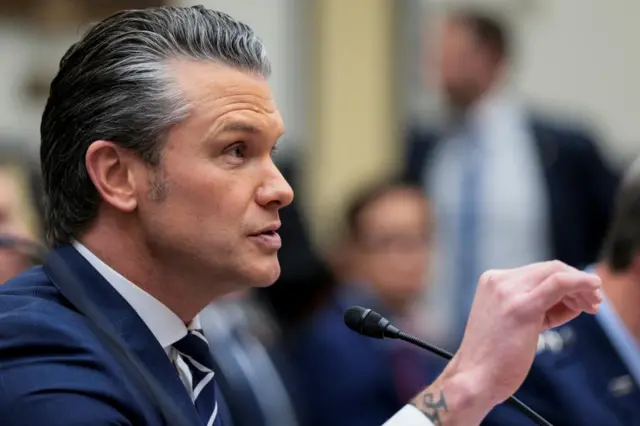
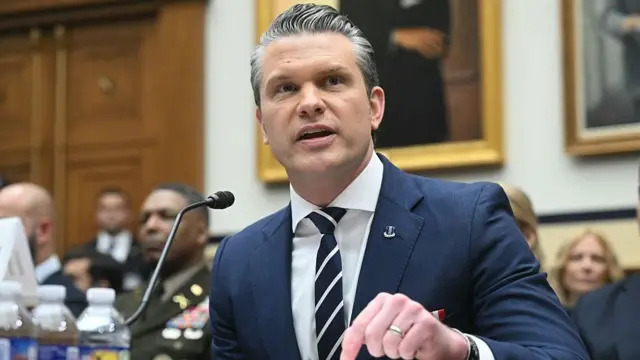
    Pete Hegseth, photographed form the side, gestures as he speaks into a microphoneImage source, Reuters
  9. The clock is ticking before lawmakers demand a say on Iran warpublished at 16:27 BST

    The US and Iran are observing an uncertain ceasefire but the White House has repeatedly said it will return to military action unless Tehran agrees to a number of terms, including giving up any nuclear ambitions.

    However, the administration's ability to resume strikes is complicated by the War Powers Resolution, a 1973 law designed to limit the president's military powers.

    It sets a 60-day deadline for a president to commit the US military to armed conflict without approval in Congress via a vote.

    It remains to be seen how the White House will respond to that deadline, which is set to expire on 1 May.

    A vote would be complicated for the Trump administration.

    While Donald Trump's Republicans have a majority in the Senate and in the House, a matter as serious as war could test loyalties on both sides of the divide, making a vote unpredictable.

    We may hear Hegseth asked about this by the committee.

  10. Democrat asks about 'imbalance' of focusing on Iran vs other global threatspublished at 16:10 BST

    Democratic Representative Joe Courtney brings up the secretary of defence's assessment from the January National Defence Strategy, which concluded that China posed the highest threat to the US, followed by Russia and North Korea, but that Iran by that point was "weaker and more vulnerable than it has been in decades".

    Therefore he questions the "imbalance" of having so many US assets in the Middle East for the Iran war rather than in other places around the world.

    Gen Caine says "a president will employ national force and power based on the political and security situations that a president deems appropriate".

    "There are always trade-offs," he adds.

    The House then stands for a short recess.

  11. Iran war has cost US $25bn so far - Pentagon finance chiefpublished at 16:07 BST

    Democratic ranking member of the committee Adam Smith asks how much the war in Iran has cost the US so far, and if lawmakers can receive a full cost estimate from the Pentagon soon.

    Pentagon Comptroller Jules Hurst, also at the hearing, chimes in to say "about $25bn", with munitions forming most of that cost.

    "I'm glad you answered that question because we've been asking for a hell of a long time and no one's given us the number," Smith says. He directs his next question at Hegseth, asking how the government plans to end the nuclear threat from Iran.

    Hegseth accuses previous administrations of cutting "bad deals" - and mentions the Joint Comprehensive Plan of Action (JCPOA), also known as the Iran nuclear deal, signed in 2016 under US President Barack Obama.

    He gets some pushback from Smith, who says: "That's the past, what's the future?" and queries if there was an imminent nuclear threat that made war with Iran necessary.

    Hegseth says that Iran "hadn't given up their nuclear ambitions" which is why the US took action alongside Israel.

  12. Proposed budget is 'historic downpayment' for future security, Caine sayspublished at 15:58 BST

    Lawmakers are asking questions now, and chairman Mike Rogers begins by asking Hegseth what difference previous funding has done for the military.

    Hegseth says it has allowed the administration to begin improving several critical areas of US defence including the improvement in living conditions for service members.

    General Caine is also asked what the proposed budget means for securing US global interests.

    He says the $1.5 trillion sought by the military "represents a historic down payment for future security" that would allow the US to get ahead of fast-evolving technology.

    "All of those ways that are now manifesting themselves on the battlefields around the world require a higher end of capital investment," he says.

  13. Pentagon needs this money to meet challenges of growing global risk - Cainepublished at 15:50 BST

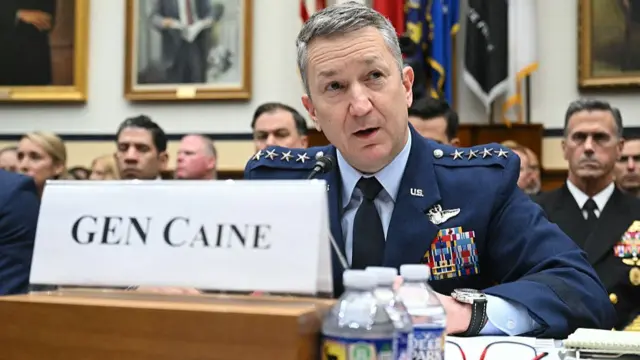
    Dan CaineImage source, Getty Images

    Next up is Chairman of the Joint Chiefs of Staff General Dan Caine, who begins by praising the US military, and argues "global risk is scaling".

    He says the military needs "timely, predictable and sustained investment", and says the resources discussed in the budget today are "critical to modernising our force and ensuring that whatever threats emerge... [we are] ready to meet those challenges".

    He asks the gathered lawmakers to remember the US military posted around the world.

  14. Analysis

    Hegseth returns to criticisms of previous US warspublished at 15:48 BST

    Tom Bateman
    Reporting from Capitol Hill

    I heard a laugh of disbelief from one or two of the Democrats on the committee as Hegseth described congressional Democrats as "the biggest challenge, the biggest adversary we face".

    He compared the US war on Iran under Trump's leadership to the long-past American wars in Vietnam, Iraq and Afghanistan, which he criticised. The conflict against Iran, two months after it began, he said was "an existential fight for the safety of the American people" of which he was proud.

    This is a recurrent theme for Hegseth. He has repeatedly used a sense of grievance - often personally expressed about Iraq where he fought as a major in the Army National Guard - to condemn the running of American wars past.

    In the committee room here among the opposition lawmakers at least, the comment didn’t go down well as an attempted justification for the handling of Iran.

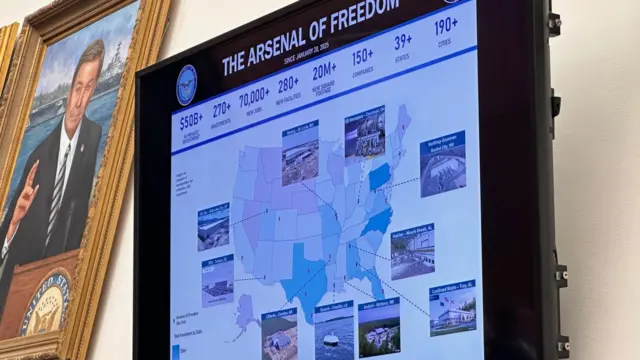
  15. Hegseth presents 'Arsenal of Freedom'published at 15:48 BST

    Tom Bateman
    Reporting from Capitol Hill

    As Hegseth presents the administration's plans for a $1.5 trillion budget request to Congress for the military, here is what lawmakers and onlookers in the room can see.

    A map of the US annotated with military spending plansImage source, BBC / Tom Bateman
  16. Budget request 'reflects urgency of the moment' - Hegsethpublished at 15:47 BST

    Pete Hegseth testifiesImage source, Getty Images

    US Secretary of Defence Pete Hegesth is speaking now.

    He says the president's request for a $1.5 trillion budget "reflects the urgency of the moment".

    Hegseth accuses the Biden administration of underinvesting in defence, and says that his department is "reversing this systemic decay" to get back on a "wartime footing".

    This is a "historic" and "war-fighting" budget, Hegseth says, adding that he looks forward to talking about the "incredible success" of the Iran war.

    US President Trump "has had the courage to ensure Iran never gets a nuclear weapon", he says.

    He says that the "biggest adversary" now is the "defeatist words" of congressional Democrats and some Republicans, who criticise the conflict when it is only two months old: "My generation understands how long we were in Iraq, how long we were in Afghanistan."

  17. Hegseth and Caine could face questions over Minab school strikepublished at 15:32 BST

    Pete Hegseth and Dan CaineImage source, Getty Images

    Representative Adam Smith goes on, acknowledging the potential of American involvement in a deadly strike on an Iranian school earlier this year.

    According to Iranian officials, that Minab strike killed 168 people, mainly children, during the opening stages of the joint US and Israel attack on Iran.

    Smith tells the House: "We made a mistake and that happens in war... two months after it happened we refused to say anything about it, giving the world the impression that we just don't care."

    Iran has blamed the US for the strike. Two months on, the Pentagon has only said that it is continuing to investigate the incident. This could be the first time Hegseth and Caine have to answer questions under oath about the attack.

    Last month, US media reported that investigators do believe an American strike was responsible for hitting the school unintentionally, but that they had not reached a final conclusion.

    BBC News has spoken to five former US officials who have criticised the administration for not acknowledging potential American involvement in the deadly strike.

  18. Democratic ranking member questions where additional $1.5tn would be spentpublished at 15:27 BST

    Now its the turn for Representative Adam Smith, the leading Democrat on the committee. In his opening remarks he says the Pentagon's request for $1.5 trillion comes amid other competing priorities such as the costs of healthcare and infrastructure.

    Adams, from Washington state, paints a different picture to chairman Rogers, saying the US can't spend limitless amounts of money with the current level of US debt and also highlighting that the US military has not yet passed an audit.

    "If we give them what is roughly a 50 to 60 percent increase, is that money going to be well spent?" he asks. "We have every reason to doubt that."

    He is also questioning how the Trump administration has pursued the war in Iran saying the military action has led to raising fuel costs across the world. He adds that nothing has fundamentally changed in Iran despite the war.

  19. Chairman advocates for Trump's $1.5tn spending increase requestpublished at 15:23 BST

    Chairman of the House Armed Services Committee Mike Rogers opens the session and thanks US Defence Secretary Pete Hegseth and Chairman of the Joint Chiefs of Staff Gen Dan Caine for coming.

    He begins by talking about defence spending in the US more broadly, suggesting the amount should be higher and comparing the US unfavourably to other countries, especially China: "All of our adversaries are spending more of their GDP on defence than we are."

    The Republican advocates for President Donald Trump's request for a $1.5tn (£1.1tn) increase in spending, saying that number "accounts for the true cost of American deterrence".

    He finishes his remarks by thanking US troops for their "bravery, dedication and professionalism".