Summary

  • Vladimir Putin and Xi Jinping will shortly conclude talks in Beijing - but their meeting ends without details on a natural gas pipeline between Russia and China

  • The previously agreed deal has been stalled for years, but the two countries reached a "general understanding" about the pipeline, an aide to Putin tells reporters

  • The agreement comes as the two leaders meet in Beijing and sign more than 20 agreements on trade and tech, as well as a declaration on a "multi-polar world order"

  • A lengthy joint statement mentions Russian gas supplies but otherwise does not indicate the leaders reached any major breakthroughs in Moscow and Beijing's relationship

  • Without Chinese money and tech, the very survival of Putin's regime would be in question, BBC Monitoring's chief analyst writes

  • But Beijing is being more careful with its language because Xi wants to appear close to Moscow, but not too close, writes our China correspondent

  1. Xi and Putin wrap up meetings but fail to agree on pipeline detailspublished at 12:48 BST

    Media caption,

    Friendship or geopolitics? BBC breaks down Xi and Putin relationship

    Xi Jinping and Vladimir Putin are wapping up their talks in Beijing with a banquet, according to Chinese state media.

    The Russian leader is due to depart Beijing in a few hours time. Here are some of the highlights from their summit today:

    • China and Russia signed more than 20 agreements on trade and tech, as well as a declaration on a "multi-polar world order"
    • They also issued a lengthy joint statement in which they appeared to criticise the US's military actions and Golden Dome defence shield plans
    • In an apparent reference to the Strait of Hormuz, China and Russia called on countries to stop "unilaterally" interfering with international trade and supply chains
    • Xi said China and Russia should focus on promoting a "more just and reasonable global governance system", while Putin said they had "reached a truly unprecedented level" in their relations
    • However, the two countries failed to finalise details on the multi-billion dollar Power of Siberia 2 natural gas pipeline, with the Kremlin saying they only reached "a general understanding"

    We're now closing our live page, but you can read more from our China correspondent Laura Bicker here.
  2. In pictures: Putin visits Beijingpublished at 12:38 BST

    It's been a big day in Beijing, as President Xi Jinping hosted Vladimir Putin as part of a state visit.

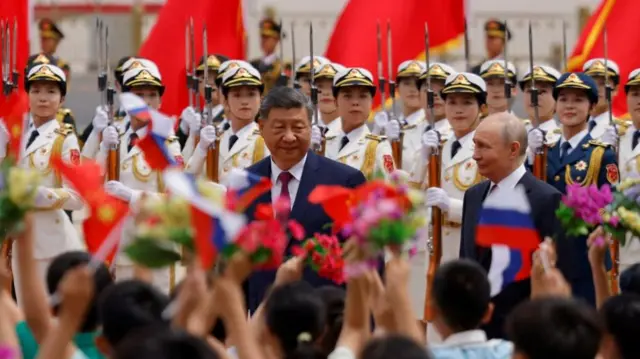
    Russian President Vladimir Putin and Chinese President Xi Jinping attend a welcoming ceremony at the Great Hall of the People in Beijing, China May 20, 2026.Image source, Reuters
    Image caption,

    Russian President Vladimir Putin was given a warm welcome at the Great Hall of the People in Beijing

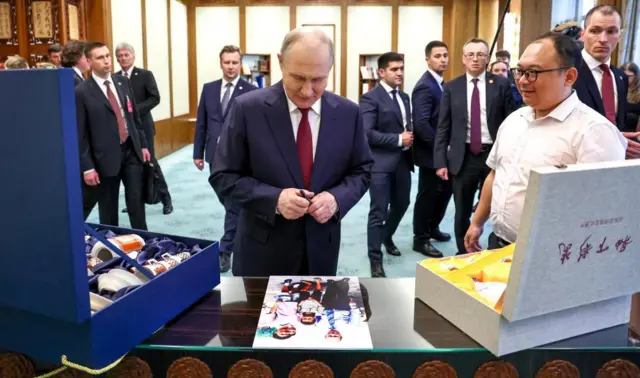
    Russian President Vladimir Putin meets with Chinese engineer Peng Pai, who was photographed with him as a child 25 years ago during his first visit to China, at the Great Hall of the People in Beijing, China May 20, 2026.Image source, Reuters
    Image caption,

    Putin met Chinese engineer Peng Pai, who was photographed with him years ago as a child

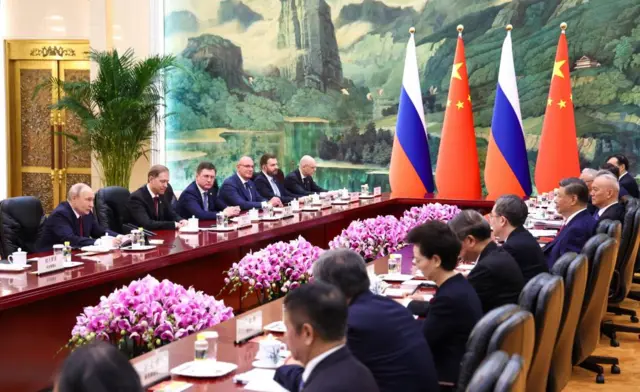
    Russian President Vladimir Putin (L) and Chinese President Xi Jinping (C R) during their meeting in Beijing, China, 20 May 2026.Image source, EPA
    Image caption,

    The two countries made a series of announcements, signing more than 20 agreements on trade and technology, as well as a declaration on a "multi-polar world order"

  3. More than half of Putin's visits to China happened during Xi's termpublished at 12:25 BST

    Ian Tang
    BBC Monitoring

    Beijing and Moscow have both touted the fact that this is Putin's 25th official visitto China.

    Fourteen of these trips have taken place after Xi became the country's leader in 2013. This means Putin has travelled to China at least once a year, barring those years when the country was locked down because of the pandemic.

    Here are some of the more significant trips:

    • Putin was the guest of honour at a military parade that China held in September 2015 to mark the 70th anniversary of the end of World War Two. Reports say Putin's presence put off major Western leaders, who shunned the parade
    • In February 2022, Putin also visited Beijing for the Winter Olympics, during which the two leaders affirmed a "no limits" bilateral partnership. This came just days before Russia launched a full-scale invasion of Ukraine
    • In September last year, the Russian president attended a military parade to mark China's victory over Japan in World War Two. This parade was also attended by North Korea's leader Kim Jong Un
    • Putin was also a primary participant in Beijing's Belt and Road forums over the years, highlighting the importance of economic and infrastructural cooperation between Russia and China
  4. Putin to attend Apec summit in China in Novemberpublished at 12:17 BST

    In November, China will host the Apec summit in the southern city of Shenzhen.

    The annual Asia Pacific Economic Co-operation Summit (Apec) is typically attended by leaders of Russia, China and sometimes the US.

    Putin earlier confirmed his intention to participate in the Apec summit, during his meeting with Xi, according to Russian state media outlet Tass.

    Meanwhile, the US has said it would send a delegation to the summit - without confirming if Trump would be part of the trip.

  5. Analysis

    All roads lead to Beijingpublished at 12:07 BST

    Laura Bicker
    China correspondent

    The timing of this visit is accidental.

    Putin’s trip to China was always on the calendar for the end of May to help mark the 25th anniversary of the Sino-Russian Treat of Friendship signed in 2001.

    But for China, the timing couldn’t be better.

    Last week, Beijing waved a warm farewell to Donald Trump after a carefully choreographed two-day summit which highlighted China’s new position of strength.

    President Xi had a strong hand as he negotiated with the US leader. He is no longer as reliant on US trade and his country’s dominance in rare earth minerals and manufacturing has given him leverage.

    The Chinese leader has also spent the last few months welcoming guests from all over the world, including Canada, the UK and Germany.

    And now comes Putin. He has been to China more than 20 times, and he does appear to have a close personal relationship with Xi, but the war in Ukraine and western sanctions has left him leaning heavily on Beijing. China is Russia’s top trading partner and its biggest customer for oil and gas.

    Xi may be eager to showcase all these visits as proof, that when it comes to economic and diplomatic power, all roads lead to Beijing.

  6. China extends visa-free policy for Russianspublished at 11:49 BST

    China has extended its visa-free policy for Russians until the end of 2027, according to the Chinese foreign ministry.

    Russian nationals can now enter China without a visa for up to 30 days, a foreign ministry spokesperson told reporters.

    The policy, which began as a one-year trial last September, was set to expire this September.

  7. Watch: Xi leads welcome ceremony for Putinpublished at 11:40 BST

    In case you missed it, here are some highlights from this morning's welcome ceremony for Putin outside the Great Hall of the People.

    We saw some similar scenes at this very spot days ago, when US President Donald Trump was in Beijing for a two-day visit.

    Media caption,

    Xi leads welcome ceremony for Putin

  8. Joint statement warns of Japan's 'accelerated rearmament'published at 11:31 BST

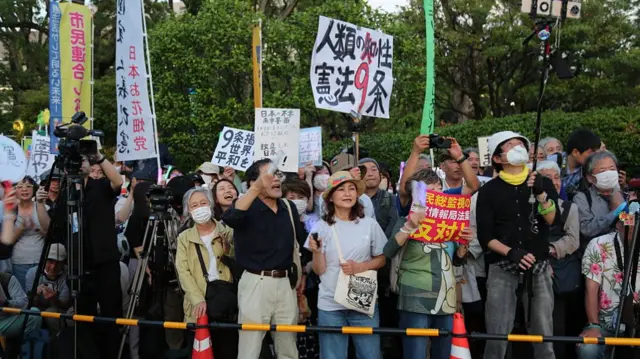
    A crowd holding signsImage source, China News Service/VCG via Getty Images
    Image caption,

    People in Japan protest against revisions to its pacifist constitution

    Japan gets a few mentions in China and Russia's joint statement. The countries say they are "seriously concerned" about Japan's accumulation of "sensitive nuclear materials" and the "highly provocative steps of Japan's right-wing forces" to revise its non-nuclear principles.

    "Japan's current course of accelerated re-armament poses a serious threat to peace and stability in the region," the joint statement says.

    In recent months China has used international forums to warn against Japan's remilitarisation and accused PM Sanae Takaichi of leading her country away from its post-war pacifism.

    The Japanese government has strenuously objected to such claims and says it is only strengthening defence capabilities.

    Russia and China's comments come as Japan and the North Atlantic Treaty Organization (Nato) have stepped up cooperation in recent months. The largest ever delegation of Nato envoys visited Tokyo last month and Japan reportedly is in talks to join a Nato defence startup accelerator.

    The joint statement also notes that any expansion of the Western military alliance into Asia-Pacific is "incompatible" with strengthening regional security.

  9. Xi and Putin denounce US Golden Dome and space weaponspublished at 11:26 BST

    China and Russia have also used their joint statement to denounce the US' planned Golden Dome project and the prospect of launching weapons into space.

    The Golden Dome - modelled on Israel's famous Iron Dome, and initially named the Iron Dome of America - is a planned multi-layer missile defence system that would detect and destroy enemy ballistic, hypersonic, and cruise missiles.

    Unlike Israel's Iron Dome, however, the Golden Dome would encompass the whole of Earth via a constellation of several thousand orbiting satellites.

    Such technology, the joint statement says, "poses a clear threat to strategic stability".

    "This significantly increases the risk of conflicts in space, contributes to the militarisation of outer space and its transformation into a site of armed confrontation, runs counter to the principles of the peaceful use of outer space... and leads to an aggravation of an already difficult situation," the statement says.

  10. China and Russia decry supply chain disruptions, in apparent nod to Strait of Hormuzpublished at 10:42 BST

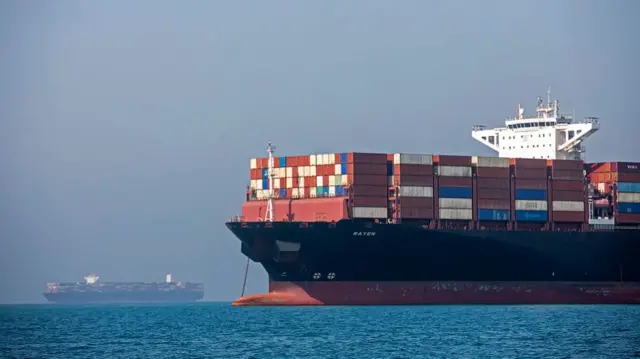
    A cargo ship floating on the waterImage source, Getty Images

    China and Russia have called on countries to stop "unilaterally" interfering with international trade and supply chains - an apparent reference to the closure of the Strait of Hormuz - in additional comments from the joint statement published by the Kremlin.

    "The parties note with concern that unilateral actions by individual states, interstate associations, and their allies that impede international shipping threaten the integrity of global supply chains and maritime trade in general," the statement reads.

    The statement does not explicitly name the key waterway, but goes on to call for "cooperation in maritime infrastructure, such as ports, should be based on market principles and commercial principles to avoid politicisation and excessive emphasis on security issues".

  11. Russia and China appear to criticise US military actionspublished at 10:21 BST

    We now bring you more lines from Russia and China's joint statement - as released by the Kremlin - on "deepening relations of good neighbourliness, friendship, and cooperation".

    The statement condemns various forms of military adventurism around the world, and appears to reference the United States's actions in Iran and Venezuela over the past six months.

    Xi and Putin call out "treacherous military strikes against other countries, the hypocritical use of negotiations as cover for preparing such strikes, the assassination of leaders of sovereign states, the destabilisation of the domestic political situation in these states and the provocation of regime change, and the brazen kidnapping of national leaders for trial".

    Such actions, they say, "grossly violate the purposes and principles of the UN Charter, the norms of international law and international relations, and cause irreparable damage to the foundations of the world order formed following World War Two".

    Xi and Putin are increasingly positioning themselves as the vanguards of a new international order, amid concerns about the current world order during Trump's second presidency.

  12. Analysis

    Joint statement contains no major breakthroughspublished at 10:13 BST

    Vitaly Shevchenko
    Chief analyst, BBC Monitoring

    Russia and China have issued a lengthy joint statement, external on strengthening relations after the two presidents' talks, but it contains no indications of major breakthroughs and, rather, restates previously known positions.

    On the key issue of Russian gas supplies, it merely says that Presidents Putin and Xi "have agreed to continue deepening comprehensive relations of partnership in the field of energy" and "deepen mutually beneficial collaboration in areas of oil and gas, and coal".

    On Ukraine, Russia and China said "the root causes" of the conflict must be removed - a phrase borrowed from the Kremlin's rhetoric justifying the invasion.

    It also says that the UN Statutes must be respected, which reconfirms Beijing's reluctance to offer explicit support for a war that violates international law.

  13. Xi is treading a tricky linepublished at 10:04 BST

    Laura Bicker
    China correspondent

    Xi has told Putin that a complete end to the war in Iran was of “utmost urgency”.

    This is a difficult line for the Chinese leader to tread given Russia's invasion of Ukraine in 2022.

    Beijing has tried to maintain a neutral stance in that war. But there’s no doubt it will not want its ally, Russia, to lose, which it may feel will put the stability of a northern neighbour at risk.

    What makes the war in Iran different is that it hurts Chinese interests. Beijing has stockpiles of oil, but there's no end in sight to the crisis which has blocked the Strait of Hormuz.

    Around 45% of China’s oil sails through that vital shipping lane. In contrast, Russia provides China with around 18% of its oil.

    By calling for an end to one war and not the other, Xi could damage his credibility as China tries to take more of a central role on the world stage.

    It also puts relations with Europe at risk where leaders have long pushed for Beijing to end its economic support for Russia.

  14. China and Russia are partners, not alliespublished at 09:43 BST

    Ankur Shah
    Editor, BBC Global China Unit

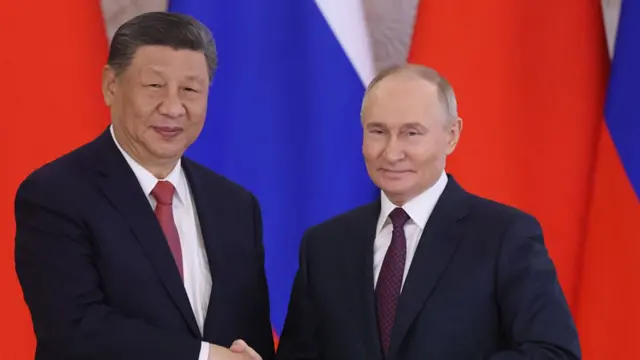
    Xi and Putin smiling for a photo as they shake handsImage source, Getty Images

    Whenever China and Russia appear to diverge, a simple truth at the heart of their relationship becomes clear: neither country must follow the other, because theirs is not a formal alliance.

    "It is not an alliance, but a flexible strategic partnership," Bobo Lo, former deputy head of mission at the Australian Embassy in Moscow, tells the BBC.

    It's one that has endured despite repeated predictions of its collapse.

    Unlike Western nations, which sanction and punish on the basis of differing values including human rights, neither Russia nor China pass judgement on the actions of the other.

    Recurring allegations of large-scale human rights abuses in the Xinjiang region of China - which China denies - and the death of Russian opposition leader Alexei Navalny have made some Western nations more wary about engaging with the countries, but Moscow and Beijing overlook these issues.

  15. 'Russia offers honey and crabs, while China has drones and robots'published at 09:26 BST

    Vitaly Shevchenko
    Chief analyst, BBC Monitoring

    Vladimir Putin says, external Russia and China want to be equal partners, but at the moment they are anything but. One key reason for this is the difference in the size of their economies (China's is almost eight times bigger, external).

    Another key difference is in what these economies have got to offer (China's is much more technologically advanced).

    Hardly surprising, then, that some Russians feel Beijing can do more for them than Moscow.

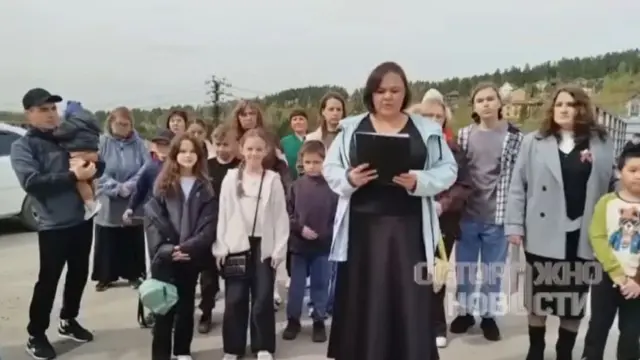
    Days before President Putin flew to China, a video clip, external appeared in which residents of the Siberian city of Irkutsk are asking China to build a new school for them. They have been asking Moscow to do this for five years, to no avail, the video address says.

    Several pupils and some adults in front of the camera. The teacher, a woman, is reading from a piece of paper.Image source, YouTube

    "How you are going to increase the birth rate is a big mystery to us," the residents' representative tells Vladimir Putin in the video. She is referring to Vladimir Putin's long-stated objective of stopping population decline in Russia.

    The president's own representative to Russia's far east, Yuri Trutnev, also could not but notice the difference in Chinese and Russian offerings at an exhibition currently being held in the Chinese city of Harbin.

    "We've only got honey and crabs, while our [Chinese] friends have drones and robots," he told the official Russian news agency Tass. "I'll be honest with you, I'm slightly upset."

  16. Putin reunites with Chinese engineerpublished at 09:05 BST

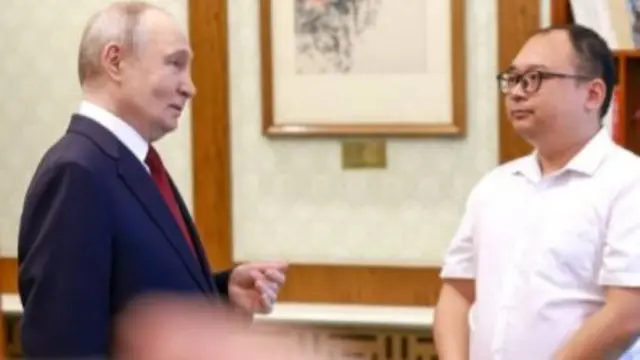
    Putin speaking to a Chinese man wearing black spectaclesImage source, Kremlin pool

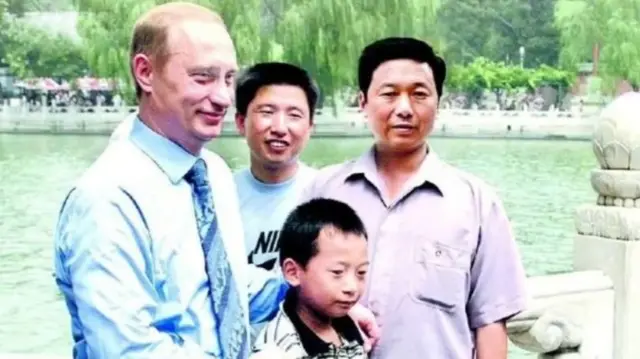
    An unlikely reunion is happening right now, between President Putin and a Chinese engineer who met the Russian leader 26 years ago.

    After a hug, Putin told the engineer he could visit Russia "anytime".

    "I will definitely go," Peng replied.

    The pair met at Beihai Park in Beijing in 2000, during Putin's first visit to China as Russia's president. In a previous interview, Peng recalled how Putin had picked him up from a railing to take a photo.

    Putin poses for a photo with a boy and two menImage source, China News Service
  17. What is the Siberia pipeline Putin has been pushing for?published at 08:49 BST

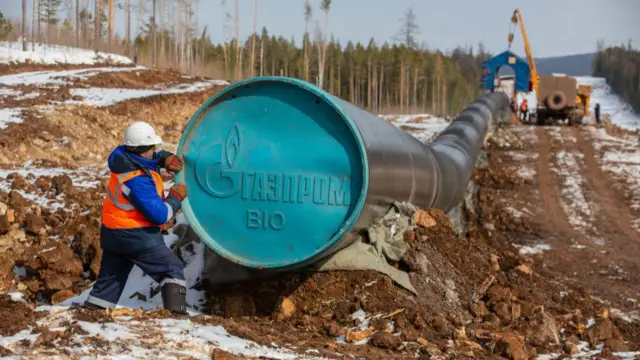
    A worker adjusts a Gazprom branded end cap on a section of pipework during pipeline laying operations for the Gazprom PJSC Power of Siberia gas transmission lineImage source, Getty Images

    We've just reported that a general understanding on the Power of Siberia 2 pipeline has been reached - though no further details or timings have been given.

    Once completed, this natural gas pipeline is expected to carry up to 50 billion cubic metres of gas a year to China, through Mongolia, from the gas fields of Russia's Yamal. This is around 12% of China's total gas consumption, based on 2025 estimates.

    A deal had been stalled for years due to disagreements over price, according to reports - but earlier this week, reports said that Russian gas giant Gazprom and the China National Petroleum Corporation had signed a preliminary deal.

    With the Russian economy under growing strain and Western sanctions chipping away at its resources, the project is likely to take on new importance for Russia. China is Russia's top trading partner and also its biggest customer for oil and gas.

  18. General understanding on major gas pipeline reached - Putin aidepublished at 08:43 BST

    Russia and China have come to a general understanding on the Power of Siberia 2 pipeline, a major project that if completed would transport up to 50 billion cubic metres of gas annually to China.

    Putin's press secretary Dmitry Peskov told reporters that "some nuances remain to be ironed out" but an "understanding already exists", according to state-owned news outlet RIA Novosti.

    The consensus includes the route of the pipeline and construction method, he reportedly said.

    No further details or timings have been given.

  19. Putin and Xi to discuss Ukraine, Iran and US issues at tea - Putin aidepublished at 08:32 BST

    Steve Rosenberg
    Russia editor

    Speaking to Russian state TV just now, President Putin’s foreign policy aide Yuri Ushakov said Putin and Xi will discuss international issues in their private tea meeting later, including “Ukraine, Iran and relations with the United States".

  20. Russia is China’s preferred partner to address global issuespublished at 08:20 BST

    Ian Tang
    BBC Monitoring

    The China-Russia declaration on the emergence of a multipolar world and a new type of international relations marks the two countries’ latest efforts to dictate the direction on global affairs.

    Such declarations, which go beyond the scope of bilateral relations, reflect Beijing’s trust in Moscow as a partner in promoting themselves as self-proclaimed defenders of international order, amid concerns of the world falling into disarray with Trump as US president.

    The two countries have previously issued declarations on strengthening cooperation to “uphold the authority of the international law” and maintaining “global strategic stability”, when Xi visited Moscow in May 2025.