Summary

  • The UK and parts of Europe are set to experience the most significant solar eclipse in nearly three decades

  • More than 90% of the Sun will be covered by the Moon for most of the UK, while parts of Iceland and Spain will witness a rare total eclipse

  • In the UK some will be able to view the eclipse from shortly after 18:00 BST before it peaks an hour or so later - where and when you could see it

  • It will be the most dramatic eclipse visible from the UK since 1999, and the first time a total eclipse can be seen from continental Europe since then too

  • The eclipse's path will start in Siberia in Russia, travelling to Alaska in the US around 07:30 local time (16:30 BST) - it will then sweep round to Greenland and through Europe

  • Watchers should not look directly at the Sun without protection or you risk seriously damaging your eyes - experts recommend only using special eclipse glasses or hand-held viewers

Will you be watching the eclipse?

  1. Eclipse glasses, pinhole projectors, or a colander - how to view the eclipsepublished at 09:39 BST

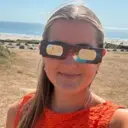
    Protective glasses to observe the solar eclipse safely, being handed out ahead of a total solar eclipse in Mazatlan, Mexico, on 6 April 2024Image source, Reuters

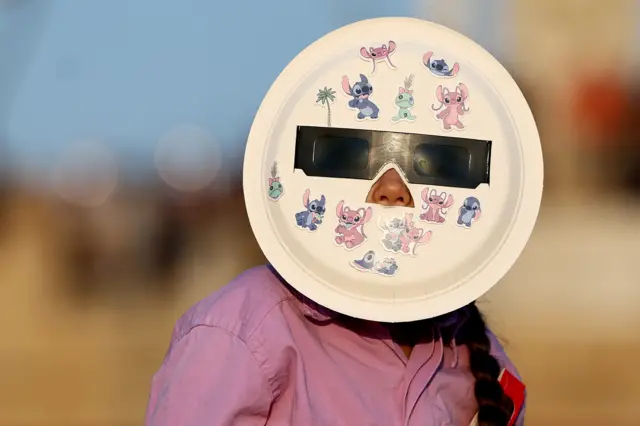
    Looking directly at the Sun can severely damage your eyes - even during an eclipse.

    Even using standard sunglasses could leave you with permanently damaged eyes, so you should only look with special eclipse glasses.

    The only time you can look without special glasses is for the brief period when the Sun is totally eclipsed by the Moon - which won't happen in the UK.

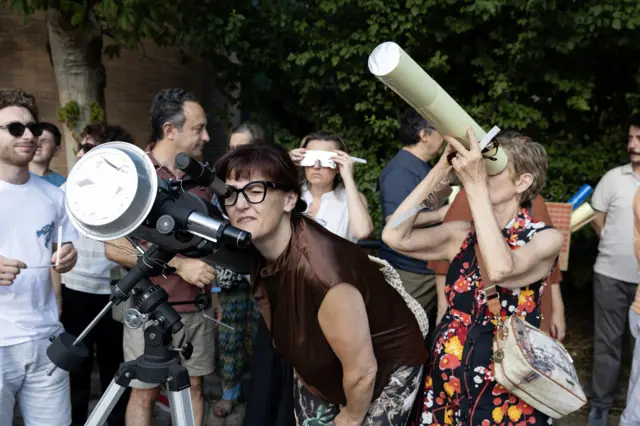
    And you cannot use binoculars or telescopes or the viewfinder of a camera even while wearing eclipse glasses - the magnifying effect can nullify the protection of the glasses and damage your sight.

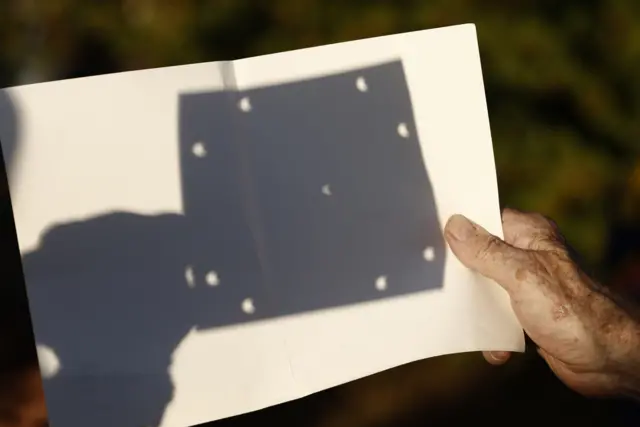
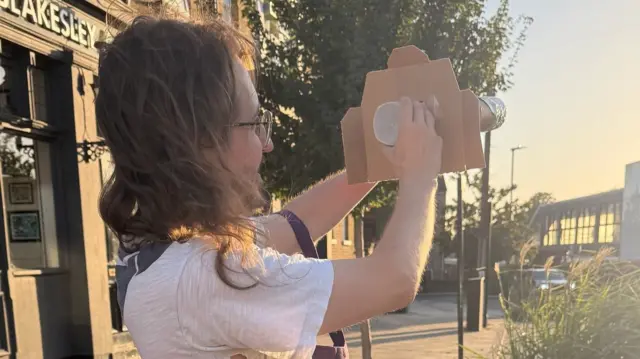
    No solar glasses or handheld solar viewers? You can use an indirect viewing method, such as a pinhole camera, which doesn't involve looking straight at the Sun.

    You can make a simple one with a single sheet of card or something more ambitious using a cardboard box - or you can use a colander to project multiple images on to a surface all at once.

    This Flourish post cannot be displayed in your browser. Please enable Javascript or try a different browser.

  2. Here in the UK, just after 7pm will be the peakpublished at 09:27 BST

    Depending on where you are in the UK, the eclipse will be at its maximum between 19:02 BST and 19:16 BST.

    What time the peak occurs for you will depend mostly on how far north you are. In general, the further north, the earlier you will see the maximum eclipse.

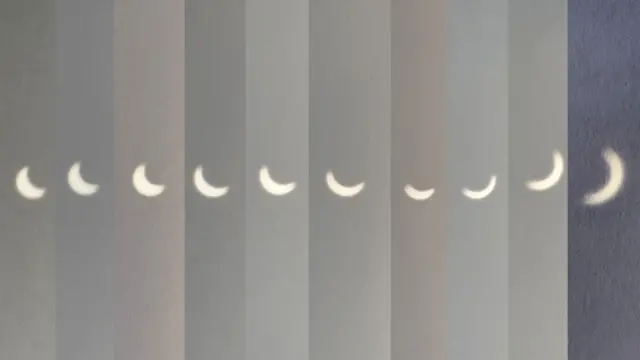
    And, in general, the further west you are, more of the Sun will be covered.

    The best places to view the eclipse are from higher ground, or areas with a clear view towards the western horizon.

    A blue-grey map of the United Kingdom, Ireland and surrounding parts of northern Europe. White labels identify the times of maximum eclipse in several UK cities: Edinburgh at 19:05, Belfast at 19:08, Manchester at 19:10, Cardiff at 19:13 and London at 19:13. Semi-transparent blue bands curve across the map, indicating the general path of the eclipse shadow. The geographical spread of the time labels shows that the peak of the eclipse occurs slightly earlier in the north than in the south.
  3. Where and when could I see the eclipse?published at 09:24 BST

    A pharmacist tries on glasses for the solar eclipse at her pharmacy in Pamplona, SpainImage source, EPA

    The solar eclipse will first be visible in the far north of Russia, before its path slowly moves across the globe - stretching as far as northern Africa.

    A total eclipse will only be visible in a few places, including:

    • Reykjavik, Iceland - 17:48 local time (18:48 BST)
    • León, Spain - 20:28 local time (19:28 BST)
    • Zaragoza, Spain - 20:29 local time (19:29 BST)
    • Valencia, Spain - 20:32 local time (19:32 BST)

    Nasa has forecast that viewers in the US and southern Canada will only see a "small bite" taken out of the sun as it appears to only be clipped by the Moon - but those watching closer to its path across Europe will see most of the Sun covered up.

    Here in the UK, large parts of the country will be able to see almost 90% coverage - peaking between 19:02 BST to 19:16 BST, depending on your location. More on that in our next post.

    This Flourish post cannot be displayed in your browser. Please enable Javascript or try a different browser.

  4. Will you be watching the eclipse? Get in touchpublished at 09:17 BST

    We want to hear from you!

    Do you plan on watching the eclipse? How are you watching?

    You can share comments, pictures and videos by pressing the get in touch button at the top of the page - or in the following ways:

    Please read our terms & conditions and privacy policy.

    In some cases a selection of your comments and questions will be published, displaying your name and location as you provide it unless you state otherwise. Your contact details will never be published.

    A purple banner displays the words 'your voice'
  5. Hours until Europe's most significant eclipse in decadespublished at 09:06 BST

    Alex Smith
    Live editor

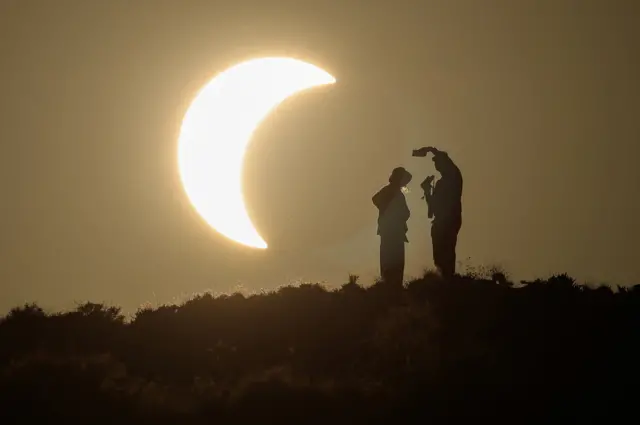
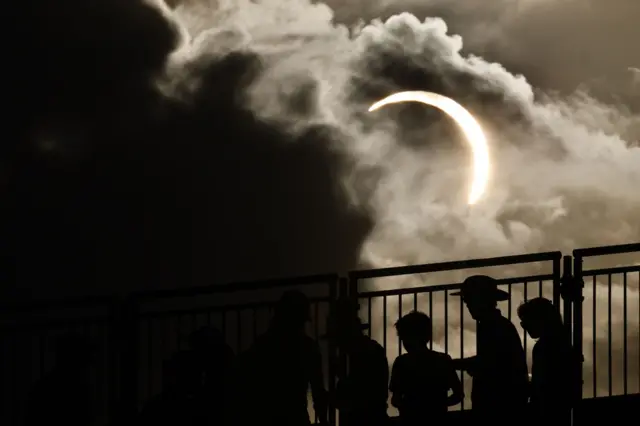
    The sun is pictured during a partial solar eclipse. The sky is dark and cloudy. The sun is a thin arc in the sky.Image source, Getty Images

    Later today, people across the northern hemisphere will crane their necks towards the sky to view a celestial phenomenon.

    A total solar eclipse will be visible in parts of Iceland, Spain and the far north of Russia. It is the first time such a sight will be visible from continental Europe since 1999.

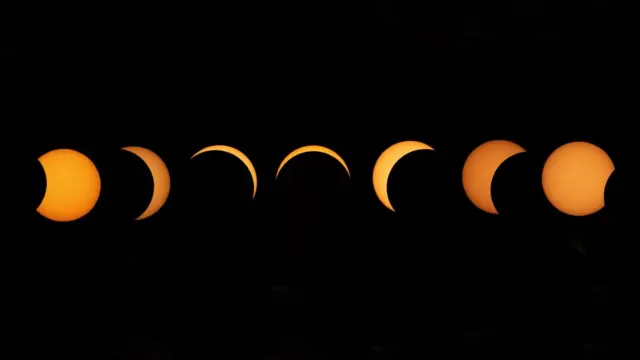
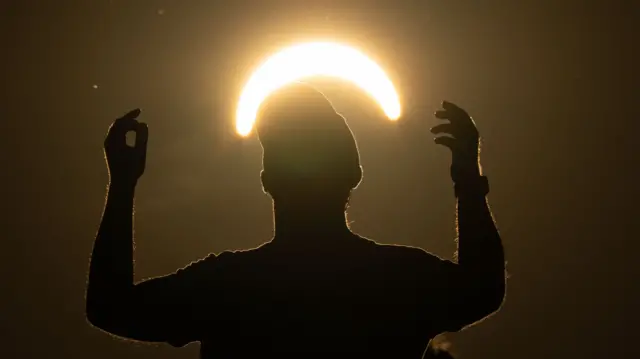
    A partial solar eclipse will be visible in other areas, with the UK set to experience its most dramatic event of this kind in 27 years, set to begin shortly after 18:00 BST.

    Large parts of the country will be able to see the Moon cover more than 90% of the Sun - that's weather permitting, of course.

    The eclipse's path will start in Siberia in Russia, travelling to Alaska in the US around 07:30 local time (16:30 BST). It will sweep round to Greenland, past Iceland and through western Europe.

    We'll be hearing from people across the northern hemisphere throughout the day as they settle in to witness the phenomenon.

    Get in touch to share your experiences and pictures of this rare event.